
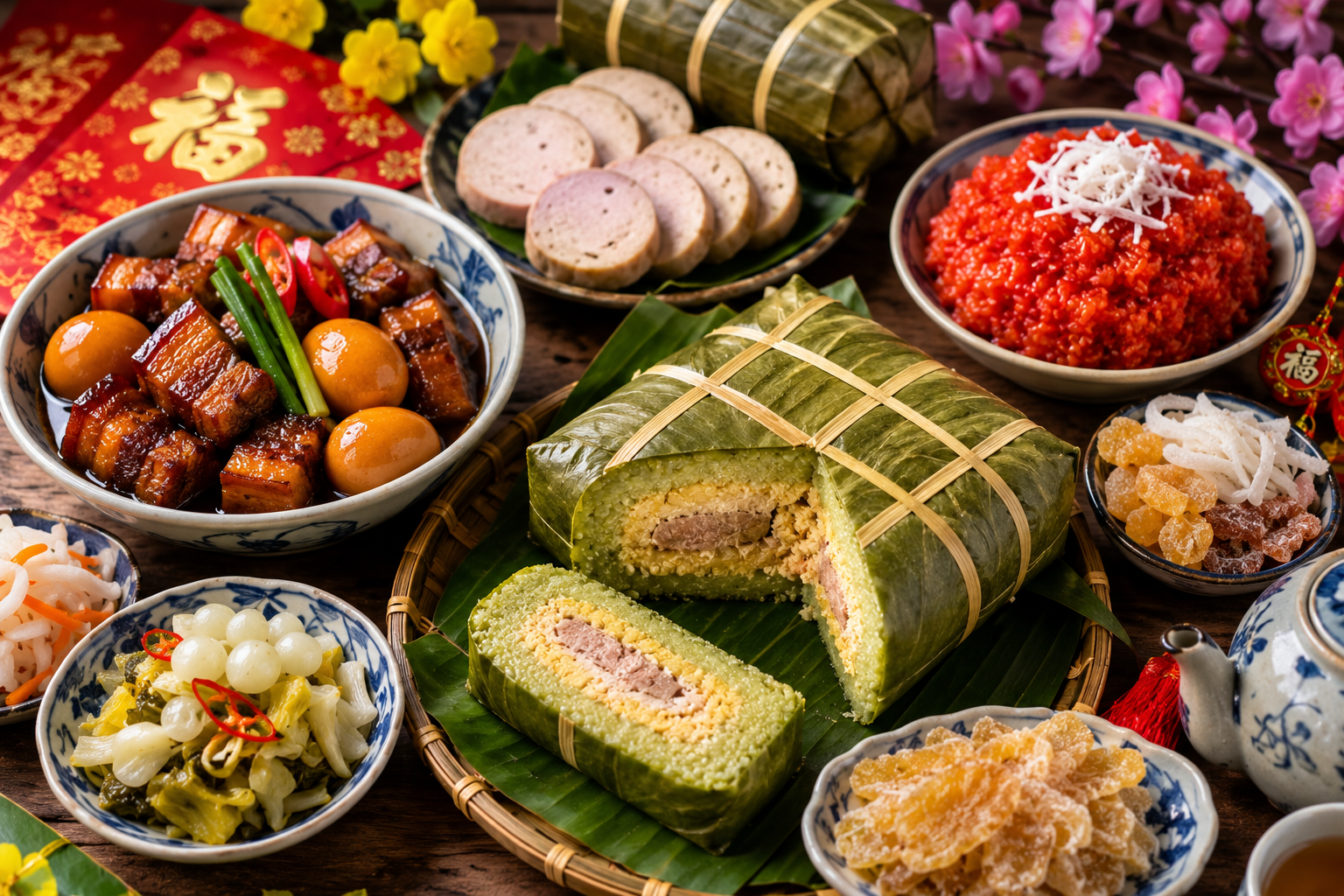
Vietnamese New Year’s food centers on a handful of dishes tied to Tết Nguyên Đán, the Lunar New Year holiday: bánh chưng or bánh tét, caramelized pork, a pot of pickled vegetables, and a box of candied fruit for guests. But there is no single national Tết menu. What lands on the table depends heavily on region, family history, and how a household chooses to balance old customs with modern life. A Hanoi family’s table in the north looks different from one in Ho Chi Minh City in the south, even though both are unmistakably Tết.
What Tết Nguyên Đán means
Tết Nguyên Đán translates roughly to “festival of the first morning” or “feast of the first day,” marking the start of the lunar calendar year. Most people simply call it Tết. It typically falls between late January and mid-February, and the date shifts each year because it follows a lunisolar calendar rather than the fixed Gregorian one.
Why food is central to the holiday
Tết is built around family reunion and ancestor veneration, and food carries both of those roles at once. Dishes are prepared to feed the living family, but many are also placed on the ancestral altar first, as an offering made before anyone eats. Cooking together in the days before Tết, particularly wrapping bánh chưng or bánh tét, is itself a family activity passed between generations, not just a task to get through.
Why there is no single Vietnamese New Year’s menu
Vietnam stretches over a long, geographically varied country, and its Tết food reflects that. Climate shaped some of it: colder northern winters favored dishes that keep well, like jellied pork, while the south’s tropical climate shaped a lighter, sweeter table. History and migration shaped some of it too, as families carried recipes with them and adapted them to new regions. Even within the same region, two households can serve noticeably different spreads based on family tradition alone.
The Most Traditional Vietnamese New Year’s Foods
Bánh chưng: the northern square sticky rice cake
Bánh chưng is a square cake of glutinous rice, mung bean paste, and fatty pork, traditionally wrapped in lá dong, a broad tropical leaf, and boiled for many hours until the rice turns a deep, leaf-tinted green. It’s most closely associated with Northern Vietnam and is traditionally offered on the ancestral altar before being served to the family.
Bánh tét: the cylindrical cake of Central and Southern Vietnam
Bánh tét uses largely the same core ingredients as bánh chưng, glutinous rice, mung bean, and pork, but is rolled into a cylinder and wrapped in banana leaves rather than shaped square. It’s the dominant version of the cake in Central and Southern Vietnam, and some Southern households also make a sweet version filled with banana or mung bean paste instead of a savory pork filling.
Thịt kho trứng: caramelized pork with eggs
Thịt kho trứng, also called thịt kho tàu in the south, is pork belly braised with hard-boiled eggs in a caramel and fish sauce broth, sometimes simmered with coconut water for added sweetness. It’s especially popular in Southern Vietnam, where it’s considered one of the defining dishes of the Tết table, and the round eggs sitting in square-cut pork are sometimes read as a nod to balance between two shapes, similar to the symbolism behind the rice cakes.
Whole boiled chicken and ancestral offerings
A whole boiled chicken, gà luộc, is a common Tết offering across much of Vietnam, often placed on the ancestral altar as part of the New Year’s Day meal before being carved and shared. It’s typically served simply, with a dipping salt of pepper and lime, letting the chicken itself be the point rather than a heavy sauce.
Giò lụa and other Vietnamese pork rolls
Giò lụa, known as chả lụa in the south, is a smooth, dense pork sausage made from pounded pork paste, wrapped tightly in banana leaf and steamed. It’s a fixture of the Northern Tết table and shows up across the country in various forms, sliced into rounds and served alongside rice cakes or in a bánh chưng and pickle plate.
Pickled vegetables that balance the Tết feast
Vietnamese New Year’s food leans rich, so pickled vegetables do real work on the table. Dưa hành, pickled shallots or scallions, is traditionally paired with bánh chưng and fatty northern dishes like thịt đông. In the south, củ kiệu, pickled small scallion bulbs, plays a similar role alongside thịt kho trứng, cutting through the richness of the pork and eggs.
Mứt Tết: candied fruits and seeds
Mứt Tết is a spread of candied fruit, root vegetables, and seeds, commonly including candied ginger, coconut, lotus seed, and kumquat, served in a tray to guests alongside tea during Tết visits. Roasted watermelon seeds are another common snack set out for the same purpose, less a dessert course than something to nibble on while chatting.
Xôi gấc and other festive sticky rice dishes
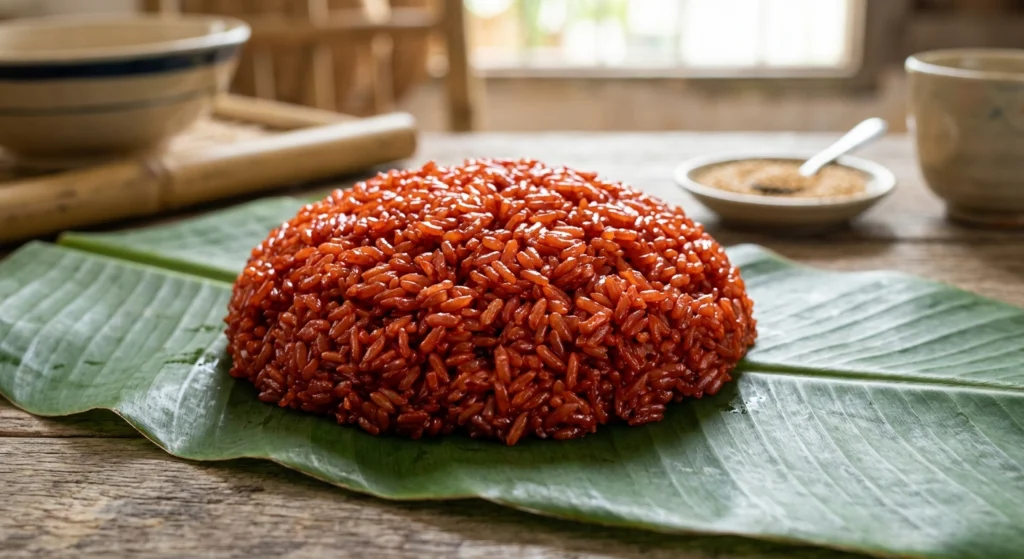
Xôi gấc is glutinous rice colored a deep red by gấc fruit, lightly sweetened, and often served on Tết morning or offered at the altar. Its red color is associated with luck and celebration in Vietnamese culture, which is part of why it appears specifically around Tết rather than as an everyday breakfast.
Bánh Chưng vs. Bánh Tét: What Is the Difference?
Shape and regional tradition
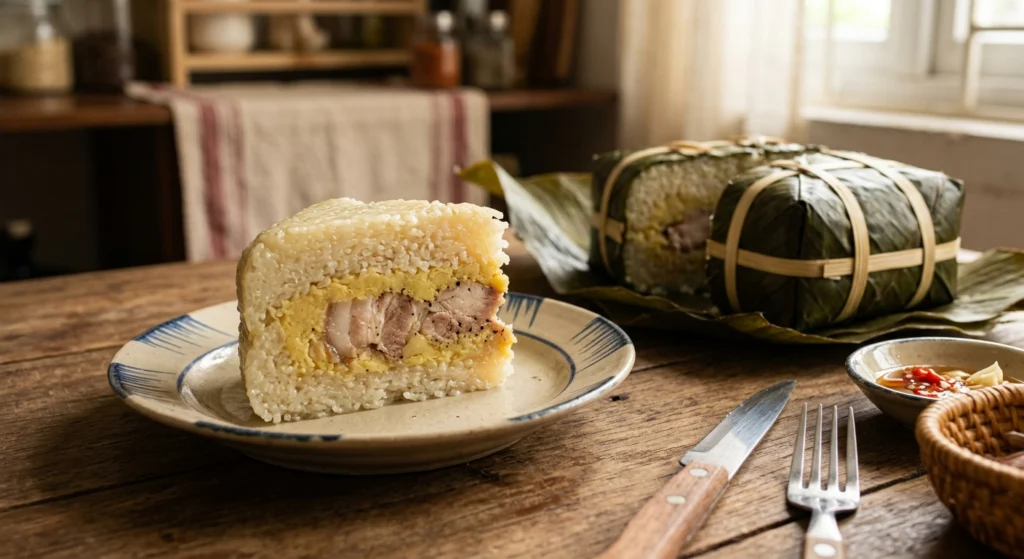
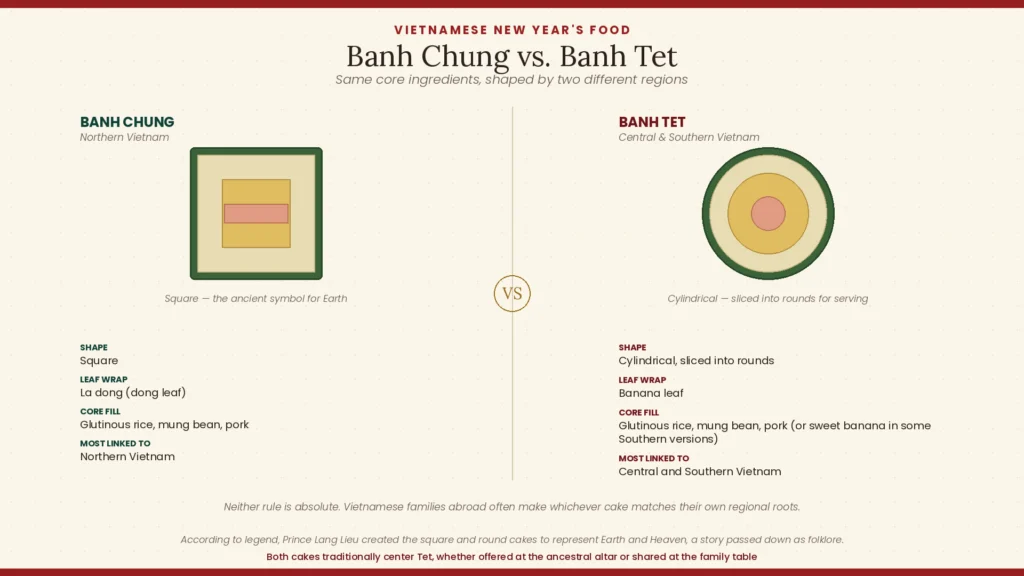
The clearest difference is shape and where each one is traditionally made. Bánh chưng is square and most closely associated with Northern Vietnam. Bánh tét is cylindrical, sliced into rounds for serving, and is the dominant version in Central and Southern Vietnam. Neither rule is absolute; bánh tét in particular can be found well beyond the south, and Vietnamese families living abroad often make whichever version matches their own family’s regional roots regardless of where they currently live.
Ingredients and preparation
Both cakes share a core: glutinous rice, mung bean paste, and pork, wrapped and boiled for hours until fully cooked through. The main preparation difference is the wrapping leaf and shape. Bánh chưng is traditionally wrapped in lá dong and folded into a square using a mold or careful hand-folding. Bánh tét is rolled into a long cylinder and wrapped in banana leaves. Some Southern versions of bánh tét swap the savory pork and mung bean filling for a sweet banana or mung bean paste filling instead.
What the cakes symbolize
According to a well-known Vietnamese legend, a prince named Lang Liêu created the square cake and a round cake to represent Earth and Heaven, based on an old Vietnamese belief that the earth was square and the sky was round.
This story, tied to the era of the Hùng Kings, is a legend passed down through generations rather than a documented historical event, and it’s the traditional explanation for why bánh chưng takes its square shape today. Bánh tét doesn’t carry that same specific origin story in most tellings, but it’s understood as the regional cylindrical counterpart that developed in Central and Southern Vietnam.
Vietnamese New Year’s Food by Region
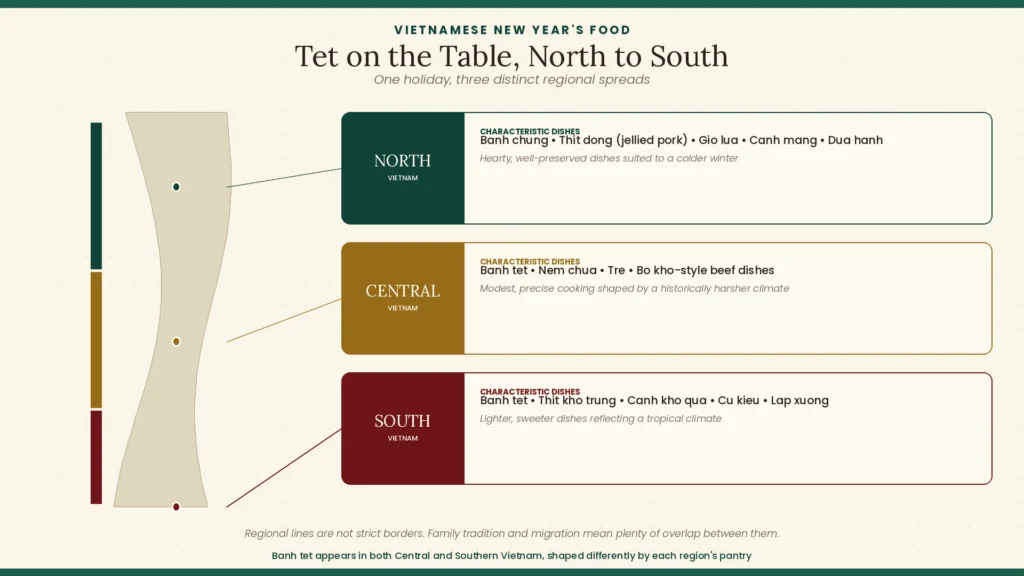
Northern Vietnam: bánh chưng, boiled chicken, nem, thịt đông and pickles
Northern Tết food tends toward hearty, well-preserved dishes suited to a colder winter, including bánh chưng, giò lụa, canh măng (a bamboo shoot soup simmered with pork or chicken), thịt đông (a jellied pork dish, chilled until the natural gelatin sets into a cold, sliceable dish), nem rán (fried spring rolls), and dưa hành on the side.
Central Vietnam: bánh tét and regional specialties
Central Vietnamese Tết food is often described as more modest and precise, shaped by a historically harsher climate and, in cities like Huế, a refined imperial food tradition. Dishes commonly associated with the region include bánh tét, nem chua (fermented pork roll), tré (a fermented pork and pork skin mix), and dishes built around bò (beef) that are less prominent further north or south.
Southern Vietnam: bánh tét, caramelized pork, bitter melon soup and pickles
Southern Tết food is generally lighter and sweeter, reflecting the region’s tropical climate and abundance of fresh produce. Thịt kho trứng, canh khổ qua (bitter melon soup, whose name plays on the Vietnamese word for hardship, khổ, suggesting that difficulties from the old year will pass), củ kiệu, and lạp xưởng (Vietnamese cured sausage) are all characteristic of a Southern Tết spread.
Why regional differences matter
Treating Vietnamese New Year’s food as one fixed menu erases a real part of the culture. The differences reflect climate, history, and local ingredients as much as taste preference, and Vietnamese people themselves are generally well aware of which dishes read as distinctly Northern, Central, or Southern. A useful guide to the topic should reflect that regional identity rather than flattening it into a single “Vietnamese Tết plate.”
5 Vietnamese New Year’s Recipes to Make at Home
These are home-kitchen adaptations for readers outside Vietnam or without access to specialty leaves and equipment. They’re meant to introduce the flavors of a traditional Tết table, not to replace or claim to be identical to a family’s own generations-old method. Nutrition figures are estimates based on standard ingredients and will vary by brand and technique.
Bánh Chưng Inspired Sticky Rice Cake
This is a simplified, foil-wrapped version of bánh chưng for a home kitchen without lá dong or a traditional mold. It captures the flavor and texture of the original but is not a substitute for the traditional technique, which uses dong leaves and typically many more hours of boiling.
Yield: 6 servings | Serving size: 1 wedge | Prep time: 45 minutes, plus overnight soaking | Cook time: 4 hours | Total time: about 5 hours, plus soaking
Ingredients
- 2 cups glutinous (sticky) rice, soaked overnight
- 3/4 cup dried split mung beans, soaked overnight
- 8 ounces pork belly, cut into thick slices
- 1 teaspoon salt, plus more for the rice and beans
- 1/2 teaspoon black pepper
- 1 tablespoon fish sauce
- 1 small shallot, minced
- Banana leaves or parchment and foil, for wrapping
Method
- Drain the soaked rice and mung beans separately and toss each with a pinch of salt. Season the pork belly with the fish sauce, pepper, and shallot, and let it marinate while you prepare the wrapping.
- If using banana leaves, soften them briefly over a flame or in hot water until pliable; otherwise line a square mold or small loaf pan with parchment, then foil. Layer a portion of rice, then mung beans, then the pork, then more mung beans, then a final layer of rice, pressing each layer down firmly. Wrap tightly in banana leaves tied with kitchen string, or fold the foil into a tight, sealed square package.
- Place the wrapped cake in a large pot, cover completely with water, and simmer for about 4 hours, topping up with boiling water as needed so the cake stays fully submerged. Remove, let cool completely, and press under a light weight for at least an hour before slicing to help it hold its shape.
Doneness cues: The rice should be fully tender and translucent throughout, with no hard or chalky grains at the center when sliced.
Substitutions: A well-marbled pork shoulder can replace pork belly. If banana leaves aren’t available, a foil packet works, though it won’t develop the same color or aroma as leaf-wrapped versions.
Storage: Refrigerate the cooked, cooled cake up to 5 days, wrapped tightly. It’s traditionally enjoyed cold or pan-fried in slices to crisp the exterior before serving.
Nutrition (estimated, per serving): 410 calories, 15g protein, 58g carbohydrates, 13g fat.
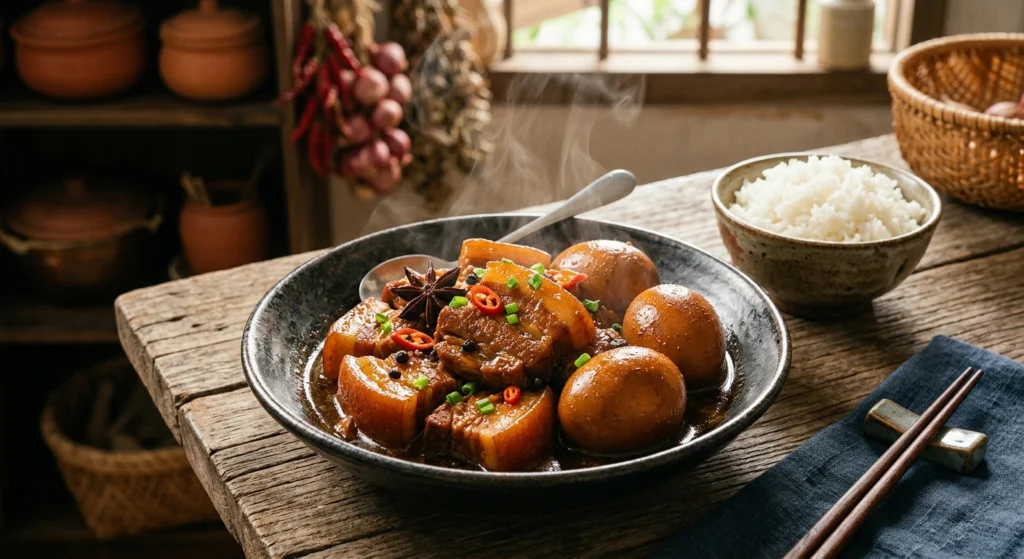
Southern-Style Caramelized Pork With Eggs
A simplified version of thịt kho trứng, this braise brings the same sweet, salty, deeply savory character as the traditional Southern dish, though home cooks in Vietnam often adjust the sugar level and cooking time by family preference.
Yield: 6 servings | Serving size: about 4 ounces pork with 1 egg | Prep time: 15 minutes | Cook time: 1 hour 15 minutes | Total time: 1 hour 30 minutes
Ingredients
- 2 pounds pork belly, cut into 2-inch chunks
- 6 large eggs, hard-boiled and peeled
- 1/4 cup sugar
- 3 tablespoons fish sauce
- 2 cups coconut water
- 3 garlic cloves, smashed
- 1 shallot, sliced
- 1/2 teaspoon black pepper
Method
- In a heavy pot, melt the sugar over medium heat, swirling occasionally, until it turns a deep amber color. Carefully add the pork, stirring to coat it in the caramel, then add the garlic, shallot, and fish sauce.
- Pour in the coconut water, bring to a simmer, and cook uncovered for about 1 hour, stirring occasionally, until the pork is tender and the sauce has reduced to a glossy, deep brown consistency. Add the peeled eggs during the last 20 minutes so they absorb flavor without overcooking.
Doneness cues: Pork should be fork-tender with a glossy, clinging sauce, not watery, and the eggs should be tinted brown from the braise.
Substitutions: Pork shoulder can replace pork belly for a leaner version. Coconut water can be swapped for plain water with an extra teaspoon of sugar if unavailable, though the flavor will be less rounded.
Storage: Refrigerate up to 4 days; the flavor often deepens the next day.
Reheating: Warm gently on the stovetop over low heat, adding a splash of water if the sauce has thickened too much.
Nutrition (estimated, per serving): 430 calories, 24g protein, 12g carbohydrates, 32g fat.
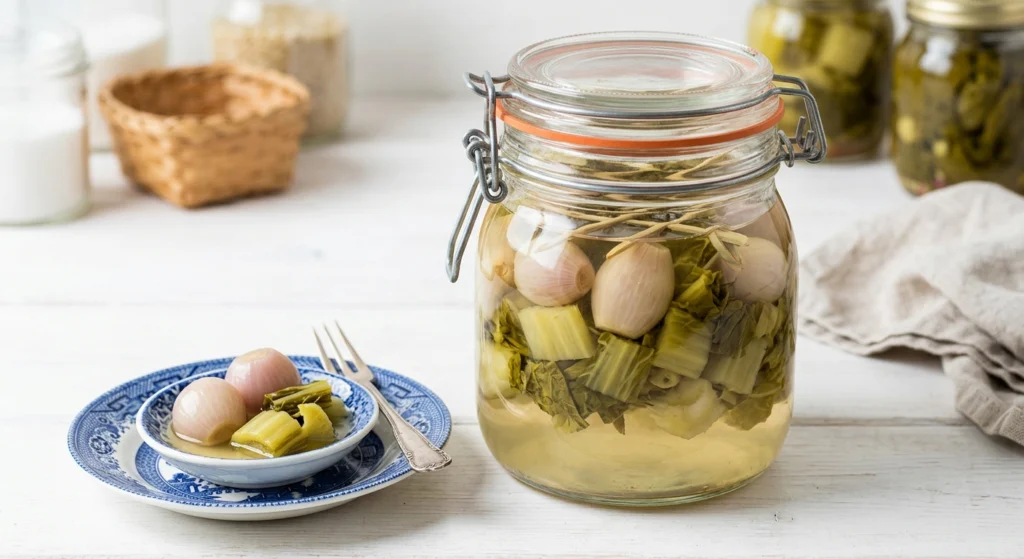
Vietnamese Pickled Mustard Greens or Shallots
A quick pickle inspired by dưa hành and dưa cải chua, meant to cut through the richness of pork-based Tết dishes.
Yield: 8 servings | Serving size: about 1/4 cup | Prep time: 20 minutes, plus 2 to 3 days pickling | Cook time: 5 minutes | Total time: 25 minutes active, plus pickling
Ingredients
- 1 pound mustard greens or small shallots, trimmed
- 2 cups water
- 1/2 cup rice vinegar
- 1/3 cup sugar
- 1 1/2 tablespoons salt
- 2 dried chiles, optional
Method
- If using mustard greens, let them wilt slightly in the sun or a warm spot for a few hours, or blanch briefly, then cut into 2-inch pieces. If using shallots, peel and trim the root ends but leave them whole.
- Combine the water, vinegar, sugar, and salt in a small pot and bring to a boil, stirring until fully dissolved. Let the brine cool slightly, then pour it over the greens or shallots packed into a clean jar, adding the chiles if using. Make sure the vegetables stay submerged.
- Let the jar sit at room temperature for 2 to 3 days, until the vegetables taste tangy and lightly fermented, then move to the refrigerator.
Doneness cues: The pickle is ready when it tastes distinctly sour and slightly effervescent rather than just salty.
Substitutions: Napa cabbage or green cabbage can replace mustard greens. Pearl onions can replace shallots if needed.
Storage: Refrigerate in the brine up to 3 weeks; flavor continues to develop over time.
Nutrition (estimated, per serving): 35 calories, 1g protein, 8g carbohydrates, 0g fat.
Xôi Gấc Inspired Red Sticky Rice
A home version of xôi gấc using more widely available ingredients, since fresh gấc fruit is difficult to find outside Vietnam. This version leans on frozen gấc pulp, which is sold in many Asian grocery stores, or a food-safe substitute for color if gấc truly isn’t available.
Yield: 6 servings | Serving size: about 3/4 cup | Prep time: 15 minutes, plus overnight soaking | Cook time: 30 minutes | Total time: 45 minutes, plus soaking
Ingredients
- 2 cups glutinous rice, soaked overnight
- 1/2 cup thawed gấc fruit pulp, or 1/4 cup cooked, mashed dragon fruit as a milder substitute for color only
- 2 tablespoons sugar
- 1/2 teaspoon salt
- 2 tablespoons coconut milk
- 1 tablespoon vegetable oil
Method
- Drain the soaked rice and toss it with the gấc pulp, sugar, salt, and oil until evenly coated and deep red throughout.
- Transfer to a steamer lined with cheesecloth or a steamer basket, and steam over simmering water for 25 to 30 minutes, until the rice is fully tender and glossy. Halfway through, drizzle in the coconut milk and fluff gently to distribute it.
Doneness cues: Grains should be tender and slightly sticky but still distinct, not mushy, with an even red color throughout.
Substitutions: If gấc isn’t available, a natural food coloring can approximate the color, though the flavor will be milder than true gấc, which has its own subtle, slightly nutty taste; label the dish as a color-inspired version rather than traditional xôi gấc if using a substitute.
Storage: Refrigerate up to 3 days.
Reheating: Steam again for 5 to 8 minutes, or microwave covered with a damp paper towel to restore moisture.
Nutrition (estimated, per serving): 260 calories, 4g protein, 52g carbohydrates, 4g fat.
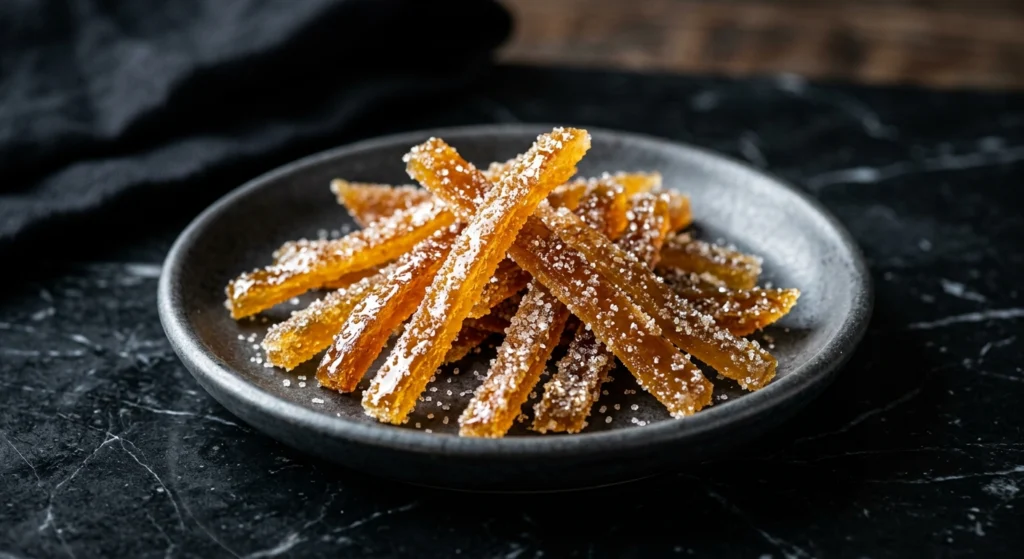
Mứt Gừng, Candied Ginger
A home version of one of the most common items in a mứt Tết tray, meant to be nibbled alongside tea when guests visit during Tết.
Yield: about 20 pieces | Serving size: 4 pieces | Prep time: 20 minutes, plus soaking | Cook time: 30 minutes | Total time: 50 minutes, plus soaking
Ingredients
- 1/2 pound fresh ginger, peeled and thinly sliced
- 1 1/2 cups sugar, divided
- 1 cup water
- Pinch of salt
Method
- Soak the sliced ginger in cold water for at least 2 hours, changing the water once or twice, to mellow its sharpness. Drain, then blanch in boiling water for 2 minutes, and drain again.
- Combine the ginger, 1 cup of the sugar, the water, and salt in a saucepan. Bring to a simmer and cook over medium-low heat for 20 to 25 minutes, stirring occasionally, until the liquid reduces to a thick syrup that coats the ginger.
- Remove from heat and toss the ginger in the remaining 1/2 cup sugar while still warm, separating the slices so they don’t clump. Spread on a rack or parchment to dry and firm up for about an hour before storing.
Doneness cues: The ginger should look glossy and slightly translucent at the edges, with the syrup nearly fully absorbed rather than pooling in the pan.
Substitutions: Young ginger, when available, produces a milder, less fibrous result than mature ginger.
Storage: Store in an airtight container at room temperature for up to 3 weeks, layered with parchment to prevent sticking.
Nutrition (estimated, per serving): 110 calories, 0g protein, 28g carbohydrates, 0g fat.
How a Traditional Vietnamese Tết Meal Comes Together
Foods for the family table
The everyday Tết meal, eaten by the family over the first few days of the new year, typically centers on whichever rice cake the family makes, a protein like thịt kho trứng or boiled chicken, a soup, and pickled vegetables on the side, echoing a normal Vietnamese meal structure but built around dishes made specifically for the holiday.
Foods associated with ancestor offerings
Before the family eats, many households first place a portion of the meal on the ancestral altar as an offering, often including the rice cake, boiled chicken, and a tray of fruit, as a way of including ancestors in the New Year’s meal before the living family sits down.
Foods served to visiting guests
Guests who visit during the first days of Tết are typically offered mứt Tết and tea rather than a full meal, since visiting is usually brief and centered on well-wishing rather than dining. Watermelon seeds and other roasted seeds are common alongside the candied fruit tray for the same casual, conversational stretch of hosting.
How savory, sour, sweet and rich foods balance each other
A Tết spread leans rich by design, with fatty pork and dense rice cakes as the backbone, so the sour crunch of pickled vegetables and the sweetness of a soup like canh khổ qua exist specifically to offset that richness rather than as an afterthought. Understanding the meal as a balance of textures and flavors, not just a list of individual dishes, is part of what makes it work as a multi-day spread instead of a single heavy dinner.
What Makes Tết Food Different From Everyday Vietnamese Food?
Foods prepared specifically for the holiday
Dishes like bánh chưng, bánh tét, and mứt Tết are rarely part of a regular weekday meal in Vietnam. They’re associated specifically with the New Year period, both because of the effort involved and because of their symbolic role in the holiday.
Foods made in large quantities
Because Tết traditionally involves several days of family gatherings and visiting guests, dishes like thịt kho trứng, thịt đông, and pickled vegetables are often made in much larger batches than a typical family dinner, meant to be eaten over multiple days rather than in one sitting.
Foods designed for several days of eating
Several Tết dishes were historically chosen in part because they hold up well without refrigeration for a few days, including thịt đông, which is naturally preserved by its own gelatin, and pickled vegetables, which last for weeks due to the vinegar or fermentation. This mattered more before modern refrigeration was widespread, though the dishes remain traditional regardless.
The role of family preparation
Wrapping bánh chưng or bánh tét has historically been a multi-person, multi-hour family task, often done together in the days leading up to Tết, and many households still treat it as a shared activity rather than something done individually, even as fewer families make the cakes entirely from scratch each year.
How to Prepare Vietnamese New Year’s Food Ahead
What can be prepared one or two days early
Pickled vegetables, mứt Tết, and the boiled and peeled eggs for thịt kho trứng can all be made a day or two ahead and kept refrigerated until needed. Rice cakes, once cooked, also keep well refrigerated for several days, which is part of why they’ve traditionally been made in advance of the holiday itself.
What should be cooked or assembled closer to serving
Thịt kho trứng benefits from a full simmer close to serving, since the sauce is at its best freshly reduced, though leftovers reheat well the next day. A whole boiled chicken for ancestral offerings is also typically cooked close to when it will be served or offered, rather than days in advance.
How to store leftovers safely
Cooked meats and rice cakes should go into the refrigerator within about two hours of cooking, consistent with general food-safety guidance for perishable foods, and should be reheated to steaming hot before eating again rather than eaten cold from multiple days prior. Pickled vegetables are shelf-stable in the refrigerator for weeks specifically because of their acidity, unlike the meat-based dishes on the table.
FAQs
What is the most traditional Vietnamese New Year’s food?
Bánh chưng in the north and bánh tét in the central and southern regions are generally considered the most traditional and symbolically important Vietnamese New Year’s foods, though a full Tết table includes many other dishes alongside them.
What is bánh chưng?
Bánh chưng is a square Vietnamese rice cake made of glutinous rice, mung bean paste, and pork, wrapped in lá dong leaves and boiled for hours, traditionally associated with Northern Vietnam and Tết.
What is bánh tét?
Bánh tét is a cylindrical Vietnamese rice cake made from the same core ingredients as bánh chưng but wrapped in banana leaves, traditionally associated with Central and Southern Vietnam.
What is the difference between bánh chưng and bánh tét?
The main differences are shape, wrapping leaf, and regional association: bánh chưng is square and wrapped in lá dong, most linked to the north, while bánh tét is cylindrical, wrapped in banana leaves, and most linked to the central and southern regions.
What meat is eaten during Tết?
Pork is the most prominent meat across Vietnamese New Year’s food, appearing in rice cakes, thịt kho trứng, giò lụa, and thịt đông, alongside whole boiled chicken, which is common as both a family dish and an ancestral offering.
What sweets are served during Tết?
Mứt Tết, a tray of candied fruits, ginger, and seeds, is the primary sweet offering during Tết, typically served to guests alongside tea rather than as a dessert course after a meal.
What foods are eaten in Northern versus Southern Vietnam?
Northern Tết food leans toward hearty, well-preserved dishes like bánh chưng, thịt đông, and canh măng, while Southern Tết food is generally lighter and sweeter, built around bánh tét, thịt kho trứng, and canh khổ qua.
Leave a Reply
You must be logged in to post a comment.