
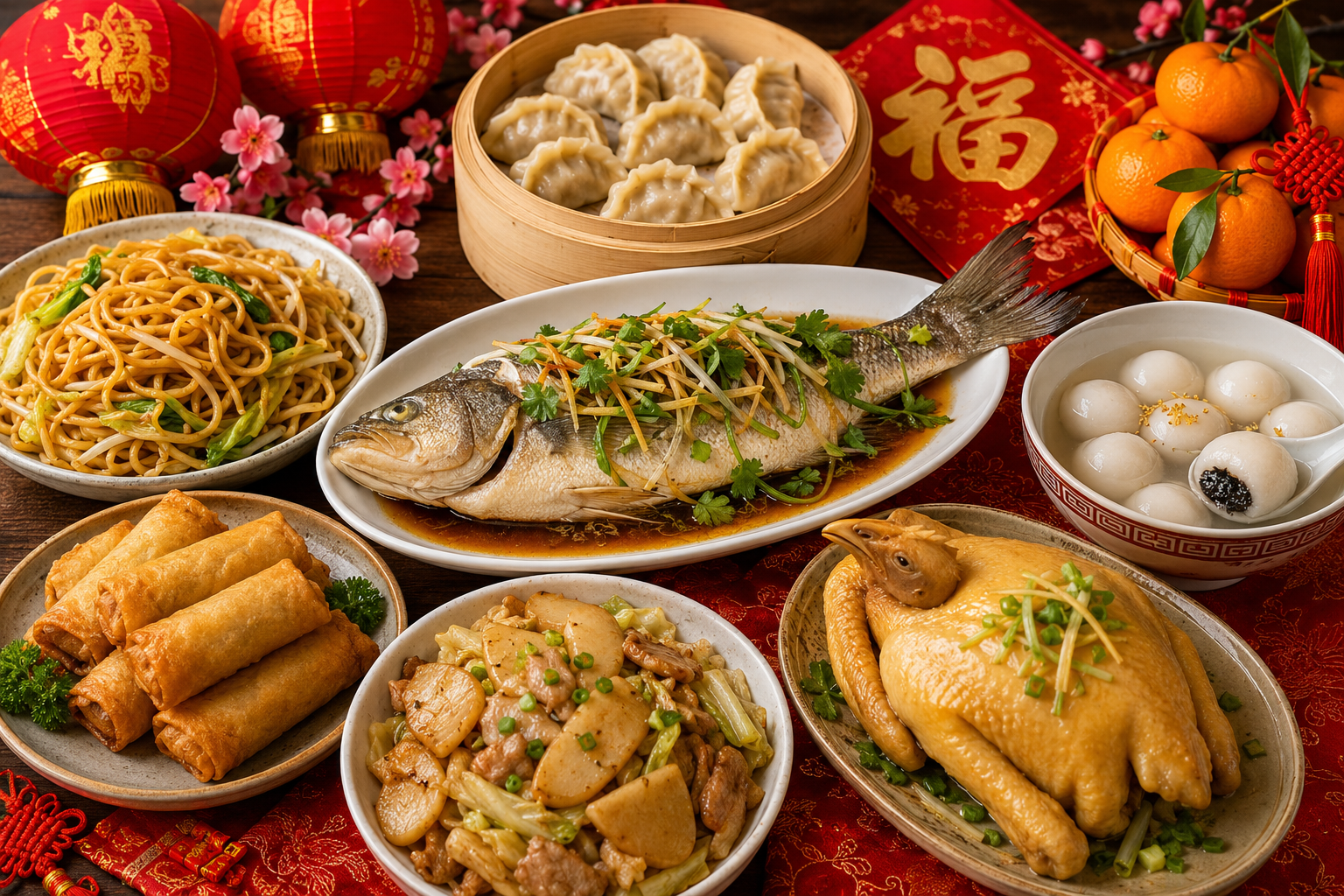
The eight most talked-about Chinese New Year food symbols are fish, jiaozi (dumplings), longevity noodles, nian gao, oranges and tangerines, spring rolls, whole chicken, and tangyuan. During Chinese New Year, also called the Spring Festival or Lunar New Year, dishes on the reunion dinner table often carry meaning that goes beyond flavor. A food can become auspicious because its name sounds like a lucky word, because its shape recalls something valuable, because of its color, or simply because a family or region has served it for generations.
These eight foods are widely recognized across Chinese culture and its diaspora communities, though no single household serves all eight on New Year’s Eve. Which ones show up on a given table depends on region, dialect, and family history.
8 Chinese New Year Food Symbols and What They Mean
Why food carries symbolic meaning during Spring Festival
Chinese New Year’s Eve dinner is called nian ye fan, the reunion dinner, and it is the most important meal of the year for many Chinese families. Relatives travel long distances to sit at the same table, and the meal becomes a way of speaking wishes out loud without saying them directly. Instead of announcing a hope for a good year, a family serves a dish whose name or shape already carries that hope.
This habit of encoding wishes into food is tied to a long agricultural history, where a good harvest, a large family, and financial stability were the things people wanted most for the year ahead.
How Chinese food symbolism works through sound, shape and tradition
Chinese food symbolism generally works through four overlapping mechanisms.
- Sound (homophones): Mandarin and Cantonese both have a limited number of syllables, so many words share the same or a similar pronunciation. Fish, 鱼 (yú), sounds like the word for surplus, 余 (yú), so eating fish becomes a way of wishing for more than enough.
- Shape: Foods that resemble valuable objects, such as gold ingots or coins, take on the meaning of those objects. Dumplings folded into a curved shape resemble ancient Chinese ingots called yuanbao.
- Color: Gold and red are associated with wealth and good fortune, so golden fried foods or reddish dishes are often read as auspicious.
- Established custom: Some foods carry symbolic weight simply because a region or family has served them at New Year for generations, independent of wordplay or shape.
Most of the eight foods below combine more than one of these mechanisms at once.
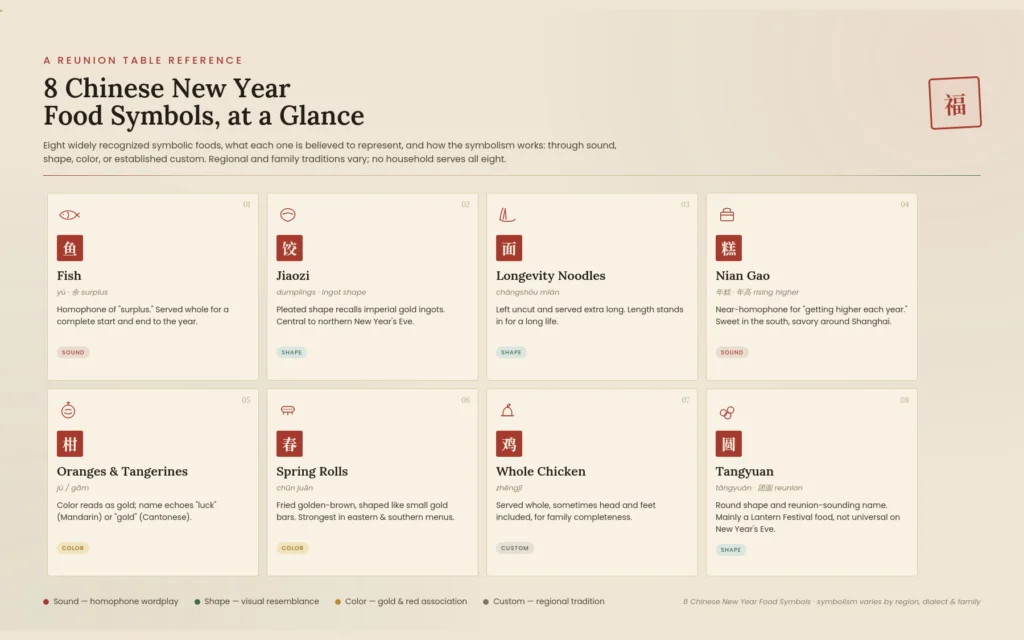
Why these eight foods are not a universal checklist
China has more regional cuisines than most single-country food traditions in the world, and Chinese New Year is celebrated by hundreds of millions of people across mainland China, Taiwan, Hong Kong, Southeast Asia, and diaspora communities worldwide. A family in Beijing, a family in Guangzhou, and a Chinese American family in California may celebrate the same holiday with almost entirely different menus.
The eight foods in this article are commonly discussed and widely recognized symbols, not an official or complete list, and treating them as a single national menu would flatten a food culture that is genuinely regional and varied.
1. Fish: A Symbol of Abundance and Surplus
Fish is one of the most consistently mentioned Chinese New Year food symbols, and its meaning comes almost entirely from a single, well-known homophone.
The yú and yú wordplay
The Chinese word for fish, 鱼 (yú), sounds identical to 余 (yú), meaning surplus or remainder. Combined into the common New Year phrase 年年有余 (nián nián yǒu yú), roughly “may there be surplus year after year,” fish becomes a stand-in for the wish to have more than enough, in food, money, and general fortune. Eating fish does not literally create wealth. It symbolizes and expresses a wish for abundance.
Why fish is often served whole
Fish for the reunion dinner is typically served whole, head and tail intact, rather than filleted or cut into pieces. A whole fish represents a complete beginning and a complete end to the year, and cutting it apart before serving is generally avoided because it would break that sense of wholeness.
Why some families leave part of the fish uneaten
In some households, a portion of the fish, often near the middle or the head, is deliberately left on the plate rather than finished. This custom connects directly to the surplus wordplay: leaving food behind is meant to represent having more than enough, with the wish that the surplus continues into the new year. Not every family observes this practice, and some serve fish specifically to be eaten in full at the meal itself.
2. Dumplings: Wealth, Fortune and Reunion
Jiaozi, boiled or pan-fried dumplings, are among the most recognizable Chinese New Year foods, especially in northern China, and their symbolism comes from what they look like rather than how they sound.
Why jiaozi resemble ancient ingots
Traditional jiaozi are pleated and curved at the ends, a shape commonly said to resemble yuanbao, the boat-shaped gold and silver ingots used as currency in imperial China. Because of this resemblance, dumplings are strongly associated with wealth, and a table full of them is sometimes read as a table full of “ingots.”
The northern Chinese New Year connection
Dumplings are especially central to New Year’s Eve in northern China, where wheat, not rice, has historically been the dominant staple grain. Many northern Chinese families eat jiaozi around midnight as the new year begins, treating the dish almost as a ritual marker of the transition from one year to the next. Southern Chinese New Year menus do not share this same emphasis on dumplings, and rice-based dishes tend to play a larger role instead.
Making dumplings as a family activity
In households where dumplings are part of the holiday, making them is often a shared, multi-generational activity rather than a solo kitchen task. Family members gather around a table to roll wrappers, mix filling, and fold dumplings together in the hours before the reunion dinner, which turns the dish into a bonding ritual as much as a meal.
A safety note on the coin custom: One well-known custom involves hiding a single coin inside one dumpling in a batch, with the idea that whoever finds it will have good luck in the coming year. This is a cultural tradition, not a cooking instruction, and it carries a real choking and dental-injury risk, especially for children and older adults. If you want to recreate the spirit of the custom at home, mark one dumpling differently instead, using a distinct fold, a different filling, or a small edible topping, rather than placing anything hard inside the food.
3. Longevity Noodles: A Wish for Long Life
Longevity noodles get their symbolism from something simple: length.
Why long noodles represent longevity
The noodles used for this dish are made intentionally long, sometimes a single strand per serving, because their length is read as a direct visual metaphor for a long life. This is shape-based symbolism rather than wordplay, and it is one of the more literal connections on this list.
How longevity noodles are served
There is no single official recipe for longevity noodles. Depending on the region and household, they might be stir-fried with vegetables and a light soy-based sauce, served in broth, or dressed simply with oil and garlic. The specific noodle, whether wheat-based, egg-based, or otherwise, and the accompanying ingredients vary by family and region, but the emphasis on unbroken length stays consistent.
Why cutting the noodles can matter symbolically
Because the noodles represent long life, cutting or breaking them, whether during cooking, serving, or eating, is often avoided since it is seen as undercutting the wish they carry. Some people try to eat the noodles without biting through a strand, slurping the full length instead, though how strictly this is observed varies from household to household.
4. Nian Gao: Progress and Rising Higher
Nian gao, a cake made from glutinous rice flour, carries one of the more direct wordplay symbols on this list.
The meaning behind the name
年糕 (nián gāo), meaning “year cake,” sounds nearly identical to 年高 (nián gāo), meaning “year” plus “high” or “getting higher.” Because of this near-homophone, nian gao is associated with rising higher each year, whether that means career advancement, growing children, or general progress and improvement.
Regional forms of nian gao
Nian gao takes noticeably different forms depending on where it is made. In Cantonese-speaking regions, it is often a dense, sweet, steamed cake flavored with brown sugar. In Shanghai and the wider Jiangnan region of eastern China, nian gao usually takes the form of firm, sliced rice cake that gets stir-fried rather than eaten as a sweet cake. Fujianese and other regional versions differ further still. No single version of nian gao represents the dish nationally.
Sweet and savory preparations
Sweet nian gao, often steamed and sometimes pan-fried in batter afterward, tends to be treated as a holiday dessert or snack. Savory nian gao, more common in eastern Chinese cooking, gets sliced thin and stir-fried with ingredients like napa cabbage, pork, and scallions, closer to a main dish than a treat. Both preparations lean on the same rising-higher symbolism. The difference between them is regional and culinary, not symbolic.
5. Oranges and Tangerines: Good Fortune and Auspicious Wishes
Citrus fruit, especially tangerines and mandarin oranges, is one of the most visually familiar Chinese New Year symbols, and it is also one of the more regionally specific ones.
Color, shape and wordplay
The bright orange-gold color of these fruits is often read as visually resembling gold, linking them to wealth. In Mandarin, the word for tangerine, 橘 (jú), is a near-homophone of 吉 (jí), meaning luck or auspiciousness. In Cantonese, the word for tangerine, 柑 (gām), sounds identical to 金 (gām), meaning gold, which makes the wordplay even more direct in Cantonese-speaking regions.
Why citrus is exchanged or displayed
Tangerines and oranges are commonly given in pairs, since even numbers are considered more auspicious than odd ones for gifts, and they are often left with the stem and a leaf or two still attached, since a fruit that is whole and intact is read as more complete than one separated from the plant. Bowls of citrus are displayed in homes, shops, and offices throughout the holiday, and the fruit is sometimes placed on family altars as an offering.
Regional and dialect differences in symbolism
Because so much of this symbolism depends on pronunciation, it is not identical across China. The gold homophone is strongest in Cantonese-speaking regions like Guangdong, Hong Kong, and Macau, and it carries over into Cantonese diaspora communities in places like Southeast Asia and North America. The luck-based Mandarin wordplay matters more in Mandarin-speaking areas.
Not every fruit in the citrus family carries the same weight, either. Kumquats, often kept in small potted trees, are treated as their own good-luck symbol in some southern regions, distinct from loose tangerines or oranges.
6. Spring Rolls: Golden Shapes and Prosperity
Spring rolls owe their New Year symbolism to how they look right out of the fryer.
Why fried spring rolls resemble gold
A well-fried spring roll turns a deep golden-brown and takes on a cylindrical shape not unlike a small gold bar. That resemblance is the basis for the dish’s prosperity symbolism, in the same visual-association family as the color symbolism behind citrus fruit and fried foods generally during the holiday.
Common fillings
Fillings vary widely and typically include shredded cabbage, carrots, wood ear mushroom, glass noodles, and either pork or shrimp, wrapped in a thin wheat wrapper and deep-fried until crisp. Vegetarian versions built around cabbage, mushroom, and tofu are also common.
Regional variation
Spring rolls carry a stronger customary presence in eastern and southern Chinese New Year traditions, particularly in Shanghainese and Cantonese households, than in much of northern China, where dumplings and wheat-based dishes tend to dominate the table instead. They should not be treated as a universal or required dish. Their prominence is regional and customary rather than fixed.
7. Whole Chicken: Completeness and Family Unity
Serving a whole chicken at the reunion dinner is a completeness symbol more than a wordplay one, though there is a linguistic layer in some regions too.
Why serving the whole bird matters
Where this tradition applies, the chicken is served whole, sometimes including the head and feet, rather than pre-cut into individual portions. A complete bird is read as a symbol of a complete, unified family, and carving it up before serving is thought to undercut that meaning in households that follow the custom closely.
The auspicious meaning of chicken
In some dialects, the word for chicken has a phonetic closeness to words associated with luck, which reinforces the bird’s place on the table beyond pure completeness symbolism. That linguistic link is not as strong or as widely cited as the fish or nian gao wordplay, and the completeness symbolism generally carries more weight than the sound-based one.
How whole chicken appears at the reunion meal
A common preparation is a whole poached or steamed chicken served at room temperature with a dipping sauce on the side, though roasted versions appear too. Not every regional New Year menu centers chicken this way. Some southern and coastal traditions favor duck or other proteins as the “whole bird” centerpiece instead, and the practice is far from universal across China.
8. Tangyuan: Roundness, Harmony and Reunion
Tangyuan are round, chewy glutinous rice balls, and their symbolism is almost entirely about shape and sound, with an important calendar caveat.
What the round shape represents
The round shape of tangyuan is read as a symbol of wholeness, unity, and harmony, echoing the shape of a full moon and a complete family circle. The name itself, tangyuan, sounds close to 团圆 (tuányuán), the word for reunion, which reinforces the same meaning through sound as well as shape.
Tangyuan versus yuanxiao
Tangyuan and yuanxiao refer to closely related but differently made rice balls. In southern China, tangyuan are typically shaped by hand around a filling, such as black sesame or red bean paste, giving them a smooth surface. In northern China, the same style of ball is usually called yuanxiao and made by rolling a piece of filling in dry glutinous rice flour repeatedly until a rougher-textured ball builds up around it.
Why this food should not be presented as a universal New Year’s Eve dish
Tangyuan and yuanxiao are most strongly and traditionally associated with the Lantern Festival, which falls on the fifteenth day of the first lunar month and marks the formal end of the Spring Festival season, not with Chinese New Year’s Eve itself. That said, in parts of southern China, Taiwan, and among some diaspora communities, small glutinous rice balls are also served at the New Year’s Eve reunion dinner as an additional reunion symbol, separate from the Lantern Festival tradition.
It would be inaccurate to say all Chinese families eat tangyuan on Chinese New Year’s Eve. Its stronger and more consistent tie is to the Lantern Festival two weeks later.
How Chinese New Year Food Symbols Work Together
Individually, each of these eight foods carries its own specific wish. Put together on a reunion dinner table, they form a kind of symbolic shorthand for everything a family might hope for in the year ahead.
| Food | Core Symbolic Meaning |
| Fish | Abundance and surplus |
| Jiaozi (dumplings) | Wealth |
| Longevity noodles | Long life |
| Nian gao | Progress and advancement |
| Oranges and tangerines | Good fortune and prosperity |
| Spring rolls | Wealth, through color and shape |
| Whole chicken | Completeness and family unity |
| Tangyuan | Reunion and harmony |
Prosperity foods
Dumplings, spring rolls, and citrus fruit all lean on wealth symbolism, though they arrive at it differently: dumplings through shape, spring rolls through color and shape, and citrus through both color and wordplay.
Longevity and progress foods
Longevity noodles and nian gao both look toward the future rather than the present, one wishing for a long life and the other for continual improvement year over year.
Reunion and family foods
Whole chicken and tangyuan both center on completeness, one through the wholeness of the bird itself and the other through the round shape of the rice balls and their reunion-linked name.
How a symbolic menu can combine several meanings
Fish sits somewhat on its own, tied specifically to the idea of surplus rather than the other three categories. A reunion dinner that includes several of these dishes is not randomly assembled. It is typically built, consciously or by inherited habit, to touch on more than one kind of wish at once, wealth, longevity, progress, and family unity, within a single meal.
Chinese New Year Lucky Food by Region
Regional differences in Chinese New Year food are not a minor footnote. They are one of the main reasons no single list of eight dishes can represent the whole country.
Northern China
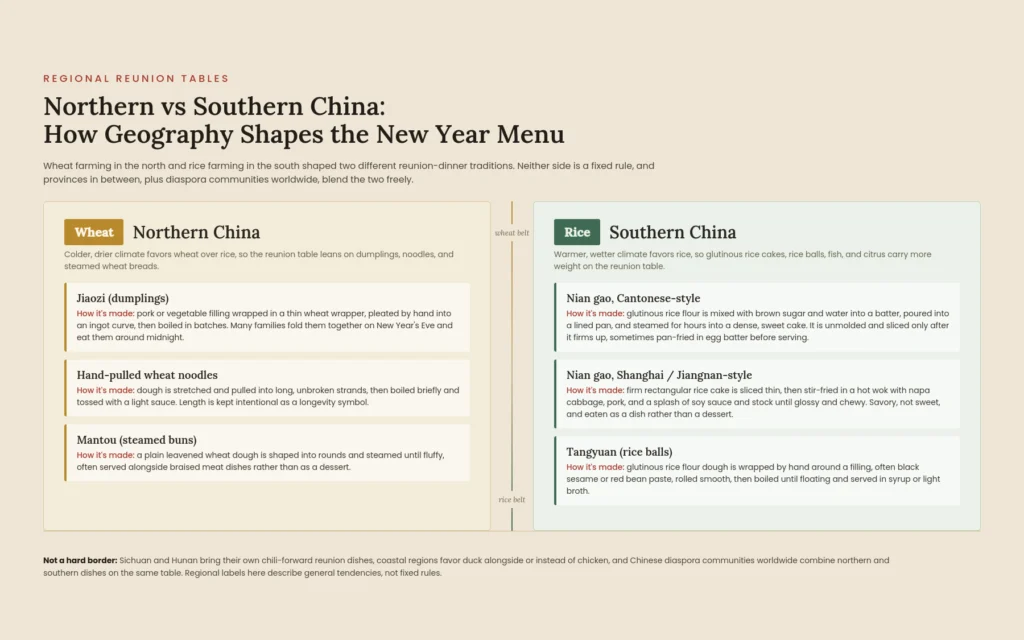
Northern China’s food culture has historically centered on wheat rather than rice, since the region’s climate favors wheat farming. That shows up directly in New Year menus: dumplings, wheat noodles, and steamed wheat buns play a much larger role in northern reunion dinners than rice-based dishes do. Jiaozi around midnight is one of the most consistent northern Chinese New Year customs.
Southern China
Southern China’s warmer, wetter climate favors rice, and that shows up in the region’s New Year food too. Nian gao, made from glutinous rice flour, is especially associated with southern and eastern Chinese New Year tables, and how it is made changes as it moves south to north. In Guangdong it tends to be a sweet, dense, steamed cake flavored with brown sugar, unmolded and sliced only after it firms up.
In the Jiangnan region around Shanghai, it is more often sold as firm rectangular blocks, sliced thin, and pan-fried or stir-fried in a hot wok with cabbage, pork, and a splash of soy sauce and stock until the slices turn glossy and chewy rather than sweet. Fish and citrus fruit also carry particularly strong symbolic weight in southern and Cantonese-speaking regions, largely because of the stronger Cantonese wordplay around gold and luck described earlier in this article. Spring rolls and tangyuan-style rice balls, similarly, show up more consistently on southern and eastern reunion tables than on northern ones.
Regional and family variation
Beyond the broad north-south split, individual provinces and cities add their own dishes entirely. Sichuan and Hunan-influenced New Year tables often bring more chili heat than either the wheat-heavy north or the rice-heavy south typically features. Family history, migration, and personal taste all shape the final menu as much as regional custom does, which is exactly why the eight foods in this article should be read as commonly discussed touchpoints rather than a fixed regional or national standard.
5 Symbolic Chinese New Year Recipes to Make at Home
These five recipes translate five of the symbols above into dishes you can make in a home kitchen. They are written as approachable home versions, not as the definitive version of any regional dish.
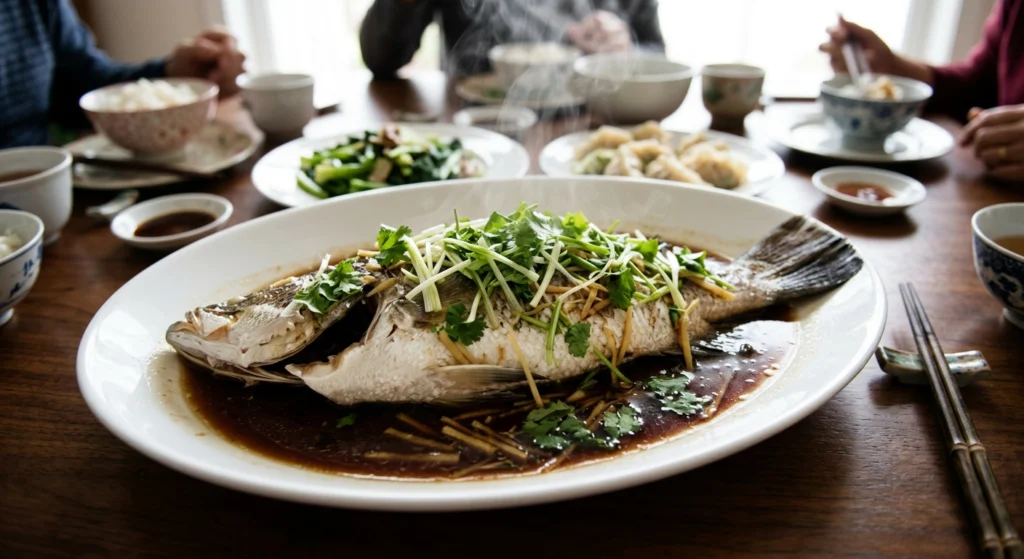
Whole Steamed Fish (Cantonese-Style)
A light, delicate way to prepare a whole fish for the reunion table, dressed with ginger, scallion, and a hot oil finish that represents the abundance wish behind fish symbolism.
Yield: 1 whole fish, serves 4 as part of a shared meal
Serving size: about 6 oz cooked fish per person
Prep time: 15 minutes
Cook time: 12 minutes
Total time: 27 minutes
Ingredients
- 1 whole white-fleshed fish (about 1.5 lb / 700g), cleaned and scaled, such as sea bass or tilapia
- 1 tsp salt
- 2 tbsp julienned fresh ginger, divided
- 3 scallions, cut into 2-inch lengths, plus 2 tbsp finely sliced scallion for garnish
- 3 tbsp light soy sauce
- 1 tbsp Shaoxing wine (or dry sherry)
- 1 tsp sugar
- 3 tbsp neutral oil (vegetable or peanut)
- Cilantro leaves, for garnish (optional)
Instructions
1. Season the fish. Pat the fish dry and rub salt inside the cavity and over the skin. Let sit 10 minutes.
2. Set up for steaming. Score the skin twice on the diagonal on each side. Place half the ginger and scallion inside the cavity and scatter the rest under the fish on a heatproof plate.
3. Steam the fish. Set up a steamer with boiling water. Steam the plate of fish, covered, over high heat for 10 to 12 minutes, until the thickest part flakes easily and reads 145°F (63°C).
4. Warm the sauce. While the fish steams, combine soy sauce, Shaoxing wine, and sugar in a small saucepan and warm gently until the sugar dissolves.
5. Dress the fish. Remove the fish from the steamer, discard the cooked aromatics, and scatter fresh ginger and scallion over the top. Pour the warm soy mixture over the fish.
6. Finish with hot oil. Heat oil in a small pan until just smoking, then carefully pour it over the scallions and ginger so it sizzles. Garnish with cilantro and serve immediately.
Doneness cue: Flesh turns opaque and flakes easily at the thickest part near the spine. If it still looks translucent, steam 2 more minutes.
Substitutions: Swap sea bass for tilapia, branzino, or snapper. Use tamari for a gluten-free version, and omit the wine for an alcohol-free version.
Storage: Refrigerate leftovers in an airtight container up to 2 days.
Reheating: Reheat gently in a covered steamer for 3 to 4 minutes. Microwaving tends to dry it out.
Nutrition (estimate, per serving): 220 calories, 28g protein, 4g carbohydrates, 9g fat. This is an approximate estimate, not a lab analysis.
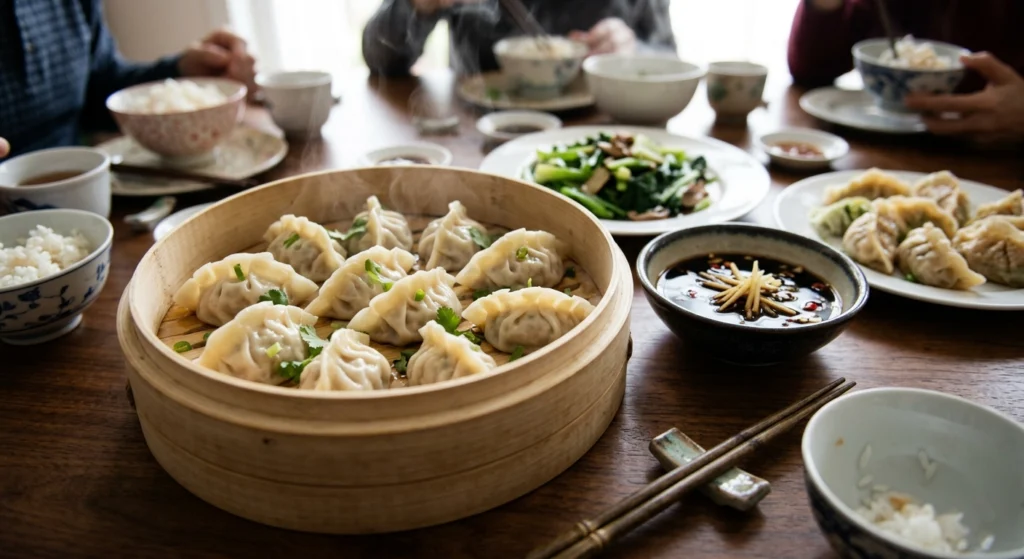
Jiaozi Dumplings (Pork and Napa Cabbage)
Classic northern-style boiled dumplings, hand-folded into the curved shape that gives them their ingot symbolism.
Yield: about 40 dumplings, serves 6 to 8 as part of a shared meal
Serving size: 5 to 6 dumplings per person
Prep time: 45 minutes
Cook time: 15 minutes, cooked in batches
Total time: 60 minutes
Ingredients
- 1 lb (450g) ground pork
- 2 cups finely chopped napa cabbage, salted and squeezed dry
- 2 scallions, finely chopped
- 1 tbsp minced ginger
- 2 tbsp light soy sauce
- 1 tbsp Shaoxing wine
- 1 tsp sesame oil
- 1/2 tsp white pepper
- 1/2 tsp salt
- 40 round dumpling wrappers, store-bought or homemade
- Water, for sealing
- Dipping sauce: 3 tbsp black vinegar, 1 tbsp light soy sauce, chili oil to taste
Instructions
1. Mix the filling. Combine pork, cabbage, scallion, ginger, soy sauce, wine, sesame oil, white pepper, and salt in a bowl. Mix in one direction until the filling looks slightly sticky and holds together.
2. Fold the dumplings. Place a wrapper in your palm, add about 1 tsp of filling to the center, wet the edge with water, and fold into pleats, pressing firmly to seal.
3. Boil in batches. Bring a large pot of water to a boil. Add dumplings in batches of about 15, stirring gently so they do not stick to the bottom.
4. Cook until they float. Once the water returns to a boil, add 1/2 cup cold water and repeat this twice more, boiling until the dumplings float and the wrappers look translucent, about 8 to 9 minutes total per batch.
5. Serve. Remove with a slotted spoon and serve hot with the dipping sauce.
Doneness cue: Wrappers turn translucent and dumplings float. Cut one open to confirm the pork inside is no longer pink.
Substitutions: Ground chicken or turkey in place of pork. Finely chopped shiitake and extra cabbage for a vegetarian filling. Gluten-free wrappers where available.
Storage: Uncooked dumplings freeze well on a tray, then transfer to a bag, up to 2 months. Cooked dumplings refrigerate up to 2 days.
Reheating: Pan-fry frozen or refrigerated cooked dumplings in a little oil with a splash of water, covered, until heated through, about 5 minutes.
Nutrition (estimate, per serving of 5 dumplings): 260 calories, 14g protein, 24g carbohydrates, 12g fat. Estimate only.
Do not hide a coin or other hard object inside any of these dumplings. If you want to recreate that custom, mark one dumpling with a different fold or a different filling instead.
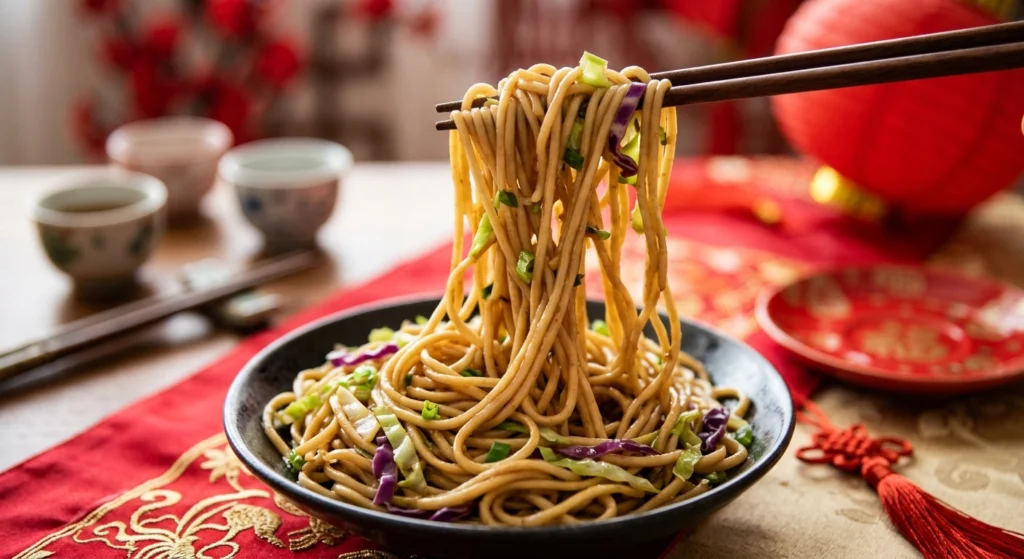
Longevity Noodles (Garlic Soy Stir-Fry)
Long wheat noodles stir-fried simply, so the noodle itself, not a heavy sauce, stays the center of the dish.
Yield: serves 4
Serving size: about 1.5 cups
Prep time: 10 minutes
Cook time: 10 minutes
Total time: 20 minutes
Ingredients
- 12 oz (340g) fresh long wheat noodles, or dried longevity noodles
- 2 tbsp neutral oil
- 4 cloves garlic, thinly sliced
- 1 cup thinly sliced napa cabbage or bok choy
- 1 cup bean sprouts
- 2 scallions, cut into 2-inch lengths
- 2 tbsp light soy sauce
- 1 tbsp oyster sauce, or mushroom stir-fry sauce for a vegetarian version
- 1 tsp sesame oil
- White pepper, to taste
Instructions
1. Cook the noodles. Bring a large pot of water to a boil and cook the noodles until just tender, about 3 to 4 minutes for fresh noodles. Drain, keeping strands intact rather than cutting them, and toss with a little oil to prevent sticking.
2. Bloom the garlic. Heat oil in a wok or large skillet over high heat, add garlic, and stir until fragrant, about 30 seconds.
3. Add vegetables. Add cabbage and bean sprouts and stir-fry for 1 to 2 minutes until just softened.
4. Combine gently. Add the noodles, scallions, soy sauce, and oyster sauce. Toss gently with tongs, lifting rather than chopping, to coat evenly without breaking the strands.
5. Finish and serve. Finish with sesame oil and white pepper, and serve immediately in long, unbroken portions.
Doneness cue: Noodles should be tender but still have a slight chew. Vegetables should stay bright and crisp-tender, not limp.
Substitutions: Rice noodles for a gluten-free version, though the texture will differ from wheat longevity noodles. Tamari in place of soy sauce.
Storage: Refrigerate up to 2 days in an airtight container.
Reheating: Reheat in a skillet with a splash of water over medium heat, tossing gently to avoid breaking the strands.
Nutrition (estimate, per serving): 340 calories, 11g protein, 52g carbohydrates, 9g fat. Estimate only.
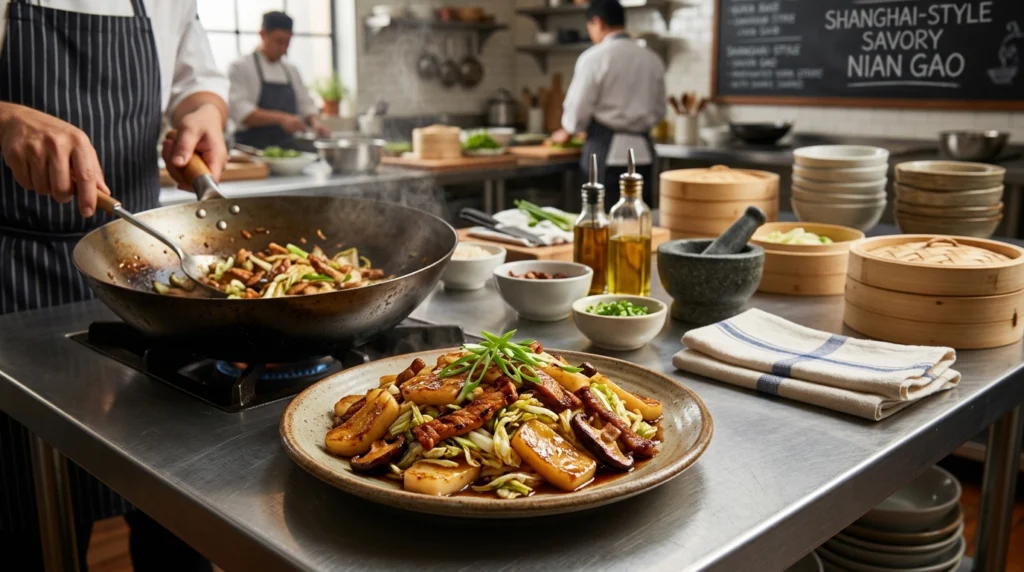
Nian Gao (Shanghai-Style, Pan-Fried and Savory)
A savory, eastern Chinese take on nian gao, sliced thin and stir-fried with pork and vegetables until slightly chewy, in the style common around Shanghai and the Jiangnan region.
Yield: serves 4
Serving size: about 1.5 cups
Prep time: 15 minutes
Cook time: 12 minutes
Total time: 27 minutes
Ingredients
- 1 lb (450g) sliced nian gao (rice cake), fresh or thawed from frozen
- 4 oz (115g) pork loin or shoulder, thinly sliced
- 2 tbsp light soy sauce, divided
- 1 tsp Shaoxing wine
- 2 tbsp neutral oil
- 2 cups shredded napa cabbage
- 2 scallions, cut into 2-inch pieces
- 1/2 cup chicken or vegetable stock
- 1/2 tsp sugar
- White pepper, to taste
Instructions
1. Marinate the pork. Toss pork slices with 1 tbsp soy sauce and the wine, and let sit 10 minutes.
2. Soften the rice cake. If the rice cake slices are firm, soak them in warm water for 10 minutes to soften slightly, then drain.
3. Cook the pork. Heat 1 tbsp oil in a wok over high heat and stir-fry the pork until just cooked through, about 2 minutes, then remove and set aside.
4. Cook the rice cake. Add the remaining oil, then the cabbage, and stir-fry 1 minute. Add the rice cake slices and stock, and cook, stirring often, until the slices turn glossy and tender but still chewy, about 4 to 5 minutes.
5. Combine and finish. Return the pork to the pan, add scallions, remaining soy sauce, sugar, and white pepper, and toss until everything is heated through and lightly glazed.
Doneness cue: Rice cake slices should be soft and pliable with a chewy bite, not hard or brittle in the center. If still firm, add a splash more stock and cook a few minutes longer.
Substitutions: Sliced chicken thigh or shrimp in place of pork. Mushroom and extra cabbage with a vegetarian stir-fry sauce for a meat-free version.
Storage: Refrigerate up to 2 days. Rice cake can firm up when cold.
Reheating: Reheat in a skillet with a splash of water or stock over medium heat until warmed through and pliable again.
Nutrition (estimate, per serving): 310 calories, 12g protein, 48g carbohydrates, 8g fat. Estimate only.
Tangyuan (Black Sesame Filled, in Ginger Syrup)
Hand-shaped glutinous rice balls filled with sweet black sesame paste, served warm in a light ginger syrup, in the hand-wrapped southern style.
Yield: about 20 balls, serves 4 to 5
Serving size: 4 to 5 balls with syrup
Prep time: 40 minutes, includes filling chilling time
Cook time: 10 minutes
Total time: about 50 minutes active, plus chilling
Ingredients
- Filling: 1/2 cup toasted black sesame seeds, ground
- Filling: 3 tbsp softened unsalted butter or coconut oil
- Filling: 3 tbsp sugar, plus a pinch of salt
- Dough: 1 1/2 cups glutinous rice flour
- Dough: about 3/4 cup warm water, plus 1 tsp sugar
- Syrup: 4 cups water
- Syrup: 1/2 cup sliced fresh ginger
- Syrup: 1/3 cup rock sugar or brown sugar
Instructions
1. Make and firm the filling. Mix ground sesame, softened butter, sugar, and salt into a paste. Freeze 20 minutes until firm enough to roll, then roll into 20 small balls and freeze until solid.
2. Make the dough. Combine glutinous rice flour, sugar, and warm water, kneading until you have a smooth, soft dough that does not crack at the edges. Rest 10 minutes, covered.
3. Wrap the filling. Divide dough into 20 pieces. Flatten each piece, place a frozen sesame ball in the center, gather the edges up and around, pinch to seal, and roll into a smooth sphere.
4. Make the syrup. Combine water, ginger, and sugar in a pot and simmer 10 minutes.
5. Boil the tangyuan. Bring a separate pot of water to a boil, add the tangyuan, and cook until they float and stay floating for about 1 minute, roughly 6 to 8 minutes total.
6. Serve in syrup. Transfer the cooked tangyuan directly into bowls of warm ginger syrup and serve immediately.
Doneness cue: Balls float and the outer skin looks slightly translucent and glossy. If a ball still feels dense in the center when pressed gently, cook another minute.
Substitutions: Store-bought black sesame paste in place of homemade filling. Red bean paste or peanut filling as alternatives. Plain unfilled tangyuan for a simpler version.
Storage: Uncooked, filled tangyuan freeze well for up to 1 month. Cook directly from frozen, adding 1 to 2 extra minutes.
Reheating: Best made fresh. If needed, gently reheat cooked tangyuan and syrup together over low heat. Avoid microwaving directly, since the skin can toughen.
Nutrition (estimate, per serving of 4 balls with syrup): 260 calories, 5g protein, 42g carbohydrates, 9g fat. Estimate only.
Frequently Asked Questions
What are the 8 Chinese New Year food symbols?
The eight foods most commonly discussed as Chinese New Year symbols are fish, jiaozi (dumplings), longevity noodles, nian gao, oranges and tangerines, spring rolls, whole chicken, and tangyuan. This list reflects widely recognized symbolism rather than an official or universal menu, and individual families typically serve only some of these dishes.
What food symbolizes wealth?
Jiaozi dumplings and spring rolls are both associated with wealth, dumplings because their shape resembles ancient gold and silver ingots and spring rolls because their golden fried color resembles gold. Oranges and tangerines carry wealth symbolism too, especially through the Cantonese gam and gold homophone.
What food symbolizes abundance?
Fish is the food most closely tied to abundance, based on the homophone between 鱼 (yú, fish) and 余 (yú, surplus).
What food symbolizes longevity?
Longevity noodles, because of their intentional uncut length.
What food symbolizes progress?
Nian gao, because its name is a near-homophone for “getting higher year after year.”
What food symbolizes reunion?
Tangyuan, both through their round shape and through their name’s resemblance to 团圆 (tuányuán), meaning reunion. Whole chicken also carries a completeness and family-unity meaning.
Why is fish eaten during Chinese New Year?
Fish is eaten because of the homophone between the words for “fish” and “surplus” in Chinese, making it a symbolic wish for having more than enough in the year ahead, not a literal claim that eating fish creates wealth.
Why are dumplings lucky?
Dumplings are considered lucky mainly because of their shape, which resembles traditional Chinese gold and silver ingots, reinforced by their strong customary place in northern Chinese New Year’s Eve meals.
What does nian gao symbolize?
Nian gao symbolizes rising higher or improving year over year, based on a near-homophone between its name and the phrase for “getting higher each year.”
Are tangyuan a Chinese New Year food?
Tangyuan appear in some Chinese New Year and southern regional traditions, but they are most strongly and traditionally associated with the Lantern Festival, which falls about two weeks after Chinese New Year. They should not be described as a food every Chinese family eats specifically on New Year’s Eve.
Leave a Reply
You must be logged in to post a comment.