
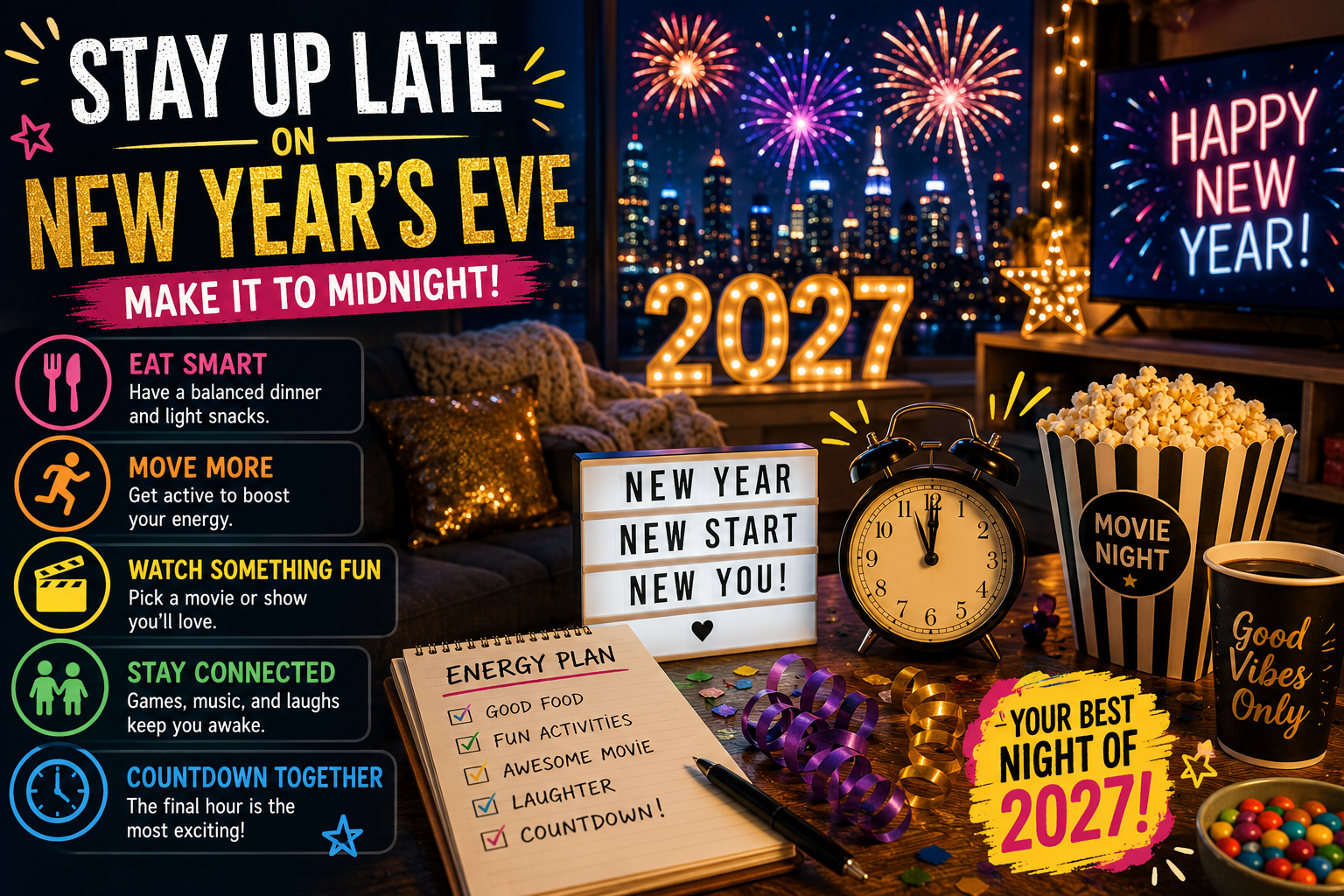
The problem usually isn’t a lack of willpower. It’s that the stretch between dinner and midnight is long, mostly unstructured, and easy to spend sitting still, which is exactly when people get sleepy. The fix is to break that stretch into shorter segments with different kinds of energy, eat normally instead of overeating late, save your most engaging activity for the hours you’re most likely to fade, and treat kids as a separate planning problem rather than smaller adults who just need more caffeine.
Below is a timeline you can actually follow, a set of movies chosen specifically for their ability to hold attention rather than because they’re set on New Year’s Eve, and a straightforward plan for what to do if the room starts nodding off at 10:30.
Why Midnight Feels So Far Away on New Year’s Eve
If your normal bedtime is somewhere around 9 or 10 p.m., midnight isn’t just “a bit later,” it’s two to three hours past when your body expects to wind down. That gap is even bigger for young children, whose bedtimes often land between 7 and 8:30 p.m. A 2025 discussion among parents of 7 and 10 year olds captured this exactly: midnight isn’t a stretch goal for a kid on an 8:30 schedule, it’s a different night entirely.
The usual advice, drink some coffee, take a nap, watch a movie, treats the evening as one long block of time to survive. That’s the actual problem. A single long stretch of low-stimulation waiting is what makes anyone drowsy, adults included. The better approach is to plan the evening in changing segments so no single stretch runs long enough for anyone to settle into sleep mode.
Build Your Evening Around Activity Changes, Not One Long Stretch of Waiting
Start With Dinner, Not a Huge Late-Night Meal
A heavy meal eaten late tends to bring on a slump rather than prevent one. Eating at a normal dinner hour, then having lighter snacks later in the evening, keeps blood sugar steadier than one large meal followed by hours of nothing.
Use Movement Before You Get Sleepy
Waiting until someone is already fading to suggest a walk or a dance break is too late. Movement works best as prevention. A short burst of activity an hour or two before the point where people usually start crashing does more than the same activity attempted after everyone’s already low-energy.
Save Your Most Engaging Activity for the Late Hours
Whatever is most likely to hold attention, a movie, a game, a group activity, works better scheduled for the hours right before the previous bedtime would have kicked in, not right after dinner when everyone’s still naturally alert.
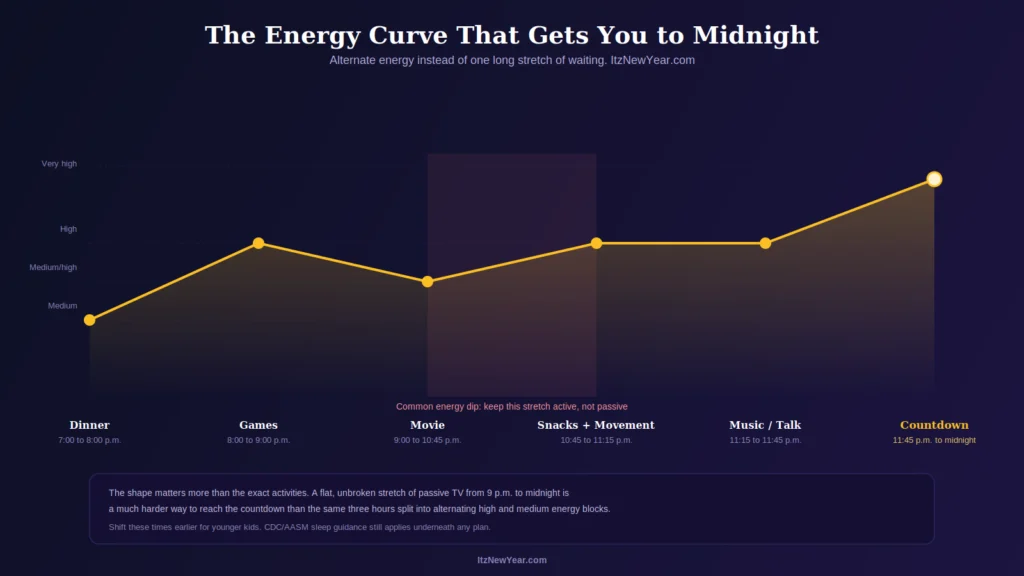
A New Year’s Eve Timeline That Can Carry You to Midnight
This is a starting framework, not a fixed schedule. Shift the times earlier or later depending on your household’s normal routine.
| Time | Activity | Energy level |
|---|---|---|
| 7:00 to 8:00 p.m. | Dinner | Medium |
| 8:00 to 9:00 p.m. | Games or a group activity | High |
| 9:00 to 10:45 p.m. | Movie | Medium to high |
| 10:45 to 11:15 p.m. | Snacks and movement | High |
| 11:15 to 11:45 p.m. | Music or conversation | High |
| 11:45 p.m. to midnight | Countdown preparation | Very high |
The pattern that matters more than any specific activity is the alternation itself: medium, high, medium, high. A flat evening of passive television from 9 p.m. to midnight is a much harder way to reach the countdown than the same three hours split across a movie, a break, and a final stretch of something social.
Movies That Actually Help Fill the Hours Before Midnight
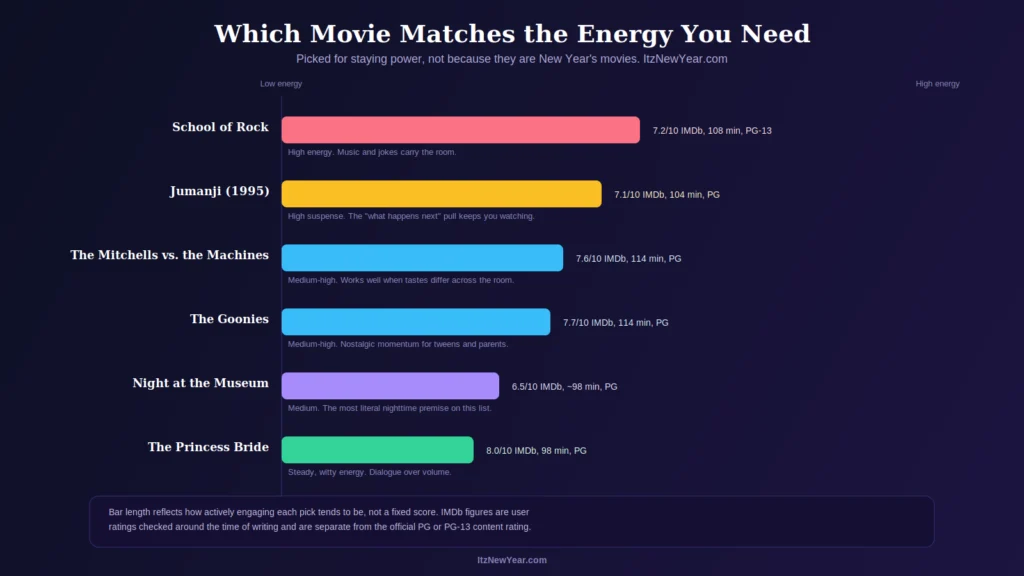
None of the movies below are New Year’s Eve stories. They’re picked for a different reason: they’re good at holding attention during the exact window when people start getting sleepy. If you want an actual New Year’s-themed movie, that’s a separate list; this one is built around momentum, humor, and runtime.
| Movie | IMDb rating | Runtime | Rating | Best for |
|---|---|---|---|---|
| Night at the Museum | 6.5/10 | ~98 min | PG | A late-evening family adventure |
| School of Rock | 7.2/10 | 108 min | PG-13 | High energy, music-driven fun |
| The Mitchells vs. the Machines | 7.6/10 | 114 min | PG | A group with very different tastes |
| Jumanji (1995) | 7.1/10 | 104 min | PG | Tweens, teens, and adults who want suspense |
| The Goonies | 7.7/10 | 114 min | PG | Tweens plus nostalgic parents |
| The Princess Bride | 8.0/10 | 98 min | PG | A witty, cross-generational pick |
IMDb ratings reflect user averages checked around the time of this writing and can shift over time; they’re not an official content rating.
Best for a Nighttime Adventure: Night at the Museum
A newly hired museum night guard discovers that the exhibits come alive after the building closes. IMDb lists it at 6.5 out of 10, rated PG, with a runtime around 98 to 100 minutes, checked at the time of this writing.
This is the most literal match for the keyword on this whole list: a movie about staying alert overnight while everything around the main character keeps moving. Common Sense Media rates it appropriate from around age 7, noting cartoonish action, some chasing and explosions, and imagery that can be intense for sensitive kids, alongside its generally lighthearted tone. It’s a solid choice for the 9 to 10:45 p.m. window in the timeline above.
As of this writing it’s listed on Disney+ in the U.S., with rental and purchase options also available; streaming placement shifts, so it’s worth a quick check before you sit down.
Best for Music and Energy: School of Rock
A struggling musician poses as a substitute teacher and turns his class into a rock band. IMDb rates it 7.2 out of 10, rated PG-13, runtime 108 minutes.
This is the pick when the room needs energy rather than atmosphere. Community discussion around the film consistently comes back to Jack Black’s performance and the music itself, both of which make it a poor choice for background viewing and a good one for people trying to stay actively engaged.
Common Sense Media recommends it from around age 10 and flags profanity, drug and alcohol references, and some sexual references that mostly go over younger kids’ heads but are worth knowing about beforehand. It also sets up a natural post-movie activity: let everyone pick a song for an impromptu living-room performance once the credits roll.
Best Modern Family Pick: The Mitchells vs. the Machines
A dysfunctional family’s road trip to drop their daughter off at college turns into an unlikely last line of defense against a robot uprising. IMDb rates it 7.6 out of 10, rated PG, runtime 114 minutes.
What sets this one apart from a typical animated action comedy is how consistently viewers describe the emotional payoff alongside the jokes, not just the jokes themselves. Recurring discussion highlights the father-daughter relationship and calls the film genuinely rewatchable rather than just funny once. If the household has very different tastes across ages, this is one of the more reliable ways to keep everyone actually watching instead of half-watching their phones.
Best Suspense Pick: Jumanji
Two siblings discover a magical board game that unleashes real jungle dangers into their house and frees a man who’s been trapped inside the game for decades. IMDb rates it 7.1 out of 10, rated PG, runtime 104 minutes.
Be honest with yourself about who’s in the room before choosing this one. Common Sense Media rates it from around age 10 and describes considerable peril, animal attacks, frightening imagery, and some language, which is a different profile than a gentle family movie even though it carries the same PG rating as several others on this list. The “what happens next” pull that makes it effective for staying awake is the same quality that makes it too intense for younger or more sensitive kids. It’s currently listed on Netflix in the U.S., with rental and purchase options as an alternative; check current availability before you plan around it.
Best Tween-and-Parent Classic: The Goonies
A group of kids finds a pirate treasure map and sets off to save their neighborhood from redevelopment. IMDb rates it 7.7 out of 10, rated PG, runtime 114 minutes.
This works less because of the plot and more because of who tends to enjoy it together: parents who grew up on it and tweens experiencing the treasure-hunt structure for the first time. Community discussion around the film leans heavily nostalgic, with people describing it as a genuine childhood favorite decades later rather than just a movie they remember existing.
Free, ad-supported options including The Roku Channel and Pluto TV currently carry it in the U.S., alongside the usual rental and purchase routes.
Best Witty Family Movie: The Princess Bride
A grandfather reads his grandson a story about a farm boy turned pirate trying to reunite with the woman he loves. IMDb rates it 8.0 out of 10, rated PG, runtime 98 minutes.
This is the choice for a household that wants dialogue and humor over action and volume. Its comedy is written to land with adults as much as kids, which is part of why it’s held up as a rewatch favorite across a wide age range rather than aging into “a kids’ movie” the way some 1980s titles have.
What to Do When You’re Still Awake but the Movie Is Over
A 9 p.m. movie ending around 10:45 leaves over an hour before the final countdown stretch, which is exactly the kind of unstructured gap that causes people to fade. A few options that keep the energy up without requiring much setup:
- A music round where everyone takes a turn picking a song, essentially a smaller version of the post-School of Rock idea above.
- A quick trivia round, using questions about the past year or about each other.
- A round of predictions for the coming year, written down now and reopened next December 31.
- A photo slideshow from the past year, which tends to generate more conversation than a scheduled activity would suggest.
- A short board game, which real accounts from parents suggest works better than more passive screen time during this stretch. One parent specifically remembered staying up until midnight playing a video game with their child as one of their best New Year’s Eves, and other families describe board games carrying a group straight through to the countdown.
Staying Up With Kids Is a Different Problem
An activity rotation helps everyone in the house, but it can’t override a child’s actual sleep needs, and treating it like it can is where a lot of New Year’s Eve plans go wrong.
Younger Children
The CDC recommends 10 to 13 hours of sleep for kids ages 3 to 5. For a child whose bedtime normally lands around 7 or 7:30 p.m., midnight isn’t a stretch, it’s roughly four to five hours past where their body expects to be asleep. An earlier celebration, covered below, is usually the better plan for this age group rather than trying to activity-rotate your way to local midnight.
Elementary-Age Children
This is where individual differences matter most. The CDC and the American Academy of Sleep Medicine both put the range for ages 6 to 12 at 9 to 12 hours. Some kids in this range genuinely want to try for midnight and can handle it with a rest beforehand and an engaging evening; others will fall asleep around 10 p.m. no matter how much fun they’re having, and that’s normal, not a failure of planning.
Recent parent discussions describe exactly this split: some children make it, some don’t, and forcing the ones who don’t tends to produce a miserable next morning rather than a memorable New Year’s Eve.
Tweens and Teens
The recommended range narrows to 8 to 10 hours for ages 13 to 17, and most teenagers can handle a later night better than a younger sibling can. That said, “can handle it” isn’t the same as “should do it every time.” The same activity rotation used for adults, games, a movie, movement, conversation, tends to work well for this age group without much modification.
What If Everyone Starts Falling Asleep at 10:30?
Treat this as a normal part of the evening rather than a sign the plan failed. A few things actually help in the moment:
- Change the activity immediately rather than trying to push through the current one. If the movie is losing the room, pause it.
- Get people standing up. A few minutes of movement does more at this point than food or drinks.
- Put on music people know. Familiar songs tend to re-engage a tired room faster than starting something new.
- Offer a small snack rather than a full second meal, which risks making the slump worse.
- If it’s a child who’s genuinely exhausted rather than just bored, let them go to bed. Forcing a child who is clearly done isn’t going to produce a better outcome than an earlier celebration would have.
You Don’t Have to Wait for Your Own Midnight
If local midnight is realistically too late for the kids in your house, celebrating a different time zone’s countdown solves the problem without cutting anyone out of the moment. Parents commonly use an earlier region’s live countdown coverage, footage from a past year’s celebration, or simply agreeing as a family that “midnight” happens at 8 or 9 p.m. this year.
None of that makes the celebration less real for a child who’s genuinely excited about a countdown and less concerned with whether the clock matches everyone else’s.
Frequently Asked Questions
Is it okay for kids to stay up until midnight on New Year’s Eve?
It depends heavily on the individual child and their age. Elementary-age kids vary a lot in how they handle a late night, and some will comfortably make it to midnight while others fall asleep well before, regardless of how engaging the evening is. Younger children, especially those under 6, are usually better served by an earlier celebration than by being pushed to stay up several hours past their normal bedtime.
What time should younger kids celebrate New Year’s?
There’s no fixed answer, but many families with young children pick a time that lines up closer to a normal bedtime routine, often somewhere in the 7 to 9 p.m. range, and treat that as their household’s countdown moment rather than waiting for actual local midnight.
What can I watch while waiting for midnight?
A movie with real momentum works better than something passive. Night at the Museum, School of Rock, The Mitchells vs. the Machines, Jumanji, The Goonies, and The Princess Bride each hold attention differently, from suspense to music-driven energy to dialogue-heavy humor, so the right pick depends more on your group’s mood than on the movie being New Year’s themed.
How do I stay awake without relying on caffeine?
Breaking the evening into shorter segments with alternating energy levels, food, activity, a movie, movement, does more than caffeine alone. Caffeine can help, but it doesn’t fix an evening that’s otherwise one long stretch of sitting still, which is the actual cause of the slump for most people.
Leave a Reply
You must be logged in to post a comment.