
No, modern Japan does not celebrate Lunar New Year as its nationwide New Year holiday. Japan’s official New Year’s Day is January 1, under the Gregorian calendar. However, some lunar-calendar traditions still survive in parts of Okinawa, and Chinese New Year is celebrated by Chinese communities and at cultural festivals in several Japanese cities.
That’s the short version. The longer answer involves a calendar reform from more than 150 years ago, one region that never fully let go of the old system, and a handful of Chinatowns that celebrate a completely different New Year from the rest of the country.
Does Japan Celebrate Lunar New Year?
Japan’s national New Year’s Day falls on January 1 every year, following the Gregorian calendar used across most of the world. This holiday is called Oshogatsu, and it’s the one Japan observes with public holidays, family gatherings, and shrine visits.
Lunar New Year, the holiday tied to the first new moon of the lunar calendar and observed in China, Vietnam, South Korea, and elsewhere, is not Japan’s national New Year celebration. Japan used to follow a lunisolar calendar of its own, but that system was officially replaced well over a century ago.
That said, “Japan doesn’t celebrate Lunar New Year” isn’t the full picture either. A handful of communities in Okinawa still mark the old lunar New Year, and Chinese New Year is actively celebrated in specific Japanese cities. The rest of this guide breaks down exactly where and how.
When Did Japan Stop Celebrating New Year by the Lunar Calendar?
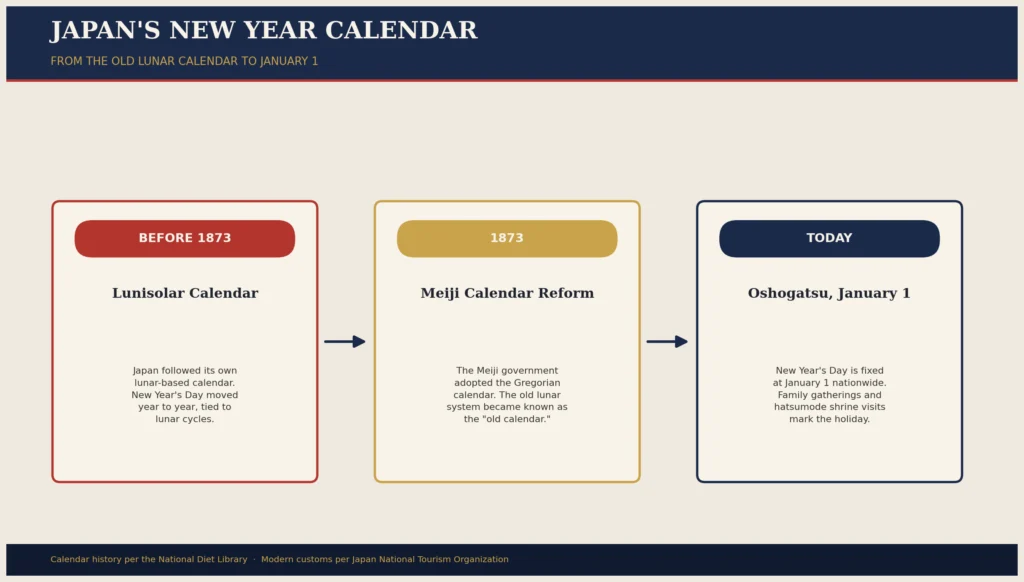
Japan historically used a lunisolar calendar, similar in structure to the traditional Chinese calendar, where months followed the moon and New Year’s Day shifted around based on lunar cycles.
That changed during the Meiji era. The National Diet Library’s historical calendar records confirm that Japan adopted the Gregorian calendar in Meiji 6, which corresponds to 1873. The older lunisolar system became known afterward as the “old calendar.” Once the switch took effect, January 1 became Japan’s fixed, official New Year’s Day, replacing the moving lunar date the country had followed for centuries.
This single reform is the reason Japan’s New Year no longer shifts each year the way Lunar New Year does in other countries. It’s a fixed calendar date now, not a lunar one.
Why Does Japan Celebrate New Year on January 1?
Since the 1873 reform, January 1 has been Japan’s official New Year’s Day under the Gregorian calendar, and it remains a national holiday today.
Modern Oshogatsu traditions built up around this fixed date include:
- Family gatherings and reunion meals
- Hatsumode, the first shrine or temple visit of the year
- Traditional New Year foods, such as osechi ryori
- New Year decorations placed at homes and entrances
- Watching or welcoming the year’s first sunrise
The Japan National Tourism Organization lists January 1 as Japan’s New Year’s Day and describes it as one of the country’s most important family holidays, centered on these customs rather than on any lunar calendar observance.
Does Anyone in Japan Still Celebrate Lunar New Year?
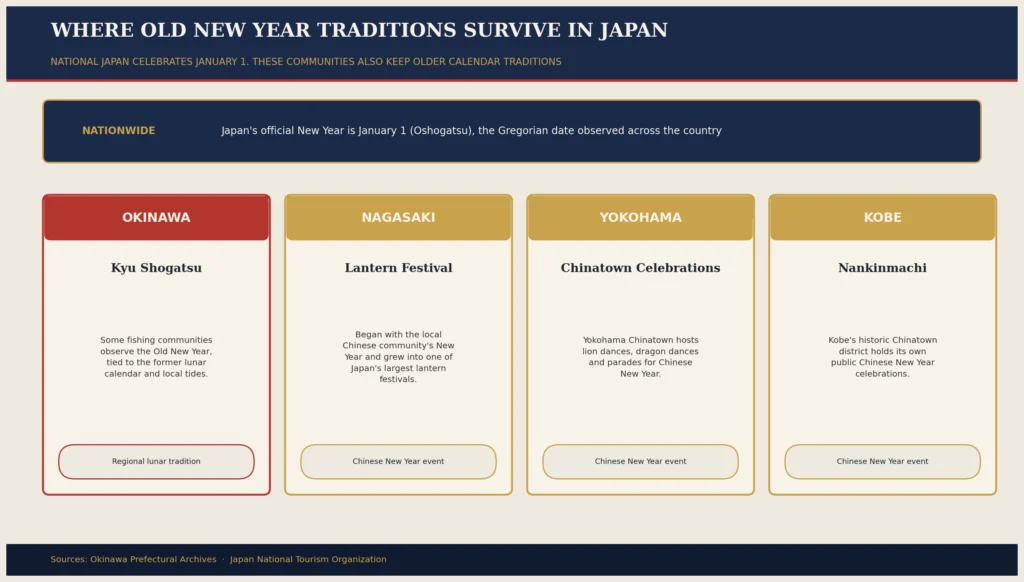
Yes. Some communities in Japan continue lunar-calendar New Year traditions, but this is not a nationwide Japanese holiday. The clearest example is in Okinawa.
Okinawa’s Kyu Shogatsu Tradition
Kyu Shogatsu translates to “Old New Year,” and it refers to a New Year observance tied to the old lunar calendar rather than January 1.
The Okinawa Prefectural Archives documents that some communities in Okinawa, particularly fishing villages, have continued to observe Kyu Shogatsu. The tradition has historically been connected to the lunar calendar’s relationship with tides, which matters directly to communities whose livelihoods depend on the sea.
It’s important not to overstate this. Kyu Shogatsu isn’t practiced uniformly across Okinawa, let alone across Japan. It’s accurate to say that some communities in Okinawa continue traditions associated with the old lunar New Year, rather than claiming Okinawa as a whole celebrates Lunar New Year the way China or Vietnam does.
Does Japan Celebrate Chinese New Year?
This is a separate question from Kyu Shogatsu, and it has a separate answer. Chinese New Year celebrations in Japan come from Chinese communities and cultural districts, not from a national adoption of the Chinese calendar.
A few Japanese cities host well-known public Chinese New Year events:
| City | Event | Notes |
|---|---|---|
| Nagasaki | Nagasaki Lantern Festival | JNTO describes it as originating with local Chinese residents celebrating Chinese New Year, later growing into one of Japan’s largest lantern festivals |
| Yokohama | Yokohama Chinatown celebrations | JNTO notes lion and dragon dances and parades during Chinese New Year |
| Kobe | Nankinmachi Chinese New Year celebrations | JNTO highlights festivities in Kobe’s historic Chinatown district |
These events draw large crowds and are genuinely major festivals in their cities. But they reflect the traditions of local Chinese communities and cultural tourism, not a shift in Japan’s national New Year holiday.
What Is Japanese New Year Called?
Japan’s New Year is called Oshogatsu, sometimes written O-Shogatsu. The Japan National Tourism Organization describes it as the term for New Year and its associated customs, tied firmly to the January 1 Gregorian date rather than any lunar calculation.
Oshogatsu customs center on family time, seasonal food, and shrine or temple visits, rather than the reunion dinners and lunar zodiac symbolism associated with Lunar New Year in China or Vietnam.
How Is Japanese New Year Different From Lunar New Year?
The two holidays share the idea of a fresh start, but the mechanics behind them are different in almost every respect.
| Feature | Japanese New Year (Oshogatsu) | Lunar New Year |
|---|---|---|
| Date | January 1, fixed every year | Changes annually with the lunar calendar |
| Calendar system | Gregorian | Lunar or lunisolar, depending on the culture |
| National status in Japan | Official national holiday | Not Japan’s national New Year |
| Historical background | Replaced Japan’s older lunisolar calendar in 1873 | Still actively used to set New Year in several countries |
| Regional exception | None nationally | Okinawa’s Kyu Shogatsu follows old-calendar timing |
Where Can You See Lunar or Chinese New Year Celebrations in Japan?
If you’re looking for actual lunar or Chinese New Year observances inside Japan, a few specific places are where it happens:
- Okinawa: select communities, especially fishing villages, observe Kyu Shogatsu around the old lunar New Year date
- Nagasaki: the Nagasaki Lantern Festival, rooted in the local Chinese community’s Chinese New Year celebrations
- Yokohama: Yokohama Chinatown hosts parades, lion dances, and dragon dances for Chinese New Year
- Kobe: Nankinmachi, Kobe’s Chinatown district, holds its own Chinese New Year festivities
Outside these specific communities and districts, Lunar New Year isn’t part of how most of Japan marks the New Year.
What Do People in Japan Do for New Year?
For the vast majority of the country, New Year centers on January 1 and the days immediately around it. Common customs include family reunions, hatsumode visits to a shrine or temple, eating traditional New Year foods, displaying seasonal decorations, and watching the year’s first sunrise. These practices are part of Oshogatsu, not Lunar New Year, and they happen on a fixed Gregorian date rather than a shifting lunar one.
Frequently Asked Questions
Is Lunar New Year a holiday in Japan?
No. Lunar New Year is not a national holiday in Japan. Japan’s official New Year’s Day is January 1.
What New Year does Japan celebrate?
Japan celebrates Oshogatsu, its New Year holiday, on January 1 under the Gregorian calendar.
Why doesn’t Japan celebrate Lunar New Year?
Japan replaced its older lunisolar calendar with the Gregorian calendar in 1873, which fixed New Year’s Day at January 1 instead of a shifting lunar date.
When did Japan stop using the lunar calendar?
Japan officially adopted the Gregorian calendar in 1873, during the Meiji era, according to the National Diet Library’s historical records.
Does Okinawa celebrate Lunar New Year?
Some communities in Okinawa, particularly fishing villages, continue Kyu Shogatsu, a New Year tradition tied to the old lunar calendar. It is not observed uniformly across the entire prefecture.
What is Kyu Shogatsu?
Kyu Shogatsu means “Old New Year.” It refers to New Year traditions based on Japan’s former lunisolar calendar, still observed by some communities, mainly in Okinawa.
Does Japan celebrate Chinese New Year?
Chinese communities and cultural districts in cities such as Nagasaki, Yokohama, and Kobe hold public Chinese New Year celebrations, though it isn’t Japan’s national New Year holiday.
Is Chinese New Year a national holiday in Japan?
No. Chinese New Year is not a national holiday in Japan. It is celebrated locally within Chinese communities and at cultural festivals.
What is Japanese New Year called?
Japanese New Year is called Oshogatsu, observed on January 1.
Where can you see Chinese New Year celebrations in Japan?
The most prominent public Chinese New Year celebrations in Japan take place in Nagasaki (the Nagasaki Lantern Festival), Yokohama Chinatown, and Kobe’s Nankinmachi district.
Leave a Reply
You must be logged in to post a comment.