
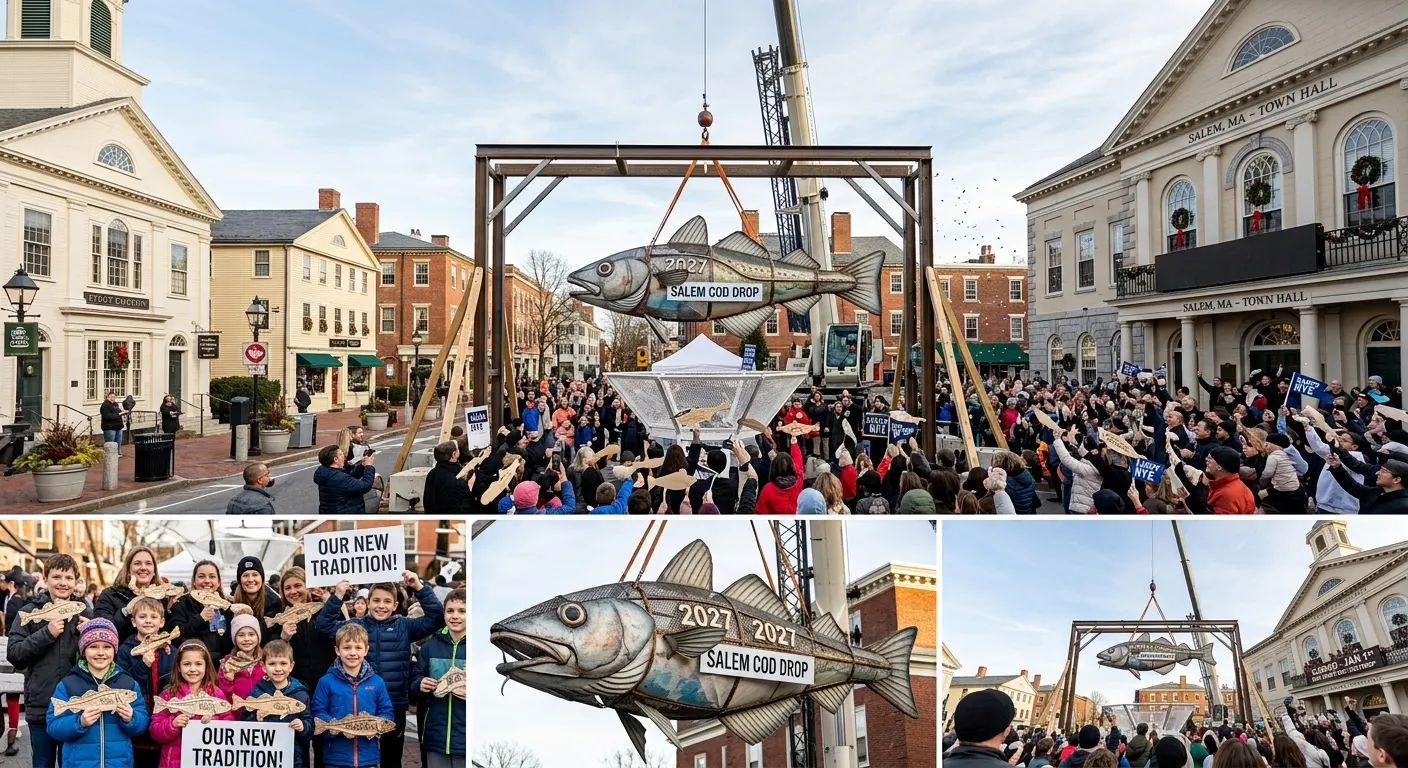
Because a lot of pages online will tell you otherwise: Massachusetts doesn’t drop anything on New Year’s Eve. There’s no giant peach like Atlanta, no potato like Boise, no shoe descending over a bar like Key West.
If you’ve seen a claim online about Boston dropping a “giant illuminated snow globe” or Plymouth dropping a replica of Plymouth Rock into the harbor, that’s not a real tradition, it appears to be an invented detail from a low-quality content site, and it doesn’t show up in any actual event listing, news coverage, or official source covering the state’s New Year’s celebrations.
What Massachusetts actually has instead is arguably a bigger deal than a novelty drop: Boston’s First Night, one of the largest, oldest, and most influential New Year’s Eve celebrations in the entire country, built entirely around fireworks, art, and public performance rather than a single object falling from a pole.
Here’s the real story of what Massachusetts does for New Year’s, why it skipped the drop trend other cities embraced, and where you can actually find a literal ball drop if that’s specifically what you’re looking for.
Why Boston Never Adopted a Ball Drop
The “drop” tradition, in its most famous form, comes from New York’s Times Square ball, which has descended at midnight since 1907.
Plenty of other cities and towns across the US have since built their own novelty version of it: Atlanta drops an 800-pound fiberglass peach, Boise drops a giant potato, Key West drops both a giant conch shell off a bar Ernest Hemingway used to frequent and, separately, a drag queen inside a ruby slipper, and Mobile, Alabama drops a 600-pound MoonPie.
These are fun, but they’re fundamentally novelty acts, a local landmark or local food turned into a spectacle purely because Times Square did it first with a ball.
Boston took a different path entirely, and it did it earlier than most of these novelty drops even existed. In 1976, a group of local artists launched First Night Boston, an alcohol-free, family-friendly celebration built around visual art, live performance, ice sculpture, and fireworks instead of a countdown gimmick.
It’s widely credited as the original event that launched the broader “First Night” concept, which other cities across the US and beyond later adopted and adapted for their own New Year’s celebrations. Boston wasn’t copying a drop tradition. It was building the template that other cities’ arts-focused New Year’s events would eventually copy from Boston instead.
First Night Boston: The State’s Real New Year’s Tradition
First Night Boston is the actual answer to what Massachusetts does on December 31st, and it’s a genuinely massive event, regularly drawing over a million people into the city across the day. It’s free and open to the public, has been since 2015, and runs from mid-morning on New Year’s Eve straight through to just after midnight.
The celebration marked its 50th anniversary heading into 2026, having relocated its main hub to City Hall Plaza a few years back after decades centered around Copley Square and Boston Common.
The day’s programming is genuinely packed. Live performances run more or less nonstop at City Hall Plaza starting in the early afternoon, covering everything from classical music and figure skating to pop and hip-hop acts, alongside family-friendly activities earlier in the day like archery lessons on Boston Common and ice skating shows at the Frog Pond. Boston’s mayor traditionally appears at the Main Stage in the early evening to officially welcome the crowd into the celebration.
The Two Fireworks Shows That Actually Anchor the Night
Since there’s no object drop, fireworks do the job of marking the transition into midnight, and Boston actually runs two separate displays rather than just one. An early show, timed for around 7pm, goes off over Boston Common specifically so families with younger kids can watch a real fireworks display without needing to stay out until midnight.
Then, right at midnight, a second, larger show launches over Boston Harbor, visible from the waterfront between the North End and East Boston, with an additional pyrotechnic display timed to the same moment in Copley Square.
That midnight harbor show has its own long history, run in partnership with Boston Harbor Now and local waterfront organizations, and it’s become almost as central to the identity of Boston’s New Year’s as the daytime festival itself. If you’re trying to answer “what does Boston do at midnight on New Year’s,” fireworks over the harbor is the real answer, not a falling object.
Ice Sculptures, a Parade, and Everything Else First Night Brings
Beyond the fireworks, First Night leans hard into visual art as its signature element, which tracks with its origins as an arts collective’s idea in the first place.
Elaborate ice sculptures, often depicting famous landmarks or seasonal themes, get installed across multiple neighborhoods each year, including East Boston, Charlestown, the Seaport, South Boston, Revere, and Downtown, along with additional sculptures around Back Bay near the Boston Public Library.
Wandering between sculpture locations, sometimes called an Ice Sculpture Stroll, has become its own mini-tradition within the bigger event.
The other signature piece is the People’s Procession, a parade that marches from Copley Square up Boylston Street to Boston Common, usually starting in the early evening hours before the midnight fireworks. It’s less a formal parade with floats and more a community march, open to anyone who wants to walk along, which fits the event’s original spirit of being participatory rather than something you just watch from the sidelines.
Where the “First Night” Concept Actually Started
It’s worth sitting with this for a second, because it reframes the whole “what does Massachusetts drop” question. Boston‘s First Night wasn’t inspired by an earlier drop tradition somewhere else. It was founded specifically as an alternative to rowdier, alcohol-centered New Year’s parties, with a small group of Boston-based artists building a celebration around public art installations and performance instead.
The idea worked well enough, and drew crowds consistently enough, that dozens of other American cities eventually launched their own “First Night” events explicitly modeled on Boston’s, an arts-first template that spread across the country over the following decades, long before peach drops and potato drops became their own separate trend entirely.
So in a real sense, Massachusetts didn’t skip the “drop” trend by falling behind everyone else. It built an entirely different, earlier tradition that a lot of other cities’ non-drop New Year’s events actually trace back to.
The One Real Ball Drop You Can Actually Find in Massachusetts
If you’re specifically looking for something that functions like a ball drop within Massachusetts, there is one, it’s just aimed at a much younger crowd and happens hours before midnight.
The EcoTarium, a science and nature museum in Worcester, runs an annual “Noon Year’s Eve” event every December 31st, complete with a genuine kid-friendly countdown and ball drop at 12:00 pm, timed so families with young children can celebrate a “new year” without needing to stay up anywhere near midnight.
Past years have even featured two separate drops, one at 10am and another in the early afternoon, alongside other activities like building a time capsule, launching a rocket, and adding to a resolution wall.
It’s a genuinely charming, well-attended local event, and it’s the closest thing Massachusetts has to an actual object descending on a countdown. It’s just a museum program built for toddlers and elementary-age kids, not a citywide spectacle the way Atlanta’s peach or Boise’s potato are.
Other Noon Year’s Drops Around the State
The EcoTarium isn’t alone. Across Central Massachusetts specifically, a whole cluster of libraries, museums, and family venues run their own small-scale “Noon Year’s Eve” events every December 31st, each with some version of a ball or balloon drop at noon instead of midnight. The Discovery Museum in Acton runs a “Noon Year’s Eve” with a ball drop after a countdown built around party hats and noisemakers.
The Woods Memorial Library in Barre hosts a similar countdown with crafts and a ball drop right at noon. Webster’s Gladys E. Kelly Public Library runs a countdown that ends in a balloon drop, and Shrewsbury’s public library runs its own version aimed at families with younger kids.
None of these are the singular, famous “Massachusetts drop” the way a search for that phrase might imply exists somewhere. They’re a genuinely nice pattern across the state though: family venues giving young kids a real countdown-and-drop moment they’re too young to experience at an actual midnight celebration.
How Massachusetts Actually Compares to States With a Signature Drop
It helps to see the contrast directly. A handful of American cities and towns have built an entire New Year’s identity around one specific object falling at midnight:
Atlanta drops an 800-pound fiberglass and foam peach at its Peach Drop celebration in the Underground Atlanta district, tying the object directly to the state’s most famous crop. Boise runs the Idaho Potato Drop, dropping a giant illuminated potato as the centerpiece of a broader winter festival, again tying the object to the state’s signature product.
Key West runs two separate, competing drops on the same night, a giant conch shell descending from the roof of Sloppy Joe’s Bar, and a massive ruby slipper carrying a drag performer down over Duval Street at a different bar. Mobile, Alabama drops a 600-pound MoonPie, a nod to the snack’s deep Southern roots, complete with a daytime kid-friendly version and a bigger midnight version.
Massachusetts never built anything like this, and the EcoTarium’s noon ball drop aside, there isn’t a food, landmark, or local product that’s become a symbolic object for the state to drop at midnight. Instead, the state’s flagship celebration invested in fireworks, live performance, and public art as its identity from the very beginning, which is arguably a harder tradition to sum up in a single viral photo, but a genuinely more substantial one to actually attend.
Practical Info If You’re Planning to Attend
If First Night Boston is what actually brought you here, a few practical details are worth knowing. The event is completely free, though donations are accepted to help fund it, and no tickets or registration are required for the main outdoor programming.
Public transit is a smart way to get in and out of the city that night: the MBTA runs free after 8pm on New Year’s Eve specifically for this event, with extended service and later last trains than usual, typically departing sometime between 1:45am and 2:50am, to accommodate everyone leaving after the midnight fireworks.
Programming generally kicks off as early as 10am with family-focused activities, ramps up through the afternoon with performances at City Hall Plaza, and builds toward the People’s Procession in the early evening before the two fireworks shows close out the night, the family-friendly 7pm display over Boston Common and the main midnight show over the harbor.
If you’re bringing younger kids who won’t make it to midnight, the 7pm fireworks give you a real, satisfying New Year’s moment without needing to stay out that late, similar in spirit to what the EcoTarium’s noon drop offers families in Worcester.
A Quick Takeaway
So Massachusetts drops nothing on NYE, at least not in the way Atlanta drops a peach or Key West drops a shoe.
What Massachusetts actually has is First Night Boston, a genuinely original, arts-driven celebration that predates most of the country’s novelty drop trend and, in a real sense, helped inspire the non-drop alternative that a lot of other cities eventually built their own New Year’s events around. If a literal ball drop is specifically what you’re after, Worcester’s EcoTarium has you covered, just don’t expect it at midnight, and don’t expect it to be the size of a peach.
Leave a Reply
You must be logged in to post a comment.