

Heartbreak does not check the calendar before it shows up, and it does not politely disappear just because the date changes to January 1. If you are heading into 2027 with a broken heart, the pressure to “start fresh” can feel less like motivation and more like one more thing you are failing at.
Good New Year’s resolutions after a breakup are not about proving you are over someone. They focus on rebuilding routines, confidence, friendships, boundaries, and a sense of identity that belongs to you again, not on forcing yourself to stop feeling sad or pretending the relationship never mattered.
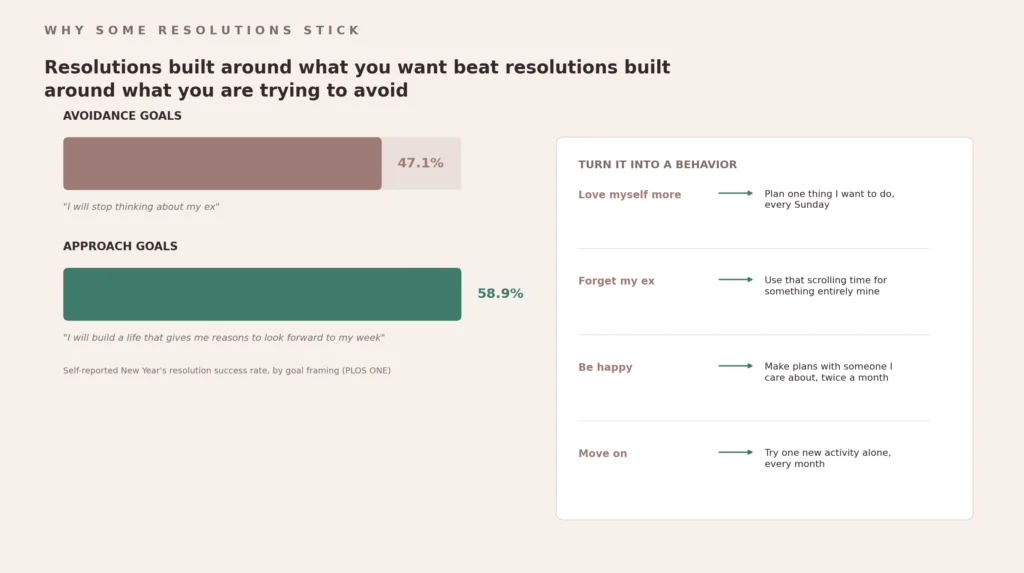
That distinction changes how you should set goals this year. A large study published in PLOS ONE, tracking over a thousand resolution-setters, found that people who framed their goals around what they wanted to move toward (approach-oriented resolutions) succeeded at a noticeably higher rate: 58.9%, compared with 47.1% for goals built around avoidance, like “stop thinking about my ex.”
That single finding is the backbone of this article. Instead of another generic list of things to do after a breakup, here is a framework built around where you actually are in the healing process, followed by 15 resolutions you can choose from depending on what you need right now.
A Framework for Choosing Resolutions That Actually Fit
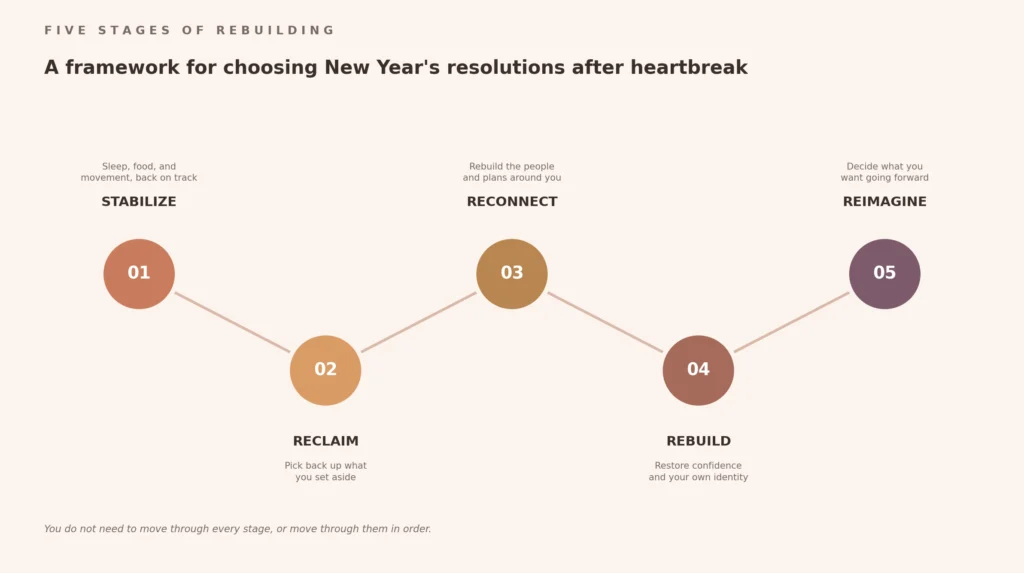
Not every resolution suits every stage of heartbreak. Someone three days out of a breakup needs different goals than someone six months in. Rather than handing you one giant list and hoping something sticks, it helps to think in five stages:
- Stabilize: get your basic routines and wellbeing back on track
- Reclaim: pick back up the parts of your life you set aside
- Reconnect: rebuild the relationships that got sidelined
- Rebuild: restore confidence and a sense of identity
- Reimagine: think about what you want going forward, including love
You do not need to move through these in order, and you do not need to complete all five in January. Pick the stage that matches where you are, and choose one or two resolutions from it.
Resolutions for the Early Days
If the breakup is recent, ambitious goals are the wrong tool. What actually helps here is small and unglamorous.
Make basic functioning the goal, not a bonus
Eating regularly, sleeping on some kind of schedule, and getting outside for a few minutes a day sound too simple to count as resolutions. After a breakup, they are not simple at all, and getting them right is genuinely worth committing to before anything bigger.
Let yourself feel it without building a home there
There is a real difference between acknowledging that you are hurting and letting the hurt become your whole personality. Cry when you need to, talk about it when you need to, then let some part of your day exist outside the breakup too.
Pick one person you can actually lean on
You do not need an entire support network by February. Research on relationship dissolution consistently points to social support as one of the biggest factors in how well people cope, and that can start with a single friend you check in with regularly.
Stop Organizing Your Life Around Your Ex
This is where most heartbreak resolutions quietly fail, because “stop thinking about them” is not something you can will yourself into. What works instead is changing the behaviors that keep feeding the loop.
Set boundaries on their social media, not a total ban
Instead of promising yourself you will never look, which rarely survives a bad night, try muting, unfollowing, or deleting the app for a set period. Give yourself something else to reach for when your thumb wants to check their profile.
Stop using their life as your scoreboard
“Are they doing better than me?” is not a useful question, and it never has an honest answer anyway. Their timeline says nothing real about how either of you is actually doing.
Redirect the mental energy somewhere else, on purpose
Rumination, the habit of replaying the breakup over and over, has been linked in psychological research to slower emotional recovery. The fix is not forcing your brain to stop; it is giving that energy somewhere to go: a project, a workout, a hobby, a conversation with a friend.
Find Yourself Again
Relationships have a way of quietly shrinking your world. Part of healing is making it bigger again.
Pick back up something you dropped
Music, sports, reading, cooking, travel, whatever it was that got pushed aside without you fully noticing. Reclaiming it is not nostalgic, it is practical: it hands you back a piece of identity that was never about the relationship in the first place.
Try one new thing a month
New experiences do more than fill time. They build real evidence that your life still has room to grow, which is hard to argue with even on your worst days.
Spend time alone on purpose
Being single is not a waiting room, and solitude is not the same as loneliness. A dinner out, a solo trip, or an afternoon with a book by yourself is worth trying, even if it feels strange at first.
Rebuild Confidence
Breakups are rough on self-esteem, especially when self-blame is involved. A few small, repeatable habits do more here than any single grand gesture.
Keep the promises you make to yourself
Book the appointment. Finish the workout. Show up to the thing you said you would show up to. Confidence rebuilds through a track record, not through motivation.
Practice self-compassion instead of rewriting yourself as the villain
Research on breakup adjustment has found that self-compassion is associated with better emotional outcomes, particularly for people who tend to blame themselves for what happened. That does not mean skipping accountability; it means not turning a breakup into permanent proof that something is wrong with you.
Write it down without turning it into self-punishment
A simple three-column exercise works well here:
| What happened | What I learned | What I want next time |
|---|---|---|
| Example: I ignored some early warning signs | I want to trust my instincts sooner | Pay attention when something feels off from the start |
This is a reflection tool, not therapy, and it should feel clarifying, not like another way to blame yourself.
Love, Dating, and What Comes Next
Do not make “find someone new” your resolution
Dating can be part of your year, but it should never be the deadline you are racing toward to prove you have healed. Healing that depends on someone else showing up is not really healing.
Get clear on what you actually want next time
Trust, respect, communication, compatibility, and boundaries are worth thinking through now, while you have some distance, rather than figuring them out mid-relationship again.
Give yourself permission to wait
There is no schedule that says you should be ready to date by a certain month. Being single in 2027 is not a sign you are behind.
Making a Resolution You Can Actually Keep
The difference between a resolution that lasts and one that quietly dies by February usually comes down to how specific it is. Vague, feeling-based goals are hard to act on. Behavioral ones are not.
| Vague resolution | Actionable version |
|---|---|
| Love myself more | Spend 30 minutes every Sunday planning one thing I genuinely want to do that week |
| Forget my ex | Stop checking their social media and use that time for something entirely mine |
| Be happy | Make plans with someone I care about at least twice a month |
| Move on | Try one new activity by myself every month |
| Get over the breakup | Keep one weekly commitment to myself, no matter how small |
Approach-oriented goals like these, framed around what you are building rather than what you are trying to suppress, are the ones the research says actually stick.
Fifteen Resolutions for a Broken Heart
Use this as a quick reference once you know which stage you are working from. Pick two or three, not all fifteen.
| Stage | Resolution |
|---|---|
| Stabilize | Put sleep, food, and movement back on a basic schedule |
| Stabilize | Reach out to one trusted person on a regular basis |
| Reclaim | Pick back up one hobby or interest you set aside |
| Reclaim | Try one new activity on your own each month |
| Reclaim | Build one weekly ritual that has nothing to do with the relationship |
| Reconnect | Set clear boundaries around checking your ex’s social media |
| Reconnect | Make plans with a friend at least twice a month |
| Reconnect | Stop measuring your progress against your ex’s life |
| Rebuild | Keep one small promise to yourself every week |
| Rebuild | Practice self-compassion instead of self-blame |
| Rebuild | Write down what the relationship taught you, once, and close the page |
| Rebuild | Build a life that does not depend on someone else’s validation |
| Reimagine | Define what you want from a future relationship, on your own terms |
| Reimagine | Wait to date until you actually want to, not on a deadline |
| Reimagine | Choose steady progress over pretending you are already fine |
What If You Are Still Heartbroken in January?
That does not mean you have failed at this. Recovery after a breakup does not move in a straight line, and research tracking people over months after a split has found several different recovery patterns: some fast, some slow, some uneven. None of them are wrong.
Missing your ex in February does not cancel out the progress you made in January. A resolution can flex. Small, repeated effort still counts, even on the days it does not feel like it.
When Heartbreak Needs More Support
Most heartbreak, even the intense kind, is a normal and painful part of life rather than a clinical problem. That said, if the distress becomes persistent, overwhelming, or starts interfering with your ability to function day to day (work, sleep, relationships), that is worth bringing to a professional. Needing more support is not a sign of weakness, and it does not mean something is fundamentally wrong with you.
FAQs
What are the best New Year’s resolutions for broken hearted?
The strongest ones focus on rebuilding your routines, confidence, friendships, boundaries, and sense of identity, rather than forcing yourself to forget your ex or “get over it” by a certain date.
How do I start the new year after a breakup?
Start small. Stabilize the basics first (sleep, food, one supportive person), then build from there as you have the emotional bandwidth.
Should getting over my ex be my resolution?
Not really; it is too vague to act on. Replace it with specific behaviors, like limiting how often you check their social media or scheduling activities that are entirely your own.
Is it a good idea to start dating again in the new year?
Only if you actually want to. Dating is optional, not a requirement for proving you have healed, and there is no correct timeline for being ready.
What if I still miss my ex when the year begins?
That is normal, and it does not undo any progress you have already made. Missing someone and rebuilding your life are not mutually exclusive.
How do I make a resolution I will actually keep?
Make it specific and behavior-based rather than emotion-based, keep it realistic, and connect it to something you genuinely want, not something meant to impress anyone, including your ex.
When should I seek professional help after a breakup?
If the sadness, anger, or self-blame becomes persistent, severe, or starts affecting your daily functioning over an extended period, a therapist or counselor can help you work through it properly.
Where This Leaves You
The point of a New Year’s resolution after heartbreak was never to prove the relationship did not matter. It is to make the coming year increasingly, unmistakably yours, one small, specific commitment at a time.
Leave a Reply
You must be logged in to post a comment.