
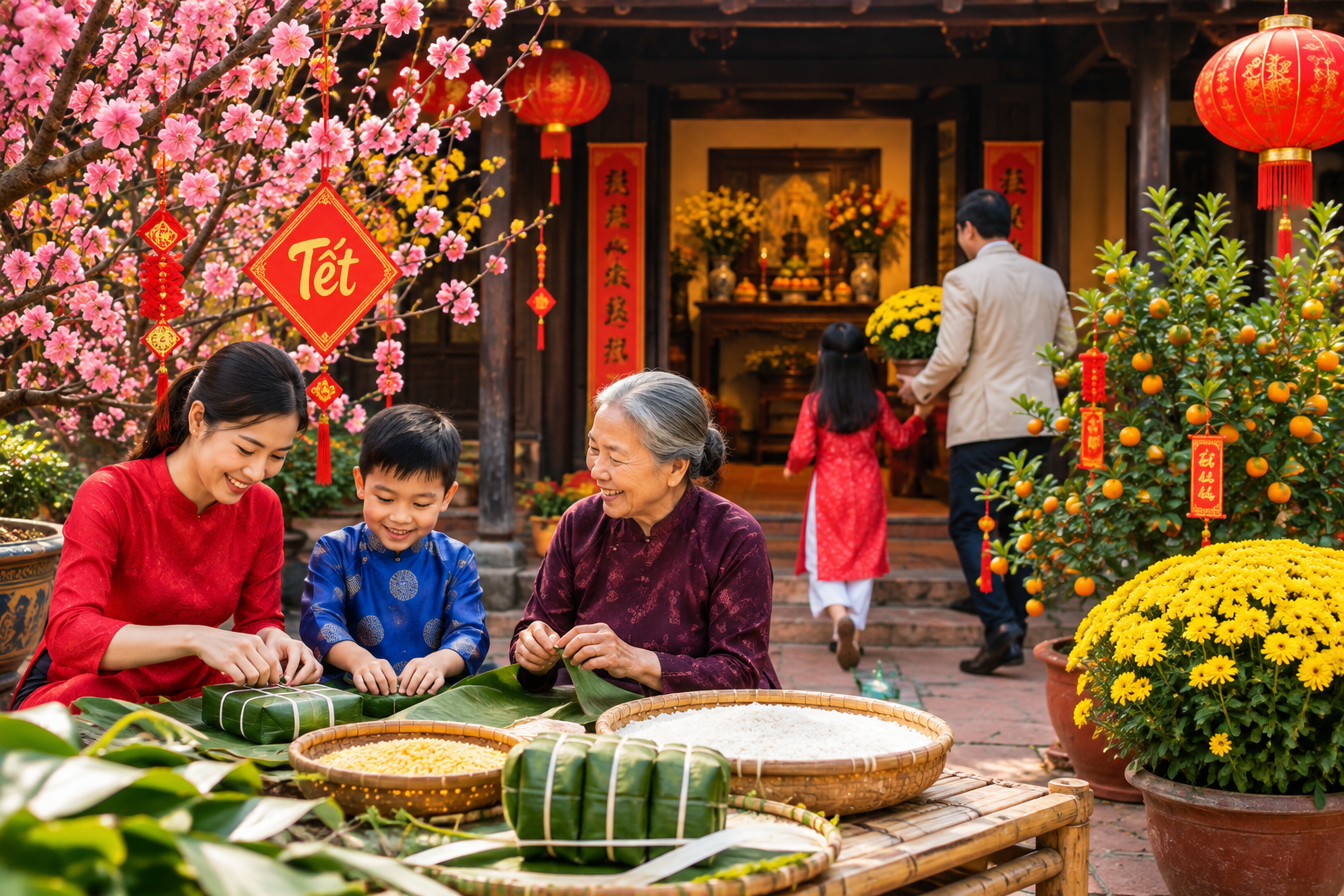
Vietnam celebrates Lunar New Year, called Tết Nguyên Đán (or simply Tết), as its most important holiday of the year. Families clean and decorate their homes, prepare traditional foods, and buy flowers in the days beforehand. Once Tết arrives, people reunite with relatives, honor their ancestors, exchange New Year’s greetings, give lucky money to children and elders, visit family and friends, and follow customs meant to bring good luck into the year ahead.
Tết isn’t a single day of fireworks and parties. It’s a stretch of preparation, reunion, and ritual that shapes daily life across the country for roughly a week, and its meaning runs deeper than the decorations suggest.
What Is Tết, Vietnam’s Lunar New Year?
Tết Nguyên Đán translates roughly to “Feast of the First Morning,” and it marks the start of the new year on the Vietnamese lunar calendar. Depending on the year, it falls sometime between late January and mid-February on the Gregorian calendar, and the date shifts because it’s tied to the lunar cycle rather than a fixed calendar day.
Vietnam’s National Authority of Tourism describes Tết as the country’s most significant celebration, one built around family reunion, ancestor veneration, and hope for the coming year. Schools and many businesses close for several days, sometimes closer to a week, and millions of people travel back to their hometowns, often creating some of the heaviest travel congestion of the year.
At its core, Tết is a family holiday first and a public celebration second. The public displays, flower markets, fireworks, and festival lights are real, but they sit around a private center: households coming together, remembering relatives who have passed, and hoping to start the year on solid footing.
Why Family and Ancestors Are Central to Tết
Three ideas repeat throughout Tết customs, and understanding them makes the rest of the celebration easier to follow.
Reunion. Vietnamese people, wherever they live or work, try to return home for Tết. Extended families that rarely gather during the rest of the year make a point of being together for at least the first few days.
Remembrance. Many households maintain a family altar, and during Tết they clean it, decorate it with fruit and flowers, and place food offerings on it. Lighting incense and remembering deceased relatives is treated as inviting ancestors to join the family’s celebration, not as a separate religious event held off to the side.
A fresh start. Cleaning the house, paying off debts, resolving disagreements, and choosing kind words are all connected to the idea that how you begin the new year sets a tone for what follows. This is less about superstition and more about a shared cultural habit of resetting before moving forward.
How Families Prepare for Tết
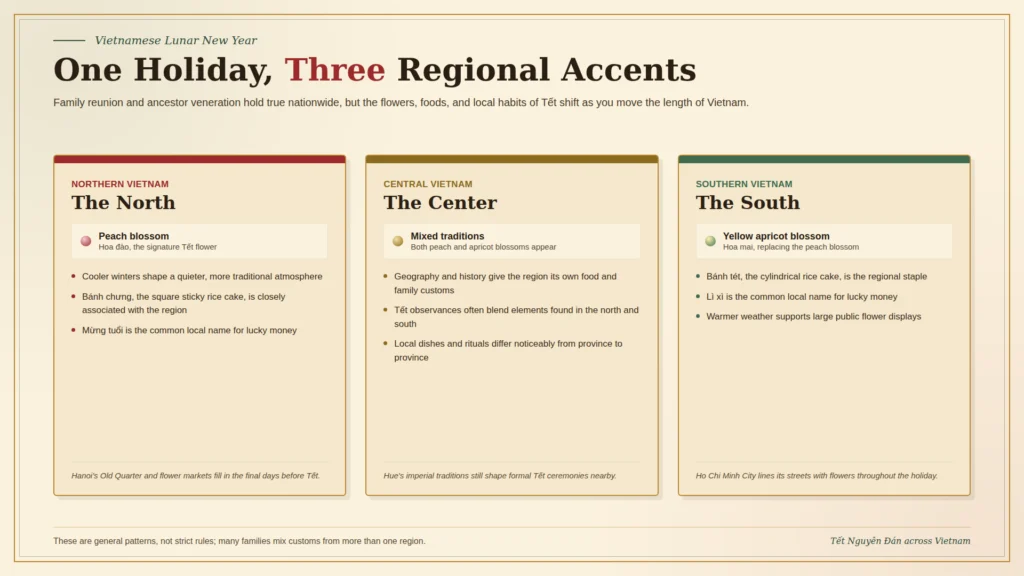
Preparation is not a footnote to Tết; it’s a meaningful part of the celebration itself, often stretching over a week or two.
Cleaning and settling the year. Homes get a deep clean, sometimes described as sweeping away the misfortune of the old year. Many people also try to settle debts, finish outstanding tasks, and patch up arguments before the new year begins, since carrying old problems forward is seen as a poor way to start.
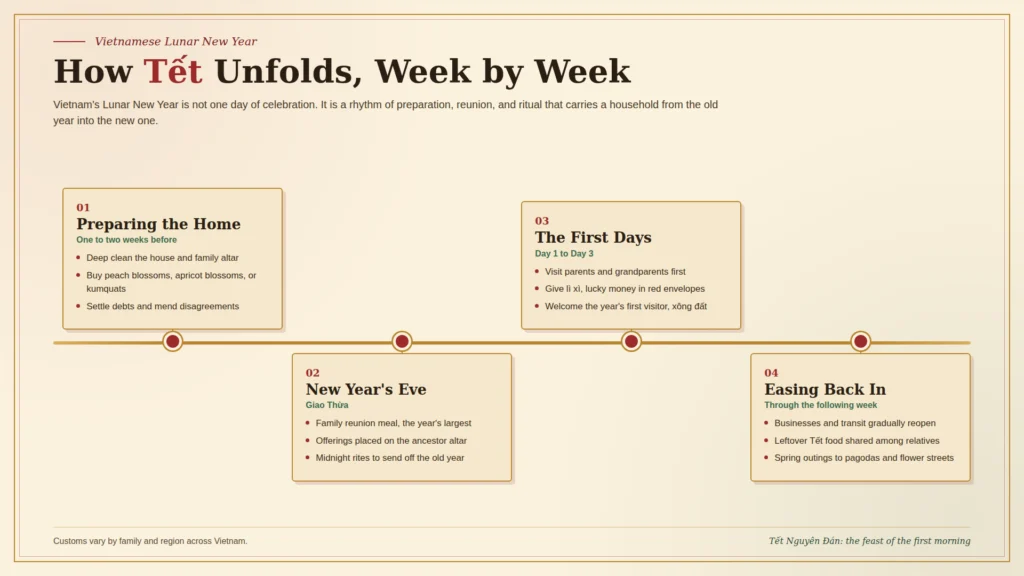
Flowers and plants. Markets fill with flowers and ornamental trees in the final days before Tết. The most recognizable choices vary by region:
- Peach blossoms (hoa đào), strongly associated with northern Vietnam
- Yellow apricot blossoms (hoa mai), more common in the south
- Kumquat trees, popular nationwide for their small, bright fruit symbolizing fruitfulness and luck
Shopping and new clothes. Families stock up on food, gifts, and household items before shops close for the holiday, and many people buy new clothes to wear during the first days of the new year.
Cooking ahead of time. Traditional dishes like bánh chưng and bánh tét take hours to prepare, so families often start cooking days in advance, sometimes as a shared activity that brings several generations into the kitchen together.
New Year’s Eve: The Turn Into the New Year
The night before Tết, known as Giao Thừa, is when the celebration shifts from preparation to arrival.
Families gather for a reunion meal, often the most elaborate of the year, and many households place food offerings on the family altar as part of a ceremony welcoming ancestors and marking the transition between years. As midnight approaches, some families hold a brief outdoor offering meant to send off the old year’s spirits and welcome the new one.
In cities like Hanoi and Ho Chi Minh City, public fireworks displays mark the countdown, and streets around lakes and central squares fill with people. But in most households, the fireworks are a backdrop to something quieter: a family finishing its last meal of the old year together before the new one begins.
What Happens During the First Days of Tết
The first three days of the new year, often referred to individually as the first, second, and third day of Tết, are the most tradition-heavy part of the holiday.
Visiting immediate family first. The first day is typically reserved for visiting parents and grandparents, often on the father’s side, followed by the mother’s side. Children greet elders with New Year’s wishes for health and longevity.
Giving lucky money. Adults give small red or gold envelopes containing money, called lì xì in the south and mừng tuổi (“celebrating another year of age”) in the north. It’s traditionally given to children and older relatives, and the amount matters far less than the gesture: a wish for luck and well-being in the year ahead.
Welcoming the first visitor. Many families pay close attention to who first sets foot in the home after midnight, a custom known as xông đất or xông nhà. Some households traditionally believe this person’s fortune, age, or personality can influence the household’s luck for the year, so a family might informally arrange for someone considered fortunate to visit first. This is a long-standing belief rather than something every family treats as literal fact, and plenty of households don’t observe it strictly at all.
Expanding the visits. By the second and third day, visiting widens to include friends, neighbors, teachers, and colleagues. Pagodas and temples also see more visitors during this period, as some people go to pray for health, luck, or prosperity in the new year.
Traditional Foods of Tết
Food during Tết carries meaning beyond the meal itself; much of it is prepared as an offering before it’s eaten as a celebration.
| Food | Common association | What it is |
|---|---|---|
| Bánh chưng | Traditionally linked to northern Vietnam | A square cake of sticky rice, mung bean, and pork, wrapped in leaves and boiled for hours |
| Bánh tét | Common in central and southern Vietnam | A cylindrical version of sticky rice cake, similarly filled and wrapped |
| Mứt | Served throughout the country | Candied fruit and seeds, offered to guests alongside tea during visits |
These dishes aren’t rigidly confined to one region; bánh chưng appears on southern tables and bánh tét on northern ones as well. The associations reflect general patterns, not strict rules, and what actually lands on the table often comes down to family tradition more than geography.
How Tết Differs Across Vietnam
Vietnam stretches over more than a thousand miles from north to south, and Tết doesn’t look identical everywhere. Some of the more noticeable differences:
- Northern Vietnam: Peach blossoms are the signature flower, winters are cooler, and Hanoi’s Old Quarter and flower markets take on a distinctly traditional atmosphere in the days before Tết.
- Central Vietnam: Families here have their own regional dishes and customs, shaped by a history and geography different from either end of the country, and Tết observances often blend elements found in both the north and south.
- Southern Vietnam: Yellow apricot blossoms replace peach blossoms as the dominant Tết flower, and Ho Chi Minh City is known for elaborate public flower displays along its streets during the holiday.
These differences are real, but they sit on top of shared values that hold across the country: reunion, remembrance, and a hopeful start to the year.
Tết Greetings and What Visitors Should Know
If you’re invited into a Vietnamese home during Tết, or simply want to understand the etiquette, a few basics go a long way.
- The standard greeting is Chúc Mừng Năm Mới, meaning “Happy New Year.”
- Greet elders first and use respectful language when possible.
- If you’re given lì xì or offered food, it’s polite to accept graciously rather than decline.
- Not every family observes every custom the same way, so don’t assume a household follows a tradition just because it’s widely known.
- Expect transportation, restaurants, and many businesses to run on limited hours or close entirely for several days around Tết, since the holiday is a period for staying home with family rather than going out.
Tết Today
Tết’s core traditions have held steady for generations, but how families practice them keeps shifting. Younger generations increasingly split their time between hometown visits and short trips, some households buy pre-made bánh chưng instead of cooking it from scratch, and lucky money is now sometimes sent digitally through banking apps rather than handed over in an envelope. Cities like Hanoi have also worked to document and publicly present traditional Tết rituals, including altar preparation and ceremonial customs, as part of preserving cultural heritage alongside these modern adaptations.
None of this replaces the older customs so much as it sits alongside them. The reunion dinner, the ancestor offerings, and the first visits to parents and grandparents remain the fixed points of the holiday, even as the smaller details around them evolve.
Frequently Asked Questions
What is lì xì?
Lì xì is Vietnam’s lucky money tradition, where money is placed in a red or gold envelope and given, usually by adults to children and older relatives, as a New Year’s wish for health and good fortune. In the north, the same custom is often called mừng tuổi.
What is xông đất?
Xông đất refers to the tradition of welcoming the first person to enter a home after the new year begins. Some families traditionally believe this visitor’s character or fortune can set the tone for the household’s luck that year, though not every family treats it as a strict practice.
Is Tết celebrated the same way throughout Vietnam?
No. The core values of family reunion, ancestor honoring, and a fresh start are shared nationwide, but the specific flowers, foods, and local customs vary between northern, central, and southern Vietnam, and even between individual families.
Bottom Line
Vietnam celebrates Lunar New Year by preparing for days in advance, cleaning and decorating homes, cooking traditional foods, and buying flowers, before reuniting with family, honoring ancestors, exchanging greetings, giving lucky money, and welcoming guests once Tết arrives. It’s a holiday built around reunion, remembrance, and the hope of starting the new year well, and while the details shift from region to region and household to household, that underlying purpose stays the same across the country.
Leave a Reply
You must be logged in to post a comment.