
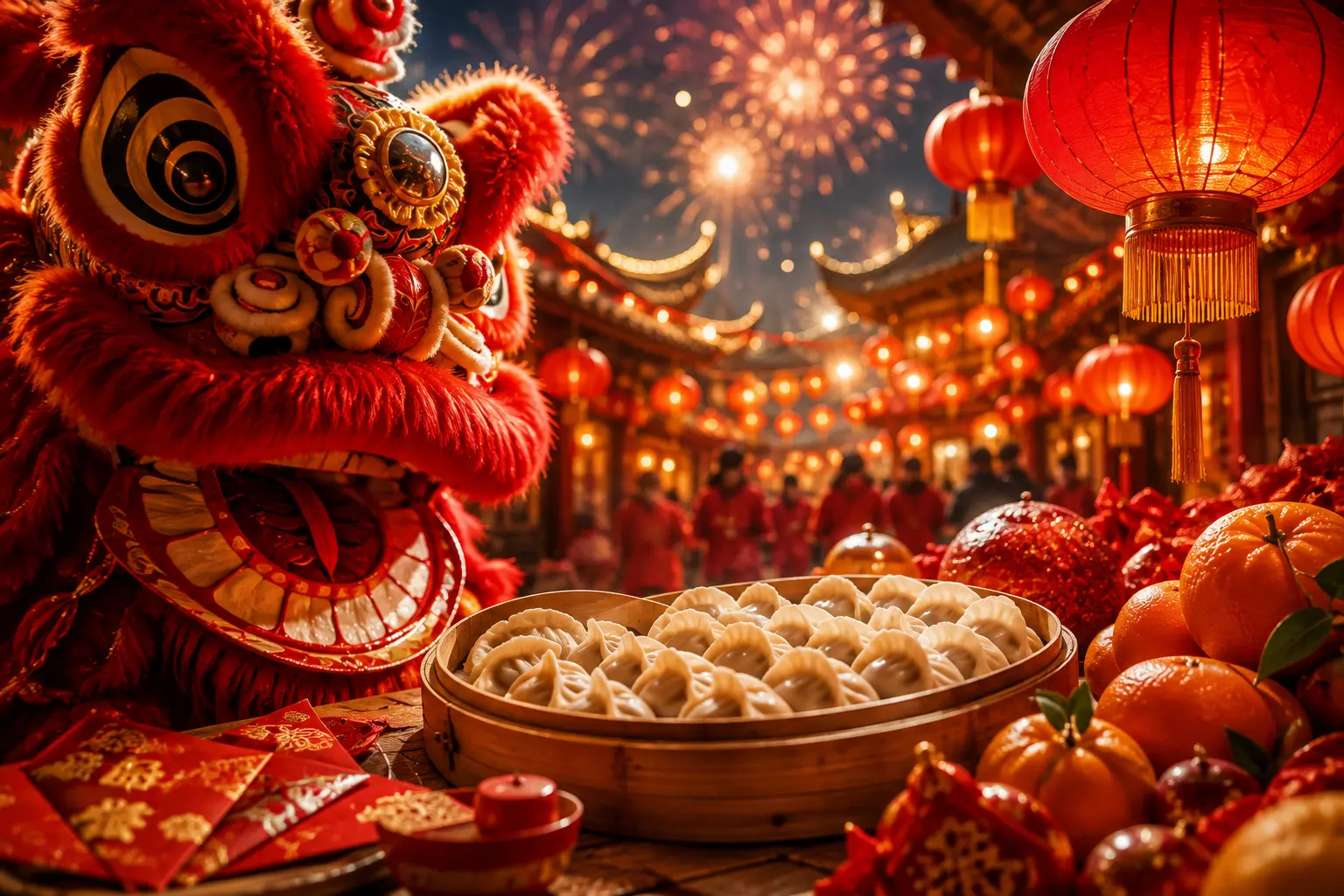
Somewhere in China right now, a grandmother is folding dumplings with her whole family gathered around the table, and nobody is allowed to leave until every last one is sealed shut. That single scene tells you almost everything you need to know about Chinese New Year. It is loud, it is red, it is deeply superstitious in the most charming way, and above everything else, it is about family sitting down together.
I want to walk you through the traditions that make this festival so special, one at a time, starting with the old legend that explains so much of what you see today. Whether you call it Chinese New Year, Lunar New Year, or the Spring Festival, you are about to get the full picture.
1. The Legend of Nian, Where It All Began
Nearly every red decoration, every firecracker, and every loud family gathering during this festival traces back to one old story, so it makes sense to start right here. Long ago, a fearsome beast called Nian was said to live deep in the mountains or beneath the sea, only coming out once a year to terrorize villages and devour livestock, and sometimes people too.
Villagers eventually discovered something important about this creature. Nian was terrified of three specific things, loud noise, bright fire, and the color red. According to the legend, an old man or beggar taught the villagers to hang red paper on their doors, burn bamboo until it cracked loudly, and light up their homes through the night. When Nian returned that year and encountered all three defenses at once, the beast fled in terror and never bothered the village again.
That single story is the reason so many Chinese New Year traditions look the way they do even today. Firecrackers, red lanterns, and staying up late together as a family all trace their roots straight back to this ancient tale. Even the Chinese phrase for celebrating the New Year, guo nian, literally means passing over Nian, keeping that old legend alive in everyday language.
2. A Festival That Follows the Moon, Not the Calendar
Unlike January 1 on the western calendar, Chinese New Year follows a lunisolar calendar, which means the date shifts every single year rather than staying fixed. The celebration typically falls somewhere between late January and mid February, and in 2026, Chinese New Year’s Day lands on February 17, marking the beginning of the Year of the Horse.
The festival does not end after just one night either. Traditionally, celebrations stretch across a full fifteen days, starting with New Year’s Eve and closing out with the Lantern Festival on the final day. Many workers across mainland China get a full week off during this stretch, while other parts of Asia, including Hong Kong, Singapore, Malaysia, and Vietnam, typically observe a shorter break of one to three days.
3. Weeks of Cleaning, Shopping, and Decorating Before the Big Night
Weeks before the actual celebration begins, households across China start preparing in earnest. Around two weeks ahead of time, many families make laba congee, a rich porridge packed with rice, beans, lotus seeds, and other ingredients, marking the unofficial start of the holiday season.
A thorough house cleaning follows shortly after, meant to sweep away any bad luck or lingering misfortune from the previous year before the new one arrives. This cleaning has to be finished before New Year’s Eve though, since sweeping or taking out the trash on New Year’s Day itself is considered bad luck, believed to sweep away the good fortune that just arrived alongside the new year.
Once the home is spotless, decorating begins in earnest. Red paper couplets bearing hopeful phrases get pasted onto doorframes, red lanterns get hung throughout the house, and the character for good fortune, fu, often gets pasted upside down on the front door. That upside down placement is intentional too, since the word for upside down sounds identical to the word for arriving in Chinese, turning the decoration into a small wordplay wishing good fortune to actually arrive at the household.
4. The Reunion Dinner, the Emotional Heart of the Whole Festival
If Chinese New Year has one single moment that matters more than any other, it is the reunion dinner held on New Year’s Eve, known as nian ye fan. This meal is considered the single most important dinner of the entire year, and family members will travel enormous distances, sometimes crossing the entire country, just to make sure they are home in time to share it.
The dinner itself tends to be a long, generous affair, often taking days of preparation and stretching across many courses once everyone finally sits down. Extended family gathers around the table together, sharing food, catching up on the past year, and setting the emotional tone for everything that follows during the rest of the festival.
After the meal wraps up, many families follow a custom called shou sui, which means guarding the year. This involves deliberately staying awake late into the night, sometimes until dawn, as a way of showing respect for time itself and wishing for a long, healthy life for the family’s elders.
5. Dumplings, the Lucky Food Everyone Folds Together
Dumplings, known as jiaozi, hold a central place at the Chinese New Year table, especially across northern China. Families often gather together to fold dozens of them by hand, turning food preparation itself into a shared bonding activity rather than a chore.
Their shape resembles old silver ingots, which is exactly why dumplings are so closely tied to wealth and prosperity during this festival. Some households even hide a single coin inside one dumpling, and whoever happens to bite into it is considered the luckiest person at the table for the entire coming year.
6. A Whole Fish for Abundance and Surplus
Fish shows up on nearly every Chinese New Year dinner table, and the reason comes down to a simple play on words. In Chinese, the word for fish, yu, sounds almost identical to the word for surplus, making fish a natural symbol for abundance in the year ahead.
Tradition even shapes how the fish gets eaten. In many households, the fish is meant to be served whole and left partly uneaten, since finishing every last bite would symbolically use up the surplus rather than carrying it forward into the new year.
7. Spring Rolls, Niangao, and Longevity Noodles
Beyond dumplings and fish, a handful of other dishes round out the traditional Chinese New Year table, each carrying its own symbolic meaning. Spring rolls get their lucky status from their golden color and cylindrical shape, both of which resemble bars of gold and represent wealth for the year ahead.
Niangao, a sticky rice cake, gets its meaning from a clever play on words too, since its name sounds like the phrase for growing higher each year, whether that means a higher income, better grades, or a well earned promotion. Longevity noodles round out the list, deliberately prepared extra long and left uncut, since snapping them while cooking or eating is believed to symbolically shorten the eater’s life. You slurp them whole instead, no matter how long that makes the process.
Here is a quick table gathering these lucky foods together in one place.
| Food | Symbolic Meaning |
| Dumplings (jiaozi) | Wealth, since the shape resembles old silver ingots |
| Whole fish (yu) | Abundance, since the word sounds like surplus |
| Spring rolls | Wealth, thanks to their golden, gold bar shape |
| Niangao (rice cake) | Rising higher in life year after year |
| Longevity noodles | A long life, thanks to their uncut length |
| Tangyuan (rice balls) | Family togetherness, shown through their round shape |
| Chicken | Good luck, since the word sounds like good fortune |
8. Tangyuan and the Sweet Symbol of Togetherness
Tangyuan, small glutinous rice balls often filled with sweet black sesame or red bean paste, carry their own gentle symbolism at Chinese New Year. Their round shape, along with the round bowl they are served in, represents wholeness, completeness, and family togetherness.
While tangyuan are most closely associated with the Lantern Festival at the very end of the celebration, many families across southern China enjoy them throughout the entire Spring Festival period. Sharing a warm bowl together is often treated as a small, quiet way of reaffirming how important family unity remains during this season.
9. Firecrackers, Fireworks, and Noise at Midnight
Once midnight strikes on New Year’s Eve, the quiet of the night explodes into noise almost everywhere across China. Firecrackers and fireworks light up the sky, continuing that ancient tradition of scaring away Nian with loud sound and bright fire, just as the old legend describes.
This tradition has evolved a fair amount in modern cities, where fireworks restrictions have become more common due to safety and pollution concerns. Even so, the spirit of the custom lives on, whether through smaller sanctioned displays, community fireworks shows, or the simple joy of lighting a string of firecrackers outside the family home the way generations did before.
10. Hongbao, the Red Envelope Everyone Looks Forward To
Ask any child in China what they look forward to most during this holiday, and hongbao, the red envelope tradition, will almost certainly come up first. These small red packets, filled with money, are given by married adults and elders to children and unmarried younger relatives as a wish for health, safety, and good fortune in the year ahead.
Traditionally, this money is called ya sui qian, meaning money that suppresses evil, since it is believed to protect children from sickness and bad spirits throughout the coming year. Children are typically expected to say a polite, auspicious phrase and offer a small bow when receiving their envelope, treating the exchange as a small ritual of respect rather than a simple handout. A few unspoken rules travel alongside this tradition too. The amount inside should generally avoid the number four, since four sounds like the word for death in Chinese, while the number eight is considered especially lucky, since it sounds like the word for prosperity.
11. New Clothes, Family Visits, and the Days That Follow
Once New Year’s Day itself arrives, the mood of the celebration shifts noticeably. People traditionally wear new clothes, symbolizing a fresh start, and spend the day visiting relatives, exchanging warm greetings, and sharing good wishes for the year ahead.
Different days across the fifteen day festival period carry their own specific customs too. The third day is traditionally set aside for visiting temples and honoring ancestors, while other days throughout the stretch are dedicated to welcoming the God of Wealth or continuing rounds of family visits. Lion and dragon dances often appear during this period as well, performed in streets and public squares to bring good luck and chase away any remaining bad energy from the year before.
12. The Lantern Festival, Closing Out the Celebration
Chinese New Year does not really end until the fifteenth and final day, marked by the Lantern Festival. This closing celebration lights up towns and cities with glowing lanterns, riddles written on paper, and one more round of tangyuan, the same sweet rice balls associated with family unity throughout the festival.
In 2026, the Lantern Festival lands on March 3, officially bringing the entire Spring Festival season to a close. Streets fill with lantern displays, and families gather one final time to share a warm bowl of rice balls together, closing the loop on fifteen days of celebration with one last quiet, sweet moment of togetherness.
Good Luck Superstitions Worth Knowing
Beyond these twelve core traditions, Chinese New Year carries a long list of small superstitions, and while nobody follows every single one strictly, most families observe at least a few out of habit and respect for tradition. Knowing a handful of these can genuinely help you avoid an awkward moment if you are ever invited into a Chinese home during this period.
- Avoid using scissors or knives on New Year’s Day itself, since cutting anything is believed to symbolically cut away good fortune for the year ahead.
- Skip the hair wash and haircut on New Year’s Day, since washing your hair is thought to wash away good luck right along with it.
- Never say unlucky words like death, sickness, or poverty during the celebration, since spoken words are believed to carry real weight during this sensitive period.
- Avoid giving clocks, umbrellas, or pears as gifts, since each of these items sounds like an unlucky word in Chinese and carries an unfortunate association.
- Do not sweep the floor or take out the trash on New Year’s Day, since doing so is believed to sweep away the good fortune that just arrived.
- Wear something red if possible, since red is considered the luckiest color of the entire festival and is believed to ward off bad energy.
How Regional Customs Add Their Own Flavor
China is an enormous country, and these twelve traditions shift quite a bit depending on which region you happen to be celebrating in. These regional differences add wonderful variety to what might otherwise look like one single uniform celebration.
| Region | What Makes It Unique |
| Northern China | Strong dumpling culture, with families folding jiaozi together as a central New Year activity |
| Southern China | Tangyuan and niangao take center stage instead, alongside a stronger emphasis on citrus fruit gifts |
| Sichuan | Hot pot often replaces a formal banquet, bringing family together around one shared, spicy pot |
| Hunan | Rice cakes are common, along with a wish for steady, gradual improvement throughout the year |
| Hubei | Chicken soup is traditionally consumed on New Year’s Day to represent peace and mental clarity |
Even something as simple as a fish dish can vary by region, since the specific type of fish chosen often depends on local wordplay involving its name. That kind of playful, sound based symbolism runs through Chinese New Year food culture everywhere you look, no matter which part of the country you are in.
Bringing a Bit of Chinese New Year Into Your Own Celebration
You do not need to be in China to enjoy a little piece of this festival yourself. Plenty of these customs travel well and can easily become part of your own New Year celebration, wherever you happen to be.
- Fold a batch of dumplings with family or friends, turning the cooking process itself into a shared, meaningful activity.
- Hang something red around your home, echoing the protective symbolism tied to the color throughout the festival.
- Prepare a whole fish for dinner, leaving a little behind on the plate as a nod to the wish for abundance in the coming year.
- Give red envelopes to children in your life, even informally, as a small gesture of good luck and protection.
- Avoid cutting your noodles if you make a longevity noodle dish, slurping them whole the way tradition intends.
- Light a few sparklers or make some noise at midnight, keeping that ancient Nian legend alive in your own small way.
Frequently Asked Questions About Chinese New Year Traditions
What is the legend behind Chinese New Year?
The festival traces back to the legend of Nian, a beast that terrorized villages until people discovered it feared loud noise, bright fire, and the color red, giving rise to firecrackers and red decorations still used today.
Why do people give red envelopes during Chinese New Year?
Red envelopes, called hongbao, are given to children and younger relatives as a wish for health and protection from bad luck, with the money inside traditionally believed to guard against evil spirits.
What foods are considered lucky during Chinese New Year?
Dumplings, whole fish, spring rolls, niangao rice cake, longevity noodles, and tangyuan rice balls are among the most common lucky foods, each carrying its own symbolic meaning for the year ahead.
Why is red such an important color during the festival?
Red is believed to ward off bad luck and misfortune, tracing back to the legend of Nian, who was said to be terrified of the color, along with loud noise and bright fire.
What should you avoid doing on Chinese New Year’s Day?
Common taboos include avoiding scissors, skipping a haircut or hair wash, not sweeping the floor, and steering clear of unlucky words like death or poverty during conversation.
How long does Chinese New Year celebration actually last?
The full celebration traditionally spans fifteen days, beginning with the reunion dinner on New Year’s Eve and closing with the Lantern Festival on the final night.
What is the reunion dinner?
The reunion dinner, called nian ye fan, is the most important meal of the Chinese New Year celebration, bringing extended family together on New Year’s Eve to share a symbolic feast.
Bringing It All Together
Chinese New Year traditions carry centuries of meaning inside every red envelope, every folded dumpling, and every burst of firecracker noise. What started as an old legend about a fearsome beast named Nian has grown into one of the most heartfelt and widely celebrated festivals in the entire world, all built around family, gratitude, and hope for the year ahead.
I hope this list gave you a genuine sense of what makes this celebration so special, far beyond the fireworks and red decorations most people already know about. Maybe you will fold a few dumplings this year, hang something red by your door, or simply share a warm meal with the people who matter most to you. Whatever you choose to do, I wish you good fortune, good health, and a truly happy new year ahead.
Leave a Reply
You must be logged in to post a comment.