
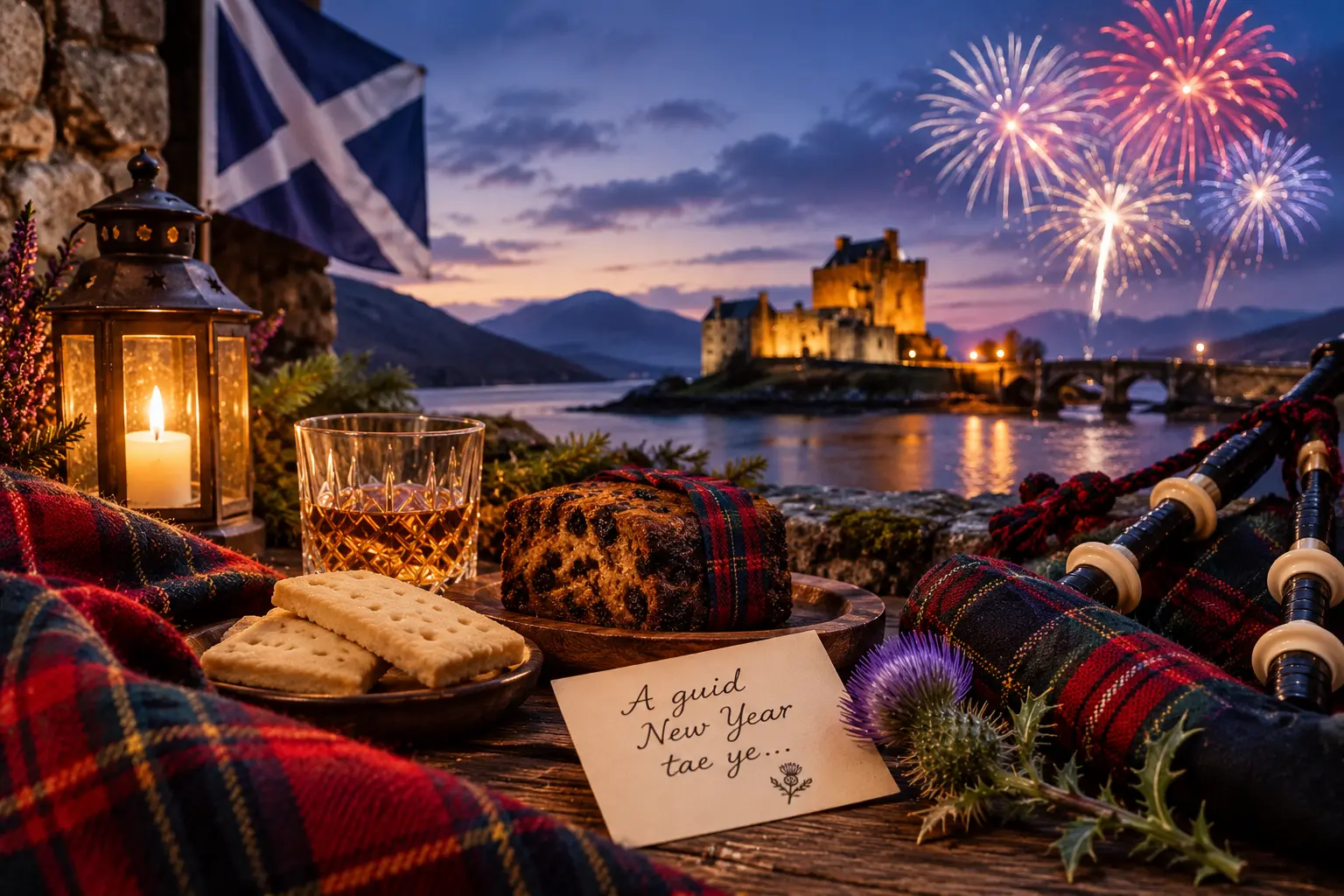
If you think New Year means fireworks, champagne, and counting down from ten, Scotland has a very different story to tell. Here, New Year’s Eve is known as Hogmanay, and it comes with its own mix of music, old customs, food, good luck rituals, fire festivals, and plenty of friendly visits.
Some traditions are still common in homes today, while others are mostly kept alive through local celebrations. You may find people cleaning the house before midnight, visiting friends after the clock strikes twelve, carrying symbolic gifts, singing Auld Lang Syne, or joining a huge public celebration in Edinburgh.
What makes Scottish New Year traditions especially interesting is the way old and new sit side by side. A centuries-old custom such as first-footing can happen on the same night as a modern street party with fireworks.
So, if you want to understand how Scotland celebrates the New Year, let’s take a closer look at Hogmanay and the traditions behind it.
What Is Hogmanay in Scotland?
Hogmanay is the Scottish name for New Year’s Eve, which falls on December 31. It is one of the biggest celebrations on the Scottish calendar, with traditions that continue into New Year’s Day and, in some cases, January 2.
Across Scotland, Hogmanay can look very different depending on where you are. Edinburgh is known for its huge public celebrations, while smaller communities often keep their own local customs alive.
You might see torchlight processions, fireworks, bonfires, traditional music, dancing, or people gathering in the streets to welcome the New Year.
At home, the celebration can be much simpler. Families and friends may share food, raise a drink at midnight, sing Auld Lang Syne, and visit one another after midnight.
The National Trust for Scotland notes that Hogmanay became especially important during periods when Christmas celebrations were discouraged in Scotland. Christmas Day did not become a national public holiday in Scotland until 1958, which helps explain why New Year developed such a strong place in Scottish culture.
Why Is New Year So Important in Scotland?
Part of the answer comes from Scotland’s complicated history with Christmas celebrations.
After the Scottish Reformation, Christmas celebrations were discouraged, and an act passed in 1640 abolished the official observation of Yule. Over time, many winter celebrations became closely connected with Hogmanay instead.
That does not mean every Scottish person stopped celebrating Christmas throughout history. Records show that Christmas traditions continued in different forms, especially among certain families and communities.
Still, Hogmanay became the big winter celebration for many Scots.
Today, the balance is very different, because Christmas is widely celebrated across Scotland. Even so, Hogmanay remains one of the country’s best-known cultural traditions.
The Story Behind Scottish Hogmanay Traditions
The exact origin of the word Hogmanay is not completely settled.
Different theories have connected the word with French, Scandinavian, and older Scottish or Gaelic terms. The National Trust for Scotland also notes that the roots of Scottish midwinter celebrations reach much further back than the modern New Year holiday.
Winter celebrations in Scotland have also been influenced by older solstice customs and Viking traditions. The Vikings brought their own midwinter celebrations to parts of Scotland, including traditions associated with Yule.
That history helps explain why fire, light, feasting, and the turning of the year appear so often in Scottish winter customs.
It is worth remembering that not every modern Hogmanay tradition can be traced directly to one ancient ceremony. Some customs changed over time, while others developed much more recently.
That mix is part of what makes Hogmanay so interesting today.
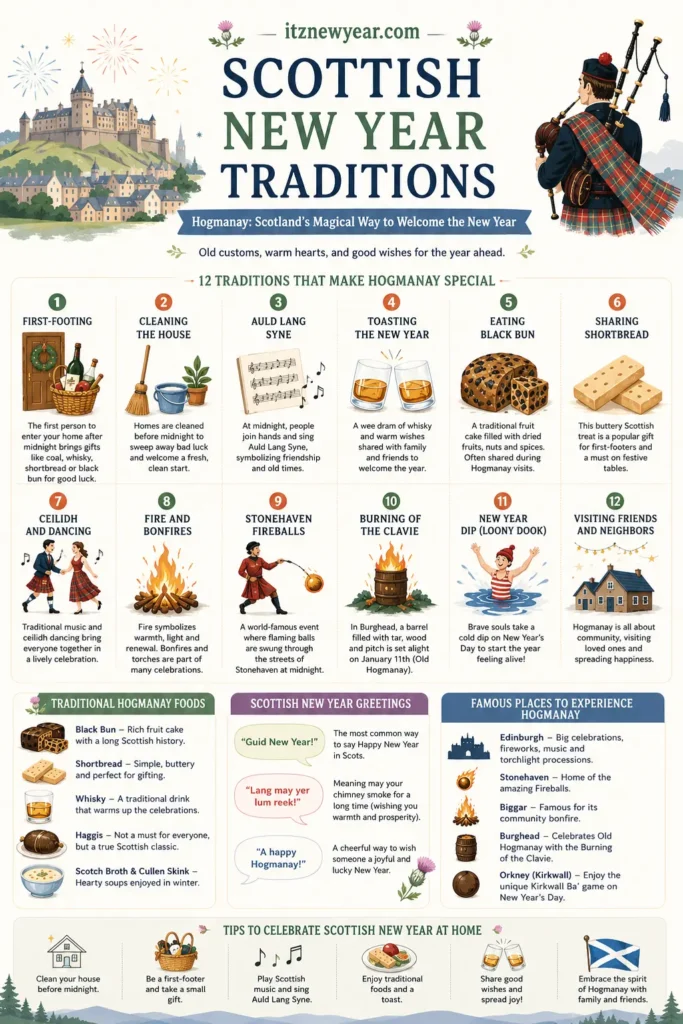
12 Scottish New Year Traditions You Should Know
If you are researching Scottish New Year traditions, these are the customs that belong at the top of your list.
1. First-Footing Brings Good Luck
First-footing is probably the best-known traditional Scottish New Year custom after Auld Lang Syne.
The idea is simple. The first person to enter your home after midnight is called the first-footer, and traditionally that person’s arrival is supposed to bring luck for the coming year.
The custom is about more than simply being the first guest through the door.
Traditionally, the first-footer brought useful or symbolic gifts for the household. These could include coal, whisky, shortbread, or other food.
The gifts had practical meanings. Coal could help keep the home warm, while food represented having enough to eat during the year ahead. Whisky offered something to share and toast with the household.
Older traditions sometimes preferred a tall, dark-haired man as the first-footer. Historical explanations often connect this preference with Viking invasions and an old belief that fair-haired visitors could bring bad luck.
However, you should not assume that every Scottish household follows this rule today. Modern first-footing is much more relaxed, and the important part is usually the visit, the good wishes, and the shared celebration.
What Does a First-Footer Bring?
Traditional first-footing gifts can include:
| Gift | Traditional meaning |
| Coal | Warmth for the household |
| Whisky | A drink for sharing and celebrating |
| Shortbread | Food and hospitality |
| Black bun | A traditional festive food |
| Other food | Plenty and good fortune |
If you want to experience first-footing yourself, the basic idea is easy. Visit someone after midnight, bring a small gift, offer good wishes, and share the moment together.
2. Cleaning the House Before New Year
Cleaning may not sound like the most exciting New Year tradition, but it has a long place in Scottish Hogmanay customs.
Some Scottish households traditionally cleaned the home before the New Year arrived. The idea was to start the year with a clean space rather than carrying the old year’s dirt and disorder into the new one.
In homes where coal fires were common, clearing out the ashes was also part of preparing for the New Year. A fresh fire could then be laid for the household.
There was also an old belief that cleaning on New Year’s Day could bring bad luck because you might accidentally sweep or wash away the good fortune that had just arrived.
You will not find every Scottish family following this belief today, of course. Still, the idea of starting fresh feels very familiar even in modern celebrations.
3. Singing Auld Lang Syne at Midnight
You probably know the melody, even if you have never visited Scotland.
At midnight, people in Scotland traditionally join hands and sing “Auld Lang Syne.”
The song is strongly connected with Scottish poet Robert Burns, who wrote down his version in 1788 using an older Scottish song as part of its source material.
The phrase auld lang syne is generally understood as referring to old times or days gone by. That makes the song a natural fit for New Year, because it looks back at friendships and memories while people move into another year.
The tradition eventually spread far beyond Scotland and is now used at New Year celebrations around the world.
And honestly, you do not need to know every word.
Most people know the tune, link arms or hold hands, and sing along as best they can.
Why Do People Link Arms During Auld Lang Syne?
Linking arms creates a sense of togetherness as everyone crosses from one year into another.
The tradition has become especially recognizable at midnight, when groups gather together and sing the song after the clock strikes twelve.
It is one of those moments where the Scottish tradition has traveled so far that many people around the world take part without realizing where it came from.
4. Toasting the New Year
Food and drink have always played an important part in Hogmanay.
A traditional New Year gathering might include whisky, shortbread, black bun, and other festive foods. The point is not simply to eat and drink, but to welcome guests and share what the household has.
Whisky is particularly connected with Scottish celebrations, and first-footers traditionally carried whisky when visiting homes after midnight.
You may also hear people offering Scottish New Year greetings such as “Guid New Year.”
That phrase simply means “Good New Year” in Scots.
The whole idea fits neatly with Hogmanay’s focus on friendship, hospitality, and good wishes for the year ahead.
5. Eating Black Bun
If you want to understand traditional Scottish New Year food, you should know about black bun.
Black bun is a rich Scottish fruit cake covered with pastry. It traditionally contains ingredients such as raisins, currants, almonds, citrus peel, spices, and other dried fruit.
It has been associated with Hogmanay and first-footing, where it could be offered to guests or carried as a gift.
The cake is dense, dark, fruity, and very different from the lighter cakes you might see at other New Year celebrations.
Black bun is not something every Scottish family eats today, but it remains an important part of traditional Scottish festive food.
6. Sharing Scottish Shortbread
Shortbread is another classic Scottish food connected with Hogmanay.
It is a simple biscuit made mainly with butter, sugar, and flour, although recipes can vary.
Shortbread has a long history in Scotland and was traditionally associated with special occasions rather than everyday eating.
During first-footing, shortbread could be brought as a gift for the household. Today, it remains one of the easiest Scottish foods to associate with a festive visit.
If you are creating your own Scottish New Year gathering, a plate of shortbread is probably one of the simplest traditions to borrow.
7. Enjoying a Traditional Ceilidh
A ceilidh brings music and dancing together in a lively Scottish social gathering.
You may find ceilidhs during Hogmanay celebrations, especially at public events and community gatherings.
Traditional ceilidh dancing is not about standing around and watching professional dancers perform. People generally take part themselves, often following a caller who explains the steps.
That makes a ceilidh a great fit for New Year celebrations because people can join in even if they have never danced a Scottish set before.
Music, dancing, laughter, and a crowded room can turn a simple New Year gathering into a proper celebration.
VisitScotland lists ceilidhs, traditional music, street parties, and fire festivals among the ways Hogmanay is celebrated across Scotland today.
8. Lighting Fires and Bonfires
Fire is one of the most striking features of Scottish New Year celebrations.
Across Scotland, Hogmanay has included bonfires, torches, fireworks, and other forms of fire-based celebration.
Older winter traditions often placed great importance on light during the darkest part of the year. Fire was associated with warmth, protection, and the return of brighter days.
However, historians are careful about claiming that every modern fire festival is simply a direct survival of one ancient pagan ritual.
The traditions have changed over centuries, and different communities have their own stories and customs.
Still, fire remains a powerful symbol of leaving the old year behind and welcoming something new.
9. Watching the Stonehaven Fireballs
If you want to see one of Scotland’s most dramatic New Year traditions, look toward Stonehaven in Aberdeenshire.
Every Hogmanay, participants carry large flaming balls through the town.
The ceremony takes place around midnight, with the fireballs being swung through the streets as the New Year arrives. The event is organized by the local community and has become one of Scotland’s best-known fire traditions.
The official Stonehaven Fireballs organization says roughly forty men and women take part in the ceremony, which lasts around twenty minutes before a fireworks display follows.
The sight is hard to forget.
Imagine a dark Scottish winter street filled with people while flaming balls move through the night sky.
That is Stonehaven’s way of saying goodbye to the old year.
10. Joining the Biggar Bonfire
Stonehaven is not the only Scottish community where fire plays a role in Hogmanay.
In Biggar, South Lanarkshire, a large community bonfire is traditionally lit on New Year’s Eve.
The event brings local people together around the fire as they welcome the New Year.
Unlike the highly dramatic fireballs in Stonehaven, a large community bonfire has a simpler feel. People gather together, watch the flames, talk with neighbors, and enjoy the atmosphere.
It is a good example of how Scottish New Year traditions can be very local.
You do not need one national version of Hogmanay. Different towns have developed their own ways of marking the occasion.
11. Watching the Burning of the Clavie
One of Scotland’s most unusual New Year traditions takes place in Burghead, Moray.
The tradition is called the Burning of the Clavie.
Instead of celebrating New Year on December 31, the community holds this ceremony on January 11, which is known as Old Hogmanay.
A wooden barrel, known as the clavie, is carried through the town before being set alight on a nearby hill.
The ceremony is connected with the older Julian calendar, which explains why Burghead’s New Year celebration falls later than the January 1 date used in the modern Gregorian calendar.
After the clavie burns, people have traditionally collected embers because they were believed to bring good luck during the coming year.
This is one of those traditions that shows how Scottish New Year customs can survive in very local forms.
12. Taking a New Year’s Day Dip
Not every Scottish New Year tradition involves staying warm beside a fire. Some involve doing the exact opposite.
The Loony Dook is a modern Scottish New Year tradition where brave participants take a cold-water dip on New Year’s Day.
The best-known version takes place around the Firth of Forth.
For many people, the appeal is simple. You dress up, gather with others, run into freezing water, and begin the year with a story you will probably remember for quite some time.
It is not an ancient Hogmanay ritual in the same sense as first-footing.
Instead, it is a more recent tradition that has become part of Scotland’s modern New Year culture.
Traditional Scottish New Year Foods
Food is a big part of Scottish celebrations, and Hogmanay is no exception.
If you are putting together a Scottish-inspired New Year meal, these are some traditional foods and drinks worth knowing.
| Food or drink | Why it matters |
| Black bun | Traditional Scottish festive fruit cake |
| Shortbread | Classic Scottish biscuit often used for gifting |
| Whisky | Traditional drink associated with first-footing |
| Fruitcake | Traditional food offered during festive visits |
| Haggis | Famous Scottish dish sometimes served during celebrations |
| Scotch broth | Traditional hearty Scottish soup |
| Cullen skink | Scottish soup made with smoked fish, potatoes, and leeks |
Not every item on this list is specifically a Hogmanay food.
That distinction matters.
For example, haggis is strongly associated with Scottish culture and is famously celebrated during Burns Night, but it is not a required Hogmanay dish.
Shortbread, black bun, fruitcake, and whisky have a more direct connection with traditional first-footing.
Scottish New Year Greetings and Words
You may hear a few Scots words during Hogmanay celebrations.
Here are some useful ones to know.
| Scottish term | Meaning |
| Hogmanay | Scottish New Year’s Eve |
| Auld | Old |
| Lang syne | Long ago or times gone by |
| Guid New Year | Good New Year |
| First-footing | Visiting a home after midnight |
| First-footer | The first person entering the home |
| Ceilidh | Social gathering involving music and dancing |
| Wee | Small |
| Dram | A small serving of whisky |
You do not need to speak Scots to enjoy Hogmanay.
Still, knowing a few words can make the tradition easier to understand, especially when you hear Auld Lang Syne sung at midnight.
Hogmanay Traditions Across Different Parts of Scotland
While Edinburgh grabs most of the international attention, Hogmanay looks a little different depending on where in Scotland you happen to be. Smaller towns and rural communities often hold onto older, more intimate customs that have been passed down within families for generations.
Here is a quick snapshot of how different regions put their own spin on the celebration.
- Stonehaven, on the northeast coast, hosts the dramatic Fireballs Ceremony described earlier, drawing thousands to watch locals swing burning cages through the streets.
- Edinburgh offers the largest organized festival, with torchlight processions, concerts, and world famous fireworks over the castle.
- The Highlands and rural villages tend to keep first footing and redding the house as the heart of their celebrations, often within close knit family gatherings.
- Coastal towns across Scotland have picked up their own versions of the Loony Dook, encouraging locals to brave the freezing water on New Year’s Day.
- Shetland holds fire festivals of its own during winter, rooted in the same Norse influenced traditions that shaped Hogmanay across mainland Scotland.
Regional Scottish New Year Traditions
Scotland’s geography has helped create many different local traditions.
Here are some of the places worth knowing.
| Place | New Year tradition |
| Edinburgh | Large Hogmanay celebrations, music, dancing, and fireworks |
| Stonehaven | Famous Fireballs ceremony |
| Biggar | Large New Year’s Eve bonfire |
| Burghead | Burning of the Clavie on January 11 |
| Dufftown | Whisky, shortbread, and midnight celebrations |
| Orkney | Kirkwall Ba’ on New Year’s Day |
The Kirkwall Ba’ in Orkney is particularly unusual.
On New Year’s Day, teams compete in a traditional mass ball game that takes over the streets of Kirkwall.
The game has deep local roots and can become an intense community event.
It shows once again that Scottish New Year customs are not limited to quiet family rituals.
Some traditions are loud, physical, competitive, and wonderfully chaotic.
Scottish New Year Beliefs About Luck
Luck appears throughout traditional Hogmanay customs.
First-footing is perhaps the clearest example because the first person crossing the threshold after midnight was believed to influence the household’s fortune.
The gifts carried by the first-footer also had symbolic value.
Coal meant warmth.
Food meant that the household would not go hungry.
Whisky provided something to share.
Other older Scottish beliefs were connected with the weather and the coming year.
Historical folklore recorded in the Highlands included beliefs about the direction of the wind on New Year’s Day. Different directions were associated with different expectations for the year ahead, including weather, farming, fishing, and crops.
These beliefs were part of traditional rural life rather than predictions that people generally follow today.
Still, they give us a useful glimpse into how seriously people once watched the signs around them.
Why Fire Matters So Much During Hogmanay
When you look at Scottish New Year traditions as a whole, one theme keeps appearing.
Fire.
You see it in bonfires, torches, fireballs, fireworks, and the old custom of clearing ashes before the New Year.
That makes sense in a country where winter nights can be long, cold, and very dark.
Older winter celebrations often placed importance on light and fire, although the exact origins of individual Hogmanay fire traditions vary.
Today, the meaning is often easier to understand than the history.
Fire creates warmth, brings people together, and makes a dramatic break between the old year and the new one.
That is exactly what a New Year celebration is supposed to do.
Is Hogmanay the Same as New Year’s Eve?
Yes, but there is an important cultural difference.
Hogmanay refers specifically to Scotland’s New Year celebration, especially New Year’s Eve and the customs surrounding the arrival of the New Year.
So if someone says they are celebrating Hogmanay, they are talking about Scottish New Year traditions rather than simply using another name for an ordinary December 31 party.
The word carries a cultural meaning that includes first-footing, Auld Lang Syne, fire traditions, Scottish food, music, dancing, and community celebrations.
What Happens at Midnight in Scotland?
If you were spending Hogmanay in a traditional Scottish setting, midnight would be the main moment of the night.
As the clock approaches twelve, people gather together and prepare to welcome the New Year.
When midnight arrives, people may cheer, toast one another, kiss, exchange good wishes, and sing Auld Lang Syne.
In some communities, fireworks or fire ceremonies mark the moment.
After that, first-footing can begin.
Friends and relatives may visit one another, bringing small gifts and good wishes for the year ahead.
In some traditional communities, these visits could continue well into the night.
So midnight is not necessarily the end of the celebration.
For many people, it is only the beginning.
How You Can Bring Hogmanay Traditions Into Your Own Home
You do not need to live in Scotland or book a flight to Edinburgh to enjoy a little bit of Hogmanay magic this year. Plenty of these traditions are simple enough to try at home, wherever you happen to be celebrating.
Here are a few easy ways to get started:
- Give your home a proper clean before New Year’s Eve, just like the redding the house tradition suggests, to symbolically clear out any old year clutter.
- Prepare a simple first footing gift for a neighbor or friend, such as a small bag of coal substitute, a piece of shortbread, or a bottle of good whisky.
- Gather everyone in a circle at midnight and sing Auld Lang Syne together, crossing arms and holding hands for that classic finishing verse.
- Bake or buy some shortbread to serve alongside a warm, hearty meal for your own New Year’s gathering.
- Light a candle or small fire if you can do so safely, as a nod to the ancient fire festivals that inspired so much of this tradition.
- Settle any small debts or return borrowed items before the new year begins, keeping that clean slate spirit alive.
Frequently Asked Questions About Scottish New Year Traditions
What is Scotland’s New Year called?
Scotland’s New Year’s Eve celebration is called Hogmanay. The celebration includes December 31 traditions and often continues into New Year’s Day.
What is first-footing in Scotland?
First-footing is the tradition of visiting someone’s home after midnight and becoming the first person to cross their threshold in the New Year. The first-footer traditionally brings gifts such as coal, whisky, shortbread, or other food for good luck.
What song do Scottish people sing at New Year?
The best-known Scottish New Year song is Auld Lang Syne, associated with Robert Burns and traditionally sung at midnight. The song focuses on friendship, memories, and the passage of time.
What food is traditionally eaten at Hogmanay?
Traditional Hogmanay foods include black bun, shortbread, fruitcake, and whisky, especially in connection with first-footing. Other Scottish foods may also appear at New Year gatherings, although they are not all specifically Hogmanay dishes.
Why do Scottish people clean their homes before New Year?
Cleaning the house before Hogmanay represents starting the New Year fresh and leaving the old year behind. Older households also cleared fireplace ashes and prepared a new fire before the New Year arrived.
Why is fire important during Hogmanay?
Fire has a long place in Scottish winter celebrations and appears in modern Hogmanay through bonfires, torches, fireballs, and fireworks. The traditions have different histories, but fire often represents warmth, light, cleansing, and renewal.
Where can you see the Stonehaven Fireballs?
The Stonehaven Fireballs ceremony takes place in Stonehaven, Aberdeenshire, around midnight on New Year’s Eve. Participants carry and swing flaming balls through the town before a fireworks display follows.
Does Scotland celebrate New Year’s Day?
Yes, New Year’s Day is an important Scottish holiday. Scotland also has a public holiday on January 2, giving the country a longer New Year holiday period than many other parts of the United Kingdom.
The Heart of Scottish New Year Traditions
Hogmanay is so much more than a countdown to midnight. It is a beautiful mix of ancient fire rituals, heartfelt songs, thoughtful gifts, and genuine hospitality that Scottish families have carried forward for hundreds of years. Every custom, from redding the house to first footing, carries a wish for good luck, good health, and good company in the year ahead.
I hope this guide gave you a warm and clear picture of what makes Scottish New Year so special. Whether you try first footing with a neighbor, sing Auld Lang Syne at midnight, or simply bake a batch of shortbread, you are joining a tradition that has brought people together for generations. Here is wishing you a very happy Hogmanay, and a bright, lucky start to your new year ahead.
Leave a Reply
You must be logged in to post a comment.