
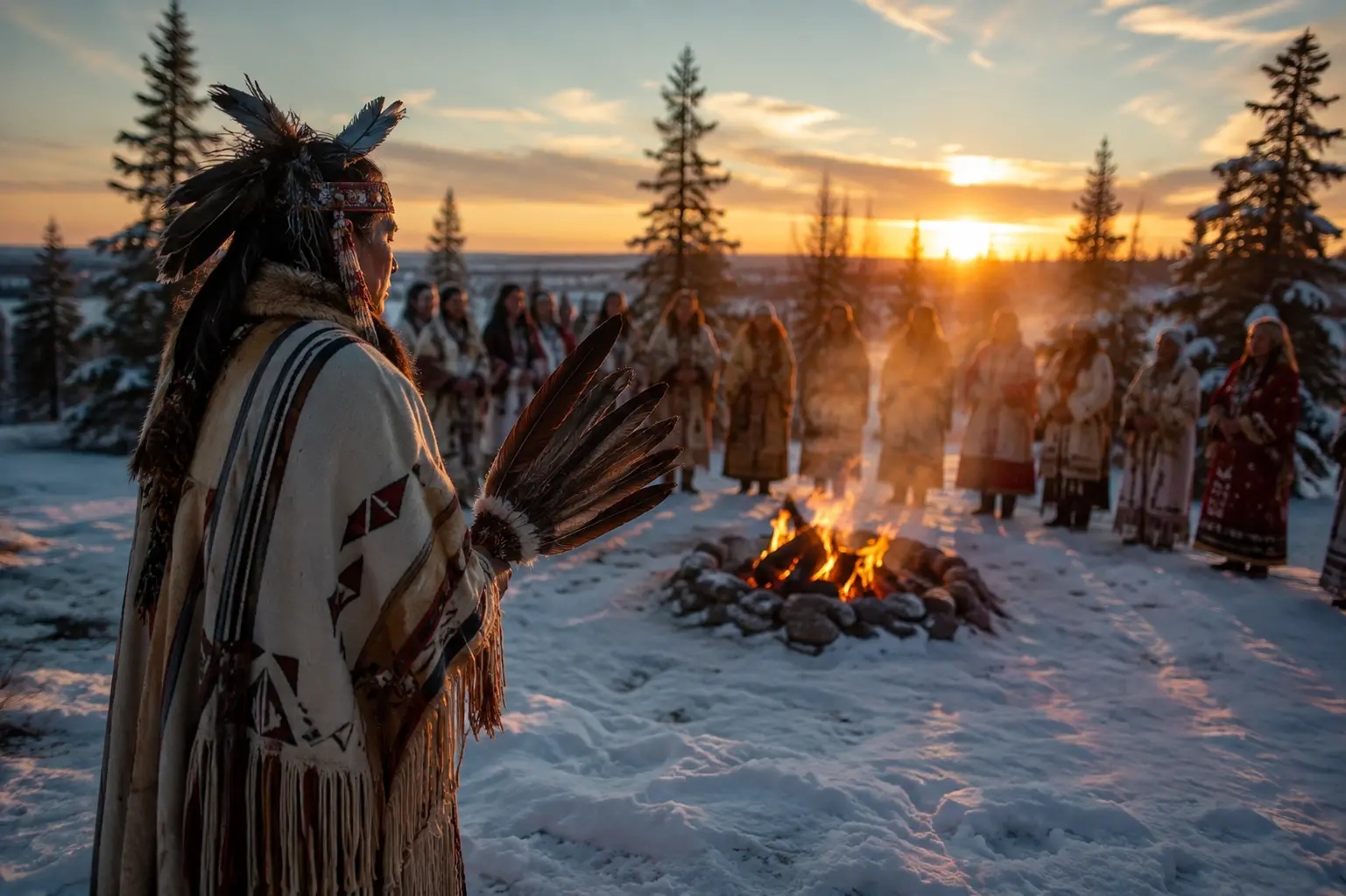
Ask ten different Indigenous people when their new year begins, and you probably won’t get the same answer twice. For the Haudenosaunee, the ceremonial year turns during winter, with Midwinter timed to a new moon and the position of the Pleiades. In some Pueblo communities, an important winter dance marks the return of the sun. Among Southeastern nations, the first corn of summer brings its own period of renewal. The Alutiiq people of Kodiak Island even have two January New Year observances, reflecting both the modern Gregorian calendar and the older Julian calendar connected to their Russian Orthodox history.
So, is there a single Native American New Year? Not really.
“Native American” covers hundreds of distinct Indigenous nations in the United States and Canada, each with its own history, language, government, traditions, and ways of keeping time. Some communities have ceremonies that genuinely function as a new year, while others mark an important seasonal change, harvest, or the return of an animal or food source. Those celebrations can involve the same ideas people associate with a fresh start, but that doesn’t necessarily make them New Year’s ceremonies.
That distinction is worth keeping in mind as you explore these traditions. They aren’t variations of one giant Native American holiday. They come from different peoples and places, and many are still practiced today.
There Isn’t One Native American New Year
The easiest way to understand Indigenous New Year traditions is to forget the idea that everyone starts the year on January 1.
The Gregorian calendar gives much of the modern world a fixed date for the beginning of the year. Traditional Indigenous calendars often worked differently. The moon, stars, changing seasons, crops, rivers, and animals could all provide clues about where the community stood in its yearly cycle. In some cases, the timing of an important ceremony could shift from one year to the next because it depended on what people were observing in the natural world.
The Haudenosaunee Midwinter Ceremony is a good example. Its timing is connected to a winter new moon and the position of the Pleiades, so it doesn’t simply fall on the same printed date every year. The Green Corn Ceremony follows a completely different rhythm. It comes in summer, when the first corn ripens, and brings together fasting, purification, thanksgiving, forgiveness, and a new fire.
Then there are traditions such as first-salmon ceremonies in the Pacific Northwest. These welcome the return of an important food source and renew the relationship between people and salmon. They aren’t literally New Year’s celebrations, but they do mark the beginning of another seasonal cycle.
This is why the phrase “Native American New Year” needs a little context. There isn’t one answer that can be applied to every Indigenous nation.
What Does “New Year” Mean in Indigenous Cultures?
For many people, a new year is simply the point when December ends and January begins. Traditional Indigenous systems of timekeeping could be much more closely tied to what was happening outside the community.
People watched the sky. They followed the moon. They noticed when certain stars appeared in familiar positions. Farmers watched crops develop, while communities that depended on fishing or hunting paid attention to the seasonal return of important animals and food sources.
In that sense, the calendar wasn’t necessarily something separate from everyday life. It was part of understanding the land and the changes taking place around you.
Lunar and Star-Based Timekeeping
Some Indigenous nations used lunar cycles to keep track of the year, sometimes alongside observations of particular stars. The Haudenosaunee ceremonial year, for example, follows thirteen moons rather than twelve fixed Gregorian months.
The Pleiades, also known as the Seven Dancers, are important to the timing of the Haudenosaunee Midwinter Ceremony. Because the ceremony follows a combination of lunar and astronomical observations, its timing can move slightly from one year to another.
That’s quite different from looking at a calendar and knowing that a holiday will always fall on the same date.
Solstices and Equinoxes
The winter solstice can also serve as an important seasonal marker. It is the shortest day of the year in the Northern Hemisphere, after which daylight gradually begins to increase again.
Several Pueblo traditions are connected with the winter solstice and the return of light. Equinoxes can also have significance in some regional ceremonial calendars, particularly because they mark a point when day and night are roughly balanced.
That doesn’t mean every Indigenous nation follows the solstice or equinox in the same way. Each ceremonial calendar belongs to a particular community, so it is better to look at individual nations rather than create one general rule.
Agricultural Cycles
For farming communities, the most important turning point may be found in the fields rather than the sky.
The Green Corn Ceremony is one of the clearest examples. Among Muscogee, Cherokee, Choctaw, Chickasaw, Seminole, Yuchi, and other Southeastern nations, the ripening of the first corn brings an important period of ceremony, thanksgiving, purification, and renewal.
The timing makes sense within an agricultural way of understanding the year. The arrival of new food isn’t just a practical event. It is something to acknowledge and give thanks for.
First Foods and Seasonal Returns
The same idea appears in other parts of North America through first-food traditions. In the Pacific Northwest, salmon return to rivers each spring, and several tribes hold ceremonies to welcome the first salmon. In Alaska Native communities, seasonal traditions can be connected to seals, whales, and other animals that play an important role in subsistence and community life.
These aren’t all New Year ceremonies in the strict sense. They do, however, show another way of understanding renewal. A new cycle can begin when something important returns to the land, water, or community.
A Quick Look at Different Timekeeping Traditions
| Timekeeping tradition | What it follows | Examples |
|---|---|---|
| Lunar and star cycle | New moon and star positions such as the Pleiades | Haudenosaunee |
| Winter solstice | Shortest day and return of increasing sunlight | Rio Grande Pueblo communities |
| Agricultural cycle | Ripening of the first corn | Muscogee, Cherokee, Choctaw, Seminole, Chickasaw |
| Julian calendar | Fixed dates connected to Russian Orthodox history | Alutiiq |
| First-food cycle | Return of salmon | Yakama, Umatilla, Nez Perce, Lummi, Puyallup |
| Animal and subsistence cycle | Seasonal seal and whale traditions | Cup’ik, Iñupiaq |
One practical point follows from all of this: if you’re trying to find out when a particular ceremony will happen, don’t rely only on a generic “Native American holidays” calendar. Check information from the nation, pueblo, tribal organization, or cultural center involved. The timing may depend on observations and decisions that aren’t captured by a standard calendar.
Why January 1 Isn’t a Universal Indigenous New Year
January 1 belongs to the Gregorian calendar, which became the civil calendar used throughout much of the modern world. It wasn’t the traditional calendar of Indigenous nations across North America.
That doesn’t mean Indigenous people don’t celebrate January 1. Many do. Families may gather for dinner, stay up until midnight, watch fireworks, or simply enjoy the holiday together. That’s part of contemporary life, and there’s nothing unusual about an Indigenous person celebrating the same modern holiday as everyone else.
The important distinction is that January 1 and a nation’s traditional ceremonial calendar can exist side by side.
Someone might celebrate New Year’s Eve on December 31 and then participate in a traditional Midwinter Ceremony later in January. Another person might celebrate January 1 and also observe Green Corn during the summer. Modern and traditional calendars aren’t necessarily competing with each other.
That is also why it is misleading to talk about Indigenous traditions as though they belong to a distant past. These are living cultures, and people continue to decide how their traditions are practiced, taught, shared, and passed on.
The Haudenosaunee Midwinter Ceremony
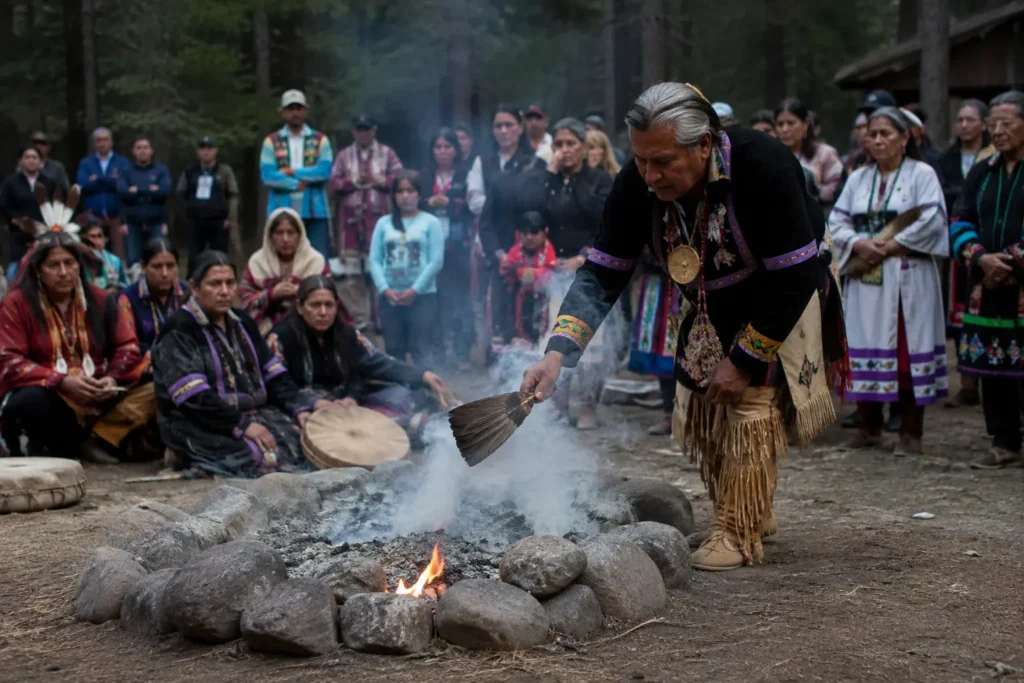
For the Haudenosaunee Confederacy, Midwinter is one of the most important ceremonial periods of the year and is often described as their new year. The Haudenosaunee Confederacy includes the Mohawk, Oneida, Onondaga, Cayuga, Seneca, and Tuscarora nations.
Midwinter generally begins in late January. Its timing is connected to a winter new moon and the position of the Pleiades, or Seven Dancers, in the night sky. Depending on the longhouse and community, the ceremony can continue for several days, with five to nine days being a common range.
The focus is renewal, but it isn’t simply a celebration where people count down to a new date. The ceremony gives the community a chance to reflect on the previous year, give thanks, resolve conflicts, and prepare spiritually for the cycle ahead.
Stirring the Ashes
One of the best-known parts of Midwinter is the Stirring of the Ashes.
The ashes of the sacred fire are stirred as a symbolic way of clearing away the old year and making room for the new one. Some Haudenosaunee elders describe the action in terms of turning the earth over so that something new can grow.
It’s a simple image, but it captures the idea behind the ceremony well. The old year isn’t simply forgotten. It is acknowledged, cleared away, and followed by a fresh beginning.
Dreams, Tobacco, and Thanksgiving
Dream sharing is another part of Midwinter. Community members may share and interpret dreams from the previous weeks because dreams can be understood as revealing needs of the spirit that deserve attention during the coming year.
Tobacco also has an important ceremonial role. Community tobacco is burned as an offering, carrying thanksgiving and requests for a successful year to the Creator.
Other parts of Midwinter can include naming children born during the previous year and recognizing or renewing the roles of faithkeepers and medicine society members. Dances such as the Bear Dance, Feather Dance, and Water Drum Dance are also part of many observances.
The Peach Stone Game is another familiar element. It is traditionally played between groups, and in some communities the outcome may be viewed as a sign of what the coming harvest could bring.
Why Midwinter Is Different From a Typical New Year’s Celebration
Some Haudenosaunee speakers have emphasized the importance of keeping Midwinter separate from Christmas and the modern New Year season. The ceremony has its own focus, songs, prayers, and traditions, and its meaning isn’t based on the arrival of January 1.
At the same time, there isn’t one identical Midwinter Ceremony practiced by every Haudenosaunee community. Each of the Six Nations has its own traditions, and some ceremonial details are private to the longhouse and its members.
What can be discussed publicly is the broader picture: Midwinter is a time for thanksgiving, reflection, conflict resolution, and renewal, with its timing connected to the natural world rather than a fixed date on a modern calendar.
The Green Corn Ceremony: Renewal in the Southeast
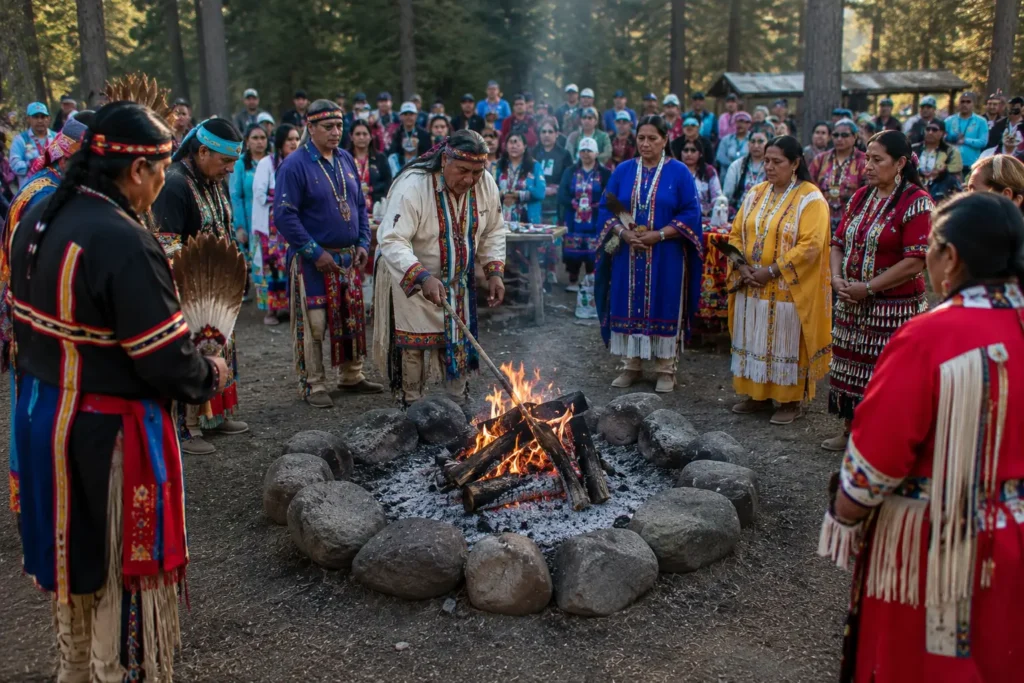
If Midwinter shows how renewal can follow the winter sky, the Green Corn Ceremony shows what renewal can look like when it follows the agricultural cycle.
The ceremony is associated with the Muscogee (Creek), Cherokee, Choctaw, Chickasaw, Seminole, Yuchi, and other Southeastern nations. Among the Muscogee, it is called Posketv or the Busk, a name connected with fasting.
It generally takes place in June or July, when the first corn ripens. Although it can feel similar to a communal reset, it is more accurate to describe Green Corn as a harvest, purification, thanksgiving, and renewal ceremony rather than a literal New Year’s celebration.
Fasting and the New Fire
The ceremony traditionally unfolds over several days, beginning with fasting and a night of vigil.
One of its central moments is the sacred fire. The old fire is extinguished, and a new one is ceremonially lit at the heart of the ceremonial grounds. Household fires can then be relit from that new fire, giving the entire community a physical symbol of beginning again.
Purification is also part of the ceremony and may involve ceremonial immersion in a nearby creek or river.
The symbolism is pretty powerful. Instead of simply saying that the new year has begun, the community actually creates a new fire and carries it back into the homes.
Forgiveness and First Foods
Forgiveness is another important part of Green Corn. Grievances and disputes from the previous year may be confessed and forgiven, with serious exceptions such as violent crimes. The idea is to avoid dragging old conflicts into another ceremonial cycle.
New foods are central as well. The first corn, beans, squash, and other foods can be offered in thanksgiving, while dances and feasting form part of the celebration.
Women may perform the Ribbon Dance, sometimes called the Ladies Dance, and stomp dances continue through the festivities. The newly ripened corn becomes part of the communal meal, connecting the ceremony directly to the harvest that made it possible.
Not Every Southeastern Nation Does It the Same Way
This is one section where it is especially important not to generalize.
Different Southeastern nations have their own versions, names, songs, ceremonial roles, and practices. Some parts are public, while others are kept private.
The Choctaw Nation has specifically noted that portions of its Green Corn Ceremony have historically been protected from outside observation. In some cases, ceremonies have even been paused when outside observers were considered disruptive.
So if you find one detailed description of a Green Corn ceremony online, don’t assume it describes every Muscogee, Cherokee, Choctaw, Chickasaw, or Seminole community. The themes may overlap, but the actual traditions belong to individual nations and communities.
Pueblo Winter Ceremonies and the Turtle Dance
In the Pueblo communities of New Mexico’s Rio Grande valley, the winter season brings another set of traditions. Several Tewa-speaking pueblos, including Ohkay Owingeh and Taos Pueblo, have ceremonies connected to the winter solstice, including the Turtle Dance.
The dance is generally held on or around January 1, which can make it look like a traditional Indigenous New Year’s celebration from the outside. Its actual timing, however, is connected to the winter solstice and each pueblo’s own ceremonial calendar rather than simply following the Gregorian date.
Why the Turtle?
The turtle is associated with the first creature to stir after the depths of winter, making it a fitting symbol for the beginning of a new cycle.
During the dance, performers may wear turtle-shell rattles tied to their legs along with strings of bells. The dancers perform in the pueblo plaza from sunrise into the afternoon, while songs in the Tewa language are repeated throughout the day.
The songs give thanks for the return of the sun and express hopes for renewal, fertility, and balance in the coming cycle.
At Ohkay Owingeh, the Turtle Dance doesn’t stand alone. It follows earlier seasonal dances, including Deer dances in October and Buffalo dances in November, making it part of a larger ceremonial sequence connected to the changing seasons.
January 1 can also have a civic role at several pueblos. Tribal governors and officials may be formally recognized in a ceremony sometimes known as the Transfer of Canes, giving the day both ceremonial and governmental significance.
One important point is easy to miss here: Pueblo peoples are not one single culture. Each pueblo has its own government, history, ceremonial calendar, and rules about visitors. What happens at Taos Pueblo should not automatically be presented as what happens at every Pueblo community.
Alaska Native New Year and Seasonal Traditions
Alaska brings yet another set of traditions into the picture. Indigenous cultures across the state have their own histories and practices, many of which are closely connected to subsistence, animals, and the environment. Along parts of the coast, Russian Orthodox history has also influenced the way some communities observe the calendar.
The Alutiiq New Year
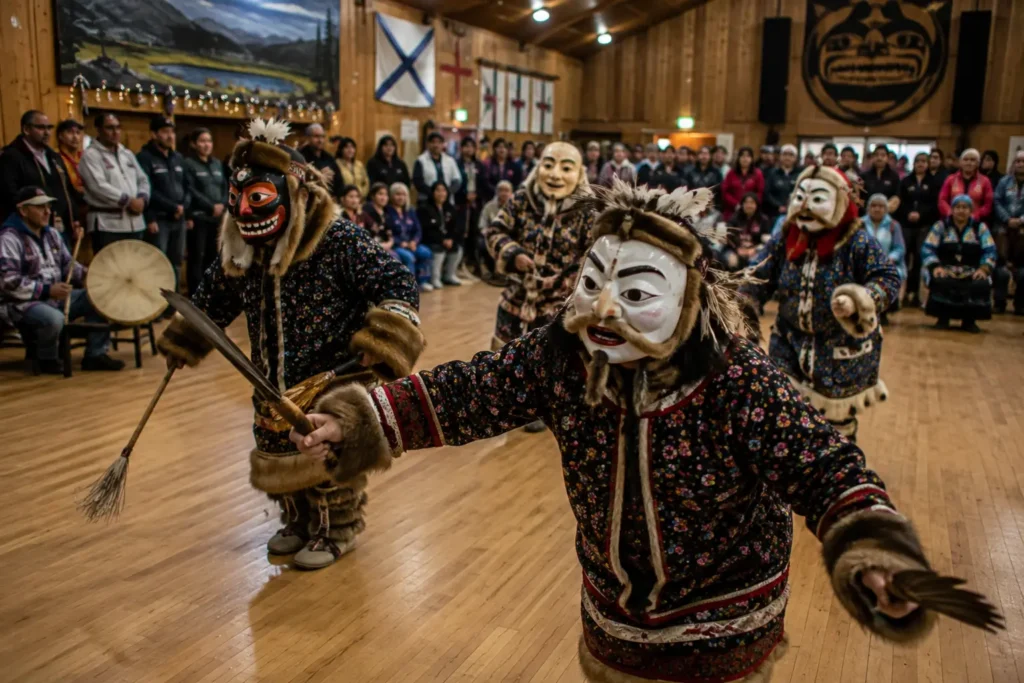
The Alutiiq people of Kodiak Island have a particularly interesting New Year tradition because January can bring two celebrations.
January 1 follows the Gregorian calendar used by the wider society. January 14 corresponds to New Year’s Day on the older Julian calendar, which is still used by the Russian Orthodox Church.
The January 14 celebration centers on a masquerade ball. The masks have roots in older Alutiiq winter traditions in which dancers represented animal spirits and sought future prosperity. Over time, the celebration also picked up influences from other communities.
Russian dishes prepared with traditional subsistence foods became part of the celebration, while dances such as polkas and waltzes were introduced through Scandinavian fishing communities.
It is a good reminder that living traditions can change without simply disappearing. Outside influences can become part of a community’s history while older cultural meanings continue underneath.
Seal and Whale Traditions
Other Alaska Native traditions are more directly tied to seasonal hunting and relationships with animals.
The Cup’ik people traditionally held a bladder festival in November or December. The bladders of seals taken during the hunting season were honored and then returned to the sea through the ice. The practice was connected to the belief that an animal’s spirit lived in its bladder and could return the following year if it was treated with respect.
The Iñupiaq Nalukataq takes place in spring after a successful whale hunt. It honors the whales taken during the season and includes the well-known blanket toss.
Neither of these is technically a New Year ceremony, but both show another way renewal can be understood. The important cycle isn’t necessarily a calendar date. It is the continuation of the relationship between people, animals, and the environment that sustains them.
First Salmon Ceremonies and Renewal Through the Land
In the Pacific Northwest, the return of salmon brings another important seasonal tradition.
Tribes including the Yakama, Umatilla, Nez Perce, Lummi, and Puyallup hold first-salmon ceremonies in the spring. The first Chinook salmon is welcomed with songs, drumming, ceremonial practices, and a shared meal.
This isn’t just a celebration because someone caught a fish.
The ceremony recognizes the relationship between the people and the salmon. The fish return to the rivers and provide food, while people have responsibilities of their own, including caring for the environment and protecting the salmon runs so that the relationship can continue.
Lewis and Clark documented witnessing a first-salmon ceremony at Celilo Falls on the Columbia River in 1806, and these traditions continue among tribes in the region today.
That makes first-salmon traditions useful when thinking about Indigenous ideas of renewal, even though they aren’t New Year’s ceremonies in the same sense as Haudenosaunee Midwinter. The beginning of a new cycle can be marked by the return of something the community depends on, whether that is salmon, corn, sunlight, or another important part of the natural world.
Why Fire Appears in Some Renewal Traditions
Fire is one of the strongest recurring images in these traditions, but it would be a mistake to turn that into a claim that there is one universal Indigenous “fire ceremony.”
The Haudenosaunee Stirring of the Ashes is part of Midwinter. In the Green Corn Ceremony, the old sacred fire is extinguished and a new one is lit, allowing household fires to be renewed. Those are specific practices belonging to specific nations.
Other traditions don’t center on fire at all. The Pueblo Turtle Dance focuses on the return of the sun, while Alaska Native traditions discussed here emphasize animals, masks, subsistence, and the sea.
The broader connection is the idea of starting again. In one tradition that may be represented by a new fire. In another, it may involve fasting, purification, forgiveness, welcoming the sun, or receiving the first food of a new season.
The similarities are worth noticing, but they shouldn’t erase the differences between the nations that practice them.
Traditional Ceremonies vs. Powwows
Dance, singing, and drumming appear throughout many Indigenous traditions, which can sometimes make it difficult for outsiders to tell one kind of event from another.
A traditional ceremonial dance isn’t automatically a powwow.
The Bear Dance, Feather Dance, Water Drum Dance, Green Corn stomp dances, and Turtle Dance all belong to specific cultural and ceremonial contexts. Powwows are different. They are generally intertribal social gatherings that can bring together people from different nations and may include competitive dancing, drumming, food, vendors, and other community activities.
Many powwows are open to the public, including non-Native visitors. They are an important part of contemporary Native life, but they shouldn’t be used as a generic label for Indigenous ceremonies.
So if you see a powwow taking place around New Year’s Day, that doesn’t automatically mean it is a nation’s traditional New Year celebration. The purpose and context of the event matter.
Can Indigenous People Celebrate January 1 Too?
Absolutely.
There is no contradiction in an Indigenous family celebrating the modern New Year while also observing a traditional ceremonial calendar.
Someone might have a family dinner on December 31, watch fireworks at midnight, and then participate in Midwinter later in January. Someone else might celebrate January 1 and take part in Green Corn when summer arrives.
That’s simply what living culture looks like.
Indigenous traditions have changed over time, sometimes because of outside pressure and sometimes because communities themselves have adapted practices to new circumstances. The Alutiiq masquerade is one example of a tradition that carries older meanings while also reflecting influences from Russian Orthodox and neighboring communities.
What matters is that these traditions continue to be practiced and passed down. They aren’t frozen historical artifacts. They belong to communities that are still here and still deciding how their cultural traditions should be carried forward.
Native American New Year Traditions at a Glance
| Nation or region | Tradition | Approximate timing | Main focus |
|---|---|---|---|
| Haudenosaunee | Midwinter Ceremony | Late January | Renewal, thanksgiving, reflection |
| Muscogee and other Southeastern nations | Green Corn Ceremony | June or July | First corn, purification, forgiveness |
| Ohkay Owingeh, Taos Pueblo | Turtle Dance | Around January 1 | Return of the sun, renewal, fertility |
| Alutiiq | January 14 New Year celebration | January 14 | Julian-calendar New Year, masquerade |
| Cup’ik | Bladder Festival | November or December | Seal renewal and respect |
| Iñupiaq | Nalukataq | Spring | Whaling, thanksgiving, community |
| Yakama, Umatilla, Nez Perce, Lummi, Puyallup | First Salmon Ceremony | Spring | Return of salmon |
The timing above is approximate, and the traditions aren’t interchangeable. Some are public, some are private, and some have both public and restricted portions.
Are These Ceremonies Open to Visitors?
There isn’t one rule for all Indigenous ceremonies.
Some events are public and welcome visitors, while others are restricted to community members. Even when a ceremony is open, photography or recording may not be allowed. Some pueblos can also change their visitor policies or close to outsiders without much advance notice.
If you are planning to attend, check directly with the nation or pueblo before you go. Ask whether the event is open that year and whether there are rules about photography, video, clothing, or where visitors can stand.
Most importantly, don’t assume that being allowed to attend one public ceremony gives you access to everything else. An invitation is usually specific to that event. If a community has chosen to keep part of a ceremony private, that boundary should simply be respected.
How to Learn About These Traditions Respectfully
For a topic like this, the best sources are often the communities themselves.
Official tribal websites, museums, cultural centers, and publications can explain traditions in a way that reflects how the people who practice them want them represented. This is especially useful when you’re researching ceremonies because not every detail is meant to be public.
If you’re visiting a public dance, feast day, or other event, it’s a good idea to contact the nation or pueblo beforehand rather than relying on an old blog post or a generic holiday calendar.
And if information isn’t available online, don’t assume you need to dig harder until you find it. Sometimes the information isn’t public because the community has chosen to keep it within the community. That’s a boundary worth respecting.
Common Misconceptions About Native American New Year Traditions
“There is one Native American New Year.”
There isn’t. Different Indigenous nations mark the turning of the year according to their own calendars, seasons, ceremonies, and relationships with the natural world.
“All Native American tribes celebrate the same traditions.”
They don’t. Haudenosaunee, Muscogee, Pueblo, Alutiiq, and Alaska Native traditions come from different cultures and shouldn’t be treated as interchangeable.
“January 1 was the traditional Indigenous New Year.”
For most Indigenous nations, it wasn’t. January 1 comes from the Gregorian calendar, although many Indigenous people celebrate it today as part of contemporary life.
“Every seasonal ceremony is a New Year ceremony.”
Not necessarily. First-salmon ceremonies, seal-related festivals, and Nalukataq focus on particular foods, animals, or seasonal relationships rather than functioning as literal New Year celebrations.
“Powwows are Native American religious ceremonies.”
Powwows are generally intertribal social gatherings centered on dance, drumming, community, and often competition. They are different from nation-specific ceremonial traditions.
“All Indigenous ceremonies are open to the public.”
Some are, some aren’t, and some have public portions while keeping other parts private. Visitor and photography rules can also vary.
“These traditions are ancient and unchanged.”
They’re living traditions. Many have adapted over time and absorbed outside influences while continuing to carry important cultural meanings.
Frequently Asked Questions
Do Native Americans celebrate New Year’s Eve?
Many Indigenous people celebrate January 1 with family gatherings, food, and other modern New Year’s traditions. At the same time, their nations may observe traditional ceremonies at different points in the year.
What is the Native American New Year?
There isn’t one. The Haudenosaunee observe Midwinter in late January, Southeastern nations have Green Corn traditions in summer, and some Pueblo communities hold winter ceremonies connected to the solstice.
Did Native Americans have their own calendars?
Yes. Many Indigenous nations used systems based on the moon, stars, solstices, seasons, crops, and the return of important foods or animals. The Haudenosaunee ceremonial calendar, for example, follows thirteen moons.
Is the Green Corn Ceremony a New Year’s celebration?
It is a major renewal ceremony, but it is more accurately described as a harvest, purification, thanksgiving, and forgiveness ceremony connected to the first corn of the season.
What is the Haudenosaunee Midwinter Ceremony?
It is the major annual ceremonial period of the Haudenosaunee Confederacy and functions as an important renewal of the ceremonial year. It is held in winter and includes traditions such as the Stirring of the Ashes, dream sharing, dances, thanksgiving, and naming ceremonies.
Do Native American traditions include fireworks?
Fireworks aren’t a traditional part of ceremonies such as Midwinter or Green Corn. Some Indigenous families do use fireworks when celebrating the modern January 1 holiday.
Are Indigenous ceremonies open to the public?
It depends on the nation and event. Some are public, while others are restricted or have private portions. Even public ceremonies may have rules against photography or recording.
What foods are associated with Indigenous seasonal celebrations?
It varies by region. Corn is important to Southeastern traditions, salmon plays a central role in Pacific Northwest first-food ceremonies, and seal and whale are important in some Alaska Native traditions. There is no single food associated with all Indigenous New Year traditions.
Leave a Reply
You must be logged in to post a comment.