
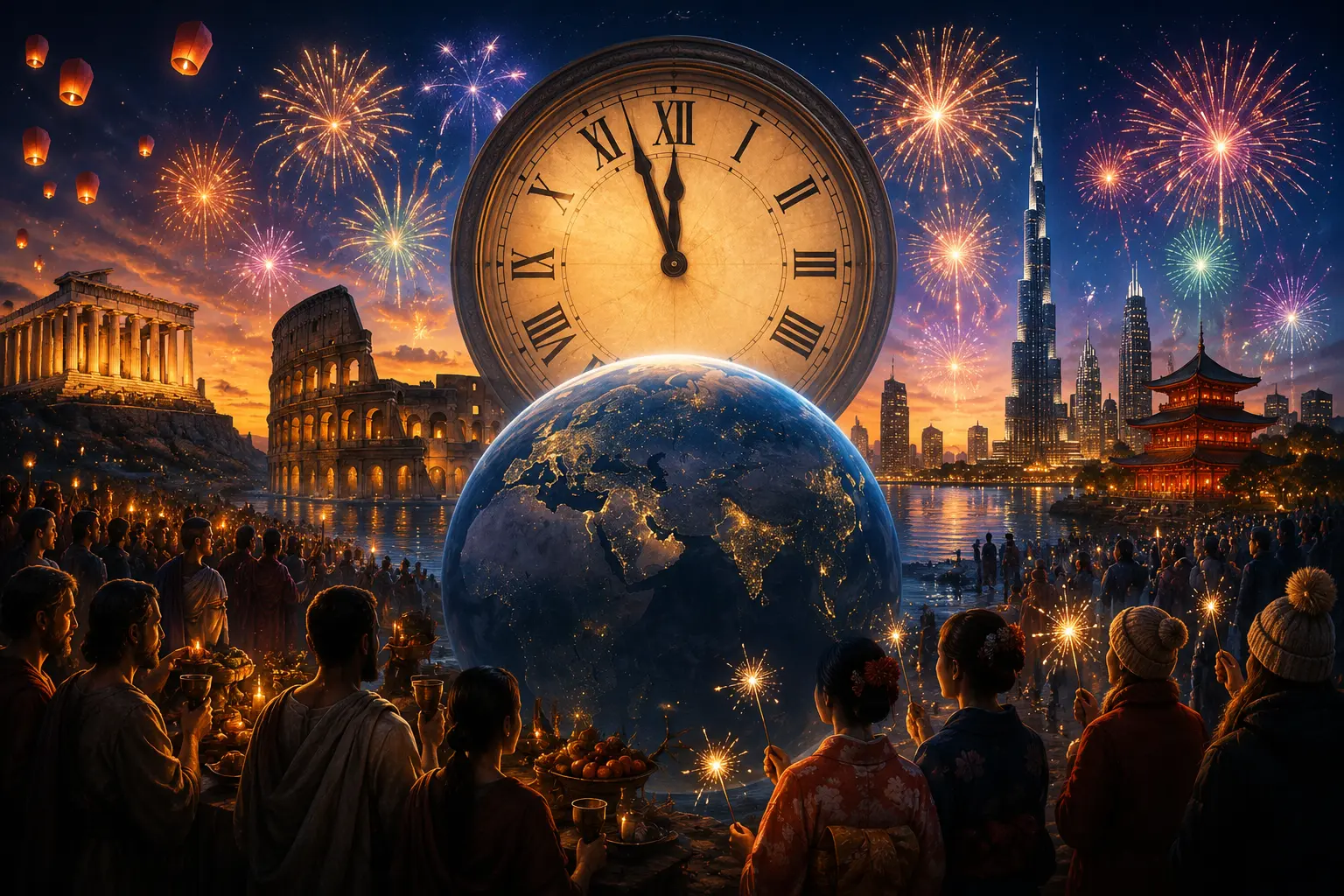
So every single year, right around the same time, the whole planet does this weird collective thing where we all agree to just start counting over again. Somewhere a clock hits midnight, somebody yells happy new year, fireworks go off, and just like that, we’ve decided the past year is officially done and a fresh one has begun. But have you ever actually stopped and wondered where this whole thing came from? Like why January 1st specifically? Why do we kiss at midnight, or eat grapes, or jump into freezing cold oceans, or hang onions on our doors? Turns out the story behind all of this is way older, way weirder, and way more interesting than most of us ever bother to ask about.
Let’s actually dig into it.
The New Year Didn’t Always Start in January
Here’s something that kind of blows my mind every time I think about it. For most of human history, January 1st wasn’t the new year at all. Not even close.
The earliest recorded new year celebrations we know of go all the way back to ancient Babylon, somewhere around four thousand years ago. And get this, their new year didn’t happen in the dead of winter like ours does. It happened in spring, tied to the planting season, right around what we’d now call late March. Made sense for them honestly. New crops, new growing season, new year. There’s a logic there that our modern January 1st kind of lacks if you really think about it, because nothing in nature is actually starting over in the middle of winter.
The Babylonians threw this massive eleven day festival called Akitu to mark the occasion. It wasn’t just partying either, it was tangled up with religion, mythology, and even politics. Kings would basically get their power symbolically renewed during this festival. Imagine that, your entire year, your entire rule as king, hinging on some ceremony that happened once a year at the start of spring.
Then the Romans Got Involved and Messed With the Calendar
Fast forward a good while and the Romans enter the picture, and honestly, they’re a big part of why we celebrate the new year when we do today.
Originally, the Roman calendar also started in March, similar to the Babylonians. Ten months, starting in spring, ending in what we’d now think of as December. But calendars back then were kind of a mess, honestly, inconsistent, adjusted by priests and politicians for their own reasons, sometimes stretched out or shortened depending on who was in charge and what they wanted.
Then Julius Caesar showed up and decided enough was enough. He introduced what we now call the Julian calendar around 45 BC, and this is the moment January 1st actually enters the story. Caesar moved the start of the year to January 1st, partly to honor Janus, the Roman god of beginnings, transitions, and doorways. Janus is depicted with two faces, one looking backward into the past, one looking forward into the future, which honestly is a pretty perfect symbol for what New Year’s Eve is even about. You’re standing right at that doorway, looking both directions at once.
This is also where a lot of early new year traditions actually started. Romans would exchange gifts, they’d make promises to be better people in the coming year, basically the ancient version of a new year’s resolution, and they’d hold parties and celebrations to welcome in the fresh start.
Speaking of resolutions specifically, that habit runs even deeper than most people realize. The ancient Babylonians, way back during that spring Akitu festival we talked about earlier, actually made promises too, things like paying off debts they owed or returning objects they’d borrowed. So this idea of using the new year as a checkpoint to become a better version of yourself, to clean up loose ends and start fresh, isn’t some modern self-help invention at all. It’s literally one of the oldest documented human traditions we have, thousands of years old, and we’re still doing some version of it every single December 31st without even realizing how far back it actually goes.
Why the Calendar Got Confusing Again After That
You’d think once Caesar fixed the calendar, that would be that. Nope. Calendars kept shifting around for centuries after this, especially once Christianity spread across Europe. A lot of regions moved the start of the new year to religious dates instead, sometimes March 25th, sometimes Christmas Day, sometimes Easter. For a big chunk of the Middle Ages, there wasn’t even a consistent answer across Europe for when exactly the new year began. Different countries, sometimes even different regions within the same country, celebrated on totally different dates.
It wasn’t until Pope Gregory XIII introduced the Gregorian calendar in 1582 that January 1st really got locked in as the standard new year date across most of the Western world. This calendar was actually created to fix some drift in how the Julian calendar tracked the solar year, but as part of the reform, January 1st became the official start of the year again, this time for good, at least across most of Europe and eventually the majority of the world.
Even then, some countries took a while to actually adopt it. England and its colonies, including what would become the United States, didn’t switch over to January 1st as new year’s day until 1752. Before that, England had been starting their year in March, which sounds wild today but honestly wasn’t that different from where this whole story started with the Babylonians.
So Why Do We Celebrate at Midnight Specifically
This part is actually pretty simple once you think about it. Midnight represents that literal, physical transition point between one day and the next. It’s the moment the clock rolls over, the exact second the old date becomes the new date. Culturally, we’ve turned that literal transition into a symbolic one too. The last second of December 31st becomes this weirdly loaded moment where an entire year’s worth of memories, mistakes, and milestones officially closes out, and a brand new set of 365 blank days opens up right in front of you.
That’s honestly part of why New Year’s Eve carries this emotional weight that most other calendar dates just don’t have. It’s not really about the number changing. It’s about what that number represents, a clean slate, another shot, a chance to actually be different this time around.
Now Let’s Get Into How Different Countries Actually Celebrate This
Okay so here’s where things get really fun, because once you start looking at how different cultures celebrate the new year, you realize just how differently people have chosen to mark this same universal moment.
The United States
Most people picture the Times Square ball drop when they think of American New Year celebrations, and for good reason, it’s been happening since 1907 and it’s become this massive, televised, almost mythic event. Millions of people either show up in person, freezing in Times Square for hours, or watch it happen live from their couch with a drink in hand, counting down the final ten seconds together as one nation staring at a giant crystal ball slowly descending a pole.
Beyond that, a lot of American traditions actually borrow from other cultures. Eating black eyed peas and greens for good luck and prosperity is a Southern tradition with roots tracing back to African and Jewish customs. Making resolutions is basically a straight continuation of that old Roman habit of promising to be better in the coming year.
Scotland
Scotland’s new year celebration, called Hogmanay, might honestly be one of the most elaborate new year traditions on the planet. It stretches across multiple days and involves torch processions, fireballs swung on chains, and a tradition called first footing, where the first person to cross your threshold after midnight is supposed to bring luck for the year, especially if they show up with symbolic gifts like coal, bread, salt, or whisky.
There’s something kind of beautiful about that specific tradition if you think about it. The very first person who walks into your home in the new year is treated like they’re carrying the entire year’s fortune with them.
Spain
In Spain, and across a lot of Latin America too, there’s a tradition of eating twelve grapes at midnight, one grape for each strike of the clock’s twelve chimes. Each grape is supposed to represent good luck for one month of the coming year. Eating all twelve in time, without choking or falling behind the chimes, is considered a genuinely good omen. It sounds simple but if you’ve ever actually tried it, twelve grapes in about twelve seconds is honestly harder than it sounds.
Japan
Japan’s new year, called Oshogatsu, leans heavily into themes of purification and fresh starts, way more spiritually focused than a lot of Western celebrations. Homes get a deep clean before the new year arrives, almost a symbolic sweeping away of the old year’s misfortune. Temples ring bells 108 times, a Buddhist tradition tied to the 108 earthly desires believed to cause human suffering, with each ring meant to cleanse one of them away. Families also eat a special dish called toshikoshi soba, long buckwheat noodles eaten specifically because their length symbolizes a long, healthy life stretching into the new year.
China
Now Chinese New Year is a whole different animal entirely, and it doesn’t even land on January 1st. It follows the lunar calendar, so the actual date shifts every year, usually falling somewhere between late January and mid February. This celebration, also called the Spring Festival, stretches across roughly two weeks and is honestly one of the biggest, most significant celebrations in the entire world, involving what’s considered the largest annual human migration on Earth as people travel home to be with family.
Traditions include red envelopes filled with money given to children, elaborate dragon and lion dances winding through the streets, and massive fireworks displays believed to scare away bad luck and evil spirits for the year ahead. Each year is also tied to one of twelve zodiac animals, and people genuinely pay attention to what that animal supposedly means for the year’s overall energy.
India
India’s new year celebrations are honestly a bit complicated because the country is home to so many different religions and regions, each with their own new year date and set of traditions. Diwali, the festival of lights, marks the new year in some regions and traditions, particularly tied to certain Hindu communities, and involves lighting oil lamps, elaborate fireworks, and prayers for prosperity. Other regions celebrate their new year at completely different points in the calendar entirely, tied to their own regional or religious calendars. It’s a genuinely good reminder that even within a single country, “new year” isn’t always one single unified date.
Brazil
In Brazil, especially along the coast, there’s a beautiful tradition tied to Yemoja, a deity from Afro-Brazilian religious traditions associated with the sea. Many people head to the beach at midnight, dressed in white for good luck, and offer flowers or small gifts to the ocean as a way of honoring Yemoja and asking for blessings in the year ahead. Rio de Janeiro in particular hosts one of the largest new year’s celebrations on the planet, with millions gathering on Copacabana Beach for fireworks that light up the entire coastline.
The Philippines
The Philippines has this wonderfully specific tradition centered around round shapes, since circles are believed to represent coins and therefore prosperity. Homes get decorated with round fruits, tables get set with exactly twelve round fruits for the twelve months of the year, and some people even wear polka dots on New Year’s Eve, all in the hope of attracting wealth and good fortune into the coming year.
Denmark
Denmark has one of the more physically dramatic traditions out there. At midnight, people literally jump off chairs, symbolizing leaping into the new year together. There’s also a slightly chaotic custom of smashing old plates and dishes against the doors of friends and family, and finding a big pile of broken dishware on your doorstep the next morning is actually considered a sign that you’re well liked and have plenty of friends who care about you.
South Africa
In some parts of South Africa, particularly certain neighborhoods in Cape Town, there’s a wild and honestly slightly alarming tradition of throwing old furniture and appliances out of windows as the new year begins, symbolically getting rid of the old to make room for the new. It’s become less common in recent years due to safety concerns, understandably, but it’s still a striking example of just how differently cultures physically express this same idea of letting go of the past year.
Mexico
Mexico shares that same twelve grapes tradition with Spain, a leftover from Spanish colonial influence, but it’s blended with its own unique customs too. Some people wear specific colored underwear on New Year’s Eve depending on what they’re hoping for in the coming year, red for love, yellow for money, green for health, and yes, people genuinely take this seriously, it’s a whole thing you’ll see discussed and joked about every December. There’s also a tradition of sweeping the house and literally sweeping the dust and dirt out the front door right at midnight, symbolically pushing out anything bad that happened during the previous year along with the actual dust.
Iran
Iran actually celebrates its new year, called Nowruz, at the spring equinox rather than in January, which if you think back to where this whole article started, is honestly closer to how the ancient Babylonians originally did it thousands of years ago. Nowruz has been celebrated for over three thousand years and is tied to Zoroastrian traditions long before it became a broader cultural celebration across Iran and several neighboring countries. Families set up a special table called a Haft Seen, containing seven symbolic items that all start with the letter S in Persian, each one representing something like rebirth, health, prosperity, or patience. It’s a beautiful reminder that even outside of the January 1st tradition most of the world follows now, there are entire cultures still marking their new year the exact way humans originally did it, tied to the actual turning of the seasons rather than a fixed date on a calendar.
Ecuador
Ecuador has one of the more theatrical new year traditions out there. People build and burn large effigies called años viejos, literally “old years,” stuffed with straw, old clothes, and sometimes firecrackers, meant to represent everything bad from the past twelve months. At midnight, these effigies get set on fire in the streets, a dramatic, very literal burning away of the old year to make room for whatever comes next. Some people even write down bad memories or mistakes on paper and stuff them inside the effigy before it burns, turning the whole thing into this cathartic, communal release.
Okay so step back for a second and look at all of this together. Grapes in Spain, broken plates in Denmark, ocean offerings in Brazil, temple bells in Japan, red envelopes in China. On the surface these all look wildly different from each other, and honestly they are. But underneath all of it, there’s this same exact thread running through every single one.
Every single tradition, no matter where it comes from, is really about the same two things. Letting go of whatever happened in the past year, and making some kind of intentional gesture toward hoping the next one is better. Whether that’s smashing a plate, purifying your home, eating something symbolic, or literally jumping off a chair, it’s all just different cultural language for the exact same human impulse. We want a clean slate. We want to believe things can genuinely be different this time around.
That’s honestly the part I find most interesting about all of this research. New Year’s Eve isn’t really about the calendar at all, not deep down. The calendar is just the excuse. What we’re actually doing, every single culture, every single tradition, in our own specific way, is giving ourselves permission to start over.
Why This Still Matters Today
We live in a world now where information moves instantly, where we’re more connected across cultures than any generation before us has ever been. And yet this particular ritual, marking a fresh start at the turn of the year, has survived basically unchanged in its core purpose for thousands of years, from ancient Babylon all the way to a rooftop party in New York City tonight.
Maybe that says something about how much we, as people, genuinely need this moment. Not because the date itself has any special power, but because we need permission sometimes. Permission to stop carrying the weight of a hard year. Permission to actually believe, even just for one night, that things can be different starting tomorrow.
A Few Quick Questions People Often Ask About This
Why do fireworks happen at midnight specifically?
This tradition actually goes back centuries, tied to old beliefs across multiple cultures, including ancient China, that loud noises and bright lights could scare away evil spirits and bad luck lingering from the old year. Somewhere along the way it evolved from a superstitious practice into just a spectacular way to visually mark the transition, but the original purpose was genuinely protective, not just decorative.
Is January 1st actually the new year for the whole world?
Not even close, and hopefully this whole article has made that pretty clear by now. It’s the standard for most of the Western world and countries that follow the Gregorian calendar for official purposes, but plenty of cultures follow entirely different calendars, lunar, solar, or a mix of both, and mark their new year on a completely different date, sometimes even a different season altogether.
Why do so many cultures involve food in their celebrations?
Food shows up in almost every single tradition we covered because it’s one of the most universal ways humans express hope and intention. Long noodles for long life, round fruits for prosperity, twelve grapes for twelve months of luck. Food is something everyone can participate in together, and it carries symbolism in a way that feels personal and shared at the exact same time.
Bringing It All Back Home
What strikes me most, after actually digging into where all of this comes from, is just how much effort humans across every corner of the globe have consistently put into this one specific moment. We’ve been doing this, in some form, for over four thousand years. Different names, different dates, different rituals, but the exact same underlying wish, carried forward generation after generation, culture after culture, without anyone ever really coordinating it.
Maybe that’s the real takeaway buried in all of this history. The new year was never really about the calendar flipping over to a new number. It was always about us, about our very human need to believe that a fresh start is actually possible, and that whatever went wrong before doesn’t have to define whatever comes next.
So whether you’re counting down grapes in Spain, jumping off a chair in Denmark, watching a ball drop in Times Square, burning an old year effigy in the streets of Quito, or just quietly sitting at home making a private promise to yourself the way the Romans did over two thousand years ago, you’re actually taking part in something a lot bigger and a lot older than you probably realized.
Happy new year, whenever and however yours happens to arrive.
Leave a Reply
You must be logged in to post a comment.