
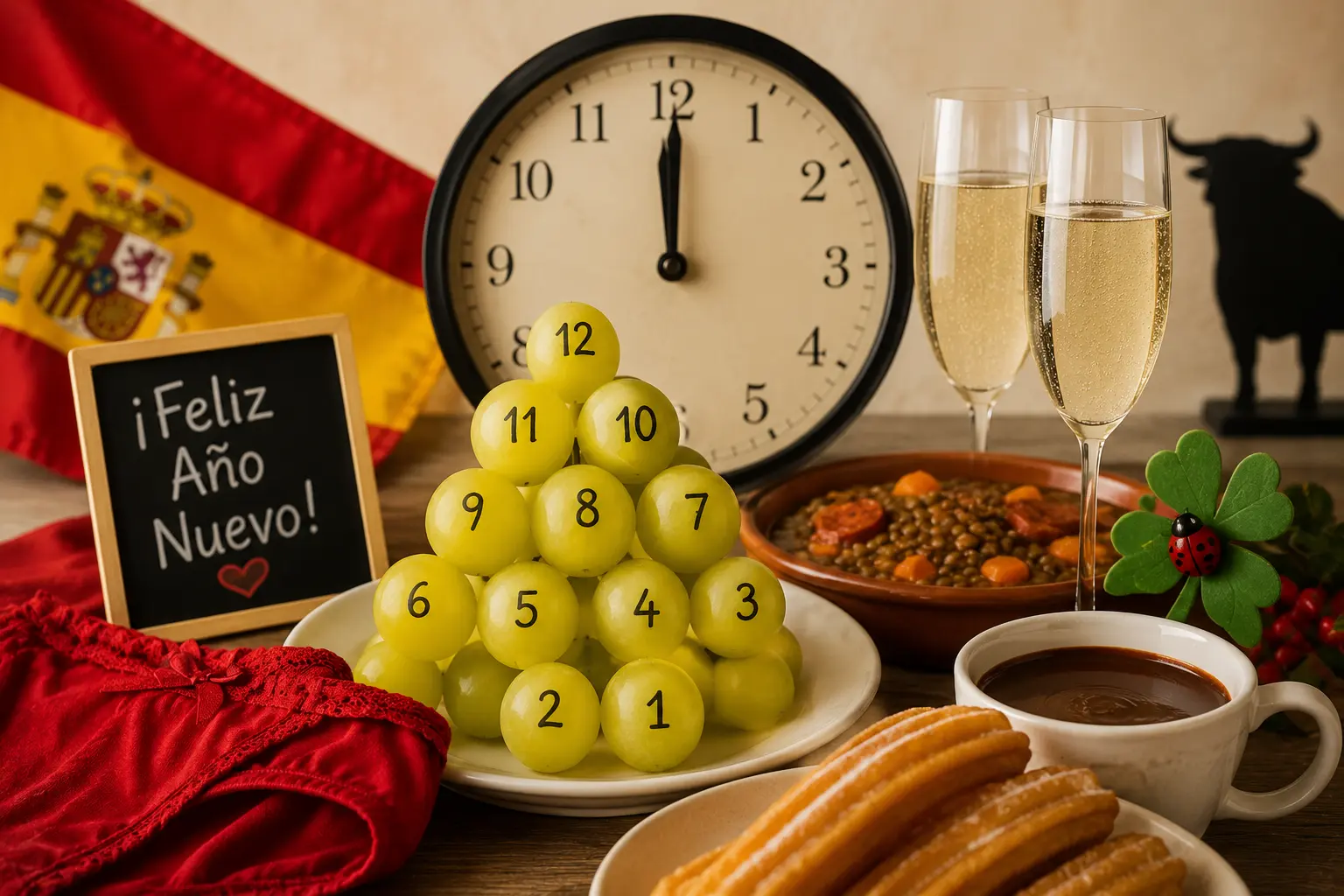
If you have ever watched Spain welcome the New Year, one image probably sticks with you the most. Twelve grapes, gone in a matter of seconds, while an entire country cheers at the exact same moment.
That midnight scramble is only the loud, famous tip of something much bigger though. Before those grapes even appear, Spanish families have already shared a long dinner, prepared their toasts, and settled into a night that often stretches all the way until sunrise. I want to walk you through the whole evening with you, not just the grape eating part everyone already knows about.
By the end of this guide, you will understand what Nochevieja really means, why the clock matters so much, and how a bowl of grapes turned into one of the most charming traditions in the world.
Getting the Names Right: Nochebuena, Nochevieja, and Año Nuevo
Before we go any further, it helps to sort out a few Spanish words that often get mixed up. Spain’s holiday season actually spans several distinct days, each with its own name and its own mood.
Nochebuena falls on December 24 and is Spain’s version of Christmas Eve, usually the biggest family dinner of the season. Nochevieja lands on December 31 and belongs entirely to New Year’s Eve, grapes and all. Then comes Año Nuevo on January 1, a much quieter day built for rest rather than celebration.
| Spanish Name | Date | What It Means |
| Nochebuena | December 24 | Christmas Eve |
| Navidad | December 25 | Christmas Day |
| Nochevieja | December 31 | New Year’s Eve |
| Año Nuevo | January 1 | New Year’s Day |
| Día de Reyes | January 6 | Three Kings Day |
The Twelve Grapes and the Campanadas
Now let’s get to the tradition everyone actually wants to hear about. It is called “las doce uvas de la suerte,” which means the twelve grapes of luck, and it happens the moment the clock strikes midnight on December 31.
The idea sounds easy enough at first. You eat one grape for each of the twelve main chimes of the clock, finishing the last grape before the ringing stops completely. Each grape stands in for one month of the year ahead, so getting through all twelve on time is meant to bring good fortune across those coming months.
Here is a detail that trips up a lot of first timers though, myself included when I first learned about it. The chimes people follow are called the campanadas, and the sequence is not just twelve random bells that start out of nowhere. A short set of warning strikes usually plays first, giving everyone a moment to get their grapes ready, and only after that does the true set of twelve main chimes begin. Start eating too early during those warning bells, and you will run out of grapes before midnight actually arrives, which honestly happens to plenty of people every single year.
Families usually prepare twelve grapes per person well ahead of time, lining them up on a small plate or bowl so nobody has to fumble around once the countdown starts. Many supermarkets even sell pre-portioned packs of exactly twelve grapes during December, seedless ones especially, since nobody wants to be picking out pips while racing against a clock.
Where the Tradition Actually Came From
You might assume there is one tidy origin story behind all this grape eating, but the real history is a little messier than that. The version you will find repeated most often online traces back to 1909, when grape growers around Alicante faced a huge surplus harvest and began marketing grapes as a lucky New Year’s charm to help move the extra fruit.
That story gets told constantly, and there is truth buried inside it, yet it does not tell the whole picture. Records actually show people eating grapes around New Year celebrations even before 1909, which means the custom already existed in some smaller form.
What the Alicante growers really did was help popularize and commercialize a tradition that was already quietly taking shape, turning a local habit into a nationwide custom within just a few years.
So instead of pinning the whole tradition to one exact date, it makes more sense to think of it as something that grew gradually and eventually became a shared national ritual. Alicante still supplies the vast majority of grapes eaten across Spain every December 31, which keeps that regional connection alive even today.
Puerta del Sol: The Beating Heart of Nochevieja
If Spain has one single spot that represents Nochevieja more than anywhere else, it has to be Puerta del Sol in Madrid. This historic square sits beneath the clock tower of the Real Casa de Correos building, and that clock has become the unofficial timekeeper for the entire nation.
Thousands of people pack into the square every year, bundled up against the cold, grapes in hand, waiting for those campanadas to begin. Television cameras stay locked on that same clock tower, broadcasting the countdown into millions of homes across Spain where families follow along from their own living rooms instead.
Because the crowds have grown so large, access to the square is now controlled during the celebration, and for the December 31, 2026 event, official capacity sits around fifteen thousand people, with visitors advised to arrive several hours ahead of time if they want a decent spot.
There is also a delightful warm up event worth knowing about called Preuvas, a playful mash up of the words “pre” and “uvas,” meaning grapes. On December 30, a full day before the real celebration, crowds gather at Puerta del Sol for a practice run of the midnight grape countdown.
The Dinner That Comes First
Long before anyone touches a single grape, Spanish families sit down for a proper Nochevieja dinner, and this meal is every bit as important as the midnight countdown that follows it. There is no single fixed menu that every household follows, since Spanish food culture shifts quite a bit from region to region and family to family.
Seafood often takes a starring role on many Spanish tables that night, especially prawns, lobster, and other shellfish treated as a special occasion indulgence. Cured meats, cheeses, and rich stews commonly round out the meal, along with festive sweets that carry over from the wider Christmas season rather than belonging strictly to New Year’s Eve.
Take a look at some of the foods and drinks that regularly show up during this stretch of the Spanish holiday calendar.
| Food or Drink | Its Role in the Celebration |
| Twelve grapes | The centerpiece of the midnight ritual, eaten one per chime |
| Turrón | A dense almond nougat that carries over from the Christmas season |
| Polvorones | Crumbly Spanish shortbread cookies enjoyed throughout the festive weeks |
| Cava | Spain’s sparkling wine, poured for the midnight toast |
| Seafood and shellfish | A festive touch reserved for special family dinners |
| Cured meats and cheeses | Common starters shared slowly over the long evening |
| Lentils | Saved for New Year’s Day, symbolizing coin shaped prosperity |
Toasting and Small Rituals for Luck
Once the grapes have been swallowed and midnight officially arrives, glasses of cava get raised all across the country. Cava is Spain’s answer to champagne, made using a similar method but produced specifically in the Catalonia region, and it is the drink of choice for that very first toast of the year.
You will hear a few different toasting phrases depending on who you are celebrating with. “¡Salud!” is the most common one, meaning cheers or literally health. “¡Chinchín!” pops up in more playful settings, while a longer and more theatrical version goes “¡Arriba, abajo, al centro y adentro!” which roughly translates to up, down, to the center, and in, usually accompanied by a bit of glass clinking choreography.
Beyond the toast itself, plenty of smaller good luck rituals fill out the rest of the night, and Spaniards generally treat them with a wink rather than deep seriousness. A few of the most common ones are worth knowing about.
- Wearing red underwear, a color linked to luck in love, often given as a gift rather than bought for yourself since buying your own is considered bad luck.
- Dropping a gold ring into your cava glass just before the toast, hoping to sip in a little financial prosperity along with the bubbles.
- Tucking a banknote into your shoe before midnight, meant to encourage steady money throughout the year ahead.
- Placing a coin under your dinner plate, a quieter version of that same wish for financial stability.
- Stepping forward with your right foot as the new year begins, tied to the popular saying about starting the year on the right foot.
After Midnight: Cotillones and Parties Until Dawn
For a lot of Spaniards, especially younger crowds, the real party actually starts once the grapes and toasts are finished. This second wave of celebration often centers around something called a cotillón, a New Year’s Eve party built around music, dancing, costumes, confetti, and plenty of noisemakers.
Restaurants, hotels, and clubs across Spain frequently organize their own cotillón events, often bundling dinner, the midnight grapes, and a full night of dancing into one ticketed package. These events can get booked up fast, so anyone planning a trip to Spain around this time should look into reservations well in advance rather than waiting until the last minute.
Spanish nightlife has a well earned reputation for running late into the night, and Nochevieja pushes that reputation even further. Bars and clubs frequently stay packed for hours after midnight, while private house parties can carry on well past sunrise.
If you are visiting a Spanish city for this occasion, keep in mind that public transport schedules often shift around this holiday, and taxis can become genuinely hard to find during the busiest overnight hours.
The Perfect Ending: Churros with Hot Chocolate
Eventually, even the most energetic Nochevieja party needs a proper ending, and Spain has a wonderfully comforting way of closing out the night. As dawn approaches, it becomes a beloved custom to stop for a plate of warm churros dipped in thick, rich hot chocolate.
There is something genuinely satisfying about this tradition once you think it through. After hours of dancing, talking, and celebrating in the cold December air, a warm churro dunked into thick chocolate feels like exactly the right way to close things out before finally heading home to sleep.
Certain cafés and chocolaterías stay open specifically for this late night rush, catering to tired but happy partygoers making their way home as the sun starts to rise.
New Year’s Day: Lentils and a Slow Morning
After such an eventful night, January 1 in Spain tends to move at a noticeably gentler pace. Shops and many restaurants often stay closed for at least part of the day, and most people spend their time resting, visiting family, or simply recovering from the night before.
Lentils frequently make an appearance on this quieter day, carrying their own bit of symbolism worth mentioning. Their small, round shape is thought to resemble tiny coins, so a bowl of lentil stew on New Year’s Day is believed to invite financial prosperity for the months ahead.
This custom shows up especially often across northern Spain, in regions like Asturias, Galicia, and Cantabria, though plenty of families elsewhere enjoy the same dish simply because it feels warm and comforting on a cold January afternoon.
How Different Regions Celebrate Nochevieja
Spain is a country made up of many distinct regions, each with its own language, food culture, and local flavor, so it makes sense that Nochevieja looks a little different depending on where you happen to be standing.
The table below breaks down a few of these regional differences.
| Region | What Stands Out |
| Madrid | Home to the famous Puerta del Sol countdown, watched live by the whole country |
| Alicante and Valencia | The historic source of Spain’s lucky grapes, still supplying most of the country’s harvest |
| Galicia | Strongly connected to the lentil tradition, alongside its own distinct regional food culture |
| Catalonia | Produces the cava used in nearly every Spanish New Year’s toast |
| Andalusia | Blends lively public celebrations with music and nightlife in cities like Seville and Málaga |
Smaller towns and villages across Spain also tend to replicate their own local version of the Puerta del Sol countdown, gathering around a central clock in the town square so residents outside Madrid can share in that same collective moment.
No matter which region you find yourself in, that shared thread of grapes, family, and midnight cheer runs through nearly every celebration.
A Few Spanish Phrases for the Night
Learning a handful of simple phrases can make your own Nochevieja celebration feel a little more authentic, even if you are nowhere near Spain when you use them.
| Spanish Phrase | What It Means |
| Feliz Año Nuevo | Happy New Year |
| Feliz Nochevieja | Happy New Year’s Eve |
| ¡Salud! | Cheers, or literally health |
| ¡Chinchín! | A playful way to say cheers |
| ¡Arriba, abajo, al centro y adentro! | A longer toast meaning up, down, to the center, and in |
A Simple Timeline of Nochevieja
Every family does things a little differently, but a typical Nochevieja tends to follow a fairly familiar rhythm from evening until the following morning.
| Time | What Usually Happens |
| Early evening | Family and friends gather together |
| Dinner | A long, relaxed meal is shared over several hours |
| Just before midnight | Twelve grapes are portioned out and made ready |
| Midnight | The campanadas ring and the grapes are eaten |
| Right after midnight | Cava is poured, along with hugs, kisses, and toasts |
| Late night | Parties, cotillones, and dancing continue |
| Early morning | Churros and hot chocolate close out the night |
| New Year’s Day | A slow, quiet day built around rest and lentils |
Tips If You Are Spending New Year’s Eve in Spain
If you happen to be traveling to Spain for Nochevieja, a few practical details will help you enjoy the night without any unnecessary stress. Dinner tends to start later than you might expect back home, and the real celebration builds gradually as the evening goes on.
Make sure you have your twelve grapes ready and portioned out well before midnight, since there is genuinely no time to prepare them once the campanadas begin ringing. If you plan to celebrate at Puerta del Sol in Madrid, remember that access is controlled and arriving several hours early is strongly recommended given the limited capacity.
Once midnight passes, expect large crowds around bars, restaurants, and public squares, along with reduced public transport schedules and taxis that can be genuinely difficult to find.
Booking a cotillón ticket in advance is also a smart move if you want to join a proper New Year’s party at a restaurant or club, since the better events tend to sell out early. And whatever you do, save a little room for churros and hot chocolate before the night is through.
Bringing a Bit of Spanish Tradition Into Your Own Celebration
You do not need a flight to Madrid to enjoy a little piece of this celebration yourself. Several of these customs travel remarkably well and slot easily into whatever New Year’s plans you already have at home.
Here are a few simple ways to give it a try:
- Portion out twelve grapes per person ahead of time and attempt the midnight countdown together as a family or group of friends.
- Pour a round of cava or sparkling wine right after the grapes, keeping the celebration flowing the way Spaniards do.
- Practice a toast phrase like “¡Salud!” so you have something festive to say the moment the clock strikes twelve.
- Wear a touch of red as a lighthearted nod to the underwear tradition, even if it is just a scarf or a pair of socks.
- Cook a pot of lentil stew the next day, both as a comforting meal and a small wish for prosperity ahead.
- End the night with something warm and sweet, channeling that churros and hot chocolate spirit even if the exact recipe is not on hand.
None of these customs demand much effort or expense, yet each one adds real warmth and intention to your own celebration.
Frequently Asked Questions About Spanish New Year Traditions
What is the main New Year tradition in Spain?
The best known tradition is eating twelve grapes at midnight, one grape for each chime of the clock, with the grapes believed to bring luck for the twelve months ahead.
What does Nochevieja mean?
Nochevieja is the Spanish name for New Year’s Eve, celebrated on December 31 with a family dinner, the midnight grapes, and celebrations that often continue until dawn.
What are the campanadas?
The campanadas are the midnight clock chimes people follow while eating their grapes, with a short set of warning strikes coming first before the true twelve main chimes begin.
What is Preuvas?
Preuvas is a rehearsal event held on December 30 at Madrid’s Puerta del Sol, where people practice the twelve grape countdown a day before the real Nochevieja celebration.
Why do Spaniards eat lentils on New Year’s Day?
Lentils resemble small coins, so eating them on January 1 is believed to bring financial prosperity, a custom especially strong in Asturias, Galicia, and Cantabria.
What is a cotillón?
A cotillón is a New Year’s Eve party featuring music, dancing, costumes, and entertainment, often hosted by restaurants, hotels, and clubs across Spain.
What do people eat after a Nochevieja party?
Churros dipped in thick hot chocolate are a beloved way to end the night, especially popular with tired partygoers heading home near sunrise.
Is New Year’s Day a big celebration in Spain?
Not really. January 1 is usually quiet, with many shops and restaurants closed, as families rest and share a comforting meal like lentil stew.
Bringing It All Together
Spanish New Year traditions carry a warmth and playfulness that feels genuinely different from a lot of other winter celebrations around the world. From the frantic grape counting to the late night churros, every part of Nochevieja seems built around bringing people together rather than rushing through the night alone.
I hope this gave you a much fuller picture of how Spain welcomes a brand new year, campanadas, cotillones, lentils, and all. Maybe you will try the twelve grapes with your own family this December, or simply raise a glass and say Feliz Año Nuevo when the clock strikes twelve. Whatever you choose to try, I wish you a warm, lucky, and joyful start to your new year ahead.
Leave a Reply
You must be logged in to post a comment.