
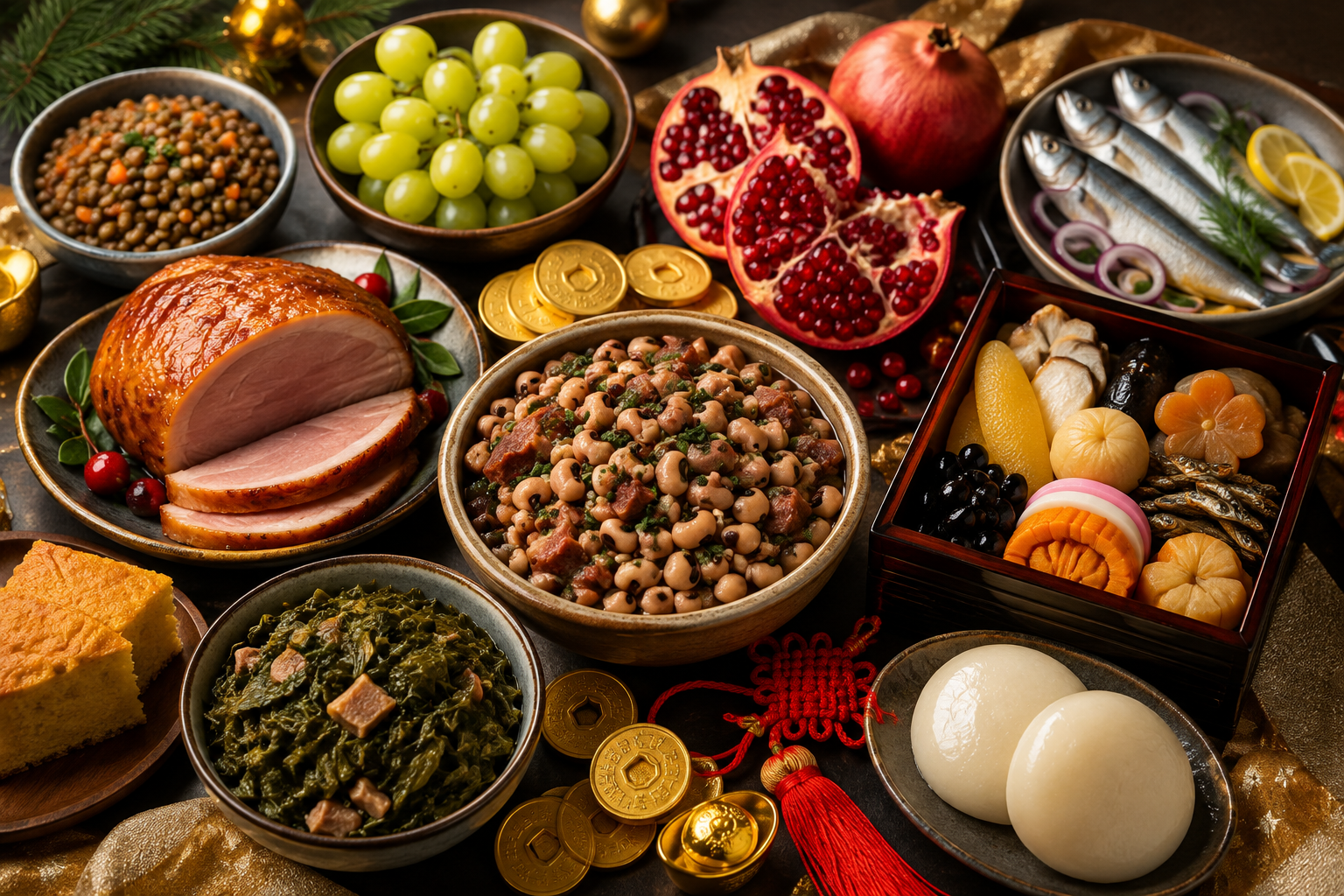
New Year’s Day good luck foods are dishes eaten on January 1 that are traditionally believed to bring wealth, longevity, or good fortune in the year ahead. In the Southern United States, that means black-eyed peas and greens. In Spain, it’s twelve grapes eaten at the stroke of midnight. In Greece, it’s a coin baked into a cake called vasilopita. In Japan, it’s a set of symbolic dishes called osechi ryori, eaten because Japan observes the Gregorian New Year on January 1, not the Lunar New Year. These are cultural traditions, some centuries old, that carry meaning through shape, color, sound, or history rather than through any proven effect on the year ahead.
What Counts as a Lucky Food?
Most New Year’s Day good luck foods fall into a few recurring categories: foods shaped like coins (round, flat, or ring shaped), foods colored like money (green), foods that grow or expand (rice, beans, noodles), and foods that swim or move forward rather than backward. Here are the foods most commonly associated with January 1 luck, along with where each tradition comes from.
- Black-eyed peas: eaten in the Southern United States, said to resemble coins.
- Leafy greens (collards, cabbage, kale): associated with paper money in Southern U.S. tradition.
- Pork: eaten in German, Central European, and some U.S. traditions; pigs root forward when they feed.
- Twelve grapes: eaten at midnight in Spain, one grape per chime of the clock.
- Lentils: eaten in Italy, their small round shape is likened to coins.
- Round fruit: displayed in sets of twelve in Filipino Media Noche tradition, symbolizing coins and a full year of abundance.
- Fish (often herring): eaten in Germany, Poland, and Scandinavia, tied to abundance and forward motion.
- Rice cakes and osechi ryori: eaten in Japan on January 1, each dish carrying its own symbolism for the year ahead.
Lucky Foods at a Glance
A side-by-side look at the most common New Year’s Day lucky foods, where each tradition is practiced, what the food is traditionally believed to represent, and how it typically reaches the table.
| Food | Tradition / Region | Symbolizes | When Eaten | Typical Serving |
| Black-eyed peas | Southern U.S. | Coins, small fortune | January 1 | As Hoppin’ John, with rice and pork |
| Collard greens / cabbage | Southern U.S. | Paper money, wealth | January 1 | Slow-cooked with ham or bacon |
| Cornbread | Southern U.S. | Gold, added prosperity | January 1 | Baked in a skillet, served on the side |
| Pork | Germany, Central Europe, U.S. South | Progress, moving forward | New Year’s Eve or Day | Roasted, or as ham alongside greens |
| Lentils | Italy | Coins, growing wealth | Midnight into Jan. 1 | As cotechino e lenticchie, with sausage |
| Twelve grapes | Spain, parts of Latin America | One wish per month | Midnight, Dec. 31 into Jan. 1 | Eaten one by one with the clock chimes |
| Pomegranate | Greece, Turkey, E. Mediterranean | Fertility, abundance, renewal | January 1 | Smashed at the doorway or eaten fresh |
| Round fruit (12 pieces) | Philippines | Coins, a full year of abundance | Media Noche, into Jan. 1 | Displayed as a centerpiece, then eaten |
| Fish or herring | Germany, Poland, Scandinavia | Abundance, forward movement | New Year’s Eve or Day | Pickled herring at midnight |
| Rice cakes (mochi) | Japan | Longevity, strength | January 1 to 3 | Part of the osechi ryori spread |
| Vasilopita (coin cake) | Greece | Luck for whoever finds the coin | Jan. 1, Saint Basil’s Day | Sliced and shared after midnight or on Jan. 1 |
| Long noodles | Various East and Southeast Asian traditions | A long life | Varies by culture and calendar | Served uncut, in broth or stir-fried |
Major Lucky Foods and Their Symbolism
Each of these foods carries its own backstory. The explanations below reflect how each tradition is commonly described, not verified history or scientific claims.
Black-Eyed Peas
In the Southern United States, black-eyed peas are the most recognized New Year’s Day food. They’re traditionally believed to resemble small coins, which is why eating them on January 1 is associated with financial luck for the year ahead. The dish most linked to this custom, Hoppin’ John, combines black-eyed peas with rice and pork. Some households aim to eat exactly 365 peas, one for each day of the year, though this is a playful custom rather than a strict rule.
Leafy Greens: Collards, Cabbage, and Kale
Greens appear on Southern New Year’s tables alongside black-eyed peas because their color is associated with paper currency. Collard greens are the most traditional choice in the American South, while cabbage plays a similar role in German and Central European households and in parts of the Northeastern United States with German or Irish heritage. The idea in each case is the same: green, leafy, and folded like a stack of bills.
Cornbread
Cornbread is often served alongside black-eyed peas and greens in the American South. Its golden color is traditionally linked to gold and added prosperity, rounding out a meal that’s meant to touch on coins, cash, and gold in a single sitting. Some households make it sweeter, others prefer a savory, skillet-baked version with a crisp crust, and the choice tends to come down to family habit rather than any rule tied to the New Year’s custom itself.
Pork
Pork shows up in New Year traditions across Germany, Austria, Hungary, Poland, and parts of the American South (often in the form of ham or the pot liquor used to cook black-eyed peas). The symbolism is tied to how pigs feed, rooting forward with their snouts rather than backward, which is why pork is associated with moving ahead into the new year rather than looking back. Some households pair the meal with a small marzipan or figurine pig for extra luck, a custom especially common in Germany and Austria.
Lentils
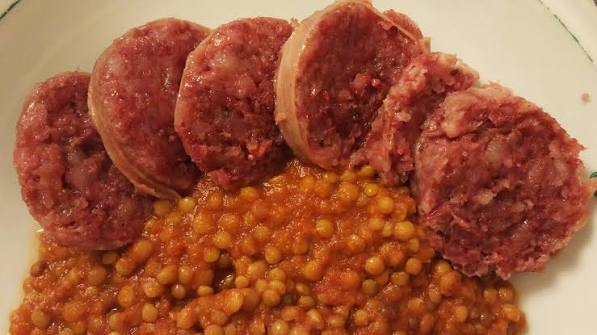
In Italy, lentils (often served as cotechino e lenticchie, a pork sausage over lentils) are eaten because their small, round, coin-like shape is associated with money. The tradition is usually tied to the transition from December 31 into January 1, with lentils served as part of the New Year’s meal rather than a stand-alone New Year’s Day dish.
Twelve Grapes
In Spain, the custom of las doce uvas de la suerte (the twelve grapes of luck) involves eating one grape with each of the twelve chimes of the clock at midnight on December 31, carrying the tradition into the first moments of January 1. Each grape is traditionally associated with good luck for one month of the coming year. The custom has also spread to parts of Latin America, including Mexico, Peru, and Venezuela, sometimes with local variations.
Pomegranate
Pomegranates are associated with New Year luck in Greece, Turkey, and parts of the wider Mediterranean and Middle East. In Greek tradition, a pomegranate is sometimes smashed against the front door on January 1, and the number of seeds that scatter is traditionally believed to reflect the abundance and fertility the household will experience in the coming year.
Round Fruit in Sets of Twelve
In Filipino tradition, a display of twelve round fruits, often called the Media Noche spread, is set on the table for New Year’s Eve into New Year’s Day. The circular shape is associated with coins, and the number twelve is tied to the twelve months of the coming year, with the goal of welcoming abundance for every month. Households often mix common fruits with a few less everyday ones for the display, since variety is generally treated as part of the wish for a fuller year, though the exact fruits used vary by family and by what’s in season.
Rice, Mochi, and Osechi Ryori
Japan observes the Gregorian New Year on January 1, and its food traditions are distinct from Lunar New Year customs celebrated in China, Vietnam, and elsewhere. On January 1 through 3, many Japanese households eat osechi ryori, a set of small symbolic dishes packed in stacked lacquer boxes. Mochi (pounded rice cakes) is associated with strength and longevity, black soybeans (kuromame) with health, and herring roe (kazunoko) with fertility and family growth. Toshikoshi soba, long buckwheat noodles eaten on New Year’s Eve, is a separate December 31 custom rather than a January 1 dish.
Fish and Herring
Fish, and herring in particular, appears in New Year traditions in Germany, Poland, and Scandinavian countries. Because fish swim forward in schools, the dish is associated with progress and abundance. Pickled herring is a common choice at midnight meals in these regions, sometimes eaten at the stroke of twelve for extra luck.
Vasilopita and Coin Cakes
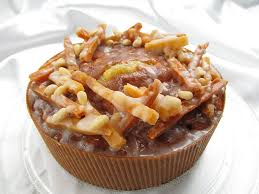
In Greece, vasilopita is a cake or sweet bread baked with a single coin hidden inside, traditionally cut and served on January 1, which is celebrated as Saint Basil’s Day. Whoever finds the coin in their slice is said to receive good luck for the year. Similar coin-in-cake customs, on different dates and with different names, appear in parts of the Balkans and elsewhere in Southeastern Europe.
Geographic and Cultural Traditions on New Year’s Day
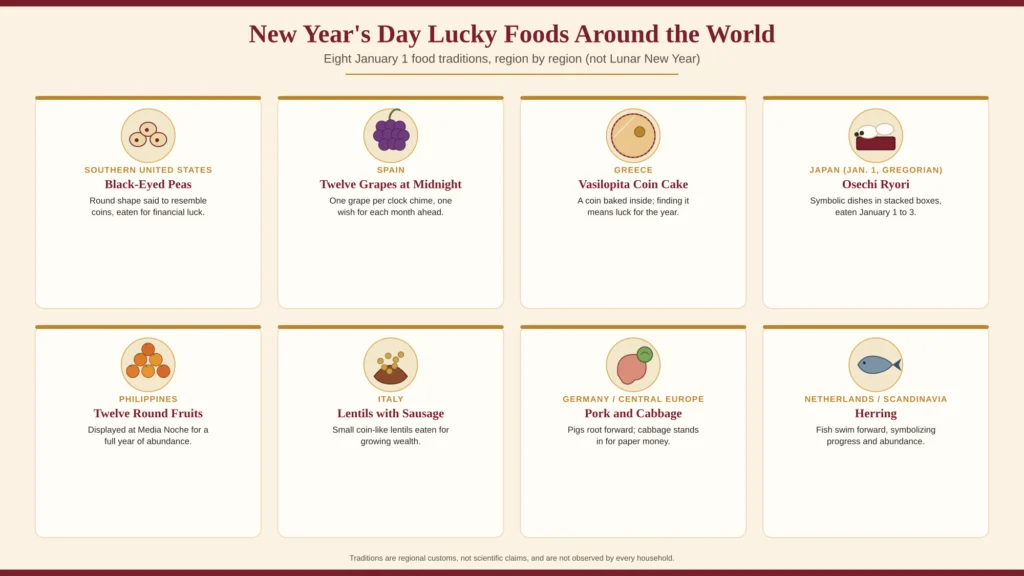
New Year’s Day lucky food traditions vary widely by country and region, and not every household within a culture follows the same custom. The traditions below are specific to January 1, observed on the Gregorian calendar. This is a different holiday from Lunar New Year, which is celebrated in China, Vietnam, South Korea, and other countries on a date that shifts each year, typically falling between late January and mid-February, and which carries its own separate set of foods and customs.
Note: January 1 and Lunar New Year are not the same holiday. Foods associated with Lunar New Year, such as dumplings, whole fish served a specific way, tangyuan, or mandarins and oranges (linked to gold in Chinese tradition), belong to a separate calendar and a separate set of cultural traditions, even in countries where some households observe both.
Southern United States
The Southern U.S. tradition centers on black-eyed peas, collard greens, cornbread, and often pork or ham. The custom is thought to have roots in African American, and more broadly Southern, foodways, and it remains one of the most widely practiced lucky-food traditions in the country on January 1. It has also spread well beyond the South itself, showing up on New Year’s tables across the United States regardless of regional background, often alongside whatever other family customs a household already keeps.
Spain
Spain’s twelve grapes tradition is a midnight custom that carries into January 1, practiced nationwide and closely tied to public countdown gatherings, including the one broadcast from Madrid’s Puerta del Sol.
Greece
Greek New Year traditions on January 1, Saint Basil’s Day, include cutting the vasilopita coin cake and, in some households, breaking a pomegranate at the doorway. Saint Basil, rather than Saint Nicholas, is the gift-giving figure associated with the Greek New Year.
Japan
Japan celebrates the New Year on January 1 under the Gregorian calendar and has done so nationally since the late 1800s. Osechi ryori, a set of symbolic dishes, is the centerpiece of the holiday, alongside customs like the first shrine visit of the year (hatsumode). This is distinct from the Lunar New Year traditions observed in China and several other East and Southeast Asian countries.
Philippines
Filipino New Year’s traditions blend Spanish and local customs. A Media Noche feast is held at midnight going into January 1, often featuring a display of twelve round fruits for abundance, along with noodle dishes for long life and sticky rice cakes.
Italy
In Italy, cotechino e lenticchie (pork sausage with lentils) is the signature New Year dish, traditionally eaten as the calendar turns from December 31 to January 1. Some regions also serve zampone, a stuffed pig’s trotter, in place of cotechino.
Germany and Central Europe
German, Austrian, and Central European New Year tables often include pork, sauerkraut or cabbage, and lentil or pea dishes, along with small marzipan pigs, four-leaf clovers, or chimney sweeps as symbolic (non-edible) luck charms. Poland and other parts of Central and Eastern Europe favor herring at midnight. The marzipan pig in particular is common as a small gift or table decoration rather than something eaten as part of the meal itself, and the phrase associated with it, translating roughly to having pig, is used in the region to mean having good luck.
Netherlands and Scandinavia
In the Netherlands, oliebollen (deep-fried dough balls, often with raisins) are a New Year’s tradition. In Scandinavian countries, herring and other fish dishes are common at New Year gatherings, tied to the same forward-swimming symbolism found in German and Polish traditions.
Where These Traditions Come From
Most New Year’s Day food customs are folk traditions rather than documented religious doctrine or official history, which is part of why exact origins are hard to pin down with certainty. Many are believed to have grown out of agrarian life, tied to whatever grains, greens, and preserved meats were on hand in the depths of winter, then layered over time with symbolism based on shape, color, or behavior.
Others are connected to specific religious calendars, such as Greece’s Saint Basil’s Day on January 1, or to public customs that became national habits, such as Spain’s midnight grapes, which is often traced to bumper grape harvests in the early twentieth century rather than to any older folk belief. Because these customs were passed down within families and communities rather than recorded formally, it’s more accurate to describe most of them as traditionally believed or commonly explained as, rather than to state a single confirmed origin story.
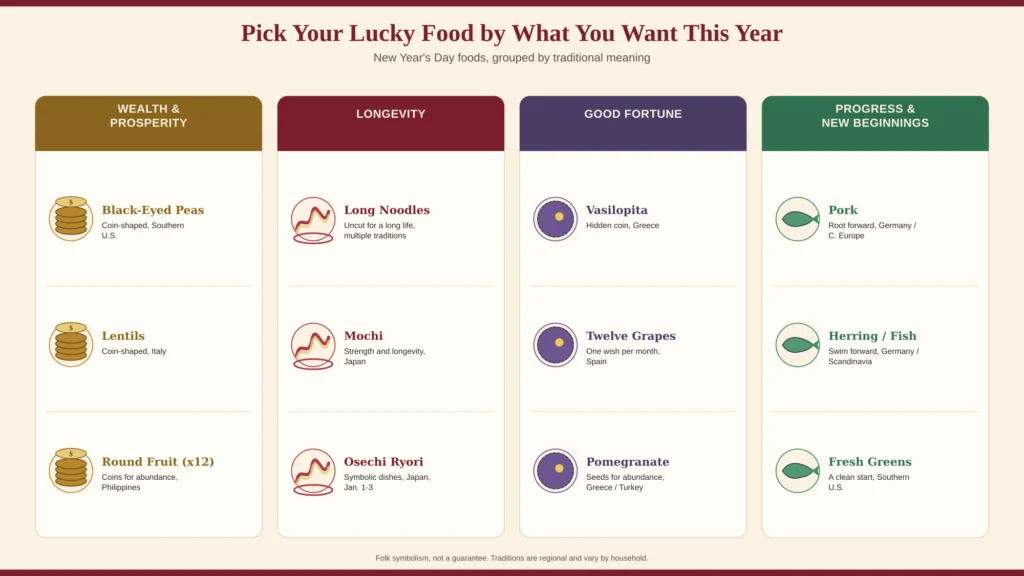
Luck by Meaning: What Each Food Is Believed to Bring
Lucky foods are often grouped by the specific kind of luck they’re associated with, rather than luck in general. This can be a useful way to build a New Year’s Day menu around what you’re hoping for in the year ahead.
Wealth and Prosperity
Coin-shaped and coin-colored foods lead this category: black-eyed peas, lentils, round fruit, and cornbread. Leafy greens are grouped here too, standing in for paper money rather than coins.
Longevity
Long noodles and Japanese mochi are the clearest examples, with the length of the noodle traditionally tied to the length of a life, uncut and unbroken while eating.
Good Fortune and General Luck
Vasilopita’s hidden coin, Spain’s twelve grapes, and Greece’s shattered pomegranate all fall into this broader category of luck, where the outcome (finding the coin, finishing all twelve grapes in time, counting scattered seeds) is treated as a small omen for the year.
Progress and New Beginnings
Pork and fish share this symbolism from two different traditions, pigs rooting forward and fish swimming forward, both standing in for moving ahead into the new year rather than staying stuck in the old one.
Build a Lucky New Year’s Day Plate
There’s no single correct way to build a lucky New Year’s Day meal, and most households mix and match rather than following one tradition exactly. Use this as a starting point, picking at least one food from each category.
- For wealth: black-eyed peas, lentils, or a small dish of round fruit.
- For prosperity and paper money: collard greens, cabbage, or kale.
- For gold: a wedge of cornbread.
- For moving forward: pork, ham, or a piece of fish.
- For a long life: a bowl of long noodles, left uncut.
- For a sweet finish and a little extra luck: a coin cake like vasilopita, or a rice-based sweet like mochi.
A few starting points, ranging from single-culture traditional meals to modern mix-and-match combinations:
- Southern-style traditional meal: black-eyed peas (often as Hoppin’ John), collard greens, and cornbread, with a side of pork or ham. A meal actually rooted in one regional tradition.
- Italian-inspired traditional meal: cotechino e lenticchie (pork sausage with lentils), which already combines the progress symbolism of pork with the coin symbolism of lentils in a single dish.
- Vegetarian lucky plate (modern combination): lentils, sauteed greens, and a round fruit dessert. This mixes symbolism from more than one culture and isn’t a traditional meal from any single region, but it follows the same coin, cash, and forward-motion logic.
- Global-inspired lucky plate (modern combination): a small plate of lentils, a piece of pan-seared fish, and a bowl of long noodles, drawing on Italian, German or Scandinavian, and East Asian symbolism at once. This is a contemporary mashup rather than an authentic dish from any one tradition, useful for a household that wants a taste of several customs in one sitting.
Foods Considered Unlucky on New Year’s Day
Alongside lucky foods, several traditions single out specific foods to avoid on January 1. As with lucky foods, these customs are regional and not universally observed.
- Lobster and crab: in Southern U.S. tradition, avoided because they move backward or sideways, which is seen as inviting setbacks rather than progress.
- Chicken and other poultry: avoided in some Southern U.S. and European households because chickens scratch backward while feeding, again linked to looking back rather than moving ahead.
- An empty cupboard or pantry: in several folk traditions, including some Southern U.S. and European customs, letting food supplies run out on New Year’s Day is thought to invite a lean year, so households often make sure something is stocked.
- Leaving the table hungry: in some traditions, not eating enough on New Year’s Day, or not having leftovers, is seen as a sign of scarcity ahead, encouraging generous portions rather than a light meal.
Do Lucky Foods Really Bring Luck?
There’s no evidence that any specific food changes a person’s luck, finances, or health outcomes over the following year. These traditions are folklore, built on symbolism (shape, color, or behavior) rather than mechanism. That doesn’t make them meaningless. Shared rituals like this one, eaten together at the start of a new calendar year, are widely understood by anthropologists and folklorists as a way of marking a transition, setting an intention, and creating a small sense of control at a moment (a new year) that’s otherwise arbitrary.
Whether or not the black-eyed peas or the grapes do anything measurable, the act of pausing to eat them with other people is the part that tends to matter most.
It’s also worth separating the cultural weight of a tradition from any claim about how it works. A family that has eaten Hoppin’ John every January 1 for three generations isn’t necessarily claiming the dish guarantees a good year. More often, the food is a marker of identity and continuity, a way of starting the year the way it’s always been started, with or without a literal belief in coin-shaped luck.
A Few Traditional Recipes to Try
These are simplified, traditional-style starting points rather than definitive versions. Each one is common enough that most home cooks can put it together with ingredients from a regular grocery store.
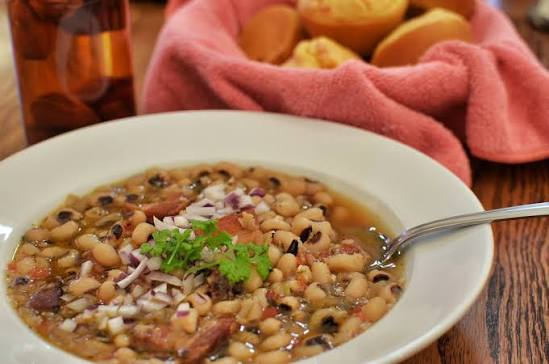
Simple Southern Black-Eyed Peas
- 1 pound dried black-eyed peas, soaked overnight and drained
- 1 small smoked ham hock or a few strips of bacon
- 1 small onion, diced
- 2 cloves garlic, minced
- 1 quart chicken or vegetable broth, plus water as needed
- Salt, black pepper, and a pinch of red pepper flakes to taste
Cook the onion and garlic in a large pot until softened, add the ham hock or bacon, then add the peas and broth. Simmer, partially covered, for about an hour, adding water if the pot looks dry, until the peas are tender. Season to taste and serve over rice, alongside cornbread and greens.
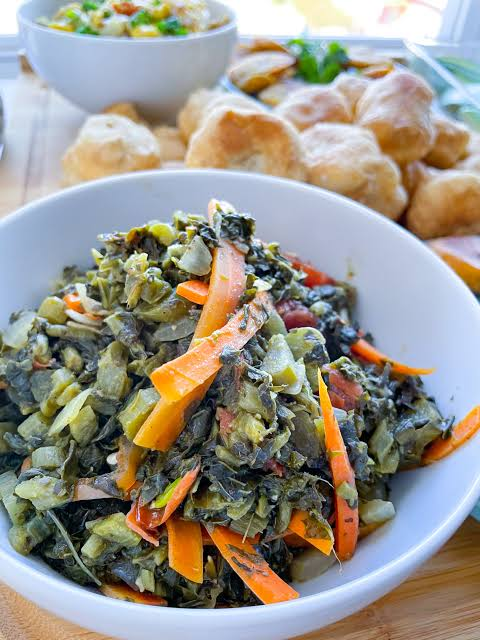
Weeknight Collard Greens
- 1 large bunch collard greens, stems removed and leaves chopped
- 2 slices bacon or a small piece of smoked ham, chopped
- 1 small onion, sliced
- 2 cups broth or water
- A splash of vinegar, salt, and pepper to taste
Render the bacon or ham in a large pot, add the onion and cook until soft, then add the collards and broth. Cover and simmer for 30 to 45 minutes, until tender, finishing with a splash of vinegar and a pinch of salt.
Italian-Style Lentils and Sausage
- 1 cup dried lentils, rinsed
- 1 pork sausage or a small piece of cotechino, sliced
- 1 carrot and 1 celery stalk, diced
- 1 small onion, diced
- 2 to 3 cups broth or water
- Olive oil, salt, and pepper to taste
Cook the onion, carrot, and celery in olive oil until softened, add the lentils and broth, and simmer for about 25 to 30 minutes until the lentils are tender. Brown or simmer the sausage separately and serve it over or alongside the lentils.
Simple Vasilopita-Style Coin Cake
- 3 cups flour
- 1 cup sugar
- 1 cup butter, softened
- 4 eggs
- 1 cup milk
- 1 tablespoon baking powder
- Zest of 1 orange
- 1 foil-wrapped coin, cleaned
Cream the butter and sugar, beat in the eggs one at a time, then mix in the milk and orange zest. Fold in the flour and baking powder until just combined. Pour half the batter into a greased round pan, tuck the wrapped coin into the batter, then add the rest of the batter on top. Bake at 350°F for about 40 to 45 minutes, until a toothpick comes out clean, and let everyone know a coin is hidden inside before slicing and serving on January 1.
Frequently Asked Questions
What is the number one lucky food for New Year’s Day?
There isn’t a single universal answer, since lucky foods are cultural rather than global. In the Southern United States, black-eyed peas are the food most closely tied to New Year’s Day luck. In Spain, it’s twelve grapes at midnight. In Greece, it’s the coin baked into vasilopita.
Why are black-eyed peas considered lucky?
Black-eyed peas are traditionally believed to resemble small coins, which is why eating them on January 1 in the Southern United States is associated with financial luck for the year ahead. The custom is often paired with rice, greens, and cornbread.
What foods are considered unlucky on New Year’s Day?
In Southern U.S. tradition, lobster, crab, and chicken are the most commonly avoided foods, because these animals move or feed backward rather than forward. Letting the pantry run empty on January 1 is also considered a bad omen in several folk traditions.
Do you eat the twelve lucky grapes on New Year’s Eve or New Year’s Day?
The tradition happens at midnight, right as December 31 turns into January 1, so it spans both days. One grape is eaten with each of the twelve clock chimes, making it as much a New Year’s Day custom as a New Year’s Eve one.
Is New Year’s Day the same holiday as Lunar New Year?
No. New Year’s Day on January 1 follows the Gregorian calendar and is observed in the United States, most of Europe, Japan, and many other countries. Lunar New Year follows a lunar or lunisolar calendar, falls on a different date each year (usually between late January and mid-February), and is celebrated in China, Vietnam, South Korea, and elsewhere with its own distinct foods and customs.
What is Japan’s traditional New Year food?
Japan observes January 1 as its New Year, and the centerpiece of the holiday is osechi ryori, a collection of small symbolic dishes served in stacked boxes, typically eaten from January 1 through 3. This is separate from toshikoshi soba, which is eaten on the night of December 31.
What should you eat on January 1 for good luck?
A common starting point is one food from each of four groups: something coin-shaped for wealth (black-eyed peas or lentils), something green for cash (collard greens or cabbage), something that moves forward for progress (pork or fish), and something long and uncut for a long life (noodles). Which exact foods you choose depends on which tradition you’re drawing from.
What food represents longevity on New Year’s Day?
Long noodles are the most common symbol of longevity, eaten uncut so the strand isn’t broken while eating. In Japan, mochi carries a similar meaning as part of the January 1 to 3 osechi ryori spread.
What if I don’t like any of the traditional lucky foods?
Most of these traditions are about symbolism rather than a fixed ingredient list, so substitutions are common. Any small, round food can stand in for peas or lentils, any leafy green can stand in for collards or cabbage, and any long noodle can carry the same longevity symbolism as soba or Filipino pancit. The gesture matters more than the exact recipe.
Leave a Reply
You must be logged in to post a comment.