
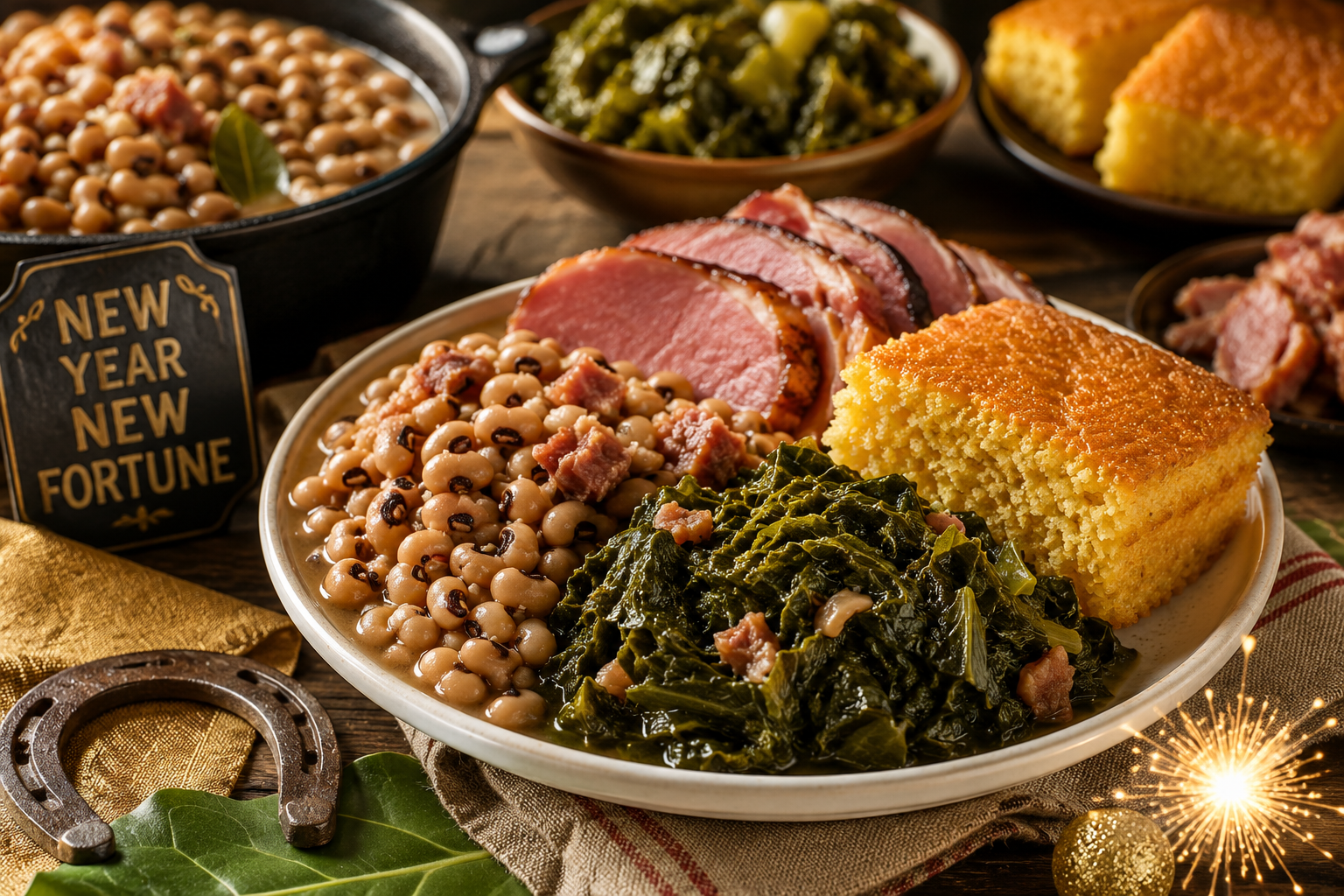
A classic Southern New Year’s Day meal centers on black-eyed peas, cooked greens, cornbread, and some form of pork. There is no single official version of this meal. Southern New Year’s food is a family tradition passed down through kitchens, not a fixed menu written down anywhere, and the details shift from state to state, church to church, and grandmother to grandmother.
What stays consistent is the core idea: eat certain foods on January 1 to invite good fortune, prosperity, and a clean start for the year ahead. The specific dishes carry that meaning.
- Black-eyed peas are the anchor of the meal, often cooked low and slow with a smoked pork product, onion, and a bit of heat.
- Greens show up as collards, turnip greens, mustard greens, or a mix, usually simmered until tender in a well-seasoned pot liquor.
- Cornbread rounds out the plate, baked in a cast iron skillet for a crisp edge and a dense, slightly sweet or savory crumb depending on the family.
- Pork appears in different forms, from a ham hock simmered into the peas to a standalone roast, chop, or slice of country ham served on the side.
Some households make Hoppin’ John, combining rice and black-eyed peas into one dish. Others keep the peas and rice separate, skip rice altogether, or serve cabbage instead of greens. Many add candied yams, macaroni and cheese, or fried chicken, simply because that’s what New Year’s dinner has always looked like in that family. None of these variations are wrong. The tradition is flexible by nature, built on regional ingredients and household habits rather than a single recipe card.
Why Southern New Year’s Foods Are Considered Lucky
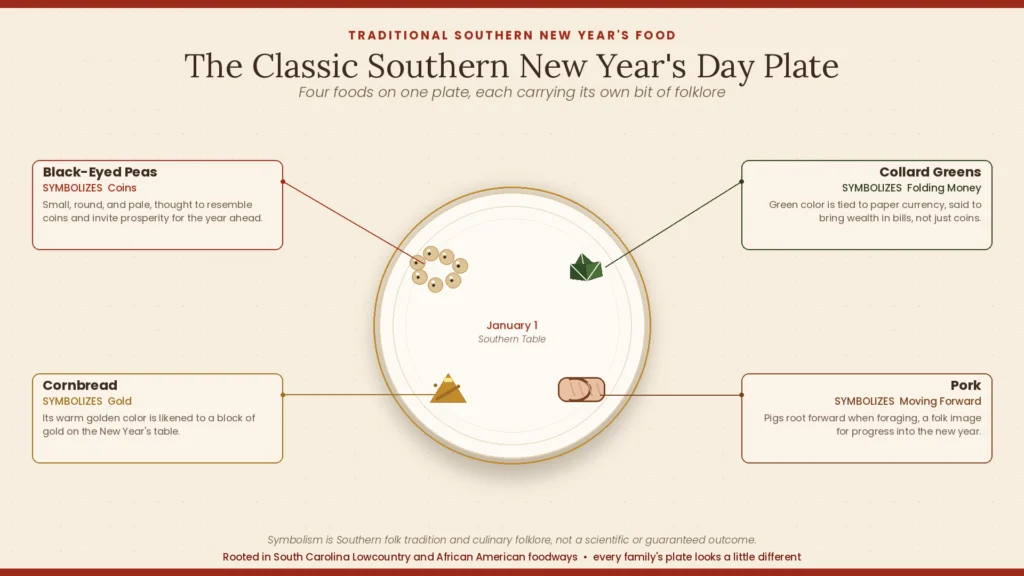
The symbolism behind these dishes is cultural tradition and folklore, not a scientific claim. People don’t eat black-eyed peas on January 1 because doing so is proven to change financial outcomes. They eat them because the practice has been repeated for generations, and repetition itself carries meaning. Here’s what each food is said to represent.
Black-eyed peas and prosperity
The most common explanation ties black-eyed peas to coins. Their small, round, pale shape is said to resemble currency, so eating them is thought to invite wealth in the coming year. Some families tie a specific number to the custom, eating a set count of peas for good measure, though this detail varies by household and isn’t a fixed rule.
Collard greens and money
Greens carry their own money symbolism, this time tied to color rather than shape. Their green color is associated with paper currency, so a plate of greens is thought to represent folding money rather than coins. Pairing peas with greens is sometimes described as covering both forms of wealth at once, coins and bills.
Cornbread and gold
Cornbread’s golden color is the basis for its symbolism. A warm, yellow square or wedge of cornbread is said to resemble a block of gold, extending the wealth theme across the whole plate. Some families serve it plain, others sweetened, and some bake it with cracklings or corn kernels folded in.
Pork and forward movement or abundance
Pork’s symbolism differs from the others. One explanation points to how pigs root forward with their snouts while foraging, tied to the idea of moving forward into the new year rather than looking back. A separate explanation points to pigs as historically abundant, fast-growing livestock in the rural South, making pork a practical symbol of a well-stocked household. Both explanations circulate, and neither is treated as definitive.
Tradition versus guaranteed luck
None of this symbolism is a guarantee. Southern New Year’s food traditions function the way most folk customs do: they give a shared ritual meaning, connect a family to earlier generations, and mark the turn of the calendar with intention. Whether luck follows isn’t really the point for most people who cook this meal every January 1.
Where the Southern New Year’s Food Tradition Comes From
This is the part of the story that deserves care, because the history is layered and not every detail is documented with the same certainty.
African American foodways and the South Carolina Lowcountry
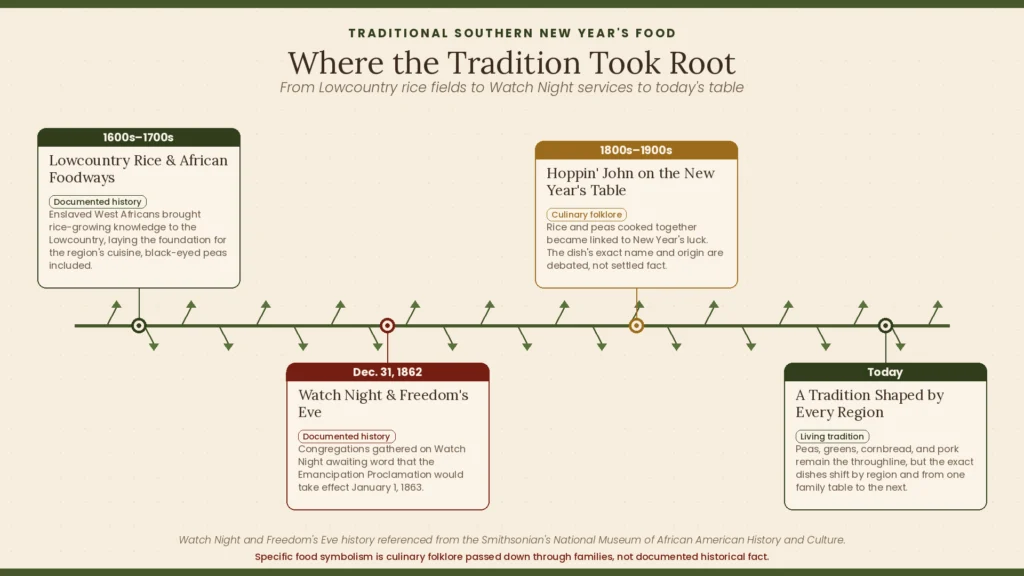
Black-eyed peas and rice have deep roots in African American foodways, particularly in the South Carolina and Georgia Lowcountry, where enslaved West Africans brought agricultural knowledge, including rice cultivation techniques, that shaped the region’s cuisine for generations. Black-eyed peas themselves trace back to Africa and Asia and were grown widely across the American South as a practical, affordable staple.
The foodways that developed in the Lowcountry, blending African, Caribbean, and European influences, are widely credited by food historians as the foundation of Southern and soul food cooking, including the New Year’s tradition.
Hoppin’ John, rice, and black-eyed peas
Hoppin’ John, a dish of rice and black-eyed peas cooked together, is one of the clearest culinary threads tying this history to the modern New Year’s table. Rice was a major crop in the Lowcountry economy, and combining it with black-eyed peas produced an affordable, filling, protein-rich dish that could be made year-round. Over time it became specifically associated with New Year’s Day. Its exact origin story, including the source of its name, is debated among food historians rather than settled fact, and no single explanation is universally agreed upon.
Watch Night and Freedom’s Eve
There’s also a spiritual and historical layer connected to December 31 itself. Watch Night services, held in many Black churches on New Year’s Eve, have a history that predates the Civil War. For many African American communities, December 31, 1862, holds particular significance as Freedom’s Eve, the night before the Emancipation Proclamation was set to take effect on January 1, 1863.
Congregations gathered that night waiting for word that enslaved people in Confederate states would be declared free. That watch, and the church tradition that grew from it, is part of why New Year’s Day carries deep cultural and spiritual weight in many African American communities, alongside the food traditions tied to it.
Documented history versus folklore
It’s worth being direct about what’s well documented and what isn’t. The existence of Watch Night services and their connection to Freedom’s Eve is part of the historical record, discussed by institutions including the Smithsonian’s National Museum of African American History and Culture. The precise origin of eating black-eyed peas for luck, the exact source of the name Hoppin’ John, and some of the more specific symbolic explanations are older folk traditions passed down orally, and historians generally present them as culinary folklore rather than fully documented fact.
A responsible account of this tradition holds both truths at once: real, significant history around Watch Night and Southern foodways, alongside folk explanations for specific food symbolism that were never meant to be verified like a historical record.
Traditional Southern New Year’s Dishes to Know
Before getting into full recipes, it helps to know what each dish actually is and where it sits on the plate.
Hoppin’ John
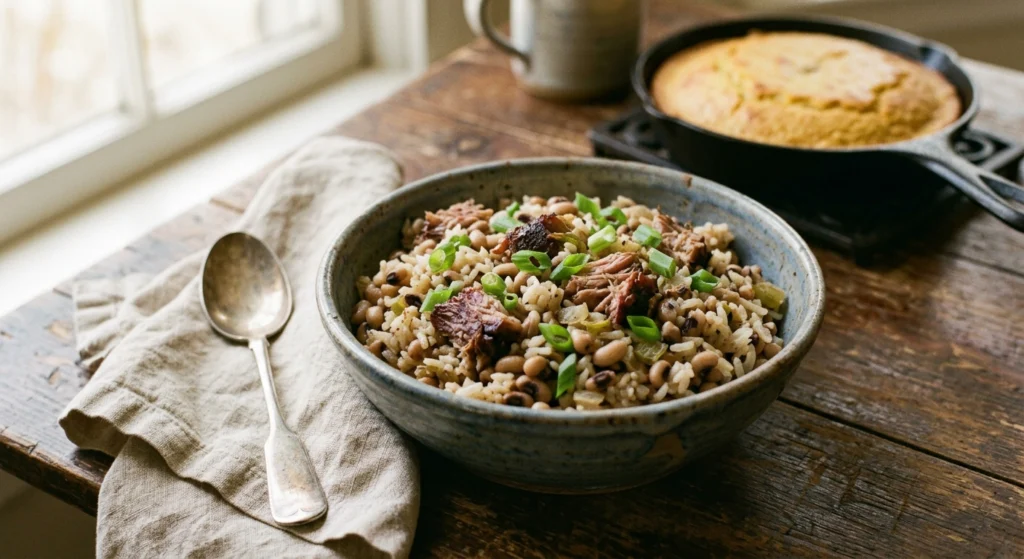
Hoppin’ John is black-eyed peas and rice cooked together, usually with a smoked pork product, onion, and a touch of heat from cayenne or a dried chile. It’s typically the centerpiece of a Lowcountry-style New Year’s plate, served as a hearty, one-pot main rather than a side.
Southern black-eyed peas
This version keeps the peas on their own, simmered in a seasoned broth with pork and aromatics but not mixed with rice. The peas are ladled over rice at the table instead of cooked into it, or served alongside it. Families who don’t make Hoppin’ John specifically often still make a pot of black-eyed peas this way.
Collard greens
Collards are large, sturdy leafy greens that need a long simmer to turn tender. Southern-style collards are typically cooked with smoked pork, onion, vinegar, and a bit of sugar to balance the greens’ natural bitterness, producing a rich, savory pot liquor along the way.
Cornbread
Cornbread is a quick bread made primarily from cornmeal, usually baked in a preheated cast iron skillet for a crisp, browned crust. Southern versions tend to use little or no sugar, favoring a savory, slightly crumbly texture that holds up well against peas and pot liquor.
Pork, ham, ham hocks, or smoked meat
Pork shows up throughout the meal rather than as one single dish. Ham hocks or smoked neck bones are common for seasoning peas and greens, while a baked ham, pork roast, or pan-seared chops often serve as the standalone protein on the plate.
Cabbage, turnip greens, mustard greens, and other regional choices
Not every family cooks collards. Cabbage is common in parts of the South as a New Year’s green, sometimes standing in for or joining collards. Turnip greens and mustard greens, both more peppery and slightly bitter than collards, are traditional in other households, and some cooks combine two or three greens in the same pot.
Potlikker
Potlikker is the seasoned liquid left in the pot after simmering greens for hours with pork and aromatics. It’s considered a delicacy in its own right in Southern cooking, often served spooned over cornbread or sipped on its own, and it carries much of the smoky, savory depth of the greens themselves.
5 Traditional Southern New Year’s Recipes
These five recipes cover the classic plate. Each one is written to be cooked on its own or as part of the full meal. Nutrition figures are estimates based on standard ingredients and will vary depending on exact products used.
Hoppin’ John
A one-pot rice and black-eyed pea dish built on smoked pork and slow-cooked aromatics, meant to serve as the centerpiece of the plate.
Yield: 6 servings
Serving size: About 1 cup
Prep time: 15 minutes
Cook time: 1 hour 15 minutes
Total time: 1 hour 30 minutes
Ingredients
- 1 pound dried black-eyed peas, rinsed and picked over
- 8 ounces smoked ham hock or thick-cut bacon, chopped
- 1 medium yellow onion, diced
- 1 green bell pepper, diced
- 3 celery stalks, diced
- 3 garlic cloves, minced
- 1 teaspoon smoked paprika
- 1/2 teaspoon cayenne pepper, or to taste
- 2 bay leaves
- 6 cups low-sodium chicken broth or water
- 1 1/2 cups long-grain white rice
- 2 green onions, sliced, for serving
- Salt and black pepper, to taste
Method
- In a large Dutch oven over medium heat, cook the ham hock or bacon until it releases its fat and starts to brown, about 5 minutes. Add the onion, bell pepper, and celery, and cook until softened, about 6 minutes. Stir in the garlic, smoked paprika, and cayenne, and cook 1 minute until fragrant.
- Add the peas, bay leaves, and broth. Bring to a boil, reduce to a low simmer, cover partially, and cook 45 to 60 minutes, until the peas are tender but still holding their shape. Season with salt and pepper partway through, since salt added too early can toughen dried peas.
- Stir in the rice, cover, and simmer 18 to 20 minutes, until the rice is cooked and most liquid is absorbed. Remove the bay leaves, fluff with a fork, rest 5 minutes, and top with green onions before serving.
Doneness cues: Peas should be tender enough to mash easily between two fingers but not falling apart. Rice should be tender with no visible liquid pooling at the bottom of the pot.
Substitutions: Use smoked turkey leg or smoked turkey sausage in place of ham hock for a lighter or pork-free version. Brown rice can replace white rice, though it will need about 20 extra minutes and roughly 1/2 cup more liquid.
Storage: Refrigerate in an airtight container for up to 4 days. Reheat gently on the stovetop with a splash of broth or water to loosen the rice.
Nutrition (estimated, per serving): 340 calories, 17g protein, 52g carbohydrates, 8g fat, 9g fiber, 480mg sodium.
Southern Black-Eyed Peas
A simple, spoonable pot of peas simmered separately from rice, meant to be ladled over rice or served alongside greens and cornbread.
Yield: 6 servings
Serving size: About 3/4 cup
Prep time: 10 minutes
Cook time: 1 hour
Total time: 1 hour 10 minutes
Ingredients
- 1 pound dried black-eyed peas, rinsed and picked over
- 6 ounces smoked ham hock or salt pork
- 1 small yellow onion, diced
- 2 garlic cloves, minced
- 1 dried bay leaf
- 1/2 teaspoon red pepper flakes
- 6 cups water or low-sodium chicken broth
- 1 tablespoon apple cider vinegar
- Salt and black pepper, to taste
Method
- Combine the black-eyed peas, ham hock, onion, garlic, bay leaf, red pepper flakes, and water in a large pot. Bring to a boil, then reduce to a gentle simmer and cover partially.
- Cook for 45 to 60 minutes, stirring occasionally and adding more water if the peas look dry, until the peas are tender and the broth has thickened slightly. Remove the ham hock, shred any usable meat off the bone, and stir it back into the pot. Discard the bay leaf.
- Stir in the apple cider vinegar, then season with salt and pepper to taste. Let the peas sit off heat for 10 minutes before serving so the broth thickens further.
Doneness cues: The broth should look slightly creamy from the starch released by the peas, and the peas should hold their shape while being easy to mash with a spoon.
Substitutions: For a vegetarian version, omit the pork, use vegetable broth, and add 1 teaspoon smoked paprika plus 1 tablespoon soy sauce for depth.
Storage: Refrigerate up to 4 days or freeze up to 3 months. Reheat over low heat, adding water as needed to loosen the broth.
Nutrition (estimated, per serving): 190 calories, 13g protein, 28g carbohydrates, 3g fat, 8g fiber, 340mg sodium.
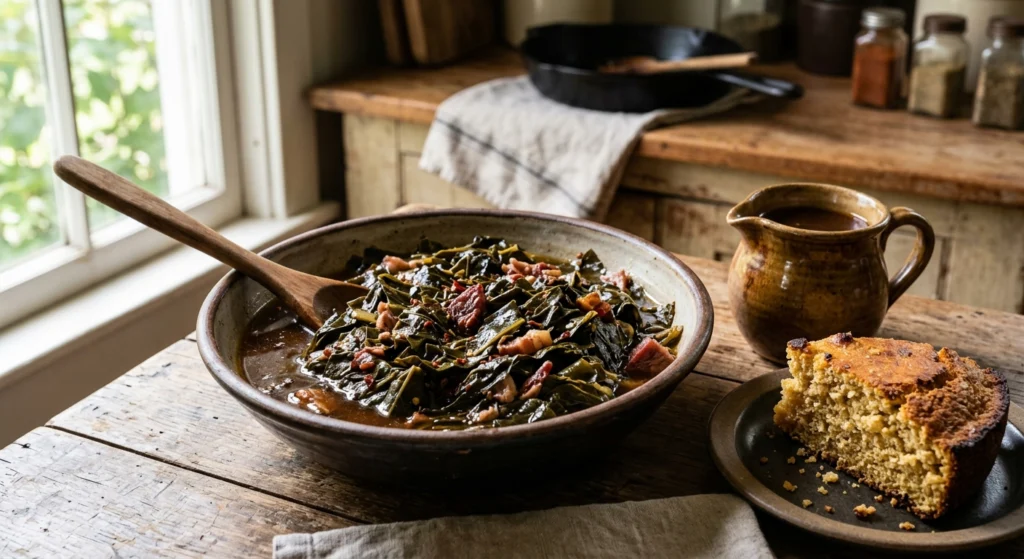
Slow-Simmered Collard Greens
Tender, smoky collard greens cooked low and slow, with a peppery pot liquor worth saving.
Yield: 8 servings
Serving size: About 1 cup
Prep time: 20 minutes
Cook time: 1 hour 45 minutes
Total time: 2 hours 5 minutes
Ingredients
- 3 pounds collard greens, stemmed and roughly chopped
- 8 ounces smoked ham hock or smoked turkey wing
- 1 medium yellow onion, sliced
- 3 garlic cloves, smashed
- 1/2 teaspoon red pepper flakes
- 6 cups water or low-sodium chicken broth
- 1 tablespoon apple cider vinegar
- 1 teaspoon sugar
- Salt and black pepper, to taste
Method
- In a large stockpot, combine the smoked meat, onion, garlic, red pepper flakes, and water. Bring to a boil, then reduce to a simmer and cook uncovered for 30 minutes to build a flavorful base.
- Add the collard greens in batches, letting each addition wilt down before adding more. Once all the greens are in the pot, reduce heat to low, cover, and simmer for 1 to 1 1/2 hours, stirring occasionally, until the greens are fully tender.
- Remove the smoked meat, shred any usable meat off the bone, and return it to the pot. Stir in the vinegar and sugar, then season with salt and pepper to taste.
Doneness cues: Fully cooked collards should be soft enough to cut easily with the side of a fork, with no tough or fibrous bite remaining.
Substitutions: Turnip greens or mustard greens can replace collards using the same method, though they typically need 20 to 30 minutes less simmering time. For a meatless version, use vegetable broth and add 1 tablespoon smoked paprika.
Storage: Refrigerate up to 5 days. Collards often taste better the next day, once the flavors have had time to settle. Save the potlikker to spoon over cornbread.
Nutrition (estimated, per serving): 90 calories, 6g protein, 8g carbohydrates, 4g fat, 4g fiber, 310mg sodium.
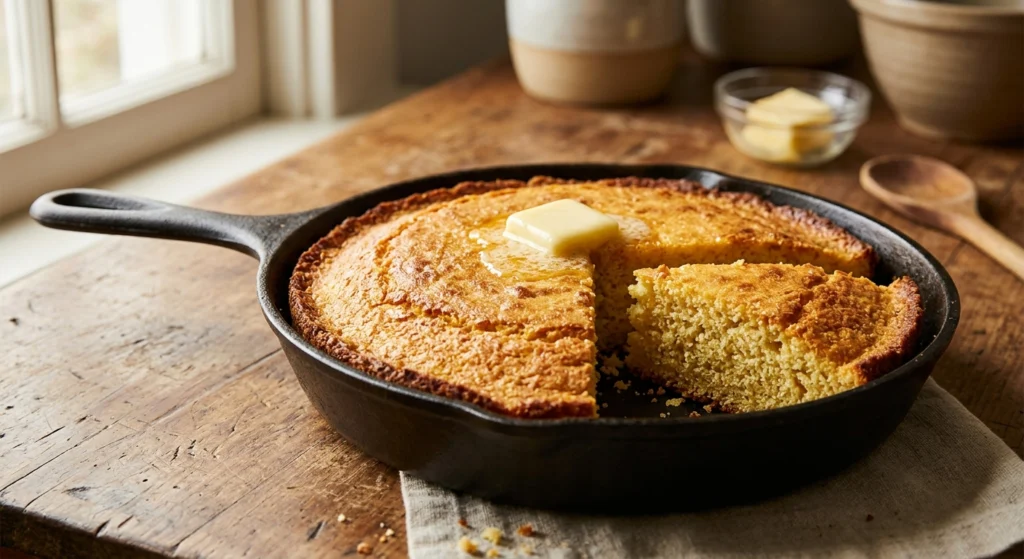
Skillet Southern Cornbread
A savory, crisp-edged cornbread baked in cast iron, built for soaking up pot liquor.
Yield: 8 servings
Serving size: 1 wedge
Prep time: 10 minutes
Cook time: 25 minutes
Total time: 35 minutes
Ingredients
- 1 1/2 cups yellow cornmeal
- 1/2 cup all-purpose flour
- 1 tablespoon baking powder
- 1/2 teaspoon baking soda
- 1 teaspoon salt
- 1 tablespoon sugar, optional
- 1 1/4 cups buttermilk
- 2 large eggs
- 1/4 cup unsalted butter, melted, plus 2 tablespoons for the skillet
- 1/4 cup vegetable oil
Method
- Place a 10-inch cast iron skillet in the oven and preheat to 425°F, letting the skillet heat for at least 10 minutes.
- In a large bowl, whisk together the cornmeal, flour, baking powder, baking soda, salt, and sugar if using. In a separate bowl, whisk the buttermilk, eggs, melted butter, and oil until smooth. Pour the wet ingredients into the dry and stir just until combined, leaving a few small lumps.
- Carefully remove the hot skillet from the oven and add the remaining 2 tablespoons butter, swirling to coat the bottom and sides. Pour the batter into the skillet, where it should sizzle on contact.
- Bake for 20 to 25 minutes, until the top is golden brown and a toothpick inserted in the center comes out clean. Let cool in the skillet for 5 minutes before slicing into wedges.
Doneness cues: The edges should pull slightly away from the skillet and look deeply golden, while the center springs back when pressed lightly.
Substitutions: For a dairy-free version, use unsweetened plant-based milk mixed with 1 tablespoon lemon juice in place of buttermilk. For a gluten-free version, use a 1:1 gluten-free flour blend in place of the all-purpose flour.
Storage: Keep covered at room temperature for up to 2 days, or refrigerate up to 5 days. Reheat wedges in a 350°F oven for 5 to 7 minutes to restore the crust.
Nutrition (estimated, per serving): 250 calories, 5g protein, 27g carbohydrates, 13g fat, 2g fiber, 430mg sodium.
Southern Pork Main Dish
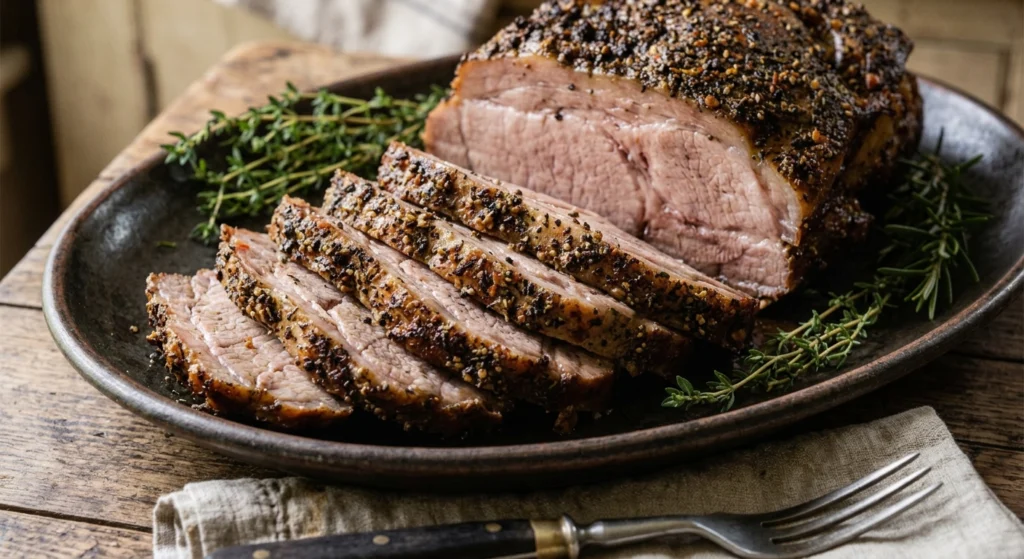
A simple, oven-roasted pork shoulder with a peppery brown sugar crust, built as the standalone protein for the plate.
Yield: 8 servings
Serving size: About 5 ounces cooked pork
Prep time: 15 minutes, plus overnight refrigeration
Cook time: 3 hours
Total time: 3 hours 15 minutes, plus resting
Ingredients
- 4 pounds boneless pork shoulder
- 2 tablespoons brown sugar
- 1 tablespoon kosher salt
- 1 teaspoon black pepper
- 1 teaspoon smoked paprika
- 1/2 teaspoon cayenne pepper
- 1/2 teaspoon garlic powder
- 1/2 teaspoon onion powder
- 2 tablespoons vegetable oil
- 1 cup low-sodium chicken broth
Method
- Combine the brown sugar, salt, pepper, smoked paprika, cayenne, garlic powder, and onion powder in a small bowl. Pat the pork shoulder dry, rub it all over with the spice mixture, then cover and refrigerate for at least 4 hours or up to overnight.
- Preheat the oven to 300°F. Heat the oil in a heavy oven-safe pot or Dutch oven over medium-high heat and sear the pork on all sides until deeply browned, about 8 minutes total. Add the broth to the pot, cover, and transfer to the oven.
- Roast for 2 1/2 to 3 hours, until the pork is fork-tender and shreds easily. Remove from the oven, let rest for 15 minutes, then slice or shred as preferred.
Doneness cues: The pork should reach an internal temperature of at least 195°F and pull apart with light pressure from a fork.
Substitutions: A bone-in pork roast can be used instead, adding roughly 20 to 30 minutes to the cook time. For a smoked turkey alternative, use a 3-pound smoked turkey breast, roasted at 325°F for about 1 1/2 hours or until it reaches 165°F internally.
Storage: Refrigerate cooked pork in its juices for up to 4 days, or freeze up to 3 months. Reheat gently in a covered pan with a splash of broth to keep it moist.
Nutrition (estimated, per serving): 320 calories, 34g protein, 4g carbohydrates, 18g fat, 0g fiber, 520mg sodium.
How to Build a Traditional Southern New Year’s Day Plate
A traditional plate usually follows a simple logic: a starch base, a protein-rich pea dish, a portion of greens, and cornbread on the side.
- Start with rice or Hoppin’ John as the base if peas and rice are served together, or plate rice and a separate pot of black-eyed peas side by side.
- Add a generous portion of greens, spooning a little potlikker over the plate rather than serving it dry.
- Add sliced or shredded pork, either mixed into the peas or plated separately.
- Finish with a wedge of cornbread, ideally still warm.
For portion planning, figure on about 1 cup of peas or Hoppin’ John, 1 cup of greens, 4 to 5 ounces of pork, and one wedge of cornbread per adult serving, adjusting up if the meal is the main event of the day rather than one course among several.
Much of this meal can be prepared the day before. Black-eyed peas and collard greens both hold up well and often taste better after a day in the refrigerator, since the flavors have more time to settle. The pork roast can also be cooked a day ahead and reheated gently in its own juices. Cornbread is the one component worth baking fresh, or at least reheating properly, since it loses its crisp edge quickly once fully cooled and stored.
On the day itself, a reasonable order is to reheat the peas and greens on the stovetop first, reheat the pork covered in the oven at a low temperature, and bake or reheat the cornbread last so it comes out of the oven close to serving time.
Southern New Year’s Food Variations by Region and Family
Southern New Year’s food isn’t standardized, and regional habits shape what actually lands on the table.
- South Carolina Lowcountry: Hoppin’ John tends to be the centerpiece, reflecting the region’s rice-growing history and its role as a foundation of African American foodways. Collard greens and cornbread round out the plate.
- Georgia and the broader Southeast: Black-eyed peas and collards remain common, though many families favor peas and rice served separately rather than combined, alongside baked ham or fried chicken.
- Mississippi and Alabama: Cabbage sometimes joins or replaces collard greens, and pork ranges from ham hocks simmered into the peas to a standalone smoked ham or pork chops on the side.
- Louisiana: Black-eyed peas may be seasoned with the onion, celery, and bell pepper trinity used in gumbo and jambalaya, and rice is a near-constant presence.
Beyond region, individual families layer in their own additions, from candied yams to macaroni and cheese to fried chicken, shaped by whatever that family has always served. None of these additions replace the tradition. They sit alongside it.
Can You Make a Southern New Year’s Meal Without Pork?
Yes, and it’s a common adjustment for religious dietary practices, personal preference, or health reasons. Pork adds smoky depth to peas and greens, so replacing it means finding another way to build that flavor.
Smoked turkey is the most direct substitute. A smoked turkey leg, wing, or neck can season a pot of peas or greens almost the same way a ham hock does, adding both smokiness and body to the broth.
A vegetarian approach typically leans on smoked paprika, a splash of soy sauce or liquid smoke, and a good vegetable broth to rebuild some of that savory depth. A parmesan rind simmered in the pot can also add richness to greens or peas.
A vegan approach follows the same logic without dairy, using smoked paprika, liquid smoke in moderation, soy sauce or tamari, and a well-seasoned vegetable broth as the flavor base, along with a splash of oil to replace the fat pork would otherwise contribute.
None of these substitutions taste identical to a pork-based pot of peas or greens, and it’s worth being upfront about that rather than pretending otherwise. What they do is get close enough in smokiness and savory depth that the dish still reads as a traditional Southern New Year’s plate, just built around a different protein.
Nutrition and Practical Notes
Southern New Year’s food, cooked the traditional way, brings a mix of nutritional strengths worth knowing about, without turning this into a health claim.
Black-eyed peas are a solid source of plant protein and fiber, which is part of why they’ve historically served as an affordable, filling staple. Leafy greens like collards, turnips, and mustard greens bring fiber and volume to the plate with relatively few calories on their own, before butter, oil, or pork fat are factored in. Cornbread contributes carbohydrates and, depending on the recipe, a fair amount of fat and sugar from butter and added sweetener.
Pork, particularly smoked or cured cuts like ham hocks and bacon, adds protein and flavor but also tends to be one of the higher-sodium components of the meal, especially once it’s simmered into both the peas and the greens.
Sodium is worth watching across the whole plate, since smoked pork, broth, and added salt can stack up when the same seasoning base flavors multiple dishes. Using low-sodium broth, salting later in the cooking process, and tasting before adding extra salt are practical ways to manage that without changing the meal’s character. Portion size matters too: a full plate with a cup of peas, a cup of greens, pork, and cornbread is substantial on its own, so there’s no need to treat every component as a small side.
FAQs
What is the most traditional Southern New Year’s meal?
The most traditional version centers on black-eyed peas, cooked greens, cornbread, and pork, often with Hoppin’ John serving as the centerpiece in Lowcountry-influenced households.
What three foods are eaten for good luck?
Black-eyed peas, greens, and cornbread are the three most commonly cited lucky foods, symbolizing coins, folding money, and gold, respectively.
Why are black-eyed peas eaten on New Year’s Day?
Black-eyed peas are eaten for luck and prosperity in the coming year, a tradition rooted in Southern and African American foodways, with folklore linking their shape to coins.
Why do Southerners eat collard greens on New Year’s?
Collard greens are eaten because their green color is associated with paper money, making them a folk symbol of financial prosperity for the year ahead.
Is Hoppin’ John the same as black-eyed peas?
No. Hoppin’ John is a specific dish made by cooking black-eyed peas together with rice, while “black-eyed peas” can also refer to a pot of peas served on their own or ladled over rice.
Do you have to eat pork?
No. Smoked turkey, vegetarian seasoning bases built on smoked paprika and vegetable broth, or fully vegan versions are common substitutions that keep the meal’s flavor and tradition intact.
Can you eat these foods on New Year’s Eve instead?
Yes. While the strongest tradition centers on New Year’s Day itself, many families serve some or all of these dishes as part of a New Year’s Eve dinner, particularly around Watch Night church services, without losing the meal’s meaning.
Leave a Reply
You must be logged in to post a comment.