
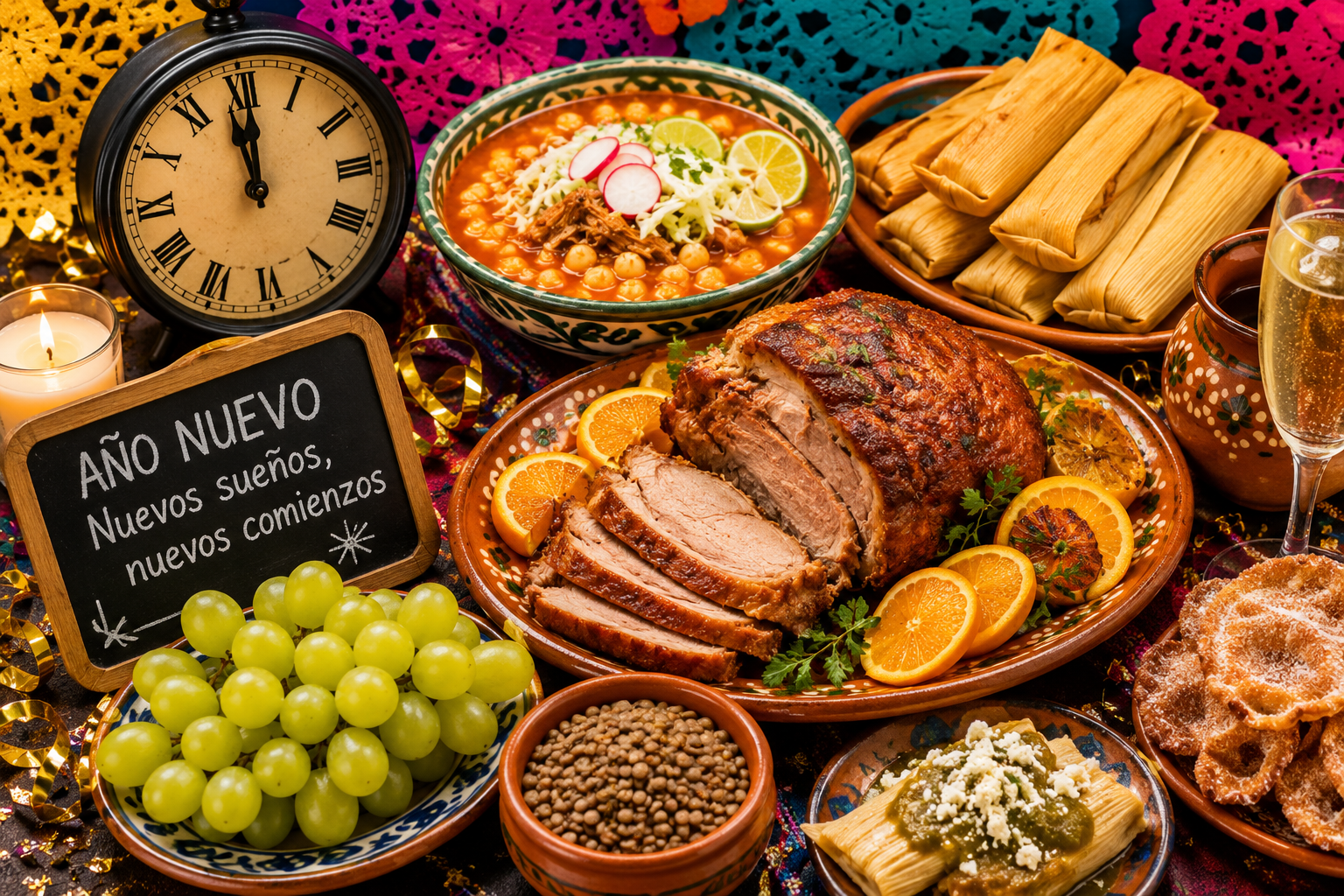
Mexican New Year food is built around two layers that often get flattened into one. The first is a set of midnight rituals, eaten in small bites right as the clock strikes twelve, meant to set intentions for the year ahead. The second is the celebratory dinner itself, a full meal that varies by region, family budget, and personal taste. The two overlap on the same table but they are not the same thing.
The midnight rituals are specific and widely recognized: twelve grapes eaten one at a time with each campanada (bell chime), and a spoonful of lentils eaten or set aside as a symbol of abundance for the coming year. Both are quick, symbolic gestures rather than dishes you sit down to eat.
The dinner that surrounds those rituals is a different story. It draws from the same pool of holiday-season cooking as Nochebuena on December 24, which means pork, turkey, tamales, and pozole all show up in Mexicahon homes in late December, but not because any single one of them is required specifically for New Year’s Eve. What lands on a given table depends heavily on region, family history, and who is cooking.
The midnight traditions: 12 grapes and lentils
At midnight, two small rituals take priority over anything on the dinner table. Eating twelve grapes, one per chime of the clock, is meant to represent good wishes for each of the twelve months ahead. Lentils, eaten by the spoonful or scattered as a gesture, symbolize money and abundance because their small, round, coin-like shape has long been associated with prosperity. Neither ritual requires cooking. Both are performed in the same one-minute window as the countdown itself.
The celebratory dinner versus the midnight ritual
The New Year’s Eve dinner, called cena de Fin de Año or cena de Nochevieja, is a separate event from the midnight ritual, even though they happen hours apart on the same night. Dinner is usually served earlier in the evening, sometimes shared with extended family, and it draws on whatever the household considers festive: roasted meats, tamales, soups, or a combination. The grapes and lentils happen afterward, right at midnight, often standing up with a glass in hand rather than seated at the table.
Why there is no single Mexican New Year’s menu
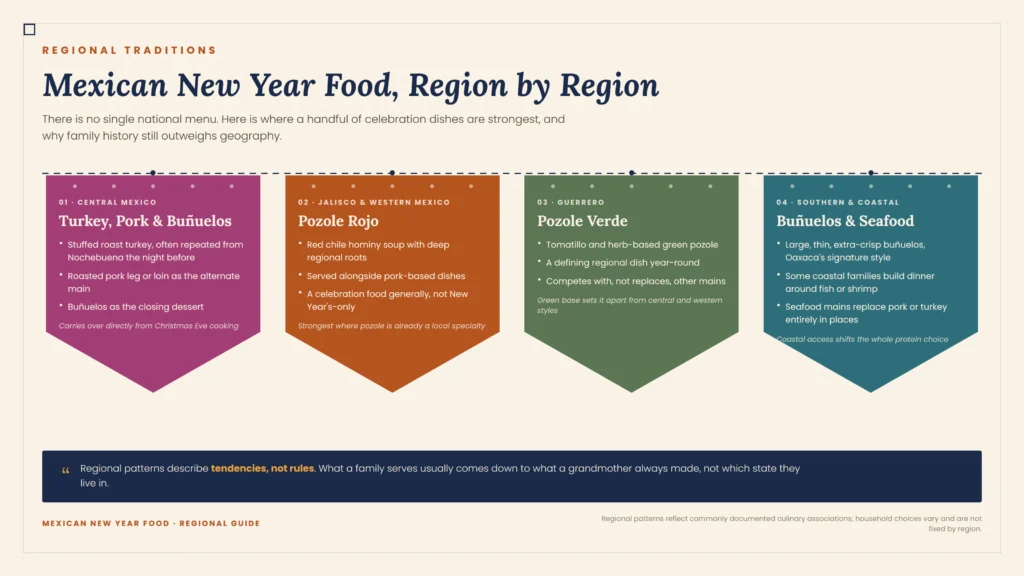
Mexico does not have one official New Year’s Eve menu the way some countries have a fixed holiday dish. Regional cuisine, family recipes passed down through generations, and simple practicality (what’s affordable, what’s already been cooked for Nochebuena leftovers, what a given household enjoys) all shape the meal. A family in Jalisco might serve pozole rojo. A family in Mexico City might roast a turkey. A family in Guerrero might make pozole verde. All of these are legitimate, all of these are regional or family choices, and none of them is “the” national New Year’s dish.

The Most Traditional Mexican New Year’s Foods and Rituals
Some foods on this list are ritual foods tied specifically to midnight. Others are commonly served at the dinner but are shared with the broader December holiday season, especially Nochebuena. The table below sorts them out.
| Food | Ritual or dinner food? | How common |
|---|---|---|
| 12 grapes | Midnight ritual | Widely practiced, especially since the 2000s |
| Lentils | Midnight or pre-dinner ritual | Common, though practiced in different ways by different families |
| Pork (leg, loin, or pierna) | Dinner food | Common at both Nochebuena and New Year’s dinners |
| Stuffed turkey | Dinner food | Common in central Mexico and among families with Nochebuena-style traditions |
| Tamales | Dinner food, regional | Common in many households, especially where masa dishes are a family or regional staple |
| Pozole (rojo, blanco, verde) | Dinner food, regional | Strongly associated with celebrations generally; not a universal New Year’s requirement |
| Buñuelos | Dessert, regional | Common in central and southern Mexico, especially Oaxaca |
Festive pork dishes
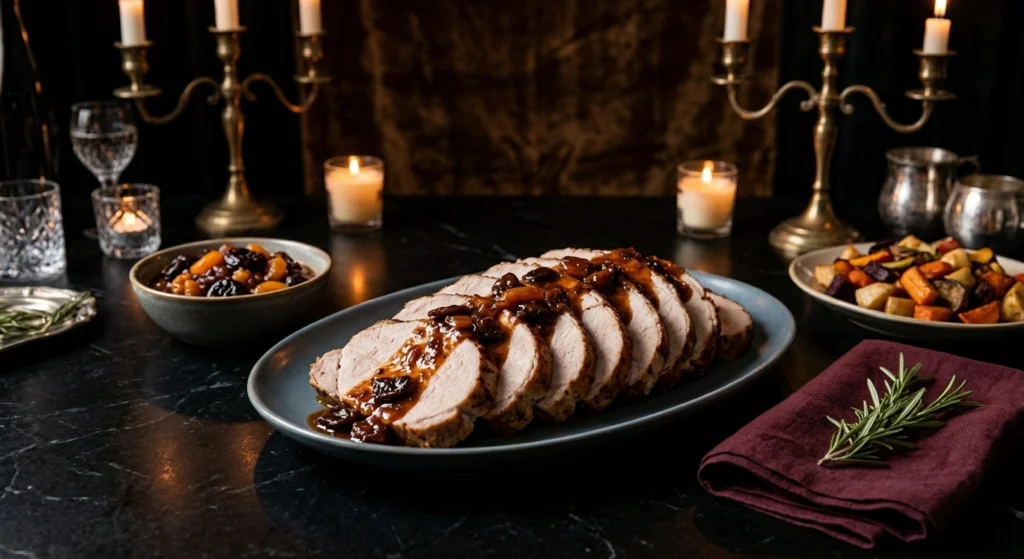
Pork shows up on more Mexican New Year’s tables than almost any other protein, largely because it is the backbone of December holiday cooking generally. A whole roasted pork leg (pierna horneada), pork loin with a fruit-based sauce, or pork in a chile-based adobo are all common choices. This isn’t a New Year’s-specific ritual food. It’s a holiday-season centerpiece that carries over from Nochebuena into New Year’s Eve in many households.
Stuffed turkey and other holiday mains
Turkey, often stuffed with a mixture that can include ground pork, dried fruit, and nuts, is another Nochebuena-and-New Year’s crossover dish, particularly popular in central Mexico. Families that roast a turkey for Christmas Eve sometimes repeat it for New Year’s, and others make it specifically for the December 31 dinner instead.
Tamales and regional masa-based foods
Tamales are extremely popular throughout the December holiday season, but they are not a food invented for or reserved exclusively for New Year’s Eve. They appear at Nochebuena, at Día de la Candelaria in February, and at family gatherings throughout the year. Where tamales are a strong regional or family tradition, they absolutely can appear on the New Year’s table. Presenting them as a mandatory New Year’s dish, though, overstates how the tradition actually works.
Pozole and other celebratory dishes
Pozole, a hominy soup that comes in red (rojo), white (blanco), and green (verde) versions depending on the region and the chiles or ingredients used, is a celebration food in a broad sense. It shows up at birthdays, Independence Day gatherings, and holiday dinners generally. Guerrero is particularly known for pozole verde. Jalisco and much of western and central Mexico favor pozole rojo. Some families do serve pozole on New Year’s Eve, especially where it’s a regional specialty, but it sits alongside tamales and pork as one of several possible dinner options rather than a fixed requirement.
Buñuelos and other seasonal sweets
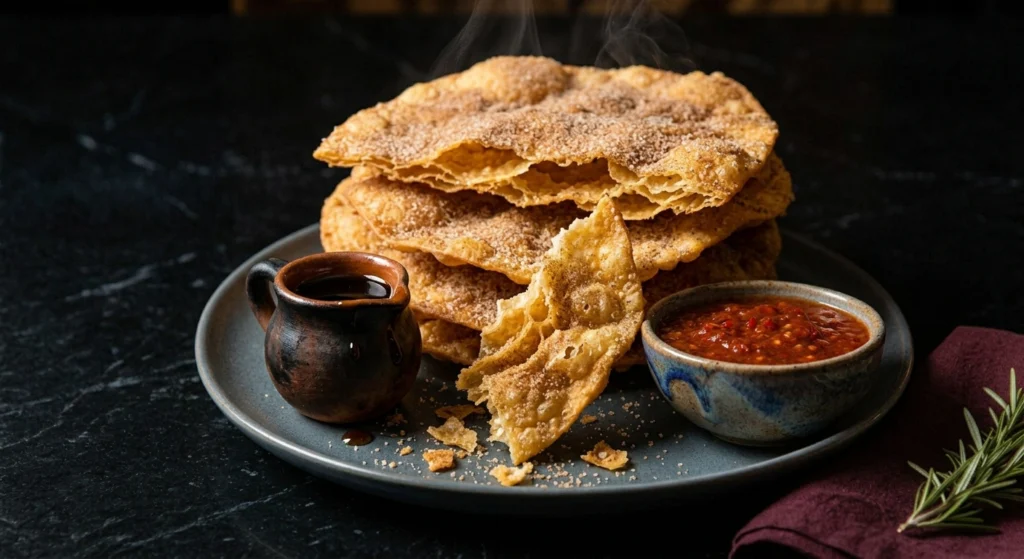
Buñuelos, thin fried dough disks dusted with sugar and cinnamon or drizzled with a piloncillo (unrefined cane sugar) syrup, are a signature December dessert in central and southern Mexico, with Oaxaca especially known for large, crisp versions served in clay bowls. They appear throughout the posada and Nochebuena season and often carry through to New Year’s Eve as the dessert that closes out the meal.
Why Mexicans Eat 12 Grapes on New Year’s Eve
What each grape represents
The general idea is one grape per chime, twelve chimes, twelve months. Each grape is meant to represent a wish or intention for the corresponding month of the coming year. That said, there is no single fixed, universally agreed meaning assigned to each individual grape (grape one equals health, grape two equals love, and so on). Most sources describe the ritual in terms of general good wishes tied to the month, rather than a rigid, one-to-one symbolic chart, and versions of the exact meanings shift depending on who is telling it.
How the ritual works at midnight
At the final minute before midnight, participants prepare twelve grapes each, ideally seedless and already peeled if possible so the pace of eating isn’t interrupted. As the clock chimes twelve times to mark the new year, each chime is matched with one grape, eaten in rhythm. Finishing all twelve within the chimes is considered good luck; some versions of the tradition hold that a sour grape signals a harder month ahead, while a sweet one signals good fortune, though this is folk interpretation rather than a fixed rule.
The Spanish connection and its adoption in Mexico
The twelve grapes tradition did not originate in Mexico and it is not pre-Hispanic. It traces back to Spain, with the most widely cited account pointing to 1909, when grape growers in southeastern Spain, facing an unusually large harvest, promoted the custom of eating grapes at midnight as a way to move surplus fruit and tie it to good luck for the year ahead. An earlier, related account describes wealthier residents of Madrid ushering in the new year with grapes and champagne in the late 1800s, a habit that spread more broadly once the 1909 harvest gave it commercial momentum.
From Spain, the custom spread across the Spanish-speaking world, including Mexico, Peru, Venezuela, and Colombia. In Mexico specifically, the ritual became widespread more recently than many people assume, gaining real popularity from the 2000s onward as television broadcasts of the Puerta del Sol countdown in Madrid and other cultural exchange brought the custom into wider practice.
Why Lentils Are Associated With Mexican New Year
Prosperity and abundance symbolism
Lentils are tied to money and abundance largely because of their shape. Small, round, and flattened, they resemble coins, and that resemblance is the basis of the symbolism across the Mediterranean and Latin America alike. The association with prosperity goes back to ancient Rome, where lentils were already linked to wealth for the same coin-like reason, and the custom spread through Europe before taking root in Mexico and other parts of Latin America.
How lentils are served as a ritual
The lentil ritual takes a few different forms depending on the household. Some people eat a spoonful of cooked lentils right at midnight or as the last bite of the old year and the first bite of the new one. Others keep a handful of raw, dry lentils in a small bag or pocket to carry through the year as a good-luck charm. A newer variation, popularized partly through social media, involves tossing a handful of raw lentils into the air at midnight while making a wish, then gathering a few to keep. All versions point to the same underlying idea: lentils as a stand-in for money and financial stability in the year ahead.
Lentils as a dish versus lentils as a New Year’s symbol
It’s worth separating the ritual gesture from an actual lentil dish. The ritual only requires a spoonful, a handful, or a small tossed portion. A full lentil soup or stew, the kind served as an actual course at dinner, is a separate and optional choice. Some families do serve a lentil soup as part of the New Year’s meal specifically because of the symbolism, often paired with something smoky like chorizo, but plenty of households do the small ritual gesture without cooking a full lentil dish at all.
5 Mexican New Year’s Recipes to Make at Home
These five recipes reflect the foods most commonly associated with Mexican New Year’s dinners, drawn from ritual symbolism (lentils), regional celebration dishes (pozole), and December holiday mainstays (pork, tamales, buñuelos). None of them is claimed to be the single “correct” New Year’s dish. Together they give you a realistic, flexible menu to build from.
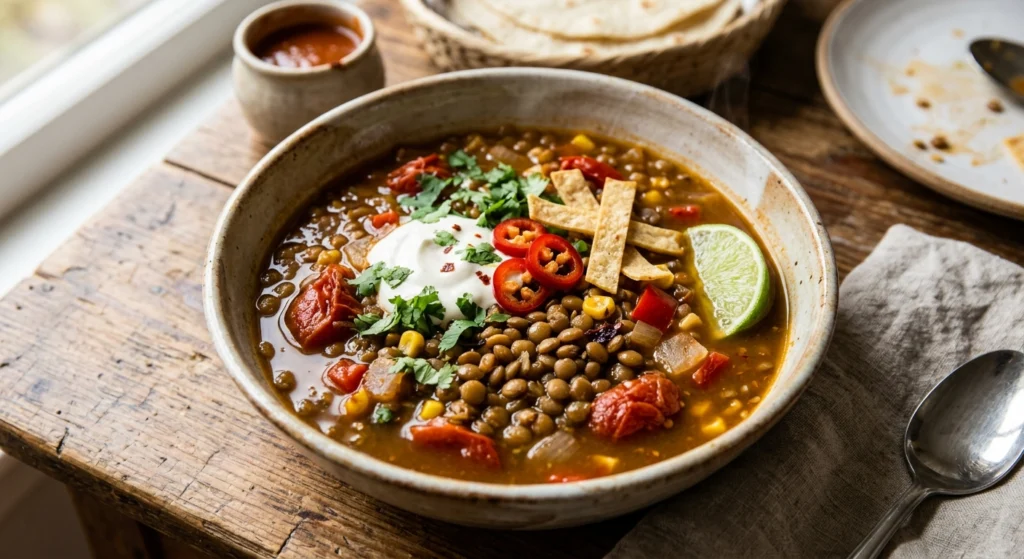
Mexican-Style Lentil Soup
This soup takes the symbolic ritual lentils and turns them into an actual first course, seasoned the way many central Mexican households prepare lentils for everyday cooking and for the holidays alike.
Yield: 6 servings | Serving size: about 1.5 cups Prep time: 15 minutes | Cook time: 45 minutes | Total time: 1 hour
Ingredients
- 2 cups (400 g) dried brown or green lentils, rinsed and picked over
- 8 cups (1.9 L) low-sodium chicken or vegetable broth
- 1 tablespoon olive oil
- 1 white onion, finely chopped
- 3 garlic cloves, minced
- 2 Roma tomatoes, diced
- 1 carrot, peeled and diced
- 1 chayote or 1 small potato, peeled and diced
- 2 slices bacon or 4 oz (115 g) Mexican chorizo, diced (optional)
- 1 bay leaf
- 1/2 teaspoon ground cumin
- Salt and black pepper, to taste
- Fresh cilantro and lime wedges, for serving
Instructions
- Heat the olive oil in a large pot over medium heat. If using bacon or chorizo, cook it first until it renders fat and turns lightly crisp, about 4 minutes, then remove half for garnish and leave the rest in the pot.
- Add the onion and cook until translucent, about 4 minutes. Add the garlic and cook for 30 seconds until fragrant.
- Stir in the tomatoes, carrot, and chayote or potato. Cook for 3 minutes.
- Add the lentils, broth, bay leaf, and cumin. Bring to a boil, then reduce to a simmer.
- Simmer uncovered for 35 to 40 minutes, stirring occasionally, until the lentils are fully tender and the soup has thickened slightly. The lentils should hold their shape but mash easily against the side of the pot with a spoon.
- Season with salt and pepper. Remove the bay leaf.
- Ladle into bowls, top with reserved bacon or chorizo, cilantro, and a lime wedge.
Substitutions: Swap chorizo for smoked ham if you want a milder flavor. For a vegetarian version, skip the meat and use vegetable broth; add a smoked chipotle pepper for depth.
Storage: Refrigerate in an airtight container for up to 4 days.
Reheating: Warm on the stovetop over medium-low heat, adding a splash of broth or water since the soup thickens as it sits.
Nutrition (estimated per serving): 280 calories, 18 g protein, 38 g carbohydrates, 6 g fat. Estimates only, based on standard ingredient values; not a medical or dietary claim.
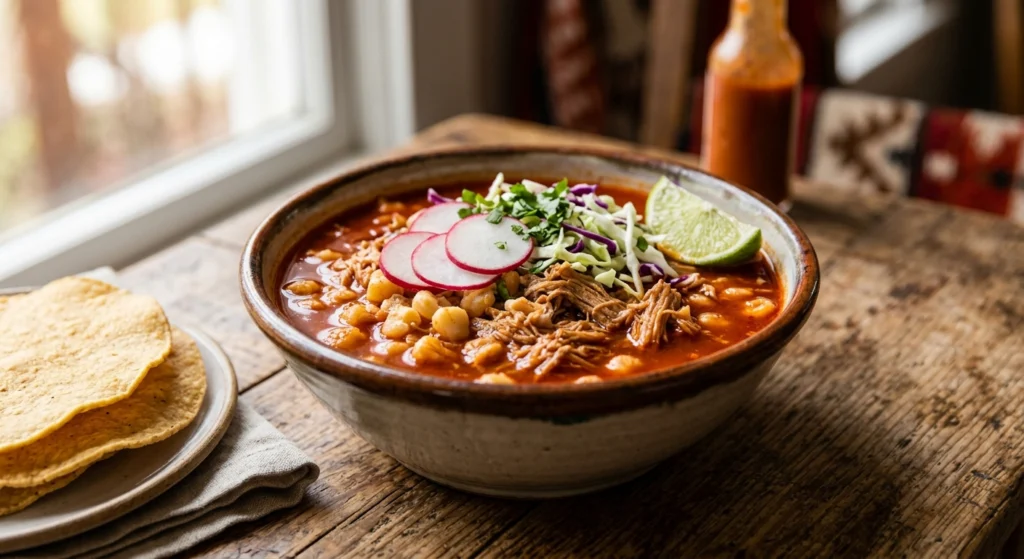
Pozole Rojo
Pozole rojo represents the red-chile version of Mexico’s best-known hominy soup, common in Jalisco and much of central and western Mexico as a celebration dish. It belongs in this article as a regional option for New Year’s, not a required one.
Yield: 8 servings | Serving size: about 2 cups Prep time: 30 minutes | Cook time: 2.5 hours | Total time: 3 hours
Ingredients
- 3 lbs (1.4 kg) bone-in pork shoulder, cut into large chunks
- 1 lb (450 g) pork ribs, cut into sections
- 1 white onion, halved, plus 1/2 cup finely chopped for serving
- 6 garlic cloves, peeled
- 2 bay leaves
- Salt, to taste
- 6 dried guajillo chiles, stemmed and seeded
- 4 dried ancho chiles, stemmed and seeded
- 2 dried árbol chiles (optional, for heat)
- 1 teaspoon dried oregano
- 1/2 teaspoon ground cumin
- 2 cans (25 oz / 700 g each) white hominy, drained and rinsed, or 6 cups fresh-cooked hominy
- Shredded cabbage or lettuce, sliced radishes, dried oregano, lime wedges, and tostadas, for serving
Instructions
- Place the pork shoulder and ribs in a large pot with the halved onion, 4 garlic cloves, bay leaves, and enough water to cover by 2 inches. Season with salt.
- Bring to a boil, skim off any foam, then reduce to a simmer. Cook uncovered for 1.5 hours, until the meat is fork-tender. Remove the meat, shred or cube it, and strain the broth, discarding the solids. Return the broth to the pot.
- While the meat cooks, toast the guajillo, ancho, and árbol chiles in a dry skillet over medium heat for about 1 minute per side, until fragrant but not burnt.
- Soak the toasted chiles in hot water for 15 minutes until softened. Blend with the remaining 2 garlic cloves, oregano, cumin, and 1 cup of the soaking liquid until smooth.
- Strain the chile mixture through a fine mesh sieve into the pot with the broth to remove any tough skins.
- Add the shredded meat and hominy to the pot. Simmer for 45 minutes to 1 hour, until the broth is deep red and the hominy is tender with a slight chew. Adjust salt to taste.
- Serve hot, letting each person add cabbage, radishes, oregano, lime, and chopped onion at the table.
Substitutions: Use bone-in chicken thighs instead of pork for a lighter version, reducing the initial simmer to 40 minutes. If árbol chiles aren’t available, a pinch of cayenne adds similar heat.
Storage: Refrigerate for up to 4 days, or freeze the broth and meat (without garnishes) for up to 3 months.
Reheating: Reheat gently on the stovetop over medium-low heat until warmed through; add fresh garnishes after reheating.
Nutrition (estimated per serving): 420 calories, 32 g protein, 28 g carbohydrates, 19 g fat. Estimates only; not a medical or dietary claim.
Pork With Dried Fruit or Festive Mexican-Style Sauce
Pork is one of the most common proteins across December holiday tables in Mexico, and this version, pork loin simmered in a fruit-forward sauce, reflects how many households dress up a simple cut of meat for a festive dinner.
Yield: 6 servings | Serving size: about 5 oz cooked pork with sauce Prep time: 20 minutes | Cook time: 1 hour 15 minutes | Total time: 1 hour 35 minutes
Ingredients
- 2.5 lbs (1.1 kg) boneless pork loin
- Salt and black pepper, to taste
- 2 tablespoons vegetable oil
- 1 white onion, sliced
- 3 garlic cloves, minced
- 2 ancho chiles, stemmed, seeded, and soaked in hot water for 15 minutes
- 1 cup (240 ml) orange juice
- 1/2 cup (75 g) pitted prunes, halved
- 1/2 cup (70 g) dried apricots, halved
- 1 cinnamon stick
- 2 tablespoons apple cider vinegar
- 1 tablespoon brown sugar or piloncillo, grated
- 1 cup (240 ml) chicken broth
Instructions
- Season the pork loin generously with salt and pepper. Heat the oil in a large oven-safe pot or Dutch oven over medium-high heat and sear the pork on all sides until browned, about 8 minutes total. Remove and set aside.
- In the same pot, add the onion and cook until soft, about 5 minutes. Add the garlic and cook for 30 seconds.
- Blend the soaked ancho chiles with the orange juice until smooth, then pour into the pot.
- Add the prunes, apricots, cinnamon stick, vinegar, brown sugar, and chicken broth. Stir to combine and bring to a simmer.
- Return the pork to the pot, spooning some sauce over the top. Cover and reduce heat to low, or transfer to a 325°F (165°C) oven, and cook for 55 to 60 minutes, until the internal temperature reaches 145°F (63°C) and the pork is tender enough to pull apart slightly with a fork.
- Remove the pork, let it rest for 10 minutes, then slice. Remove the cinnamon stick from the sauce, taste and adjust salt, and spoon the sauce and fruit over the sliced pork before serving.
Substitutions: Swap prunes and apricots for dried figs or raisins if that’s what you have. Pork shoulder works in place of loin for a fattier, more forgiving cut, though it will need closer to 1.5 hours to become tender.
Storage: Refrigerate sliced pork and sauce together in an airtight container for up to 4 days.
Reheating: Reheat covered in a low oven (300°F / 150°C) with a splash of broth to keep the meat moist, or gently on the stovetop over low heat.
Nutrition (estimated per serving): 390 calories, 34 g protein, 24 g carbohydrates, 16 g fat. Estimates only; not a medical or dietary claim.
Chicken or Pork Tamales
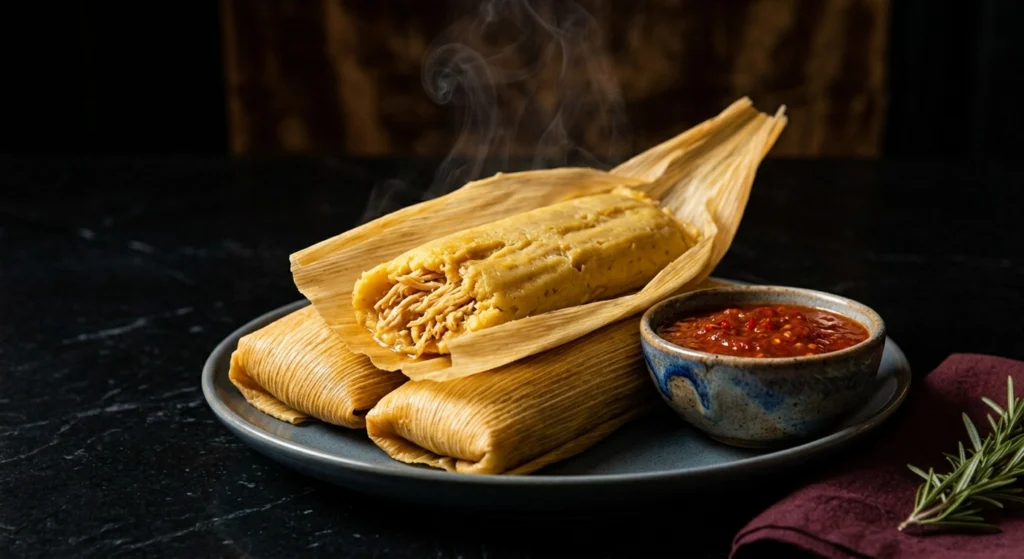
Tamales are a December holiday staple in many Mexican households, and while they aren’t reserved exclusively for New Year’s Eve, they’re common enough at year-end dinners to include here as a make-ahead option.
Yield: about 20 tamales | Serving size: 2 tamales Prep time: 1 hour (plus soaking corn husks) | Cook time: 1 hour 15 minutes | Total time: about 2.5 hours
Ingredients
- 30 dried corn husks, soaked in hot water for at least 30 minutes until pliable
- 4 cups (500 g) masa harina
- 1 teaspoon baking powder
- 1.5 teaspoons salt
- 1 cup (225 g) lard or vegetable shortening
- 2.5 to 3 cups (600 to 720 ml) warm chicken broth
- 3 cups cooked, shredded chicken or pork
- 1.5 cups red or green salsa (store-bought or homemade), plus extra for serving
Instructions
- Toss the shredded chicken or pork with the salsa in a bowl and set aside; this is your filling.
- In a stand mixer or large bowl, beat the lard until light and fluffy, about 3 minutes.
- In a separate bowl, whisk together the masa harina, baking powder, and salt. Add this to the lard in batches, alternating with the warm broth, beating until you have a smooth, spreadable dough about the texture of thick peanut butter. A small ball of dough dropped in a glass of cold water should float; if it sinks, beat in a bit more broth or lard.
- Pat a soaked corn husk dry. Spread about 3 tablespoons of masa dough in a thin, even layer over the wide end of the husk, leaving a border.
- Spoon 1 to 2 tablespoons of filling down the center of the masa. Fold the sides of the husk in toward the center, then fold up the empty tapered end, leaving the top open.
- Stand the tamales upright in a steamer basket set over simmering water, open end up. Steam for 1 hour to 1 hour 15 minutes, until the masa pulls away cleanly from the husk when unwrapped. Check water levels periodically and top up as needed.
- Let tamales rest for 10 minutes before serving, since they firm up slightly as they cool.
Substitutions: Banana leaves can replace corn husks for a softer texture, common in southern Mexico. Vegetable shortening can replace lard for a version without pork fat.
Storage: Refrigerate cooked tamales in their husks for up to 5 days, or freeze for up to 3 months.
Reheating: Steam frozen or refrigerated tamales for 15 to 20 minutes until heated through, or microwave individually wrapped in a damp paper towel for 1 to 2 minutes.
Nutrition (estimated per serving, 2 tamales): 340 calories, 16 g protein, 30 g carbohydrates, 18 g fat. Estimates only; not a medical or dietary claim.
Mexican Buñuelos
Buñuelos close out the meal the way they close out much of the December holiday season in central and southern Mexico, especially in Oaxaca, where large, thin, crisp versions are a signature. They’re included here as the dessert most likely to appear on a New Year’s table where buñuelos are already a family tradition.
Yield: 12 buñuelos | Serving size: 1 buñuelo Prep time: 20 minutes (plus 30 minutes resting) | Cook time: 20 minutes | Total time: about 1 hour 10 minutes
Ingredients
- 3 cups (375 g) all-purpose flour
- 1 teaspoon baking powder
- 1/2 teaspoon salt
- 2 tablespoons granulated sugar
- 2 large eggs
- 4 tablespoons unsalted butter, melted
- 1/2 cup (120 ml) warm milk
- Vegetable oil, for frying
- 1/2 cup (100 g) granulated sugar mixed with 1 tablespoon ground cinnamon, for coating
- Optional: 1 cup (240 ml) piloncillo syrup (piloncillo simmered with water, cinnamon, and a strip of orange peel until syrupy), for serving
Instructions
- Whisk together the flour, baking powder, salt, and sugar in a large bowl.
- In a separate bowl, whisk the eggs, melted butter, and warm milk together. Pour into the dry ingredients and mix until a shaggy dough forms.
- Turn the dough out and knead for about 5 minutes, until smooth and elastic. Cover and let rest for 30 minutes at room temperature.
- Divide the dough into 12 equal balls. On a lightly floured surface, roll each ball into a thin round, about 6 to 7 inches across; the dough should be thin enough to see light through in spots but not tear.
- Heat about 1.5 inches of vegetable oil in a heavy skillet to 350°F (175°C). Fry each buñuelo for 1 to 2 minutes per side, until golden brown and blistered.
- Drain on paper towels, then immediately toss or dust each buñuelo in the cinnamon sugar while still warm so it sticks.
- Serve as is, or drizzle with warm piloncillo syrup.
Substitutions: Baking powder can be swapped for 1/4 teaspoon baking soda plus 1/2 teaspoon lemon juice in a pinch. If you don’t have piloncillo, dark brown sugar simmered with water and cinnamon makes a close substitute for the syrup.
Storage: Store cooled, undrizzled buñuelos in an airtight container at room temperature for up to 2 days; they soften over time.
Reheating: Crisp them back up in a 350°F (175°C) oven for 4 to 5 minutes. Add syrup only right before serving.
Nutrition (estimated per serving): 260 calories, 5 g protein, 38 g carbohydrates, 10 g fat. Estimates only; not a medical or dietary claim.
How to Build a Mexican New Year’s Dinner
There’s no single official menu, but here’s how the pieces realistically fit together.
A traditional-style family dinner
A larger, multi-generational dinner often includes a main protein (pork, turkey, or both), a starch or soup course (tamales or pozole), a simple vegetable side like dressed nopales or a fresh salad, and a dessert table that might include buñuelos alongside other seasonal sweets. Wine, cider, or ponche (a warm fruit punch) often accompanies the meal.
A simpler home-cooked menu
For a smaller gathering, one main dish is often enough. A pot of pozole with all the garnishes on the side can function as a complete meal by itself. So can a smaller pork roast with rice and a side salad. The point isn’t to replicate a restaurant-scale spread; it’s to have something warm and shareable before midnight.
How to incorporate the midnight rituals
Set out twelve grapes per person in a small bowl or cup well before midnight, ideally peeled and seedless, so there’s no fumbling during the countdown. Have a small dish of dried or cooked lentils ready at the same time. Both rituals take under two minutes combined, so they work as a natural pause between dinner and dessert, or as the actual midnight moment itself if dinner wraps up earlier in the evening.
What can be prepared ahead
Pozole broth and pork can be cooked a day in advance and reheated, since the flavor often improves overnight. Tamale filling can be made a day ahead, though assembling and steaming the tamales is easiest done closer to serving. Buñuelo dough can rest in the refrigerator for a few hours if you need to fry them later. Piloncillo syrup keeps well for a week and can be made anytime beforehand.
Mexican New Year’s Food by Region and Family Tradition
Central Mexico
In and around Mexico City and the surrounding states, roast turkey and pork are common New Year’s mains, often carried over from a Nochebuena tradition the night before. Buñuelos are a frequent dessert here as well.
Jalisco and western Mexico
Pozole rojo has strong roots in Jalisco and much of western Mexico, and it appears at celebrations of many kinds, New Year’s included, alongside pork dishes.
Guerrero and other regional pozole traditions
Guerrero is particularly associated with pozole verde, made with a green sauce base of tomatillos, chiles, and herbs rather than the red chile base used elsewhere. Where pozole is already a defining regional dish, it’s a natural fit for a New Year’s dinner, though it competes with other options rather than replacing them outright.
Southern and coastal variations
In parts of southern Mexico, particularly Oaxaca, buñuelos take on a larger, thinner, and notably crisp style, and some coastal areas lean toward seafood-forward New Year’s dinners, including dishes built around fish or shrimp rather than the pork and turkey more common inland.
Why family tradition matters more than a fixed national menu
Even within the same city or region, what one family serves on New Year’s Eve often comes down to what a grandmother always made, what’s affordable that year, or which dish the household associates with celebration generally. Regional patterns are real, but they describe tendencies rather than rules, and family history frequently overrides regional expectation.
Mexican New Year’s Food: What Is Traditional and What Is Seasonal?
Foods strongly tied to the New Year ritual
- Twelve grapes at midnight
- Lentils, eaten or set aside as a symbol of abundance
These two are ritual foods specifically associated with the transition into the new year, not general holiday-season foods.
Foods shared with Christmas and the holiday season
- Pork dishes (roasted leg, loin, or adobo-style)
- Stuffed turkey
- Tamales
- Buñuelos
- Ponche (warm fruit punch)
These appear throughout Nochebuena and the broader December calendar and simply carry over into New Year’s Eve in many households, rather than being invented for that specific night.
Foods that vary by household
- Pozole (regional and family-dependent)
- Seafood-based dinners in some coastal areas
- Whether a full lentil soup is served or just the ritual gesture
- Whether dessert is buñuelos, another sweet, or both
Nutrition and Practical Notes
Calories and macronutrients in the featured recipes
The five recipes above range from roughly 260 to 420 estimated calories per serving, with pozole rojo and the pork dish landing on the higher end due to meat content, and buñuelos and lentil soup on the lighter end. These are estimates based on standard ingredient values, not lab-tested figures, and they’ll shift depending on exact ingredients, portion sizes, and how much oil or fat is used.
Portion considerations for festive meals
Holiday dinners in Mexico, like festive meals anywhere, tend to include multiple courses served across a longer evening rather than a single fixed portion. If you’re building a full multi-course New Year’s dinner, treat the nutrition estimates above as one part of a larger meal rather than the full picture for the night.
How preparation changes nutrition
Frying (buñuelos) adds more fat than steaming (tamales) or simmering (pozole, lentil soup, or the pork dish). Using lard versus vegetable shortening in tamale dough, or including bacon or chorizo in the lentil soup, will shift the fat and calorie counts higher than the leaner versions of each recipe. None of these adjustments make a dish inherently better or worse; they’re just worth knowing if you’re adapting a recipe to fit a particular household’s preferences.
Frequently Asked Questions
What is the most traditional Mexican New Year’s food?
There isn’t a single dish that qualifies as “the” traditional Mexican New Year’s food. The most consistently practiced traditions are the midnight rituals: eating twelve grapes with the clock’s chimes and eating or setting aside lentils for prosperity. The dinner itself varies by region and family, drawing from pork, turkey, tamales, pozole, and other holiday-season dishes.
What are the 12 grapes in Mexico for New Year’s?
The twelve grapes are a midnight ritual in which one grape is eaten with each of the twelve chimes that mark the new year, with each grape representing a wish or intention for the corresponding month ahead. The custom originated in Spain, most commonly traced to 1909, and spread to Mexico and other Spanish-speaking countries over the following decades, becoming especially popular in Mexico from the 2000s onward.
Why do Mexicans eat lentils on New Year’s?
Lentils are eaten or handled as a ritual because their small, round, coin-like shape has long been associated with money and prosperity, an association that traces back to ancient Rome and spread through Europe before becoming part of Mexican New Year’s customs. Some people eat a spoonful at midnight, others carry dried lentils in a pocket or bag through the year, and some toss a handful while making a wish.
Do Mexicans eat tamales on New Year’s?
Some do, but tamales are not a food specific to New Year’s Eve. They’re a broader December holiday staple that shows up at Nochebuena, family posadas, and other gatherings throughout the season, including New Year’s Eve in many households where they’re already a family or regional tradition.
Is pozole a Mexican New Year’s food?
Pozole is a celebration food in general, served at birthdays, national holidays, and family gatherings throughout the year, not one created specifically for New Year’s Eve. In regions like Jalisco and Guerrero, where pozole has deep roots, it’s a common and natural choice for a New Year’s dinner, but it’s one option among several rather than a universal requirement.
What meat is traditionally served on New Year’s Eve in Mexico?
Pork and turkey are the two most common proteins, both carried over from the broader Nochebuena and December holiday tradition. Which one (or both, or neither) appears depends on the household; some coastal families lean toward seafood instead.
What dessert is served for Mexican New Year?
Buñuelos, thin fried dough disks coated in cinnamon sugar or served with piloncillo syrup, are the dessert most closely associated with the December holiday season in central and southern Mexico, Oaxaca in particular. They’re a common but not universal choice for New Year’s Eve specifically.
Leave a Reply
You must be logged in to post a comment.