

A New Year’s resolution for a business only works if it fixes something real. The most useful resolutions come from looking honestly at what is currently limiting the business, whether that is cash flow, customer retention, an overloaded owner, inconsistent growth, or outdated technology, and choosing a small number of commitments that address it directly. This guide walks through how to identify that bottleneck, pick the resolution that matches it, and turn it into something measurable you can actually track through the year.
Start With Your Business’s Biggest Problem, Not a Random Resolution
Most resolution lists start with ideas. This one starts with diagnosis, because the same resolution that transforms one business will do almost nothing for another. A retail brand losing one-time buyers needs a retention resolution. A consulting firm with a full pipeline but an empty bank account needs a cash-flow resolution. Picking from a list without this step usually produces good intentions that fade by February.
Look at where your business is losing money, time, customers, or momentum
Before choosing a resolution, take an honest inventory. A few signals tend to point clearly at the real problem:
- Revenue is rising, but the bank balance never seems to catch up (cash flow)
- Sales look healthy, but profit margins keep shrinking (profitability)
- Customers buy once and never come back (customer retention)
- Some months are strong and others are dry, with no clear pattern (inconsistent growth)
- The owner is the bottleneck for nearly every decision (owner overload)
- The same manual steps get repeated differently by different people every time (inefficient processes)
- Staff spend hours on tasks that add little value (repetitive work)
- The team is missing a skill the business now depends on (team capability)
- Tools do not talk to each other, or the business has outgrown its current setup (technology needs)
- Passwords, backups, and access controls are informal or nonexistent (cybersecurity risk)
Most businesses will recognize themselves in two or three of these, not all ten. That overlap is useful information.
Choose the resolution that addresses the bottleneck
Once the pattern is visible, the resolution follows naturally. A business with strong sales but thin profit does not need a growth resolution, it needs a profitability resolution. A business that already has plenty of leads does not need more marketing, it needs a better sales process. Resolving the wrong problem, even successfully, will not move the business forward.
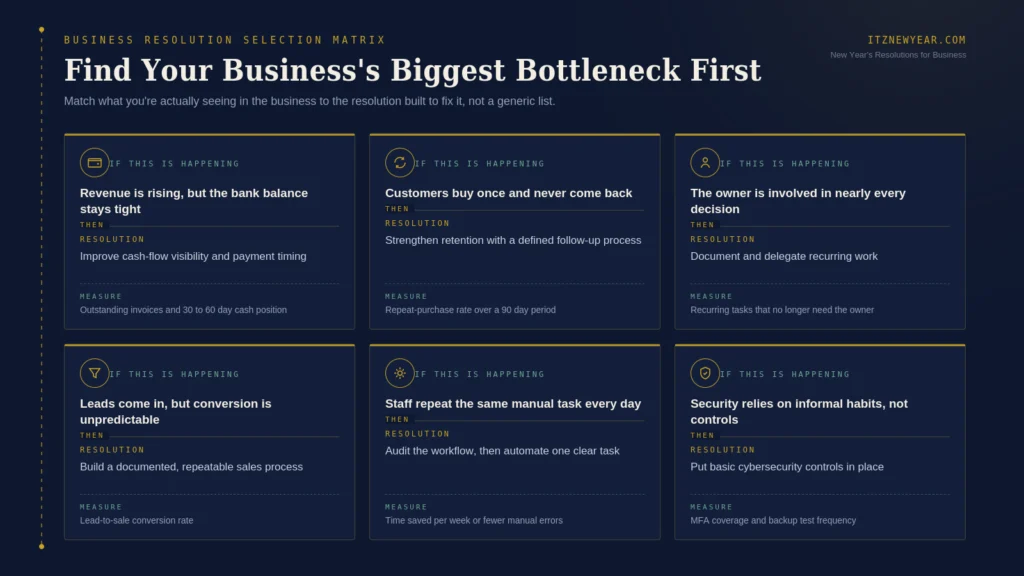
| If this is happening | Consider this resolution |
|---|---|
| Revenue is rising, but profit stays thin | Improve profit visibility and pricing discipline |
| Customers buy once and disappear | Strengthen retention and follow-up |
| The owner is involved in every decision | Document and delegate recurring work |
| Leads come in, but conversion is inconsistent | Build a repeatable sales process |
| Staff repeat the same manual task daily | Audit and automate one workflow |
| Data security relies on informal habits | Put basic cybersecurity controls in place |
This is a starting point, not a diagnosis on its own. A business showing signs in more than one row should still choose the one causing the most damage right now, rather than trying to act on all of them at once.
Limit the number of resolutions
There is no universal number of resolutions every business should set. What matters is choosing only as many as can receive consistent attention and a regular check-in. For most small businesses, that means somewhere between one and four active resolutions at a time, not ten. A short list reviewed monthly will outperform a long list written once and forgotten.
Strengthen the Financial Side of the Business
Financial resolutions tend to matter most for businesses that feel busy but not secure. Being busy and being financially healthy are not the same thing, and the gap between the two is where most financial stress lives.
Make cash flow more predictable
Cash flow problems rarely come from a lack of revenue. They come from timing, money going out before money comes in. A service business that closes strong deals but waits sixty days to get paid can still struggle to cover payroll or rent.
Problem: Revenue is growing, but cash is consistently tight.
Recommended resolution: Improve cash-flow visibility and payment timing.
First practical action: Build a simple monthly view of expected inflows, outflows, and upcoming obligations, updated on a fixed schedule.
What to measure: Outstanding invoices and projected cash position for the next 30 to 60 days.
Tightening payment terms, sending reminders earlier, or offering a small incentive for early payment are all reasonable starting points, depending on the business.
Focus on profit quality, not revenue alone
Higher sales do not automatically mean a healthier business. Revenue can grow every year while actual profit stays flat or shrinks, often because costs are climbing just as fast, or because the most profitable products or services are priced too low relative to the effort they require.
A useful resolution here is to review margins by product, service line, or client type at least once during the year, not just total revenue. Some businesses discover that a large share of their effort goes into their least profitable offering.
Review spending that no longer supports the business
Recurring costs accumulate quietly. Software subscriptions nobody uses, duplicate tools doing the same job, or services that made sense two years ago but not today all chip away at margin without anyone noticing month to month.
A simple resolution: once a quarter, review recurring expenses and cancel anything without a clear business reason to exist. This is not about cutting costs aggressively. It is about removing spending that has stopped earning its place.
Make Customer Retention a Business Resolution
Growth gets more attention than retention, but for many businesses, keeping existing customers is the faster and cheaper path to stronger revenue. A business that constantly replaces lost customers with new ones is working harder than it needs to.
Find out why customers do not return
Customers rarely leave for one dramatic reason. More often it is friction: a slow response, an inconsistent experience, a weak follow-up after the first purchase, or an onboarding process that leaves them unsure what to do next.
Problem: Customers make one purchase and never return.
Recommended resolution: Improve retention through a defined follow-up process.
First practical action: Map out what actually happens after a customer buys, and identify the first point where communication drops off.
What to measure: Repeat-purchase rate over a defined period, such as 90 days.
Improve one important customer touchpoint
Trying to fix the entire customer journey at once usually stalls progress. A more realistic resolution is to pick a single touchpoint and improve it deliberately. A subscription business, for example, might notice that customers who do not engage in their first two weeks rarely stay past month three.
A resolution built around strengthening that early window, through a check-in message or a clearer onboarding sequence, addresses the actual point of failure instead of the symptom.
Track the customer behavior you want to improve
Whatever touchpoint gets attention, it needs a way to know if the change worked. Useful measures include:
- Repeat-purchase or renewal rate
- Average response time to customer inquiries
- Patterns in complaints or support tickets
- Customer lifetime relative to acquisition cost
Tracking one or two of these consistently tells you more than tracking all of them occasionally.
Build a More Reliable Growth System
Growth resolutions are common, but the version that actually works is rarely “get more customers.” It is closer to “make growth less dependent on luck.”
Stop relying on random marketing activity
A business that posts occasionally, runs the occasional promotion, and hopes something sticks is not building a growth system, it is gambling on visibility. The resolution here is process, not volume: define which channels the business will actually use consistently, and commit to a schedule that can realistically be maintained.
Improve lead follow-up and sales consistency
Inconsistent growth often has less to do with generating interest and more to do with what happens after someone shows interest. A lead that is not followed up within a day is far less likely to convert than one that is.
Problem: Leads come in, but conversion is unpredictable.
Recommended resolution: Build a documented lead-to-customer process.
First practical action: Write down every step from first contact to closed sale, including who is responsible and how quickly follow-up happens.
What to measure: Lead-to-sale conversion rate.
Experiment without changing everything at once
Growth resolutions can backfire when a business changes pricing, messaging, offer, and channels all at the same time. When results shift, there is no way to know what caused it. A more disciplined resolution is to test one meaningful change at a time and give it enough time to produce a real signal before adjusting again.
Reduce the Work Only the Owner Can Do
This resolution category matters most for founders and solopreneurs whose businesses have quietly become dependent on them personally answering every question, approving every task, and handling every exception.
Document repetitive processes
If a process only exists in the owner’s head, the business cannot function without them, and no one else can be trained to help either. Writing down how recurring tasks actually get done, even in a simple checklist form, is the resolution that makes everything after it possible.
Delegate the right tasks
Not every task is worth delegating, but many are. A useful test: does this task require the owner’s specific judgment, or does it require the owner’s time only because no one else has been shown how to do it? Tasks in the second category are candidates for delegation.
Problem: The owner is involved in nearly every decision, including small ones.
Recommended resolution: Document and delegate recurring work.
First practical action: List every task the owner does weekly, then flag which ones do not actually require the owner.
What to measure: Number of recurring tasks that no longer require owner involvement.
Protect focused time for high-value work
An owner buried in daily operations rarely has time for the decisions that actually shape the business, such as pricing, partnerships, or major hires. Blocking even a few consistent, protected hours a week for higher-level work is a meaningful resolution on its own.
Use Technology More Intentionally
Technology resolutions work best when they solve a defined problem, not when they are adopted because a tool is trending. Buying software before understanding the underlying issue usually adds complexity instead of removing it.
Audit repetitive work before buying new tools
Automating a broken process just makes the business bad at the same thing, faster. Before adopting new technology, it is worth identifying which repetitive tasks are actually worth automating, and which ones need to be fixed or removed first.
Use AI and automation where they create a clear business benefit
AI and automation are useful for specific, well-defined tasks: drafting routine communications, summarizing information, handling first-line customer questions, or speeding up reporting. They are not a guaranteed source of growth, and adopting them does not automatically make a business more competitive.
Problem: Staff spend hours on repetitive manual tasks.
Recommended resolution: Automate one clearly defined workflow.
First practical action: Choose a single repetitive task, such as data entry between two systems, and evaluate a tool built specifically for that task.
What to measure: Time saved per week or reduction in manual errors.
The resolution is not “adopt AI.” It is “remove one specific inefficiency, and AI happens to be the tool that fits.”
Make cybersecurity a business resolution
Cybersecurity is a business risk, not just a technical concern, and it belongs on the same list as cash flow or customer retention for any business that stores customer data, processes payments, or depends on its systems staying online.
The National Institute of Standards and Technology, the U.S. federal agency behind widely used cybersecurity guidance, frames its small-business recommendations around a short set of priorities: enabling automatic software updates, regularly backing up data and testing that the backups actually work, and turning on full-disk encryption for devices that hold sensitive information.
A realistic starting resolution covers the basics:
- Turn on multi-factor authentication for key business accounts
- Set up automatic, regular backups of important data and test them periodically
- Keep software and systems updated rather than postponing patches
- Train staff to recognize suspicious emails and links
- Use a password manager instead of reused or written-down passwords
None of these require deep technical expertise to start, and each closes a common point of vulnerability.
Improve the Business System Before Adding More Work
Growth without a stable operating system tends to create chaos rather than progress. This resolution category is about making the business run more consistently before piling on new initiatives.
Standardize recurring work
When the same task gets done differently depending on who handles it, quality becomes unpredictable. Standardizing how recurring work gets done, through a checklist, template, or short written process, reduces variation and makes results more consistent.
Reduce unnecessary steps
Processes accumulate extra approvals and steps over time, often because of a past problem that no longer applies. A resolution to review one core process and remove steps that no longer add value can meaningfully speed up how the business operates.
Identify recurring mistakes
The same errors showing up repeatedly usually point to a process gap, not a person problem. Tracking where mistakes keep happening, even informally, makes it possible to fix the actual cause instead of repeatedly correcting the same issue after the fact.
A small manufacturing or fulfillment business that keeps shipping the wrong item, for example, does not necessarily have a staffing problem. It may have a picking process with no verification step. Fixing the step prevents the error from repeating, where retraining alone usually does not.
Invest in the People Who Help the Business Run
People-related resolutions belong on this list when they affect how the business performs, separate from broader workplace culture, which deserves its own focus entirely.
A few resolutions worth considering:
- Clarify expectations for roles that have grown vague or overlapping over time
- Improve training so new hires reach full productivity faster
- Build accountability by tying responsibilities to clear, visible outcomes
- Hire more deliberately for the specific skill gaps the business currently has, rather than reactively
Problem: The team is missing a skill the business increasingly depends on.
Recommended resolution: Identify the specific capability gap and address it through training or hiring.
First practical action: List the tasks currently blocked or slowed by the missing skill.
What to measure: Time to complete the affected task, before and after.
This category is easy to confuse with workplace culture, but the two are not the same thing. A resolution about capability asks whether the business has the skills it needs to operate. Questions about morale, communication style, or team environment matter, but they belong to a separate conversation from whether the business can actually perform the work in front of it.
Turn a Vague Resolution Into a Business Commitment You Can Track
A goal defines the measurable result the business wants to achieve. A resolution is the commitment to change how the business operates or what it prioritizes to get there. Neither one is useful on its own if it stays vague.
Define the outcome
Start by naming, specifically, what should be different by the end of the year. “Grow the business” is not specific. “Increase repeat customers through a documented follow-up process” is.
Choose useful measures
One or two measures are usually enough. More than that tends to dilute focus rather than sharpen it. The measure should connect directly to the resolution, not just to general business health.
Set the first action
Every resolution needs a first step that can start within the next two weeks. Without one, the resolution stays an intention indefinitely.
Set review timing
Decide in advance how often progress will be checked, whether that is monthly, quarterly, or both. Resolutions without a review point tend to quietly disappear.
| Vague resolution | Better business resolution | What to track |
|---|---|---|
| Grow the business | Improve qualified lead conversion through a documented follow-up process | Lead-to-sale conversion rate |
| Save money | Review recurring expenses and remove costs with no clear business value | Monthly recurring cost |
| Improve customer service | Reduce response delays and monitor repeat complaints | Response time and complaint trends |
| Use more technology | Automate one repetitive workflow with a defined time-saving target | Time saved or error reduction |
| Grow the team | Close a specific capability gap through training or targeted hiring | Time to complete the affected task |
A Simple Way to Keep Business Resolutions From Being Forgotten
Resolutions fail quietly more often than they fail dramatically. The most reliable safeguard is a fixed review rhythm rather than good intentions.
- Monthly: a short check on whether the first action happened and whether the measure moved
- Quarterly: a deeper look at whether the resolution is still the right priority
- As needed: adjust or drop a resolution if the underlying business condition has materially changed
Dropping a resolution is not a failure. If the business’s biggest bottleneck shifts partway through the year, from cash flow to customer retention, for example, the resolution should shift with it. A resolution that no longer reflects the business’s real problem is not worth protecting for its own sake.
Frequently Asked Questions
What are the best New Year’s resolutions for a small business?
The best resolution depends on what is currently limiting the business the most. For a business with cash-flow trouble, that might mean better payment tracking. For one losing customers, it might mean improving retention. For one running on manual processes, it might mean documenting and automating a single workflow. There is no single best resolution that applies equally to every business.
How many business resolutions should I set for the new year?
There is no universal number. Choose only as many resolutions as the business can actively work on and review regularly, which for most small businesses means somewhere around one to four. A shorter list that gets consistent attention will produce better results than a long list set once and never revisited.
What is a good business resolution for a struggling business?
Start by identifying the most immediate constraint, whether that is cash flow, weak profitability, customer loss, or inefficient operations, rather than trying to fix everything at once. A struggling business generally benefits more from stabilizing one core problem than from spreading effort across several resolutions at the same time.
Are New Year’s resolutions the same as business goals?
Not quite. A business resolution is a commitment to change how the business operates or what it prioritizes. A goal is the measurable result that change is meant to produce. In practice, the two work together: the resolution is the shift in behavior, and the goal is how progress gets measured.
How often should I review my business resolutions?
A short monthly check, to confirm the first action happened and the chosen measure is moving, paired with a deeper quarterly review of whether the resolution is still the right priority, works well for most businesses. Resolutions left unreviewed for months tend to lose momentum even when the intention behind them was sound.
Leave a Reply
You must be logged in to post a comment.