
January usually starts the same way. You feel motivated, you plan an ambitious schedule, and for the first week or two it works. Then a late meeting, a bad night of sleep, or a busy weekend gets in the way. You miss a session, then another, and the guilt makes it easier to quit than to restart.
The problem isn’t that you lack willpower. It’s that most fitness plans are built around how motivated you feel on January 1st instead of how your actual week works in March. Motivation gets you started. A routine that fits your real schedule is what keeps you going after the excitement wears off.
This article isn’t a list of generic tips. It’s a practical system: how to set a fitness goal you can actually repeat, how to build a week around it, how to remove the friction that stops you from starting, and what to do when life inevitably interrupts the plan.
Make Your Fitness Goal Easier to Repeat, Not Just Exciting to Start
An ambitious goal isn’t the problem. A goal that only works on a perfect week is the problem. The fix starts with understanding what you’re actually setting a target for.
Separate the result you want from the behavior you control
Losing 20 pounds, running a 10K, or getting noticeably stronger are outcomes. They’re the reason you started, but you can’t directly control them day to day. Your body responds to training on its own timeline, and outside factors like sleep, stress, and genetics all play a role.
What you can control is the behavior that leads there: showing up for three planned workouts a week, walking most days, or completing a specific strength program. These are process goals, and they’re worth building your routine around for one simple reason. You can check off a process goal today. You can’t force an outcome to arrive on schedule.
This distinction matters because outcome-focused goals tend to create their own kind of discouragement. If your only measure of success is the number on the scale, a normal week of no visible change can feel like failure, even when you did everything right. A process goal keeps the scoreboard in your hands.
Set a baseline you can maintain on an ordinary week
Before you decide how often to train, look honestly at a typical week, not your best one. How much time do you actually have? What’s your current activity level? Do you have access to a gym, or will most of your training happen at home?
A beginner who has been mostly sedentary and jumps straight into six gym days a week is setting up a routine that only survives if nothing goes wrong. A more durable starting point is a frequency you could hit even during a rough week, then build from there once it feels sustainable.
Signs your fitness goal is set too aggressively:
- You’re exhausted most days instead of energized
- You’re skipping warmups, cooldowns, or rest days to save time
- The schedule regularly conflicts with work, sleep, or family responsibilities
- You dread the workout before it starts
- Missing one session makes you want to skip the rest of the week
If two or more of these sound familiar, the goal isn’t wrong. The version of it you’re trying to execute right now probably is.
Build Your Week Around a Fitness Routine You Can Actually Keep
Once you know roughly how often you want to train, the next step is turning that into an actual weekly structure instead of a loose intention.
Put workouts on the calendar
“I’ll work out more this year” doesn’t survive contact with a busy week. “Gym at 6:30 a.m. on Monday, Wednesday, and Friday” does, because it has a specific day and time attached to it. Treating a workout like an appointment, something with a start time you’ve already committed to, makes it far less likely to get silently pushed aside.
Pick realistic time windows. If your evenings are unpredictable because of work, don’t build a routine that depends on leaving the office by 5:30 every day. Build around the time slots that are actually protected.
Give every workout a backup option
This is where most fitness plans quietly fall apart. They only account for the version of the day where everything goes according to plan. A more durable approach gives each planned session a smaller fallback, so a bad day doesn’t have to mean a missed day.
A workout doesn’t need to hit the same training stimulus every time to still count. Its job, on a hard week, is to keep the routine alive.
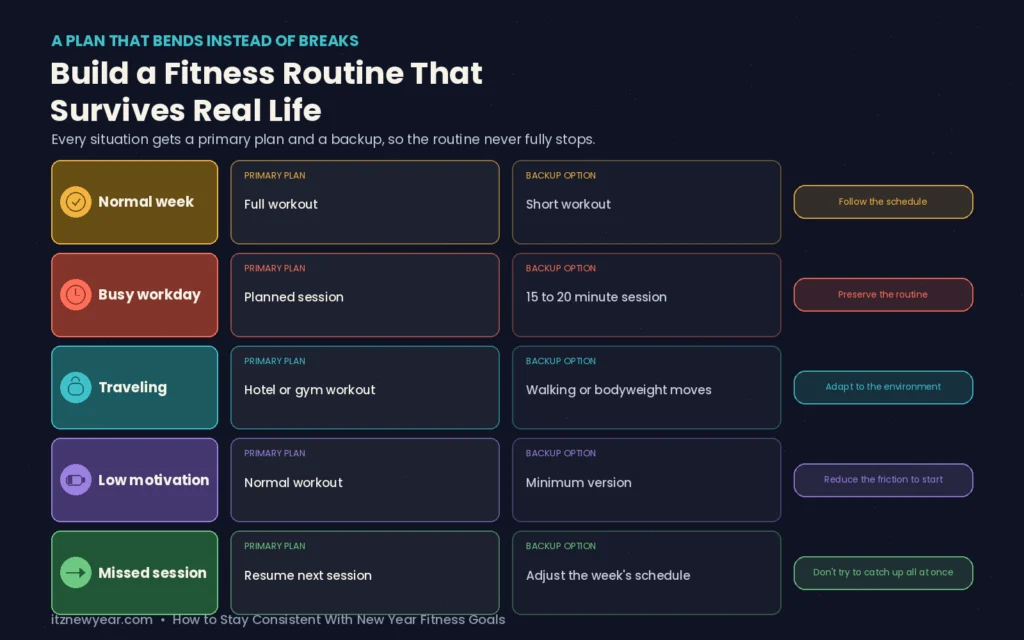
| Situation | Primary plan | Backup option | Consistency principle |
|---|---|---|---|
| Normal week | Full workout | Short workout | Follow the schedule |
| Busy workday | Planned session | 15 to 20 minute session | Preserve the routine |
| Traveling | Hotel or gym workout | Walking or bodyweight exercises | Adapt to the environment |
| Low motivation | Normal workout | Minimum version of the workout | Reduce the friction to start |
| Missed session | Resume the next planned session | Adjust the week’s schedule | Don’t try to make up for it all at once |
For example, someone planning a 45 minute gym session might set a 20 minute home workout as the backup and a 10 minute walk as the bare minimum. On a good day, the full session happens. On a chaotic one, the walk still counts, and the streak of “I did something” stays intact.
Make Exercise Easier to Start
The workout itself usually isn’t what stops people. It’s everything leading up to it: finding clean gym clothes, packing a bag, figuring out where to go, deciding what to actually do once you get there.
Removing those small decisions in advance makes the workout easier to start on a day when motivation is already low.
- Lay out clothes and equipment the night before
- Keep a bag packed and ready near the door
- Choose a location that doesn’t add unnecessary travel time
- Decide the workout ahead of time instead of figuring it out on the spot
- Default to the same time and place until it stops requiring a decision at all
Choose an activity you don’t dread
If you hate running, forcing yourself to run three times a week isn’t a discipline problem you need to fix. It’s a mismatch between the activity and the person doing it. Walking, cycling, swimming, strength training, dance classes, and recreational sports all improve cardiovascular fitness and strength in different ways, and none of them is inherently more “real” than the others.
The activity that actually gets repeated is the one worth building a routine around. A workout you’re willing to do consistently at moderate effort will beat an ideal workout you keep avoiding.
Stop Depending on Motivation to Get You Through the Year
Motivation is not a stable resource. It’s high after a good night’s sleep and a productive morning, and it disappears after a stressful day. Building a fitness routine that only runs on motivation means it will eventually stall, usually around the point where the initial excitement of a new goal wears off.
A routine reduces how much motivation you need in the first place. When the day, time, and workout are already decided, you’re not negotiating with yourself every morning. You’re just following a plan you already agreed to.
Environment plays a similar role. A gym bag by the door, a workout app already open, or shoes sitting next to the bed all lower the activation energy required to start. None of this replaces motivation entirely, but it means you’re not relying on willpower alone to get moving.
Use cues and routines instead of waiting to feel ready
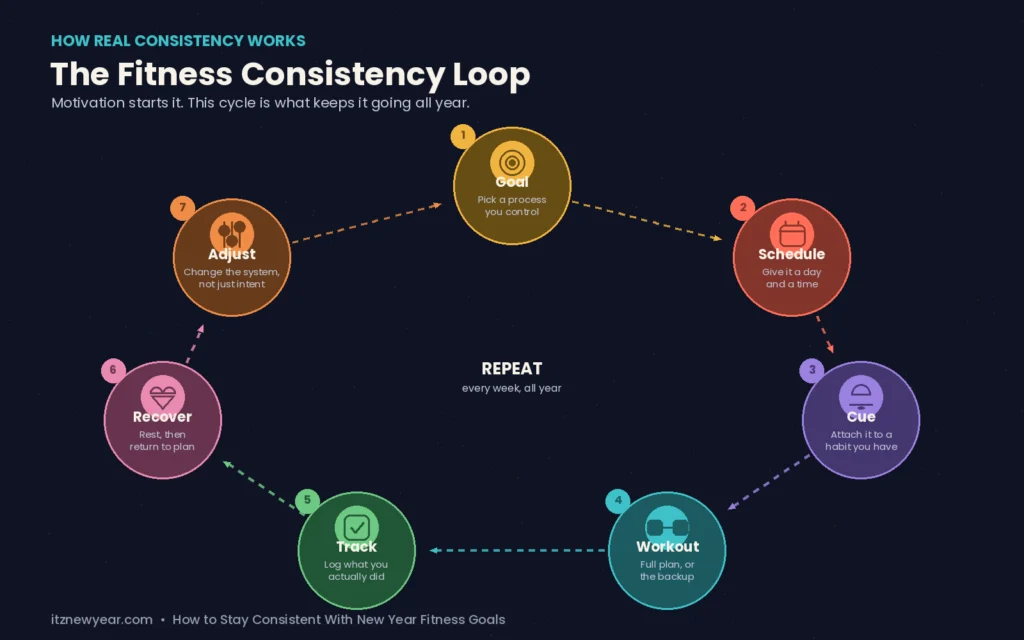
Attaching a workout to something you already do consistently makes it easier to trigger without thinking about it too hard.
- After you finish your morning coffee, put on your walking shoes
- Right after work, change into gym clothes before you sit down
- Saturday morning, before checking your phone, do the longer session
The cue doesn’t need to be complicated. It just needs to happen reliably enough that the workout becomes the next automatic step rather than a decision you have to make from scratch.
Track Consistency Without Turning Fitness Into a Scorecard
Tracking can genuinely help you stay consistent, but it can also backfire if the only thing you’re tracking is a number that fluctuates for reasons outside your control.
Useful things to track include:
- Workouts completed versus workouts planned
- Total active minutes for the week
- Strength sessions or running distance
- Steps or general daily movement
- How you felt during and after the session
Track behaviors before obsessing over results
Weight, appearance, and even performance can shift week to week because of water retention, sleep, stress, hormones, or a dozen other factors that have nothing to do with whether your plan is working. Behavior data tells you something more reliable: did you actually do what you planned to do.
Self-monitoring, simply writing down or logging what you did, can make progress easier to see and gives you feedback about whether the plan matches your real life. It won’t guarantee consistency on its own, but it removes the guesswork of trying to remember whether last week actually went well.
If you completed most of your planned sessions but still aren’t seeing the outcome you want, that’s useful information. It points toward adjusting the plan, not toward assuming the whole effort failed.
Know What to Do When You Miss a Workout
Missing a single workout is not the same thing as abandoning the goal, even though it can feel that way in the moment. What actually determines whether the routine survives is how you respond to the miss, not the miss itself.
A practical way to handle it:
- Don’t try to make up for it with an unusually long or intense session. That raises injury risk and makes the next day harder to show up for too.
- Notice why it happened. A one-off late meeting is different from a pattern of consistently missing the same day.
- Adjust the very next session if needed, rather than trying to force the original plan back into a schedule that clearly isn’t working.
- Return to your normal routine as soon as the next planned session arrives.
- If the same obstacle keeps showing up, change the system itself, not just your intentions.
Use a “never miss twice” concept carefully
A useful, if informal, guideline is to avoid missing the same workout two times in a row. It’s not a scientific rule, and treating it as an unbreakable law can create the same pressure that makes people quit after a bad week. Think of it as a general aim, not a strict requirement you have to defend.
If Monday’s workout gets skipped because of work, the goal isn’t to punish yourself on Tuesday. It’s to make sure Wednesday doesn’t get skipped for the same reason.
Adjust Your Fitness Goal When Your Life Changes
A fitness plan that can’t bend when circumstances change usually ends up broken instead. Work gets busier, you travel, family responsibilities pile up, the weather turns, or your regular gym is temporarily unavailable. None of that means the goal has to be abandoned.
Adjusting the method is different from giving up on the goal.
- Gym unavailable: switch to a home workout using bodyweight exercises or minimal equipment
- Unusually busy week: shorten sessions instead of skipping them entirely
- Traveling: rely on walking and bodyweight movements that don’t require a gym
- Family obligations pile up: shift a session to early morning or split it into two shorter blocks
- Illness or injury: scale back intensity and duration rather than stopping activity altogether once you’re able to move again
The goal stays intact. Only the shape of the week around it changes.
Progress Gradually Instead of Trying to “Catch Up”
After a missed week or a slow start, it’s tempting to compensate by suddenly training harder or more often than planned. This usually backfires. A body that hasn’t been training consistently is more prone to excessive soreness, fatigue, and injury when frequency or intensity jumps too quickly.
Federal physical activity guidance recognizes this by describing gradual increases in both frequency and intensity over time, rather than sudden jumps, as the more sustainable approach to building activity levels.
For most healthy adults, current U.S. guidelines suggest aiming for at least 150 minutes of moderate-intensity aerobic activity per week along with muscle-strengthening activity on two or more days, while also making clear that some activity is better than none for anyone starting from a lower baseline.
That range is a general framework, not a target everyone needs to hit immediately. If you’re returning from a long break or starting from very little activity, building up gradually toward that level is more sustainable than trying to reach it in the first week. Anyone managing a chronic condition, an injury, or a disability should talk with a healthcare professional about what level of activity and progression makes sense for their specific situation.
Use Other People and External Structure When It Helps
Accountability isn’t required for consistency, but it can make it easier for a lot of people. A training partner, a scheduled class, a coach, or a running club all add a layer of external commitment that doesn’t rely purely on your own motivation that day.
Some options worth considering:
- A workout buddy with a similar schedule
- A recurring group class at a fixed time
- A running or cycling club with a regular meetup
- A coach or trainer for structure and accountability
- A signed-up event, like a 5K, charity walk, or hiking trip, that puts a date on the calendar
Recent survey data from a 2026 poll by London Sport found that people who signed up for a fitness challenge or event were more likely to continue their New Year’s resolution beyond January. That’s an association worth noting, not proof that signing up for an event guarantees results. Structure helps some people more than others, and it’s one tool among several rather than a requirement for consistency.
A Simple Way to Reset When Your Fitness Resolution Falls Apart
If your original plan has completely fallen apart, the answer isn’t to force the same schedule back into place through sheer willpower. It’s to figure out why it broke and rebuild something that actually fits.
A short reset sequence:
- Review. Look honestly at what stopped working. Was the target too ambitious for your actual schedule? Did the timing conflict with work or family commitments? Did the activity itself become boring?
- Simplify. Cut the plan down to something you’re confident you can repeat, even if it’s smaller than what you originally wanted.
- Reschedule. Pick new days and times based on your current life, not the one you had when you first set the goal.
- Restart. Begin again without treating the earlier gap as evidence that you’ve failed. A pause isn’t a permanent stop.
- Reassess. After a couple of weeks, check whether the new version is actually sustainable, and adjust again if it isn’t.
A quick weekly check-in worth running through:
- Did I complete the sessions I planned this week?
- Was the schedule realistic given everything else going on?
- Did I enjoy at least part of the activity?
- What interrupted the routine, if anything?
- What’s one small change worth making next week?
This kind of regular, low-pressure review does more for long-term consistency than any single burst of motivation ever will.
Frequently Asked Questions
How do I stay motivated to exercise after the New Year?
Motivation naturally rises and falls, so the more reliable approach is reducing how much you depend on it. Scheduling workouts at fixed times, choosing an activity you don’t dread, keeping equipment ready, and adding some form of accountability all make it easier to show up on days when motivation alone wouldn’t be enough.
How many days a week should I work out to stay consistent?
There isn’t one universal number that works for everyone. Current U.S. guidelines suggest adults aim for at least 150 minutes of moderate-intensity aerobic activity weekly, plus muscle-strengthening activity on two or more days. If you’re inactive right now, building toward that gradually is more sustainable than trying to hit it immediately, and some activity is better than none while you work up to it.
What should I do if I miss a workout?
Resume your normal schedule at the next planned session instead of trying to make up for the missed one with an especially long or intense workout. One missed session is a normal part of a routine, not a sign that the whole plan has failed.
How can I stick to a workout routine when I’m busy?
Put workouts on your calendar like any other appointment, keep a shorter backup version ready for tight days, choose a convenient location that doesn’t add extra travel time, and set weekly targets flexible enough to survive a genuinely hectic week without falling apart entirely.
Is it better to work out every day or a few days a week?
It depends on your goal, current fitness level, the type of exercise, and how much recovery you need. Daily activity isn’t required for consistency, and for many people, a realistic schedule of several sessions a week with adequate rest is easier to sustain long term than trying to train every single day.
How long does it take to make exercise a habit?
There’s no universal number of days that applies to everyone, despite common claims you’ll see online. Habit formation varies by person, by the specific behavior, and by how consistently the routine fits into daily life. Focusing on repeatable scheduling and reducing friction tends to matter more than counting toward an arbitrary deadline.
What if I lose motivation for my New Year’s fitness goal?
Shift your attention from how motivated you feel to what’s already scheduled. Lean on the minimum version of your workout on hard days, prioritize an activity you actually enjoy, and consider adding accountability, like a workout partner or a class, if motivation alone isn’t carrying you through anymore.
Should I change my fitness goal if I’m not making progress?
Not automatically. First look at whether you’re actually completing your planned sessions, getting enough recovery, and using a realistic method of tracking progress. If adherence and recovery both look reasonable and progress still isn’t showing up, that’s when adjusting the goal or the approach makes sense.
The Takeaway
Staying consistent with a New Year’s fitness goal isn’t about finding more willpower in February than you had in January. It’s about building a routine specific enough to schedule, flexible enough to survive a bad week, and forgiving enough that one missed session doesn’t turn into a quiet, permanent stop. Set a target you can actually repeat, give it a backup plan, and treat setbacks as something to adjust for rather than something to recover from through sheer force.
Leave a Reply
You must be logged in to post a comment.