

Many couples sit down every December and write out personal resolutions: lose weight, read more, save money, without ever writing anything for the relationship itself. The partnership runs on autopilot while everything else gets a plan. A resolution for two people works differently than a personal one.
It only sticks if both partners can picture themselves actually doing it, and if it describes something you want to experience together rather than something one partner wants to change about the other. That distinction is usually what separates a resolution that lasts past January from one that quietly disappears.
Start With What You Want More of as a Couple
Before picking from a list, it helps to talk through what actually needs attention, because not every couple is missing the same thing. One couple might have plenty of affection but no time alone since having kids. Another might spend hours together but feel like the conversation never gets past logistics and schedules. A short, honest conversation about the past year will point you toward a better resolution than any list can.
A quick conversation to have before choosing a resolution
Sit down together, put the phones in another room, and talk through a few questions:
- What felt good about us this year that we’d like more of?
- What did we keep meaning to do together but never got around to?
- Is there something we argue about or avoid that keeps resurfacing?
- Where do we feel more like roommates than partners?
- Is there something one of us wants to pursue that the other could support more?
- If we only changed one thing this year, what would matter most?
You don’t need a tidy answer to every question. Notice which one makes you both pause. That’s usually where the resolution should come from.
Once you know roughly what you’re after, it helps to match that feeling to a category of resolution instead of scrolling through a long list hoping something jumps out.
| If you want more… | Try a resolution around… | Example |
|---|---|---|
| Connection | Protected time together | A weekly no-phone dinner or walk |
| Fun | Novelty and shared experiences | Trying one new activity a month |
| Honest communication | Structured check-ins | A 15-minute Sunday conversation |
| Teamwork | Shared responsibilities | Dividing tasks by capacity, not habit |
| Shared memories | Traditions | An annual trip or seasonal ritual |
| Financial direction | One shared money goal | A joint savings target reviewed monthly |
| Personal support | A supported individual goal | Protecting your partner’s study or training time |
New Year’s Resolutions for Couples That Strengthen the Relationship
These ideas are grouped by what they address, not ranked by importance. Pick two or three that match the conversation above rather than trying to take on all of them at once.
Make regular time for each other
This is different from vaguely deciding to “spend more time together.” Pick a day and a time that actually fits your schedule, whether that’s a Thursday evening or a Sunday morning, and treat it the same way you’d treat any other standing commitment. It doesn’t need to cost anything. A block of time with no laundry planning, no phones, and no talk about the following week counts just as much as a dinner out.
If a weekly slot feels unrealistic given your schedules, a biweekly or monthly version still works, as long as it’s fixed rather than “whenever we get a free evening.” An at-home version, cooking a specific meal together or watching something with no other screens open, protects the same thing a dinner reservation would, without the added cost or planning that can turn a good intention into another thing that keeps getting postponed.
Have a short relationship check-in
A weekly fifteen to twenty minute conversation where each person shares one thing that felt good and one thing they’d like more of gives you a consistent way to stay current with each other, instead of letting small frustrations pile up until they turn into a bigger argument. End each check-in with one small, specific action rather than a general intention.
Practice more specific appreciation
Generic thanks tends to fade into background noise after a while. Naming the specific thing your partner did, such as handling a difficult phone call calmly or covering the bedtime routine on a night you were exhausted, lands differently because it shows you actually noticed the effort, not just the outcome.
Become better listeners
Set a personal rule to hear your partner out fully before offering a solution. Ask one follow-up question before responding with advice. When your partner is telling you about their day, put down whatever you’re holding. These are small habits, but they change how conversations feel over time.
Create a phone-free ritual
Pick one recurring moment, morning coffee, a walk, the drive home, and agree it’s phone-free by default. The specific activity matters less than having one reliable pocket of the day that belongs to actual conversation instead of split attention.

Bring back something you used to enjoy together
Think about an activity that quietly disappeared as life got busier: cooking a certain meal together, a show you watched every week, a hike route, a card game. Reviving it is often more meaningful than starting something brand new, since it already has memories attached to it.
Try something neither of you has done before
New experiences give a relationship fresh material to talk about and remember together. This doesn’t need to be dramatic. A cooking class, an unfamiliar restaurant style, or a day trip to a place neither of you has visited all work. The goal is building a shared memory, not checking a box.
Make room for individual goals
A healthy relationship doesn’t require both partners to want the same things. One partner might be training for a race while the other handles the early morning routine on training days. One might be studying for a certification while the other protects their study time on weekends.
Research on couples has found that partners who know each other’s personal goals, and feel known in return, tend to report closer, more satisfying relationships. This works because supporting a goal you don’t personally share is still an act of partnership.
It helps to separate three kinds of goals instead of treating them as one category. A shared relationship goal is something you’re both intentionally practicing together, like a weekly check-in. A shared life goal is something you’re both working toward, like a home purchase or a trip you’re saving for. A supported individual goal belongs to one partner, but the other actively makes room for it. None of these require the other two to look the same, and most couples end up with a mix of all three across the year.
Build one shared financial goal
Rather than a broad resolution to “save money,” choose one thing you’re both funding together, whether that’s a trip, a repair, or an emergency cushion, and check in on it once a month. Keeping it tied to a specific goal makes it easier to stay motivated than an open-ended savings target.
Divide household responsibilities more intentionally
For couples living together, especially those raising kids, the default division of chores often forms by accident rather than by choice. Sit down and reassign tasks based on who has more bandwidth for what, then revisit the split every few months as schedules change. This one resolution tends to reduce a surprising amount of low-grade tension.
Plan something to look forward to
Put at least one thing on the calendar that’s further out than next weekend: a concert, a trip, a seasonal outing. Having something ahead of you breaks up the routine and gives both of you a shared thing to anticipate, not just shared responsibilities to manage.
Protect affection and intimacy
Busy schedules tend to squeeze out physical affection long before either partner consciously decides to deprioritize it. A resolution here can be as simple as a daily habit, a hug before leaving the house, sitting close during the evening, a check-in about what intimacy currently looks like for each of you. The specifics are personal, but the intention to protect it deliberately is what matters.
Create a tradition that belongs to the two of you
An annual ritual, whether that’s a specific hike on your anniversary, a meal you cook every New Year’s Eve, or a yearly weekend trip, gives your relationship something recognizably yours. Traditions tend to carry more weight over time than another one-off date night.
Celebrate progress instead of waiting for perfection
Notice and acknowledge the weeks you did follow through, rather than only registering the ones you missed. This isn’t about lowering the bar. It’s about recognizing that consistency, not perfection, is what actually builds the habit.
Turn a Couple Resolution Into Something You Can Actually Keep
Most lists stop at the idea. The harder part is making it something you’ll still be doing in March.
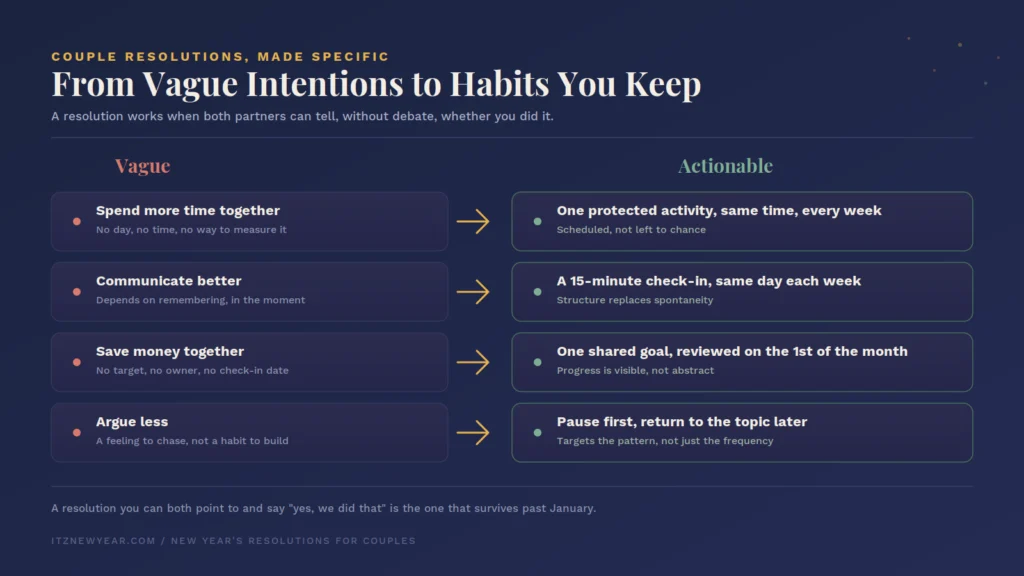
Replace vague goals with observable actions
A resolution works better when you can both tell, without debate, whether you did it or not.
| Vague resolution | More actionable version | What makes it realistic |
|---|---|---|
| Spend more time together | Have one protected activity each week | It’s scheduled, not left to chance |
| Communicate better | Hold a 15-minute weekly check-in | Gives structure instead of relying on spontaneity |
| Be more romantic | Plan two intentional gestures each month | Concrete and repeatable, not just a feeling |
| Save money | Pick one shared goal and review it monthly | Progress is visible instead of abstract |
| Travel more | Plan one trip or getaway each quarter | It’s on the calendar instead of “someday” |
| Argue less | Practice pausing and returning to hard conversations later | Targets the pattern, not just the frequency |
| Be healthier together | Choose one habit you both genuinely enjoy | Sustainable because it’s shared and not a chore |
Choose fewer goals than you think you need
It’s tempting to adopt five or six resolutions at once, but relationship goals compete for the same limited time and attention as everything else in your life. Starting with two to four is a practical guideline, not a fixed rule. Research on goal coordination among married and cohabiting couples has found that partners who coordinate clearly around their goals tend to make more progress toward them, and that progress is associated with greater life satisfaction. A smaller, clearer set of goals is easier to actually coordinate around than a long list.
Decide what happens when life gets in the way
A missed week, an illness, a stretch of travel, or a demanding period at work will interrupt almost any resolution eventually. Decide in advance that a missed week doesn’t cancel the resolution, it just means you pick it back up. Building in that flexibility ahead of time keeps one bad week from turning into an abandoned goal.
It also helps to agree on what a lighter version of the resolution looks like, rather than treating it as all or nothing. A weekly date that becomes a twenty-minute conversation during a hard week still counts. A savings goal that gets paused during an unexpected expense can resume the following month without either partner treating it as a failure. Resolutions that survive real disruptions are usually the ones with a built-in smaller version, not the ones that depend on nothing ever going wrong.
Check progress without turning your partner into a project
When you check in on how a resolution is going, the tone matters as much as the content. “You didn’t do your resolution” turns the conversation into scorekeeping. “Is this still useful for us, or should we adjust it?” keeps it collaborative. Relationship researchers, including those associated with the Gottman Institute, often point to small moments of responsiveness and repair as more predictive of relationship health than avoiding friction altogether. A resolution check-in is one of those small moments.
Couple Resolution Ideas for Different Stages of a Relationship
Not every resolution fits every couple. Here’s what tends to matter most depending on where you are.
For couples who are dating
Focus on building consistency and getting to know each other’s goals and habits. A recurring weekly date, an honest conversation about what you each want from the year, and trying new experiences together tend to matter more at this stage than long-term planning.
For newly married or newly engaged couples
This is a good time for resolutions around shared routines, money conversations, and early traditions. Deciding how you’ll handle finances together, or establishing a first shared holiday ritual, sets a pattern that’s easier to build early than to introduce later.
For long-term couples
Novelty and appreciation tend to matter most here. Long-term couples often know each other well but can fall into routines that feel more efficient than connected. Trying something new together or reviving an old shared interest can counter that drift.
For couples with children
Protected couple time and intentional division of household responsibilities tend to make the biggest difference. Even small, consistent windows, a short walk after the kids are asleep, an occasional night without them, help maintain the relationship underneath the parenting. A resolution that reduces the mental load of running the household, such as a shared weekly planning session, can matter just as much as a resolution aimed at romance.
For long-distance couples
Predictable calls, shared online activities, and planning future visits in advance give the relationship structure despite the distance. A resolution to plan the next visit before the current one ends can prevent the gap between visits from feeling open-ended. Doing an ordinary activity together over video, cooking the same meal on a call or watching something at the same time, can also make the routine stretches between visits feel less like waiting and more like shared time.
A Simple Couple Resolution Plan for the New Year
If you want a repeatable process rather than a one-time list, this works for most couples:
- Look back at the past year together and talk through what worked and what didn’t.
- Choose one relationship area to focus on, rather than trying to improve everything at once.
- Each partner suggests one goal within that area.
- Agree on a shared action that reflects both suggestions.
- Put it on the calendar with a specific day or time, not just a general intention.
- Review it after a few weeks to see how it’s actually going.
- Adjust the goal instead of abandoning it if it isn’t working as planned.
This process works because it treats the resolution as something you’re building together, not something one partner is holding the other accountable to.
FAQs
What are New Year’s resolutions for couples?
They’re shared goals or intentions that partners choose together to improve their relationship, their shared life, or their ability to support each other, rather than personal goals either partner pursues independently.
What are good New Year’s resolutions for couples?
Strong options include protected weekly time together, a regular relationship check-in, more specific appreciation, a phone-free daily ritual, one shared financial goal, and intentional support for each other’s individual goals. The best resolution is the one that matches what your relationship is actually missing.
How do couples make New Year’s resolutions together?
Talk through what felt good and what felt missing over the past year, choose one area to focus on, have each partner suggest a goal, agree on a shared action, and put it on the calendar. Review progress after a few weeks and adjust rather than abandon it.
How many resolutions should couples make?
There’s no fixed number, but starting with two to four is more realistic than a long list. Fewer, clearer goals are easier to actually follow through on together.
What are realistic relationship goals for the new year?
Realistic goals are specific and observable, such as a weekly check-in or a monthly date night, rather than broad feelings like “be closer” or “communicate better.” A goal you can both point to and say “yes, we did that” is more likely to stick.
What if one partner doesn’t want to make resolutions?
Not everyone connects with the idea of resolutions specifically. If that’s the case, reframe it as choosing one thing to try together this year rather than a formal resolution. The label matters less than agreeing on a shared action.
How can couples stick to their New Year’s resolutions?
Choose fewer goals, make them specific enough to act on, decide in advance how you’ll handle a missed week, and check in on progress without treating a slip as failure. Flexibility tends to matter more than willpower here, since most resolutions fail not because the idea was wrong but because there was no plan for the week things got busy.
What are some fun New Year’s resolutions for couples?
Trying a new activity together each month, reviving an old shared hobby, planning a spontaneous day trip, or starting a small yearly tradition all bring more play into a resolution without turning it into another obligation to manage.
Can couples have individual resolutions as well as shared ones?
Yes. A shared relationship goal, an individual goal one partner pursues, and a shared life goal you’re both working toward can all coexist. Supporting a partner’s individual goal, even one you don’t personally share, is itself a form of relationship resolution.
Where to Go From Here
The goal isn’t to become a perfect couple by December. It’s to choose a few things that genuinely matter to both of you, make them specific enough to act on, and revisit them when life changes, because it will. A relationship resolution that survives a busy month or a rough week is worth far more than a long list you both forget by February.
Leave a Reply
You must be logged in to post a comment.