
A religious New Year’s resolution is a personal commitment to strengthen your faith, spiritual practice, character, or connection to a religious community during the coming year. Instead of focusing only on external achievements, it centers on who you want to become and how your beliefs shape your actions.
These resolutions tend to fall into a few recognizable areas: deepening a relationship with the divine, growing in character, serving others, and staying connected to a faith community. A resolution might be as simple as setting aside ten minutes for prayer each morning, or as involved as committing to weekly volunteer work through a religious organization.
What sets a religious resolution apart from a general one isn’t the format, it’s the reason behind it. “Read for twenty minutes a day” is a general habit. “Read a chapter of scripture each morning to stay grounded in my faith” is the same habit with a different purpose. The action can look ordinary. The intention behind it is what makes it religious or spiritual.
This also means religious resolutions don’t require a single template. Someone returning to a faith after years away might choose a very different resolution than someone who already prays daily and wants to deepen their study. Both are legitimate starting points, and the rest of this guide is built to work for either one.
Do Religious New Year’s Resolutions Have to Begin on January 1?
Not necessarily, and this is worth addressing directly. January 1 is the start of the Gregorian calendar year, which much of the world uses for civil and business purposes. It is not the primary religious New Year for every faith tradition.
Judaism marks its central period of reflection and renewal around Rosh Hashanah, which falls in the autumn according to the Hebrew calendar. Islam follows the Hijri calendar, and its new year, Muharram, moves through the Gregorian calendar year to year rather than landing on a fixed date. Hindu traditions include multiple regional New Year observances tied to different calendars and cultural calendars across India and the diaspora. Buddhist communities in different countries also mark new year observances on dates that vary by region and tradition.
None of this means January 1 is meaningless for religious people. Many people, regardless of tradition, still use the start of the calendar year as a practical checkpoint for setting intentions, even if their faith’s spiritual new year falls elsewhere. The distinction just matters for accuracy: a resolution made on January 1 is a personal or cultural choice about timing, not necessarily a religious observance in itself.
Why the distinction matters
Treating January 1 as if it holds the same religious weight in every tradition flattens real differences between faiths. A guide to religious resolutions should acknowledge that people are arriving from different starting points, some shaped by a religious new year earlier or later in the calendar, others simply using January as a convenient time to reflect, regardless of what their tradition formally recognizes.
20 Meaningful Religious New Year’s Resolutions to Consider
These ideas are grouped by what they’re meant to strengthen. Depending on your faith tradition, some will resonate more than others, and that’s expected. None of these are presented as requirements. They’re starting points to adapt to your own beliefs and practice.
Deepen your personal faith
- Set aside a regular time each day for prayer or spiritual reflection, even if it’s just five to ten minutes.
- Study a sacred text consistently, choosing a pace you can actually sustain, such as one passage a day rather than an entire book by a deadline.
- Learn more about your faith tradition through a class, a book, or conversations with someone more knowledgeable.
- Attend worship or religious gatherings with more intention, rather than treating attendance as routine.
- Create a quiet period in your week for meditation, contemplation, or simply sitting without distraction.
Turn faith into character
- Practice patience deliberately, especially in situations that typically frustrate you.
- Become more intentional about forgiveness, whether that means repairing a specific relationship or letting go of resentment you’ve been carrying.
- Practice humility by making space for other people’s perspectives, especially when you’re confident you’re right.
- Commit to honesty in moments where a small dishonesty would be easier.
- Reduce judgment of others and practice compassion, particularly toward people whose choices you don’t understand.
Make service part of the year
- Volunteer on a regular schedule rather than only when it’s convenient.
- Look for one practical way to help someone in your immediate community this month.
- Support a charitable cause connected to your values, not just the first one that crosses your feed.
- Make generosity a recurring habit rather than an occasional gesture.
- Seek out people who are genuinely in need of support, not only causes that are easy to publicize.
Strengthen community and relationships
- Become more involved in a faith community, whether that means joining a group, a committee, or simply showing up more consistently.
- Reach out to someone who may be isolated, including people outside your usual social circle.
- Make time for learning across generations, whether that’s mentoring someone younger or learning from someone older in your community.
- Support community events or service projects organized by your congregation or tradition.
- Practice kindness that extends beyond people you already know well.
Religious Resolution Ideas by Faith Tradition
These examples aren’t exhaustive, and they aren’t meant to suggest that everyone within a tradition practices the same way. They’re illustrations of themes that commonly appear within each faith’s approach to spiritual renewal.
Christianity
Christian sources often frame New Year resolutions around prayer, scripture study, and deepening a relationship with God. Common themes include committing to regular prayer, reading through a Gospel or book of the Bible over the year, participating more actively in church life, practicing forgiveness, and increasing acts of service or charity. Some Christian writers also frame the new year as a time to reflect on spiritual growth over the past year before setting intentions for the next one.
Judaism
Jewish approaches to the new year are shaped less by January 1 and more by the High Holy Days, particularly Rosh Hashanah and the period of reflection that follows it. Some Jewish organizations have pointed out that while the secular new year isn’t the central Jewish new year, it can still be a moment for personal commitments to improvement.
Themes that commonly appear include self-examination, repairing relationships, increasing good deeds, and returning to consistent study or observance. A resolution made in January might still draw on these same values, even outside the High Holy Day period.
Islam
Islamic tradition follows the Hijri calendar, and Muharram, the Islamic new year, is not tied to a fixed Gregorian date. That said, individual Muslims can still choose to set intentions at the start of the calendar year as a personal practice. Common themes include consistency in prayer, increased Quran study, charity, gratitude, and strengthening one’s character and relationship with Allah through daily discipline. Framing a resolution around steady, sustainable practice tends to fit better than framing it around a single dramatic change.
Hindu traditions
Hindu New Year observances vary by region and calendar, so there’s no single universal date or practice. What does appear consistently across Hindu-oriented spiritual writing is an emphasis on dharma, or living in accordance with one’s duties and values, along with service, meditation, devotion, and self-discipline. A resolution in this tradition might focus on a specific spiritual practice, such as regular meditation or study, or on living out one’s responsibilities with more intention.
Buddhism
Buddhist approaches to new year intentions tend to emphasize ethical conduct, compassion, and mindfulness rather than external achievement. Rather than resolving to acquire or accomplish something, many Buddhist-influenced resolutions focus on reducing harmful patterns, such as reactive anger or habitual distraction, and cultivating awareness in daily life.
A resolution might center on a consistent meditation practice, a commitment to reducing a specific harmful habit, or simply paying closer attention to one’s actions and their effects on others.
Other faith traditions and personal spirituality
This list isn’t exhaustive, and plenty of readers follow traditions not covered here, or hold a personal spirituality that doesn’t fit neatly into one category. The broad themes in this guide, prayer or reflection, character, service, and community, tend to translate across many belief systems. If you belong to a tradition not mentioned here, the same categories can usually be adapted to fit your own teachings and practices.
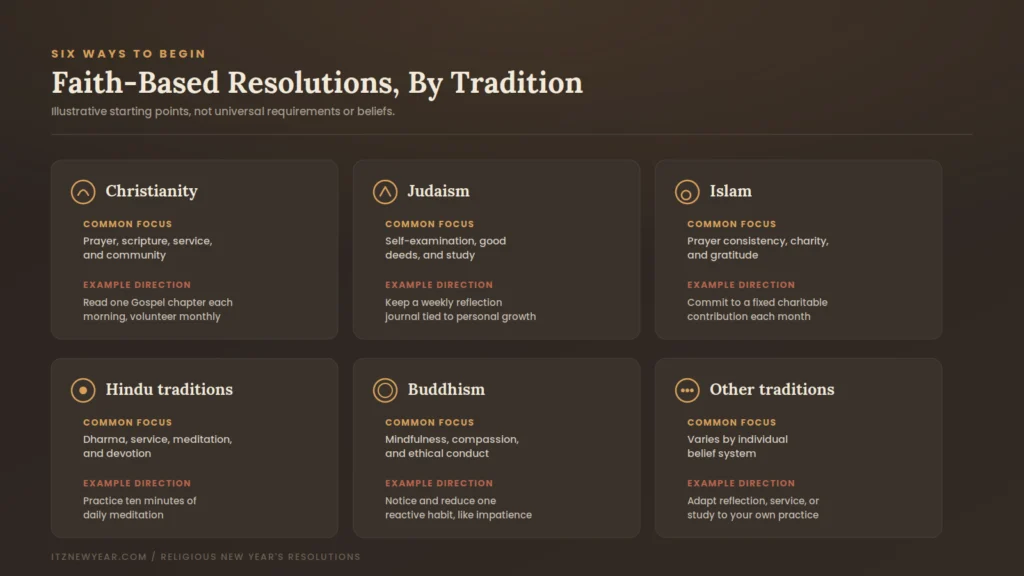
| Tradition | Common focus | Example resolution direction |
|---|---|---|
| Christianity | Prayer, scripture, service, community | Read one Gospel chapter each morning and volunteer monthly |
| Judaism | Self-examination, good deeds, study | Keep a weekly reflection journal tied to personal growth |
| Islam | Prayer consistency, charity, gratitude | Commit to a fixed charitable contribution each month |
| Hindu traditions | Dharma, service, meditation, devotion | Practice ten minutes of daily meditation |
| Buddhism | Mindfulness, compassion, ethical conduct | Notice and reduce one reactive habit, such as impatience |
| Other traditions | Varies by belief system | Adapt reflection, service, or study themes to your own practice |
How to Turn a Religious Resolution Into a Practice
Vague spiritual goals are easy to make and hard to keep. Turning them into something concrete is what actually makes a difference.
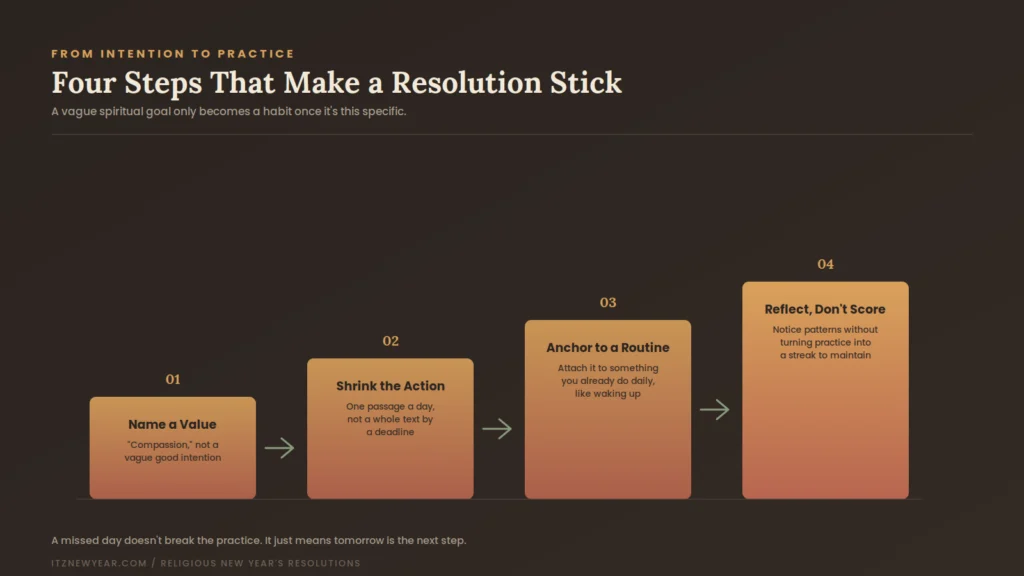
Start with a value, not a vague promise
“Be more compassionate” doesn’t tell you what to do on a Tuesday afternoon. “Perform one intentional act of service each week” does. Start by naming the value you want to grow, then translate it into a specific, repeatable action.
Make the action small enough to repeat
A resolution to “read an entire sacred text this year” often collapses under its own ambition by February. A smaller, defined pace, one passage a day, one chapter a week, one study session a month, is far more sustainable than an open-ended goal. It’s easier to keep a small commitment consistently than a large one occasionally.
Connect the resolution to an existing routine
Attaching a new practice to something you already do daily makes it far more likely to stick. Prayer after waking up, reflection before bed, a moment of gratitude before a meal, these anchors give the practice a natural trigger instead of relying on remembering to do it.
Track practice without turning faith into a performance score
Keeping some awareness of your practice, whether through a journal, a simple checklist, or a weekly moment of reflection, can help you notice patterns. But it’s worth being cautious here. Faith practiced as a box to check can start to feel hollow. The goal is a consistent practice that supports your spiritual life, not a streak to maintain for its own sake. If you miss a day, the practice isn’t broken, you just continue.
Choose a Religious Resolution That Fits Your Life
Not everyone is starting from the same place, and a good resolution should match where you actually are.
If your faith practice has become inconsistent
Focus on restarting with one manageable practice rather than trying to rebuild everything at once. A single daily habit, even five minutes of prayer or reflection, is a more realistic entry point than an ambitious overhaul.
If you are new to religious practice
Focus on learning, community, and gradual exploration rather than committing to an extreme routine right away. Attending a service, reading introductory material, or having a conversation with someone knowledgeable are all reasonable starting resolutions on their own.
If you already have a strong religious routine
Consider resolutions around character, service, or deeper study rather than adding more of what you already do consistently. Someone who already prays daily might focus a resolution on patience, generosity, or mentoring someone newer to the practice.
If you are unsure what you believe
You don’t need certainty to make a meaningful resolution. Reflective resolutions, learning more about a tradition, reading with an open mind, attending a community event, or having an honest conversation with a trusted religious teacher, are legitimate starting points in their own right.
A Simple Faith-Based Resolution Planner
Rather than picking an idea off a list and hoping it sticks, working through a short framework tends to produce a resolution you’ll actually follow through on.
| Question | Example |
|---|---|
| What value do I want to strengthen? | Compassion |
| Why does it matter to my faith? | It reflects how I want to treat others |
| What action will I take? | Volunteer twice a month |
| How often? | Every other Saturday |
| What could interfere? | Work schedule |
| What is my backup plan? | One evening volunteer shift instead |
| How will I reflect on it? | A short monthly journal entry |
Filling this out takes a few minutes, but it forces the resolution to move from a feeling into something specific enough to act on and specific enough to notice when it slips.
What Makes a Religious New Year’s Resolution Meaningful?
A few qualities tend to separate resolutions that last from ones that quietly disappear by February.
- Personal relevance. The resolution connects to something you genuinely care about, not something you feel obligated to want.
- Alignment with your tradition. The action reflects values that actually matter within your faith, rather than a generic self-improvement goal wearing a religious label.
- A realistic action. The practice fits into your actual life, not an idealized version of it.
- Room to adjust. The resolution can flex when circumstances change, rather than being abandoned the first time it’s inconvenient.
One useful distinction comes from research on resolutions more broadly. A large study on New Year’s resolutions found that approach-oriented goals, resolutions framed around doing or becoming something, were more successful than avoidance-oriented goals framed around stopping something, with roughly 59 percent of approach-oriented resolvers reporting success compared to about 47 percent for avoidance-oriented ones. In practice, that means “practice patience” tends to hold up better than “stop losing my temper,” even though both point toward the same underlying change.
What If You Break Your Religious Resolution?
Missing a day of prayer, skipping a week of study, or letting a service commitment slide isn’t a sign that the resolution has failed. It’s a normal part of maintaining any practice over a full year.
A few things help when this happens:
- Separate one missed action from abandoning the whole intention. Missing a Tuesday doesn’t cancel the resolution, it just means Wednesday is the next opportunity.
- If the goal keeps slipping repeatedly, consider whether it was unrealistic to begin with, rather than assuming the problem is a lack of discipline.
- Return to the underlying value rather than the specific metric. If “read scripture daily” isn’t working, the value behind it, staying connected to your faith through study, can still be honored through a smaller or different practice.
- Restart without treating the gap as a moral failure. A pause in practice is common, and resuming matters more than the fact that a pause happened.
Research on resolution adherence has also pointed to the importance of intrinsic motivation, meaning a resolution pursued because it genuinely matters to you tends to hold up better over time than one adopted mainly out of obligation or external expectation. A religious resolution rooted in something you actually value is more likely to survive a rough week than one you took on because it felt like it was expected of you.
Frequently Asked Questions
What is a religious New Year’s resolution?
It’s a personal commitment to grow in faith, character, service, or connection to a religious community during the coming year, often expressed through practices like prayer, study, volunteering, or reflection.
What are some good religious New Year’s resolutions?
Strong starting points include a daily prayer or reflection practice, consistent study of a sacred text, regular volunteering, practicing a specific character trait like patience or forgiveness, and becoming more involved in a faith community.
Can people from different religions make New Year’s resolutions?
Yes. While the specific practices and timing differ by tradition, most faiths include some concept of self-examination, spiritual growth, and renewed commitment that can translate into a personal resolution.
Do all religions celebrate the New Year on January 1?
No. Many traditions follow different calendars. Judaism observes Rosh Hashanah, Islam follows the Hijri calendar with Muharram as its new year, and Hindu and Buddhist communities mark various regional new year observances on different dates.
What is a good spiritual goal for the New Year?
A good spiritual goal is specific enough to act on and tied to something you actually value, such as a regular meditation practice, a consistent prayer routine, or a recurring act of service.
How can I make a religious resolution I will actually keep?
Choose a small, repeatable action rather than a broad ambition, connect it to a routine you already have, and check in on your progress without treating a missed day as failure.
Can a religious resolution be about helping other people?
Yes. Service, charity, and generosity appear as recurring themes across many faith traditions, though the specific framing and emphasis vary by belief system.
What if I am not sure which religious practice to choose?
Consider a reflective resolution instead of a specific practice, such as learning more about a tradition, attending a community event, or having a conversation with someone knowledgeable, rather than committing to something before you’re ready.
Leave a Reply
You must be logged in to post a comment.