
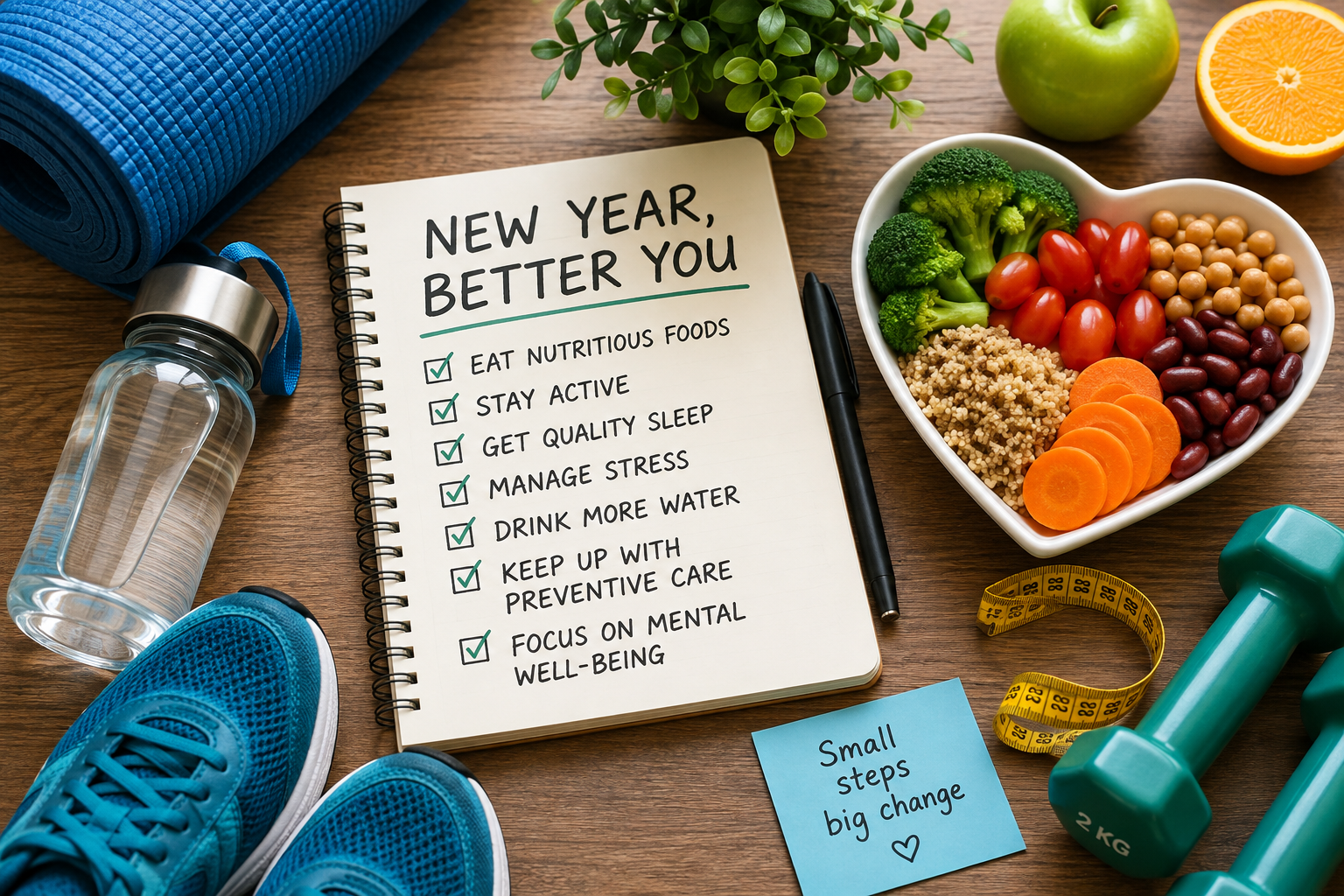
Most people think of a health resolution as losing weight, joining a gym, or overhauling their diet overnight. That framing leaves out most of what actually shapes how well you feel day to day: how you sleep, how you handle stress, whether you keep up with preventive care, and whether your daily routines make healthy choices easy or exhausting. A resolution that only targets the scale ignores all of that.
This guide treats health and wellness as several connected areas rather than one number to chase. You’ll find 25 specific resolutions organized by the part of your health they support, plus a practical process for turning any of them into a habit that survives past February.
Start With the Kind of Health You Want to Improve
Before picking a resolution, it helps to name what you’re actually trying to change. “Get healthier” is too vague to act on. “I want more energy in the afternoon” or “I want to stop dreading my next checkup” gives you something to work with.
Health touches several areas that don’t always move together. You can eat well and still sleep poorly. You can exercise regularly and still feel constantly stressed. You can be physically fine and overdue for basic preventive care you’ve been putting off for years.
A few starting points worth considering:
- Energy: do you feel tired in ways that rest doesn’t fix?
- Strength and mobility: can you do the physical things you want to do without strain?
- Sleep: do you wake up rested most days, or is that rare?
- Nutrition: do your meals generally support how you want to feel, or are they an afterthought?
- Stress: does stress feel manageable, or does it follow you through the day?
- Preventive care: are you current on the basics, or have appointments been sitting untouched?
- Mental well-being: do you have time and support for the things that keep you steady?
You don’t need to address every one of these at once. Pick the one or two that would make the biggest difference to how you actually feel, and let the rest wait.
25 Health and Wellness New Year’s Resolutions Worth Trying
These resolutions are grouped by the part of your health they support. None of them requires a complete lifestyle overhaul, and you’re not meant to adopt all 25 at once.
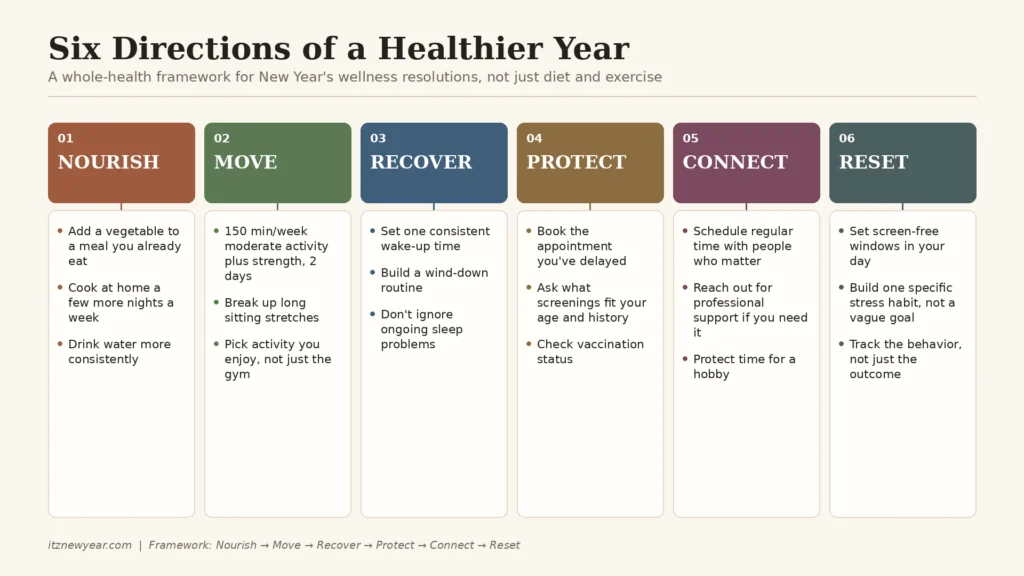
Nourish Your Body More Intentionally
1. Add a vegetable or fruit to meals you already eat. Rather than restructuring your diet, build on what’s already on your plate. USDA’s MyPlate guidance emphasizes variety across food groups rather than any single “correct” way to eat, so this can be as simple as adding a side of vegetables to dinner or fruit to breakfast a few more days a week.
2. Cook at home more often. Home cooking gives you more control over ingredients and portions than takeout or packaged meals typically allow. This doesn’t mean cooking every meal. Going from one home-cooked dinner a week to three is a realistic, meaningful shift.
3. Build meals around a mix of food groups instead of a single ingredient. A plate with vegetables, a protein source, and a grain tends to be more satisfying and balanced than one built around a single “hero” food. This is less about any particular diet and more about variety over time.
4. Drink water more consistently throughout the day. There’s no single hydration number that applies to everyone, since needs vary with activity level, climate, and individual factors. A more useful resolution than “drink eight glasses a day” is simply keeping water accessible and drinking it consistently, especially in place of sugary drinks you’re trying to cut back on.
5. Loosen your grip on restrictive eating rules. If past years involved cutting out entire food groups or following strict eating windows, consider a resolution that moves the other direction: eating in a way you can sustain for the whole year, not just January. Extreme restriction is one of the most common reasons healthy-eating resolutions fail by February.
Make Movement Part of Ordinary Life
6. Move more throughout the week, not just at the gym. The CDC’s current activity guidance for adults calls for at least 150 minutes of moderate-intensity activity per week, plus muscle-strengthening activity on two or more days. Importantly, the CDC is also clear that some activity is better than none, and it doesn’t need to happen in one long session to count.
7. Find a physical activity you don’t dread. Consistency matters more than intensity, and you’re far more likely to stay consistent with something you enjoy. Dancing, swimming, recreational sports, and hiking all count as legitimate movement, not just treadmill time.
8. Add strength training a couple of times a week. Bodyweight exercises, resistance bands, or weights all satisfy the muscle-strengthening piece of current activity guidance. You don’t need a gym membership or a structured program to start.
9. Break up long stretches of sitting. If your day is mostly sedentary, a short walk every hour or two adds up over a week even without a dedicated workout. This is a useful resolution specifically for people whose jobs keep them at a desk most of the day.
10. Combine movement with time outdoors. A walk outside does double duty: it counts toward activity guidelines and gets you outside, which many people find helps with mood and focus in ways an indoor walk doesn’t quite match.
A note on this section: the goal here is making movement a normal part of your week, not building a structured fitness program. If you want a full plan for staying consistent with a workout routine once motivation dips, that’s a more detailed topic on its own.
Treat Sleep as a Health Priority
11. Set a consistent wake-up time. The CDC notes that most adults generally need at least seven hours of sleep per night, though individual needs vary. A consistent wake time, even on weekends, tends to do more for sleep quality than chasing a specific number of hours.
12. Build a wind-down routine before bed. Reducing bright light and stimulating activity in the hour before bed makes it easier to fall asleep at a consistent time. This can be as simple as dimming lights and stepping away from screens before you actually get in bed.
13. Stop ignoring sleep problems that don’t resolve on their own. If you’re consistently exhausted despite spending enough time in bed, or you snore heavily, gasp for air, or struggle with insomnia most nights, that’s worth bringing up with a healthcare professional rather than assuming it will pass. CDC data from 2024 found that roughly 30 percent of U.S. adults report averaging less than seven hours of sleep, so this is a common issue, not a rare one.
Give Mental and Emotional Well-Being More Attention
14. Build one specific stress-management habit. Rather than a vague goal to “stress less,” pick a concrete practice: a short walk after a hard meeting, ten minutes of quiet before checking your phone in the morning, or a regular check-in with a friend. Specific habits are easier to stick with than general intentions.
15. Protect time for something you actually enjoy. Hobbies often get pushed out by work and obligations first. Scheduling even an hour a week for something enjoyable, rather than treating it as optional, keeps it from disappearing entirely.
16. Try a calming practice that fits your life. Mindfulness, breathing exercises, journaling, or quiet time outdoors can all help with day-to-day stress. There’s no single practice that works for everyone, so it’s worth trying a few before settling on one.
17. Reach out for professional support if you need it. If stress, anxiety, or low mood have been affecting your daily life for a while, a resolution to talk with a therapist or your doctor is a legitimate and often more effective step than trying to manage it alone. Self-care habits are useful, but they aren’t a substitute for professional care when it’s needed.
Make Preventive Health Part of Your Year
18. Schedule the appointment you’ve been putting off. An overdue physical, dental cleaning, or specialist visit is one of the most practical health resolutions on this list precisely because it’s easy to keep deferring indefinitely.
19. Ask about which screenings apply to you. Recommended screenings depend on factors like your age, sex, family history, and personal risk, so there’s no universal checklist that fits everyone. A useful resolution is simply asking your healthcare provider what’s appropriate for you specifically.
20. Check whether your vaccinations are current. Vaccine recommendations change over time and vary by age and health status, so this is worth a quick conversation with a provider rather than guesswork.
21. Stop dismissing symptoms that keep coming back. Persistent fatigue, pain, digestive issues, or anything else that recurs over weeks or months is worth mentioning to a healthcare professional rather than waiting for it to resolve on its own.
22. Keep up with dental and vision care. These are easy to deprioritize but are tied closely to overall health and comfort. If it’s been more than a year or two since your last visit, that’s a reasonable resolution on its own.
Reduce Health Risks That You Can Control
23. Make a supported plan to quit smoking, if you smoke. The CDC notes that quitting smoking has health benefits at any age and after any duration of smoking, so it’s never too late for this resolution to matter. A supported quit plan, using resources like a quitline or your doctor, tends to be more successful than quitting alone.
24. Take an honest look at your alcohol use. Rather than any blanket claim about what amount is fine, this resolution is about noticing your own patterns and talking with a healthcare professional if drinking has become more frequent or harder to moderate than you’d like.
25. Set specific boundaries around technology use. Instead of trying to eliminate screens entirely, define particular windows where you’re offline: during meals, the first half hour after waking up, or the hour before bed. This tends to help with sleep, attention, and how present you feel with the people around you, without requiring an all-or-nothing approach.
How to Turn a Health Resolution Into a Habit
Picking a resolution is the easy part. Most health resolutions fail not because the goal was wrong, but because it was too broad to act on consistently. Here’s how to close that gap.
Make the behavior smaller than the ambition
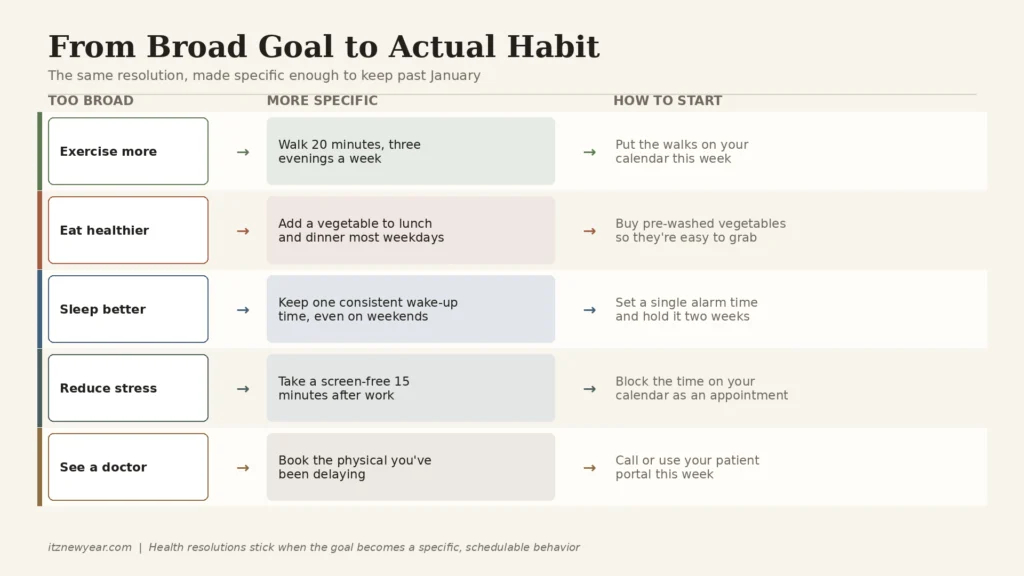
A resolution like “exercise every day” is really an outcome, not a plan. A behavior you can actually schedule looks more like “walk for 20 minutes after dinner three days a week.” The second version tells you exactly what to do and when, which the first doesn’t.
Decide when and where the behavior happens
Habits stick better when they’re attached to a specific time, place, or existing routine, rather than left to willpower each day. “I’ll drink a glass of water when I first get to my desk” is more durable than “I’ll drink more water.”
Track the behavior itself, not just the outcome
If your resolution is about eating more vegetables, track whether you added a vegetable to a meal, not what the scale says. Outcomes like weight or energy levels are affected by many factors beyond your direct control, while the behavior itself is something you can measure every day.
Plan for weeks that don’t go perfectly
Missing a few days doesn’t mean the resolution has failed. It means you pick it back up. Building this expectation in from the start makes an off week far less likely to turn into abandoning the goal altogether.
Reassess instead of pushing through a goal that isn’t working
If a resolution consistently feels impossible to keep, that’s information, not a personal failure. Adjusting the goal, whether that means a smaller version of it or a different area of health entirely, is more productive than repeating the same unworkable plan.
| Too broad | More specific | How to start |
|---|---|---|
| Exercise more | Walk 20 minutes, three evenings a week | Put the walks on your calendar this week |
| Eat healthier | Add a vegetable to lunch and dinner most weekdays | Buy pre-washed vegetables so they’re easy to grab |
| Sleep better | Keep a consistent wake-up time, even on weekends | Set one alarm time and stick to it for two weeks |
| Reduce stress | Take a screen-free 15 minutes after work | Block the time on your calendar as an appointment |
| See a doctor | Book the physical you’ve delayed | Call or use your patient portal this week |
How to Choose the Right Wellness Resolution for You
With 25 options above, the harder task is narrowing down to the ones actually worth your effort this year. A few questions can help.
What is affecting your quality of life most right now?
If poor sleep is making everything else harder, that’s a better starting point than a nutrition change that wouldn’t address your biggest problem.
Which part of this is actually within your control?
A resolution built around something you can directly act on, like cooking three dinners a week, tends to hold up better than one built around an outcome you only partly control, like a specific weight.
What change would make the biggest practical difference?
Sometimes the answer isn’t the most obvious health topic. A stress-management habit can improve sleep, eating patterns, and mood all at once, even though it isn’t a diet or exercise resolution.
What can actually fit into your current schedule?
A resolution that assumes an hour of free time you don’t have is unlikely to survive contact with a busy week. Match the size of the commitment to the time you genuinely have available.
What needs professional input rather than a self-directed plan?
Persistent symptoms, overdue screenings, or ongoing mental health concerns are areas where the right resolution is scheduling an appointment, not trying to manage things alone.
| If you want to improve… | Consider a resolution around… | Example |
|---|---|---|
| Energy | Sleep consistency | Set one wake-up time for two weeks |
| Nutrition | Adding, not restricting | Add a vegetable to two meals a day |
| Movement | Enjoyable activity | Try one new active hobby this month |
| Stress | A specific daily habit | Fifteen screen-free minutes after work |
| Preventive health | Overdue appointments | Book the visit you’ve been delaying |
| Social connection | Regular contact | A weekly call with a family member |
FAQs
What are good health and wellness resolutions for the new year?
The strongest ones are specific and behavior-based rather than broad outcomes. Examples include a consistent sleep schedule, adding vegetables to a couple of meals a day, a set weekly walk, or scheduling an overdue medical appointment. Good resolutions also cover more than diet and exercise, including sleep, stress, and preventive care.
What are the best healthy New Year’s resolutions?
There isn’t one best resolution, since the right one depends on what’s actually affecting your health and daily life. A resolution addressing your biggest current gap, whether that’s sleep, stress, movement, or overdue checkups, tends to matter more than picking whatever’s trending.
How do I make a healthy New Year’s resolution realistic?
Turn a broad goal into a specific, schedulable behavior, attach it to a particular time or routine, and track the behavior rather than only the outcome. Expect some weeks to go imperfectly, and adjust the goal rather than abandoning it if it consistently feels unmanageable.
Should my New Year’s resolution focus on weight loss?
It doesn’t have to. Health resolutions built around specific behaviors, like consistent movement, better sleep, or more balanced meals, often support overall well-being more directly than a resolution built around a number on a scale, and they’re easier to sustain because they don’t depend on one outcome.
How many health resolutions should I make?
Fewer than you might think. One or two specific, well-defined resolutions are far more likely to stick than an ambitious list covering every area of health at once. You can always add another once the first becomes routine.
What are realistic wellness goals for beginners?
Small, concrete changes work best when you’re starting out: a short daily walk, one home-cooked dinner added per week, a consistent bedtime, or a single overdue appointment scheduled. Building on early wins tends to work better than starting with an ambitious overhaul.
What is a good mental health resolution for the new year?
A specific stress-management habit, protected time for something enjoyable, or reaching out for professional support if stress or low mood have been persistent are all reasonable starting points. The goal is a concrete practice, not a vague intention to “worry less.”
Can a health resolution include preventive care?
Yes, and it’s an area many resolution lists skip entirely. Scheduling an overdue checkup, asking about appropriate screenings, or catching up on vaccinations and dental care are all practical, achievable resolutions that don’t require ongoing daily effort the way diet or exercise changes do.
Bringing It Together
You don’t need a complete lifestyle overhaul starting January 1. Look back at the areas covered here, energy, nutrition, movement, sleep, stress, prevention, and connection, and choose the one that would make the most noticeable difference to how you feel day to day. Turn it into one specific behavior, attach it to a time and place in your week, and give yourself room to adjust when a week doesn’t go as planned. That approach, repeated over months rather than crammed into January, is what actually changes how healthy a year turns out to be.
Leave a Reply
You must be logged in to post a comment.