

People often know exactly what they want their resolution to be, but staying with it becomes difficult once the initial excitement disappears. The goal was clear on January 1. By the third or fourth week, the schedule feels harder to protect, the motivation that carried the first few days is gone, and the whole plan starts to feel optional.
That drop-off isn’t a personal failing. It’s what happens when a resolution depends entirely on motivation instead of on a system that can carry it through an ordinary bad week.
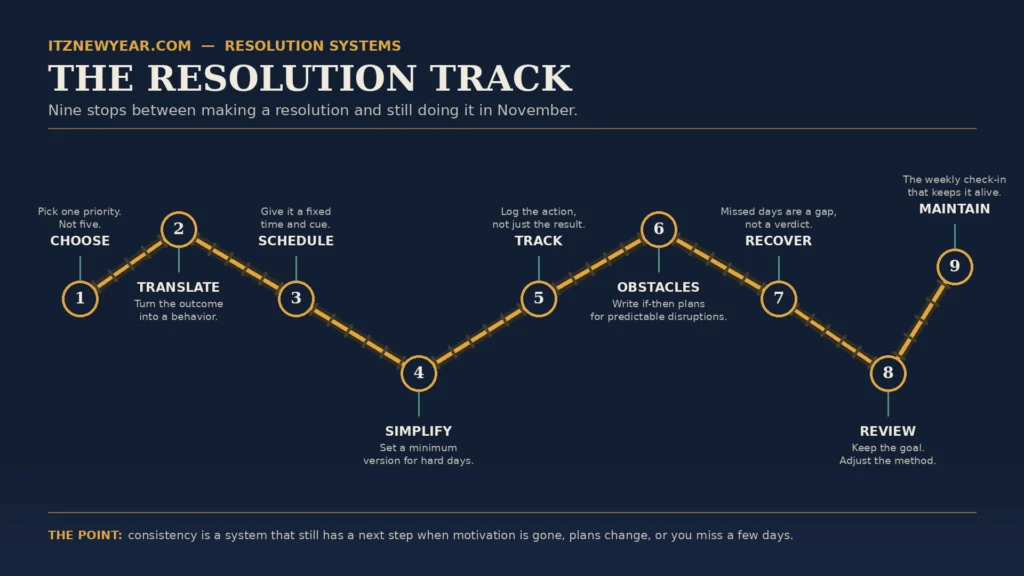
Turn the resolution into a small, specific behavior, attach it to a regular cue, track your actions instead of only the outcome, plan for the obstacles you can already predict, and adjust the plan instead of abandoning the goal when something interrupts it.
The rest of this guide walks through how to build that system, step by step, and what to do when it breaks down anyway.
First, Turn Your Resolution Into Something You Can Actually Repeat
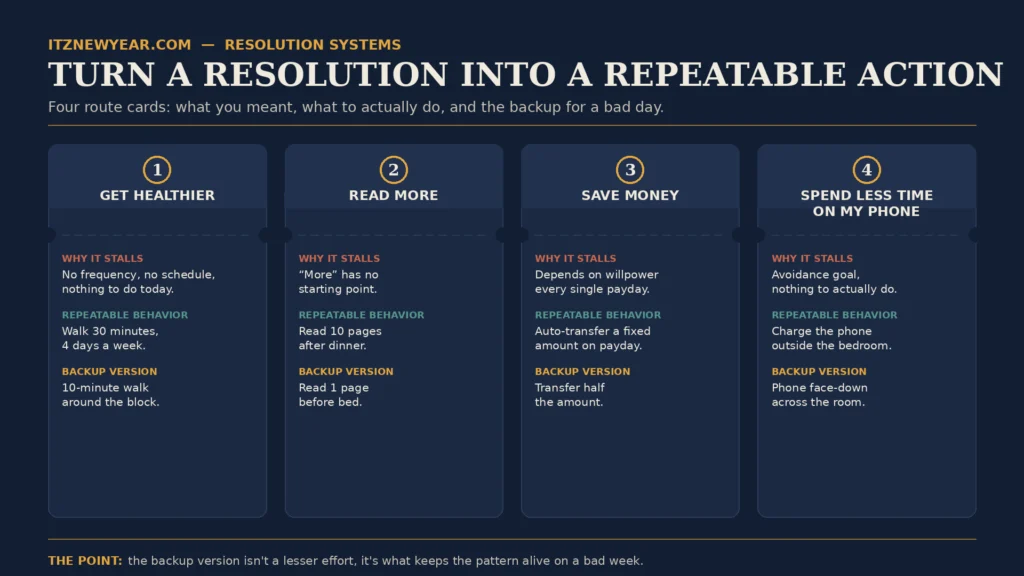
Most resolutions are written as outcomes, not instructions. “Get healthier,” “save money,” and “read more” describe a result you want. None of them tell you what to actually do on a Tuesday.
An outcome has no schedule, no frequency, and no clear starting action. A behavior does. That difference is the entire reason resolutions stall in week three: there’s nothing specific left to do once the initial burst of energy runs out.
Replace outcome-based resolutions with behavior-based commitments
Take the outcome and ask, “What would I actually be doing if I were succeeding at this?” That question turns a vague wish into a repeatable action.
| Outcome-based resolution | Repeatable behavior |
|---|---|
| Get healthier | Walk for 30 minutes, four days a week |
| Read more | Read 10 pages after dinner |
| Save money | Move a fixed amount to savings every payday |
| Spend less time on my phone | Charge the phone outside the bedroom overnight |
| Exercise more | Strength train on Tuesday and Saturday |
Notice that each behavior has a frequency and, in most cases, a rough time. That’s not a coincidence. A behavior you can picture yourself doing on a specific day is far easier to follow through on than one you’re supposed to feel motivated to start.
Choose a minimum version of the habit
Before you set the “ideal” version of the behavior, decide on the smallest version you could still do on a difficult day. If the full plan is a 45-minute workout, the minimum version might be a 10-minute walk. If it’s 10 pages of reading, the minimum might be one page.
This isn’t lowering your standards. It’s building in a version of the habit that survives days when the full plan isn’t realistic, so the habit itself doesn’t disappear along with your energy.
Build a Routine That Does Not Depend on Feeling Motivated
Motivation is real, but it’s inconsistent by nature. It’s higher after a good night’s sleep, lower during a stressful week, and largely absent by the time February rolls around. A resolution that only runs on motivation is a resolution with an expiration date.
A routine solves this differently. Instead of asking “do I feel like doing this today,” a routine removes the decision entirely by giving the behavior a fixed time, place, and trigger.
Give the habit a clear time and place
This is where implementation intentions come in, a simple planning technique that pairs a behavior with a specific moment. Researchers who study personal goals have found that people who plan exactly when and where they’ll act make more progress than people who only set a general intention.
The difference is concrete:
- Weak plan: “I will exercise more.”
- Strong plan: “After work on Monday, Wednesday, and Saturday, I will walk for 30 minutes before I check my phone.”
The second version leaves nothing to decide in the moment. You already know when it happens, so there’s no negotiation with yourself required once the time arrives.
Use your environment as a reminder
Your surroundings either support the habit or quietly work against it. A few adjustments make the desired behavior the path of least resistance:
- Keep workout shoes by the door instead of in a closet
- Put the book on your pillow so you see it before bed
- Set out a water bottle or gym bag the night before
- Block the time on your calendar the way you would a meeting
- Keep unhealthy snacks out of easy reach, and the healthier option visible
None of these guarantee you’ll follow through, but they lower the number of small decisions standing between you and the behavior. Fewer decisions means fewer chances to talk yourself out of it.
Make the Goal Easy Enough to Survive a Bad Week
Every resolution eventually runs into a week that doesn’t cooperate. A work deadline lands, someone gets sick, travel disrupts the schedule, or you’re simply exhausted. The plan that worked in a normal week can be completely unrealistic in a hard one.
This is where the earlier idea of a minimum version becomes useful again, this time applied to the whole week instead of a single day.
Set up two versions of the behavior in advance:
- Normal version: the plan you follow in an ordinary week
- Backup version: a smaller version you can still complete when the week goes sideways
For example, if the normal version is a 30-minute workout, the backup might be a 10-minute walk around the block. If the normal version is preparing a meal from scratch, the backup might be a simple 10-minute option that still counts as “not skipping dinner prep entirely.”
The backup version isn’t a consolation prize. Its entire purpose is continuity. Doing the small version keeps the pattern alive, which makes it much easier to return to the full version once the disruption passes. Skipping the week entirely makes returning to it far harder.
Track the Actions That Lead to the Result
A lot of resolutions are judged entirely by the outcome: the number on the scale, the balance in the savings account, the number of books finished. The problem is that outcomes are influenced by things you don’t fully control, day to day fluctuations, timing, and factors outside the behavior itself. Watching only the outcome can make consistent effort feel like it isn’t working, even when it is.
Tracking the behavior instead of the result gives you a more honest, and more encouraging, picture. You can’t control what the scale says on a given Tuesday. You can control whether you went for the walk.
What should you track?
Keep it to the actions that actually build the outcome you’re after:
- Workouts completed
- Walks taken
- Reading sessions finished
- Meals prepared instead of ordered
- Money transferred to savings
- A consistent bedtime or wake time
A habit tracker, a calendar with checkmarks, a notes app, or a simple spreadsheet all work. The tool matters less than the habit of checking in once a week and looking at the pattern rather than a single day.
Seeing four checkmarks out of five planned days is useful information. It tells you the system is mostly working. Seeing zero for a full week tells you something needs to change, which is far more useful than staring at a scale or bank balance and guessing why it hasn’t moved yet.
Give Yourself a Reason to Keep Going When the Initial Excitement Fades
Early motivation is often external: a fresh calendar, a bit of social pressure, the appeal of a new year. That kind of motivation fades fast, usually right around the point where the resolution needs to survive its first real test.
Research on resolution adherence has found that people who are driven by internal reasons, wanting to do the behavior for its own sake or because it fits their values, tend to stick with it longer than people relying mainly on external pressure like appearance or other people’s approval. This pattern has held up across different studies and different behaviors, though it’s a tendency rather than a guarantee for any one person.
That’s worth sitting with before you finalize a resolution. Ask honestly: do you want the result, or do you also want to be the kind of person who does this behavior? If the answer is only the first one, the plan needs to make the behavior itself as tolerable and low-friction as possible, since there’s less internal pull keeping you at it.
A few ways to build that internal pull, even for a goal you started for external reasons:
- Choose a version of the behavior you don’t dread. If running feels miserable but walking with a podcast doesn’t, the walk is the better resolution, not a lesser one.
- Notice the immediate benefits, not just the distant ones. Better sleep after a walk matters today, not just as a future health outcome.
- Connect the behavior to something you already value, rather than treating it as an obligation imposed on you.
Use Accountability Without Making Someone Else Responsible for Your Goal
Telling someone else about a goal, or checking in with them regularly, adds a layer of external structure that can help on the days internal motivation isn’t enough. This is well documented in guidance on habit maintenance, alongside realistic goal setting and planning.
Accountability can take a few forms:
- An accountability partner who’s working on their own goal at the same time
- A short weekly check-in with a friend, even a two-line text
- A coach or professional, for goals where that level of support makes sense
- A public commitment, if you’re someone who responds well to that kind of pressure
The distinction worth keeping in mind is that accountability supports the behavior, it doesn’t replace your own ownership of it. A check-in partner can notice when you’ve gone quiet for two weeks. They can’t do the walk or the reading session for you. Treat accountability as a support structure around the plan, not a substitute for the plan itself.
Decide What You Will Do Before Your Routine Gets Interrupted
Most disruptions to a resolution aren’t random. They’re predictable in general shape, even if the exact timing isn’t. Travel happens. Work gets busy at certain points. Social events land on the calendar. Deciding your response ahead of time removes the need to problem-solve in the moment, which is exactly when you have the least energy to do it well.
Identify your predictable obstacles
Think through the next few months and list what’s likely to get in the way:
- Business travel or a family trip
- A stretch of long work hours
- Weekends that are already booked with plans
- Low energy after a poor night’s sleep
- Bad weather, if the behavior happens outdoors
Create an if-then plan
For each obstacle, decide in advance what you’ll do instead of what you’d normally do. This is far more useful than a vague intention to “just be flexible.”
A few examples:
- If I can’t get to the gym, then I’ll do a 15-minute bodyweight routine at home.
- If I miss my morning reading time, then I’ll read for 10 minutes after dinner instead.
- If travel disrupts my routine, then I’ll use the shorter, travel version of the habit rather than skipping it entirely.
- If I’m too tired for the full workout, then I’ll do the 10-minute backup version instead of nothing.
Writing these down before the obstacle shows up means you’re choosing from a decision you already made calmly, instead of deciding in the middle of a stressful week when skipping the behavior entirely feels like the easiest option.
What to Do When You Fall Off Your Resolution
This is the part most resolution advice skips, and it’s usually the actual reason people quit. Not because they didn’t know how to start, but because they didn’t know what to do after missing a few days.
Here’s a more useful sequence than “just get back on track”:
- Identify what actually interrupted the behavior. Was it a one-time event, like travel or illness, or is it something recurring, like a schedule that never had room for the plan in the first place?
- Determine whether the original plan was realistic. If you’ve missed the same type of day repeatedly, the plan may be the problem, not your discipline.
- Change the system if it needs changing. A different time of day, a shorter version of the behavior, or a different day of the week can solve a problem that willpower alone won’t.
- Restart at the next reasonable opportunity, not on some symbolic date like a Monday or the first of the month. The next available slot is the right one.
- Avoid overcorrecting. Trying to make up for five missed workouts with one extreme session, or five skipped savings transfers with one enormous one, usually leads to burnout rather than recovery.
The difference between a setback and quitting
A setback is a gap. Quitting is a decision. Missing several days doesn’t automatically become quitting unless you decide the goal is over. The behavior pattern was interrupted, not erased, and it can be picked back up.
This distinction matters because a lot of people quit not during the miss itself, but during the self-judgment that follows it. Treating one missed week as proof that the whole resolution failed is what actually ends resolutions, more often than the missed days themselves.
How to restart after missing a week or more
Go back to the minimum version of the habit first, not the full version. If the goal was a 45-minute workout four times a week, the restart isn’t four 45-minute sessions. It’s one short session, done without extra pressure, followed by a return to the normal schedule once that first session is done. The point of the restart is proving to yourself that the behavior still exists, not immediately matching your best week.
Review Your Resolution Instead of Blindly Following the Original Plan
Staying on track doesn’t mean refusing to change anything about the plan. It means staying committed to the goal while being willing to change the method that isn’t working.
There’s a documented tendency for people to stick with the first approach they chose, even after it’s clear a different approach would work better, simply because they already invested time in it. Applied here, that means it’s worth periodically asking whether your original plan is still the right one, rather than assuming that changing it means giving up.
Every few weeks, review the plan itself:
- Is the behavior still realistic given your current schedule?
- Is the frequency too high to maintain long-term?
- Is the timing working, or does it keep getting bumped by something else?
- Is this goal still personally meaningful, or did your reasons for it shift?
- Is there a simpler way to get the same result?
Changing the frequency, the time of day, or the specific behavior isn’t abandoning the resolution. It’s adjusting the method while keeping the goal. The two are not the same thing, even though they can feel identical in the moment.
A Simple Weekly System for Staying on Track All Year
A short weekly check-in keeps the plan honest without turning it into a project. Set aside five minutes, ideally the same day each week, and answer six questions:
- What did I actually do this week?
- What worked?
- Where did I get stuck?
- What caused the disruption, if there was one?
- What’s one adjustment for next week?
- What’s the minimum action I need to do to keep the habit alive if next week is difficult?
This isn’t about grading yourself. It’s a five-minute habit that catches small problems before they turn into three missed weeks. Over months, this weekly review becomes the actual mechanism that keeps the resolution going long after the original January motivation is gone.
FAQs
Why do I lose motivation for my New Year’s resolution?
Motivation is naturally inconsistent. It’s usually highest right after setting a goal and drops once the behavior becomes routine rather than novel. That drop is normal and expected. It’s also exactly why a schedule, environmental cues, and tracking matter more than motivation for long-term follow-through.
How can I stay consistent with a New Year’s resolution?
Turn the resolution into a specific behavior with a set time and place, prepare a smaller backup version for hard days, track the actions rather than only the outcome, and plan your response to predictable obstacles before they happen.
What should I do if I miss a few days of my resolution?
Figure out what caused the gap, decide if the plan itself needs adjusting, and restart with the minimum version of the habit at the next available opportunity. A few missed days is a gap, not a failure, unless you decide to stop entirely.
Is it better to focus on one New Year’s resolution at a time?
Trying to overhaul several major habits at once spreads your attention and planning too thin. Focusing on one or two resolutions makes it realistic to actually build the routine, tracking, and backup plans each one needs.
How can I make my New Year’s resolution easier to stick to?
Frame it around what you’ll start doing rather than what you’ll stop doing. Goals built around adding a new action tend to hold up better than goals built entirely around restriction or avoidance.
Should I track my New Year’s resolution?
Yes. Tracking the behavior itself, not just the eventual outcome, gives you a clearer, more encouraging picture of progress and makes it easier to spot when the plan needs adjusting.
How long does it take to stay consistent with a new habit?
There’s no single fixed number of days that applies to everyone, and behavior change research generally treats it as a gradual process that varies by person and by habit. Rather than aiming for a specific day count, focus on maintaining the pattern and adjusting the plan when it stops fitting your schedule.
Can I change my resolution if my original plan isn’t working?
Yes. Changing the timing, frequency, or specific behavior isn’t the same as giving up on the goal. Staying committed to the outcome while adjusting the method is often what makes a resolution last past January.
Leave a Reply
You must be logged in to post a comment.