

Most workplace resolutions fail for the same reason: they’re written as feelings, not instructions. “Communicate better,” “be more productive,” “get organized,” and “learn something new” all describe a direction you’d like to move in, but none of them tell you what to actually do on a Monday morning.
A resolution you can’t act on by 9 a.m. isn’t really a resolution. It’s a mood.
The stronger approach is to treat a workplace resolution as a specific behavior tied to a specific problem you’re already having at work, something you can point to and say “this is what changes.” That’s the difference between a goal that fades by February and one that’s still shaping how you work in October.
Quick definition: Workplace New Year’s resolutions are practical goals or behavior changes that employees, managers, and teams choose in order to improve how they work, communicate, collaborate, develop skills, and maintain healthier workplace habits. The strongest ones target a real, current problem rather than a general aspiration.
What Makes a Good Workplace New Year’s Resolution?
There’s a real difference between a vague intention, a measurable goal, and a behavior-based resolution, and most workplace resolutions never get past the first stage.
- Vague intention: “Be a better communicator.”
- Measurable goal: “Reduce miscommunication with my team.”
- Behavior-based resolution: “Send a two-line written summary after every meeting where a decision gets made.”
Only the last one tells you what to do, when to do it, and how you’d know if you’re actually doing it.
Choose something you can actually influence
Before picking a resolution, sort your work frustrations into two piles: things you can change through your own behavior, and things that require someone else, usually a manager or the organization, to change first. Learning to speak up in meetings is something you control. Being handed an unmanageable workload by chronic understaffing is not something you can resolve your way out of.
Research on workplace stress consistently points to work design and staffing, not individual willpower, as major contributors to burnout, so a resolution aimed at a structural problem needs a different kind of action, like raising the issue directly, not a personal productivity fix.
Connect the resolution to a real workplace problem
A resolution that isn’t tied to something currently going wrong (or something you want to be different) tends to drift. If meetings run long and decisions get lost, that’s a real problem you can build a resolution around. If you genuinely don’t have that problem, skip the resolution that “fixes” it and choose one that matches something you actually experience.
Make the behavior visible enough to track
You don’t need a full goal-setting framework for this. You just need a way to notice whether you’re doing the thing. “Document decisions after project meetings” is trackable because you’ll either have the document or you won’t. “Be more proactive” isn’t trackable, because there’s no clear evidence either way.
New Year Resolutions for Employees Who Want to Work Better
This is where most of the useful ground gets covered. Each of these targets a specific, common workplace friction point, not a generic aspiration.
Set clearer priorities before your workload gets crowded
Most days don’t have one obvious priority. They have five things that all feel urgent. The resolution here isn’t “manage time better,” it’s separating what’s actually urgent from what only feels urgent because it showed up first.
A practical version: at the start of each week, pick no more than three priorities, and if a fourth “urgent” request comes in, ask your manager which of the three it should replace rather than silently adding it to the pile. That single question does more to protect your workload than any productivity app.
Improve how you communicate at work
“Communicate better” is the most repeated, least actionable resolution in any workplace list. Here’s what it actually looks like in practice:
- Confirm expectations out loud before starting ambiguous work, instead of guessing and hoping.
- Follow up important verbal decisions with a short written note, so there’s a record everyone can point back to.
- Ask a clarifying question the moment something is unclear, rather than working around the confusion for two days.
- Say directly when a deadline or scope isn’t realistic, instead of quietly trying to absorb it.
None of these require a personality change. They’re specific moves you can make in your next conversation.
Ask for useful feedback more regularly
Waiting for an annual review to find out how you’re doing means going twelve months without the information that would actually help you improve. Useful feedback is specific and tied to real work, not a vague “how am I doing” question that invites a vague answer.
A better version: after finishing a notable piece of work, ask your manager one direct question, such as “what would have made this stronger?” That’s far more useful than a general check-in, and it signals that you actually want the answer.
Build one skill that improves your current role
Learning something new is a common resolution, but it often turns into an unused course on a to-do list. The fix is picking a skill tied directly to a gap in your actual work, not a skill that sounds impressive in the abstract. If your presentations tend to lose the room, that’s a more useful thing to work on this year than an unrelated certification you’ll never use.
Protect focused work time
Constant interruptions are one of the most common complaints about modern office life, and they rarely get solved by trying harder to concentrate. They get solved by structural changes to your day:
- Block time on your calendar for deep work, and treat it the same as a meeting you can’t skip.
- Turn off non-urgent notifications during that block instead of leaving them on “just in case.”
- Batch quick, shallow tasks, replies, approvals, small edits, into one window instead of letting them interrupt you all day.
Make meetings more intentional
Bad meetings aren’t usually caused by bad people. They’re caused by missing structure. A resolution worth keeping: don’t accept or schedule a meeting without a clear purpose, and don’t let one end without a stated decision and an owner for whatever happens next. If a meeting could have been resolved with a message, say so, respectfully, the next time it happens.
Strengthen professional relationships
This isn’t about collecting contacts. It’s about being known by the people you actually work with, and building enough trust with a few people outside your immediate team that collaboration doesn’t start from zero every time. A workable version: reach out to one person outside your immediate team each month, not to ask for anything, just to understand what they’re working on. Over a year, that’s twelve real professional relationships instead of zero.
Improve your digital professionalism
How you show up in email, chat, and shared documents is now a real part of your professional reputation. This includes basic etiquette (tone, clarity, response time), keeping sensitive information where it belongs, and using workplace tools the way they’re intended to be used.
It also increasingly includes AI tools. If your workplace has guidelines for how AI should and shouldn’t be used, whether that’s for writing, data handling, or decision-making, a reasonable resolution is simply to actually learn those guidelines and follow them consistently, rather than guessing at what’s acceptable.
Create healthier work boundaries
Boundaries aren’t about doing less work. They’re about making your availability predictable, for your own sake and everyone else’s. A concrete version: define the hours you’re actually reachable, communicate that clearly if it isn’t already obvious, and stop treating every after-hours message as something that needs an immediate reply. Federal workplace health researchers have noted that unclear boundaries and constant availability expectations are linked to higher stress, which makes this less of a lifestyle preference and more of a practical one.
Take ownership without taking on everything
Initiative gets rewarded, so it’s tempting to say yes to everything that comes your way. The resolution worth making is learning to tell the difference between stepping up and quietly becoming the default person for every unclaimed task. Before agreeing to take something on, ask what you’d need to deprioritize to do it well, and say that part out loud.
Learn to document important work
Undocumented decisions have a way of getting re-litigated, re-explained, or lost entirely when someone leaves or moves teams. A simple habit: after any meeting where something gets decided, write one paragraph capturing what was decided and why, and share it with whoever needs it. It takes minutes and saves hours later.
Become more adaptable when priorities change
“Embrace change” isn’t a behavior, it’s a slogan. What actually helps is having a habit for when priorities shift: instead of treating a new direction as a disruption to resist, ask what changed and why, then re-sort your existing priorities around the new information instead of just adding the new thing on top of the old list.
Workplace Resolutions for Managers and Team Leaders
“Workplace” resolutions aren’t only about individual employees. Managers shape the environment everyone else works in, and a handful of specific habits make a disproportionate difference.
Set clearer expectations
Ambiguity is exhausting for a team. A resolution worth keeping: when assigning work, state what “done” looks like and by when, instead of assuming it’s obvious.
Give meaningful feedback throughout the year
Feedback that only shows up in an annual review arrives too late to change anything. Gallup’s workplace research has found that employees who receive regular, meaningful feedback are considerably more engaged than those who don’t. Short, specific feedback tied to real work beats a long formal conversation twice a year.
Recognize contributions consistently
Recognition works best when it’s specific and timely, not generic and delayed. Naming exactly what someone did well, close to when they did it, carries far more weight than a general “great job” months later.
Involve employees in goals that affect their work
Gallup’s research on goal setting has also found that employees are substantially more likely to be engaged when their manager involves them in setting the goals that affect their own work, rather than simply assigning targets from above. A resolution here: before finalizing a goal for someone, ask them what they think is realistic and where they see obstacles.
Address recurring team friction early
Small, repeated frustrations, the same missed handoff, the same unclear responsibility, tend to calcify into resentment if nobody names them. A better habit is raising the pattern directly once it’s happened twice, rather than waiting for it to become a bigger issue.
Protect reasonable boundaries around workload and availability
A manager’s own boundaries set the norm for the team. If a manager sends messages at midnight, the team learns that’s expected, whether or not it’s ever said out loud. Modeling reasonable availability is itself a resolution, and one of the more overlooked ones.
Team Resolutions That Can Improve the Workplace
Some of the most useful workplace resolutions aren’t individual at all. They’re shared agreements a team makes together about how it operates.
| Team problem | Resolution |
|---|---|
| Too many meetings with unclear purpose | Require a stated purpose and outcome before scheduling |
| Unclear ownership on shared projects | Name one clear owner for every deliverable, even on shared work |
| Decisions get lost or re-argued later | Document the decision and reasoning in a shared, accessible place |
| Handoffs between people or teams create confusion | Agree on what information a handoff always needs to include |
| Problems get raised too late to fix easily | Create a low-friction way to flag issues early, before they compound |
| Contributions go unnoticed | Build recognition into regular team rituals, not just big wins |
A short retrospective, even fifteen minutes every few weeks, is enough to keep these agreements alive. The point isn’t to add process for its own sake. It’s to catch small breakdowns before they become the way the team normally operates.
How to Choose the Right Workplace Resolution
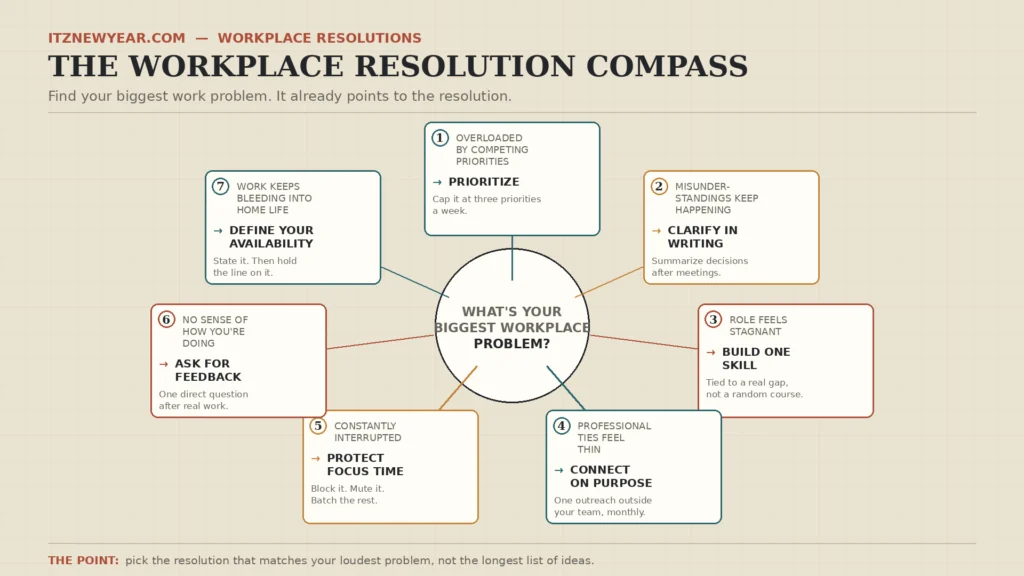
Instead of picking from a long list of ideas, it’s more useful to start from whatever is actually going wrong right now. The problem points toward the resolution.
- If your biggest issue is feeling overloaded, the resolution is prioritization, not general productivity.
- If misunderstandings keep happening, the resolution is clarifying expectations and decisions in writing.
- If your role feels stagnant, the resolution is building one skill tied directly to your actual work.
- If your professional relationships feel thin, the resolution is intentional, regular outreach.
- If your day is constantly interrupted, the resolution is protecting blocks of focused time.
- If you have no real sense of how you’re performing, the resolution is asking for specific feedback.
- If work keeps bleeding into personal time, the resolution is defining and communicating your actual availability.
Pick the one resolution that matches your loudest current problem. Trying to fix all seven at once is how most workplace resolutions collapse by February.
How to Turn a Workplace Resolution Into a Habit
A resolution only matters if it survives past the first week. Keeping it workplace-specific makes that easier than it sounds.
- Attach the new behavior to something you already do every day, like your Monday morning check of your calendar or your end-of-day email review, instead of trying to remember it cold.
- Define a clear trigger. “After every meeting where a decision is made” is a trigger. “When I remember to” is not.
- Choose one measurable behavior at a time rather than trying to change five things about how you work simultaneously.
- Check in with yourself every couple of weeks: is the behavior actually happening, and is it making a difference?
- If the resolution isn’t fitting your actual workload or role, adjust the behavior rather than abandoning the goal entirely.
- Resist stacking multiple workplace resolutions on top of each other. One well-kept habit beats four abandoned ones.
New Year Workplace Resolution Ideas by Role
| Role | Useful resolution focus |
|---|---|
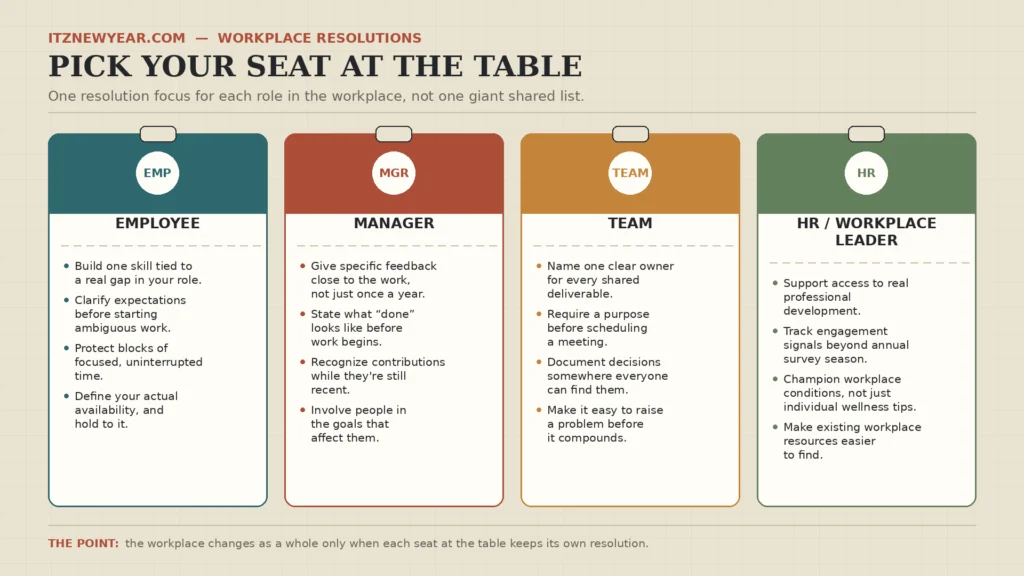
| Employee | building one relevant skill, clearer communication, protecting focus time, healthier boundaries |
| Manager | consistent feedback, clear expectations, timely recognition |
| Team | shared ownership, better handoffs, fewer purposeless meetings |
| HR / workplace leader | employee engagement, well-being support, professional development access |
| Remote or hybrid worker | proactive visibility, clear written communication, defined availability |
Each row points toward a different starting place, not a different article’s worth of ideas. Use whichever row matches your actual role this year.
FAQs
What are good New Year’s resolutions for work?
The strongest ones target a specific problem you’re already experiencing, like unclear priorities, unstructured meetings, or thin professional relationships, and translate it into one observable behavior you can actually practice, rather than a general aspiration like “be more productive.”
What are realistic workplace goals for the new year?
Realistic workplace goals are ones you can influence directly through your own actions. A goal like improving how you document decisions is realistic. A goal like fixing chronic understaffing isn’t something an individual resolution can solve; that requires organizational change.
What are some New Year’s resolutions for employees?
Common, useful ones include clarifying expectations before starting ambiguous work, asking for specific feedback instead of waiting for a review, protecting blocks of focused work time, and building one skill tied directly to a current gap in your role.
How can I make a workplace resolution measurable?
Turn it into a behavior with a clear trigger, something you either did or didn’t do. “Send a written summary after every decision-making meeting” is measurable. “Communicate better” isn’t, because there’s no clear evidence of whether it happened.
What are good New Year’s resolutions for a team?
Shared agreements work best: naming a clear owner for every deliverable, requiring a purpose before scheduling a meeting, documenting decisions somewhere everyone can find them, and creating an easy way to raise problems before they grow.
What should managers focus on in the new year?
Consistent, specific feedback throughout the year rather than saving it for a formal review, involving employees in setting goals that affect their own work, and recognizing contributions close to when they actually happen.
How many workplace resolutions should I choose?
One or two. Trying to change several habits about how you work at the same time usually means none of them stick. Pick the resolution that matches your most pressing current problem and build from there once it’s actually part of how you work.
Should workplace resolutions focus on productivity?
Not exclusively, and often not primarily. Resolutions built around communication, boundaries, relationships, and professional growth tend to hold up better over a full year than resolutions that only measure output, and they usually improve the quality of the work too.
Leave a Reply
You must be logged in to post a comment.