
Most resolution lists hand you a hundred options and leave you to sort through them. The better question isn’t “what are all the possible resolutions,” it’s “what kind of change do I actually want this year.” Once you know that, the right resolution is usually easy to spot.
This guide is built around that idea. You will find New year resolution ideas grouped by what they actually change in your life, a way to size a goal to what you can realistically keep up, and a short process for narrowing everything down to the one resolution worth committing to.
Start With The Kind Of Year You Want
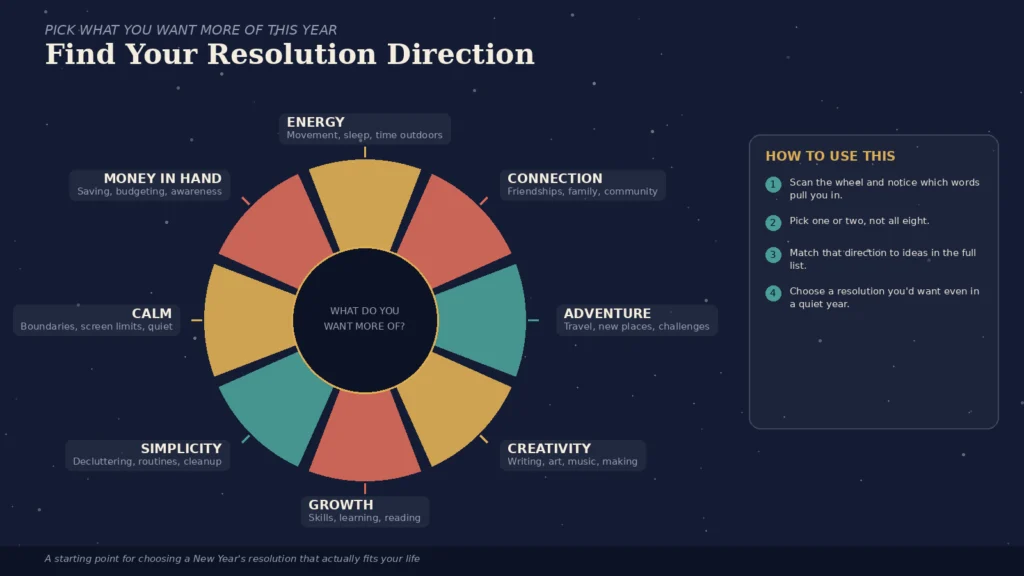
Before picking an idea, it helps to name what you want more of. Not every resolution fits every person, and a goal that excites one reader will feel like a chore to another.
| If you want more… | Look toward… |
|---|---|
| Energy | Movement, sleep, time outdoors |
| Calm | Boundaries, screen limits, quieter routines |
| Money in hand | Saving, budgeting, spending awareness |
| Connection | Friendships, family time, community |
| Adventure | Travel, new experiences, outdoor challenges |
| Creativity | Writing, art, music, making things |
| Growth | Skills, learning, reading |
| Simplicity | Decluttering, routines, digital cleanup |
If two or three rows stand out to you, that’s your starting point for the ideas below.
New Year Resolution Ideas Worth Considering
Personal Growth and Learning
- Learn a practical skill you can actually use, such as basic cooking, a repair skill, or a new software tool.
- Read consistently, even if that means ten pages before bed rather than a fixed number of books.
- Take a short course in something unrelated to your job.
- Learn enough of a new language to hold a basic conversation.
- Keep a one-line journal, writing a single sentence about your day.
- Take on a small confidence challenge, like ordering in a language you’re learning or attending a class alone.
Health and Everyday Well-Being
- Take a 20-minute walk on most days.
- Build a bedtime that stays roughly consistent, even on weekends.
- Spend at least an hour outdoors each week.
- Cook at home three nights a week instead of ordering in.
- Book the routine checkups you’ve been putting off.
- Add five minutes of stretching to your morning.
- Create a wind-down routine for the last 30 minutes before bed.
Money and Spending
- Build a monthly budget you’ll actually follow, not an aspirational one.
- Start an emergency fund with a fixed monthly amount, even a small one.
- Track discretionary spending for 90 days to see where it actually goes.
- Run a 30-day no-spend challenge on one specific category, like takeout or clothes.
- Automate a recurring transfer into savings so it happens without a decision each month.
- Review your subscriptions and cancel the ones you forgot you had.
Relationships and Connection
- Call one person you care about every week.
- Set a standing dinner or check-in with family.
- Meet one new person a month, through a class, a hobby, or a shared interest.
- Reconnect with an old friend you’ve lost touch with.
- Host people more often, even casually.
- Put your phone away during conversations.
- Write down one thing you appreciate about someone, once a week.
Home and Everyday Life
- Declutter one drawer, shelf, or closet each month.
- Build a five-minute daily reset, tidying the same spots before bed.
- Organize digital photos and files instead of letting them pile up.
- Donate or sell anything that’s gone unused for six months.
- Cook through what’s already in your pantry before buying more.
- Set up a calmer morning routine by prepping the night before.
Creativity and Hobbies
- Make something by hand each month, whatever that means to you.
- Learn an instrument, starting with 15 minutes a day.
- Take one photo a day for a season and look back at the collection.
- Write short pieces regularly instead of waiting for a big idea.
- Try pottery, ceramics, or another hands-on craft.
- Pick up drawing with no goal beyond enjoying it.
- Finish a project you already started and shelved.
- Revive a hobby you dropped years ago.
Adventure and Experiences
- Explore a new spot in your own city once a month.
- Take a solo day trip somewhere you haven’t been.
- Try twelve new experiences, one a month, big or small.
- Learn an outdoor skill, like kayaking or hiking navigation.
- Attend a local cultural event you’d normally skip.
- Take a class purely for fun, with no outcome attached.
Contribution and Kindness
- Volunteer on a regular schedule rather than only during the holidays.
- Donate items you no longer use instead of storing them.
- Support one local organization consistently throughout the year.
- Do one intentional kind act each week.
- Mentor someone in a skill or area you know well.
- Get more involved in your local community.
Digital Life and Attention
- Delete apps you no longer use.
- Set phone-free windows during the day, even short ones.
- Unsubscribe from email lists you never read.
- Keep your phone away from the table during meals.
- Set a boundary on one specific social platform.
- Swap one scrolling habit for something else, like a short walk or a call.
Choose a Resolution That Matches Your Current Bandwidth
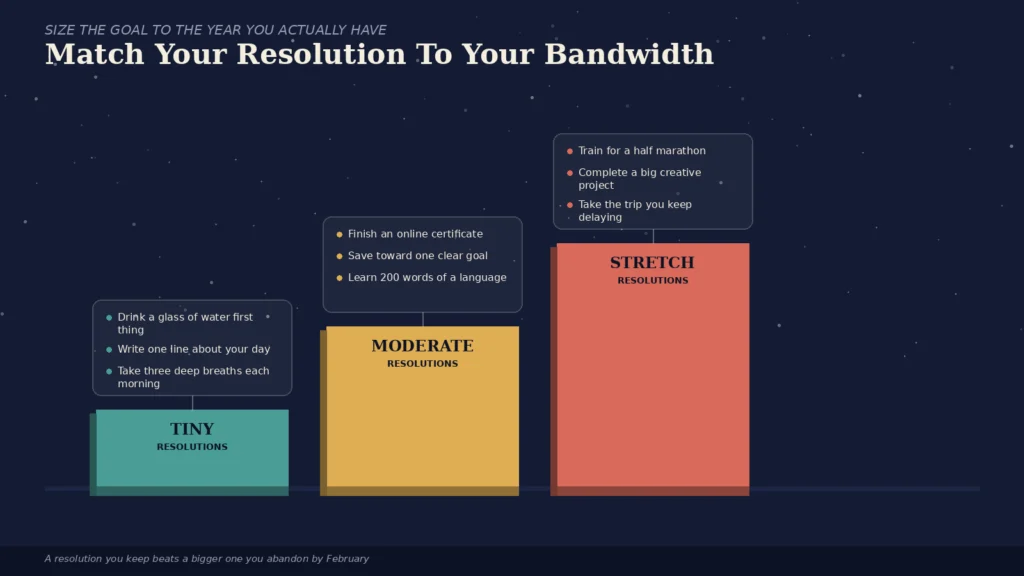
The best resolution isn’t always the most ambitious one. It’s the one that fits how much time and energy you actually have right now.
Tiny Resolutions
Small enough to fit into an already full life.
- Drink a glass of water first thing in the morning.
- Write one line about your day before bed.
- Put dishes away before going to sleep.
- Take three deep breaths before checking your phone in the morning.
Moderate Resolutions
A step up, with a defined outcome by the end of the year.
- Finish an online certificate in a skill you’ll actually use.
- Save a specific amount toward one clear goal.
- Attend one community or hobby event every month.
- Learn 200 words of a new language.
Stretch Resolutions
Bigger commitments that reshape a meaningful part of your year.
- Train for and finish a half marathon or long charity ride.
- Complete a significant creative project, like a novel draft or a built piece of furniture.
- Learn a language to a conversational level.
- Take the extended trip you’ve been putting off.
There’s no rule that says you need a stretch resolution to make the year count. A tiny resolution you actually keep up beats a stretch resolution you abandon by February.
Turn a Resolution Idea Into Something You Can Actually Follow
An idea like “read more” or “save money” is a direction, not yet a resolution you can act on. Turning it into something usable takes three small adjustments: make it observable, decide how often, and know your first move.
| Vague idea | More specific version | First action |
|---|---|---|
| Read more | Read 10 pages before bed on weekdays | Put the book on your pillow tonight |
| Save money | Set aside $200 a month by automatic transfer | Set up the transfer this week |
| Be healthier | Walk 20 minutes, four days a week | Block a 20-minute slot on tomorrow’s calendar |
An if-then plan helps too: if you sit down in bed at night, then you open the book before you open your phone. Attaching a resolution to an existing moment in your day makes it far easier to remember than relying on willpower alone.
How To Choose One New Year’s Resolution
If you’re stuck between several ideas, work through these steps in order.
- Identify what actually feels worth changing this year, not what you think you should change.
- Pick something you genuinely care about, not a goal chosen mainly to please someone else.
- Choose a behavior you can repeat, not a one-time event.
- Decide whether you want a tiny, moderate, or stretch resolution based on your current bandwidth.
- Settle on one primary resolution before adding anything extra.
- Write down the very first action you’ll take, and when.
A resolution chosen because it’s personally meaningful tends to hold up better over the year than one picked because it sounds impressive or matches what everyone else is doing.
New Year Resolution Ideas If You Want Something Different
If the standard categories above feel too familiar, here are a few less conventional directions:
- Create a personal museum of your year: keep one small object from each month.
- Explore your own city like a visitor, one new corner at a time.
- Learn the history of your own neighborhood.
- Host a themed dinner each season.
- Make one thing by hand every month, from a recipe to a repair.
- Spend a month buying nothing beyond necessities.
- Document one ordinary moment a day, in a photo or a sentence.
- Try twelve different hobbies over the year and keep the one that sticks.
- Build a family recipe archive before it’s lost.
- Send a handwritten note instead of a text, once a month.
- Learn one practical repair skill, like fixing a bike tire or patching drywall.
- Visit a local museum, gallery, or cultural site you’ve never been to.
- Declare one month a “yes month” for trying new experiences.
FAQs
What are some good New Year’s resolutions?
A good resolution is personally meaningful, realistic given your current schedule, and specific enough that you know what action to take. “Get healthier” is a direction. “Walk 20 minutes four days a week” is a resolution you can actually follow through on.
What is the most popular New Year’s resolution?
Health, fitness, and personal finance are consistently among the most commonly chosen categories in public surveys each year, though the exact ranking shifts depending on the source and the year. Popularity is a weak reason to choose a resolution on its own. A goal that fits your life matters more than one that’s trending.
What are some easy New Year’s resolutions?
Easy resolutions ask for a small, low-friction change: drinking a glass of water each morning, writing one line about your day, taking a short walk, or putting your phone away during meals. The tiny resolutions listed earlier in this guide are built around exactly this kind of low effort.
What is a realistic New Year’s resolution?
A realistic resolution fits the time, energy, and circumstances you actually have right now, not the ones you wish you had. It’s specific enough to measure, small enough to repeat consistently, and flexible enough to survive a rough week without falling apart entirely.
How many New Year’s resolutions should I make?
There’s no fixed ideal number. What matters more is prioritizing one primary resolution you’re fully committed to, rather than spreading your attention across five or six goals at once. If you want more than one, keep the rest small enough that they don’t compete with your main focus.
What are some unique New Year’s resolution ideas?
Ideas like building a personal museum of the year, learning your neighborhood’s history, or trying twelve hobbies to find the one that sticks move away from the usual fitness and finance goals. The unconventional ideas section above has more examples built around curiosity rather than self-improvement alone.
What’s the difference between a New Year’s resolution and a goal?
A resolution is typically a broader commitment to change a behavior or habit, often centered on New Year’s Day as a starting point. A goal is usually more specific and measurable, with a defined outcome and timeline. In practice, a strong resolution works best when it’s written in the specific, measurable language of a goal.
What if I don’t keep my New Year’s resolution?
One missed week or a slow start doesn’t erase the resolution. Most people who stick with a change long-term have restarted it more than once along the way. If a resolution keeps falling apart, it’s often a sign to make the goal smaller rather than to abandon it entirely.
Leave a Reply
You must be logged in to post a comment.