
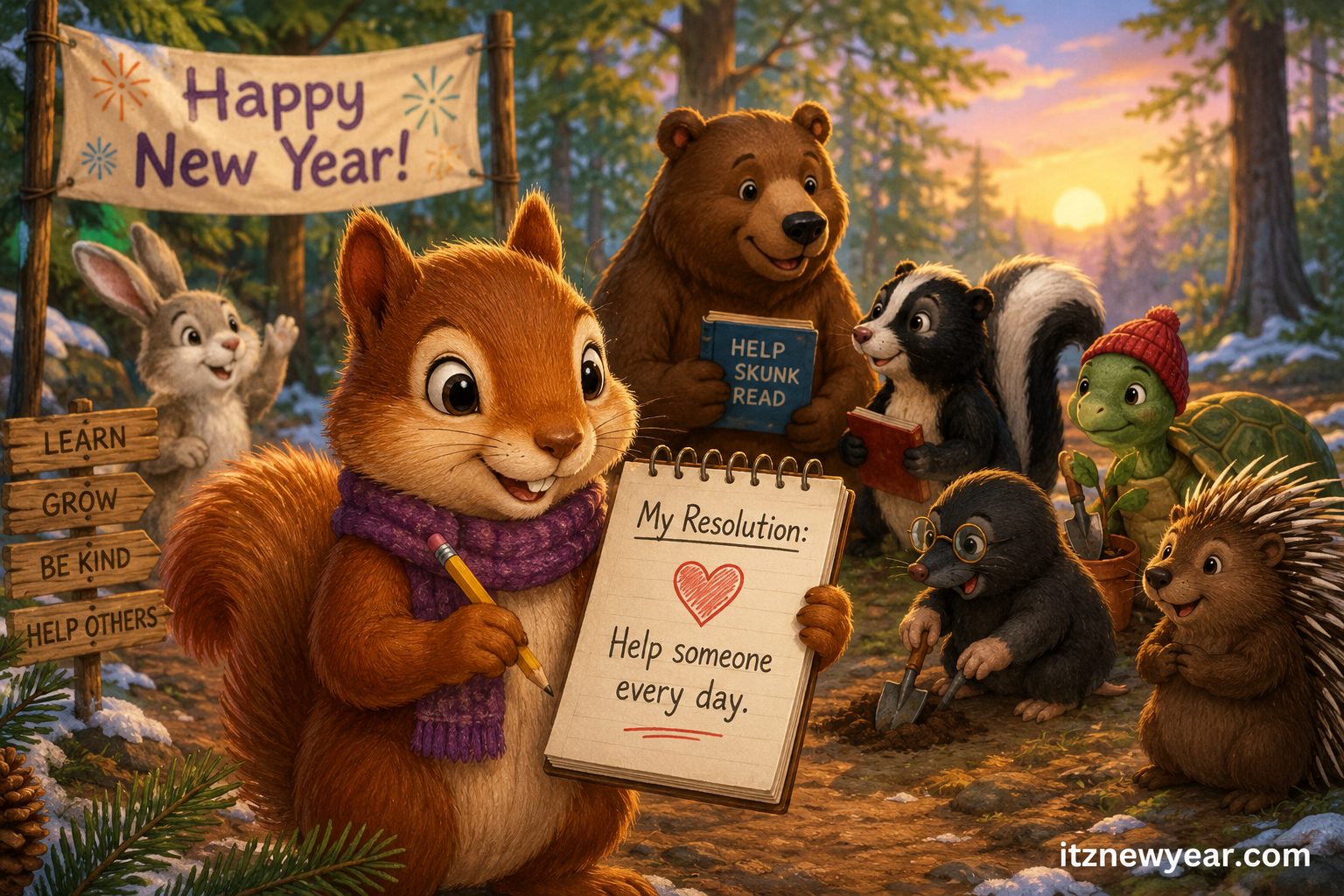
Squirrel’s New Year’s Resolution is a picture book by Pat Miller, illustrated by Kathi Ember, about a squirrel who has never heard the word “resolution” and spends New Year’s Day finding out what it means. Written for children ages 4 to 8, the story turns an abstract idea, promising yourself to change or improve something, into something a young reader can actually picture: a squirrel running from friend to friend, helping each one, without realizing she is already living out her own goal.
Squirrel’s resolution turns out to be helping someone every day, and she only discovers it after she has already been doing it all day long.
What Is Squirrel’s New Year’s Resolution About?
| Detail | Information |
|---|---|
| Title | Squirrel’s New Year’s Resolution |
| Author | Pat Miller |
| Illustrator | Kathi Ember |
| Publisher | Albert Whitman & Company |
| Published | 2010 |
| Pages | 32 |
| Age range | 4 to 8 |
| Grade range | P to 3 |
| Setting | A woodland community |
| Genre | Children’s picture book |
The book follows Squirrel through New Year’s Day as she tries to understand a word everyone else seems to already know. Bear tells her that a resolution is a promise you make to yourself, usually to improve something or to help someone else. Squirrel decides she needs one too, so she sets off through the forest to find hers.
The Story in Simple Terms
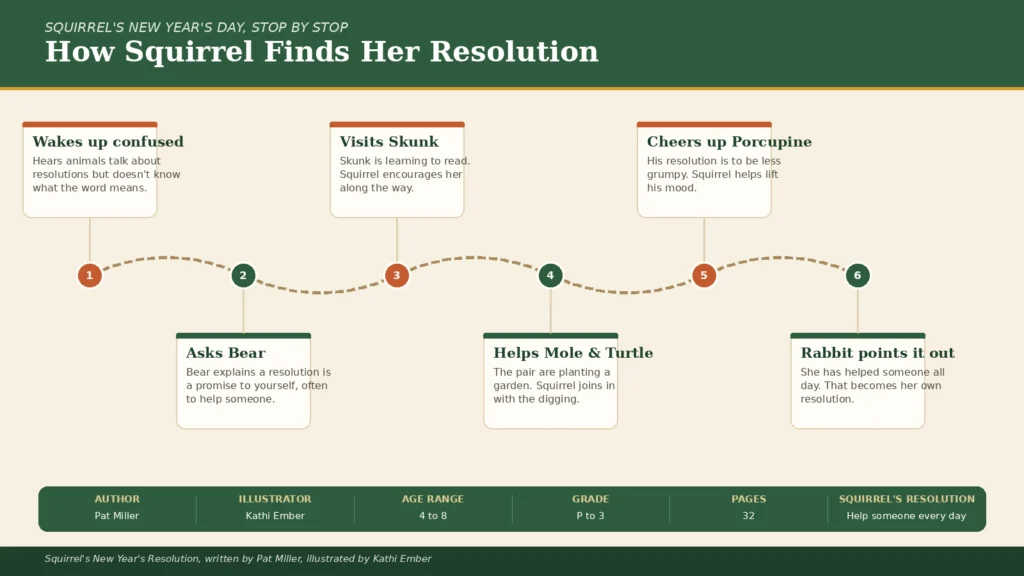
Squirrel wakes up on New Year’s Day and hears the other animals talking about their resolutions. She has no idea what the word means, so she goes to Bear, the animal most likely to know.
Bear explains that a resolution is a promise you make to yourself, and that his own resolution is to help Skunk learn to read. That gives Squirrel a problem: everyone else already has a plan, and she does not.
She visits her friends one by one to see what they are working on. Skunk is trying to learn to read. Mole and Turtle want to plant a garden. Porcupine wants to stop being so grumpy. At each stop, Squirrel does not just watch. She pitches in, whether that means encouraging Skunk, digging alongside Mole and Turtle, or cheering Porcupine up.
By the end of the day, Squirrel still has not chosen a resolution on purpose. Rabbit is the one who points out what has been obvious to the reader for a while: Squirrel has already been helping someone every single day. That becomes her resolution, not because she planned it, but because she noticed it after the fact.
What Is Squirrel’s Resolution?
Squirrel’s resolution is to help someone every day.
She does not arrive at it by sitting down and picking a goal the way the other animals do. She arrives at it by looking back at how she already spent New Year’s Day and recognizing a pattern in her own behavior. The lesson underneath the plot is that a resolution does not always start as a decision. Sometimes it starts as a habit you have not named yet.
The Characters and Their Resolutions
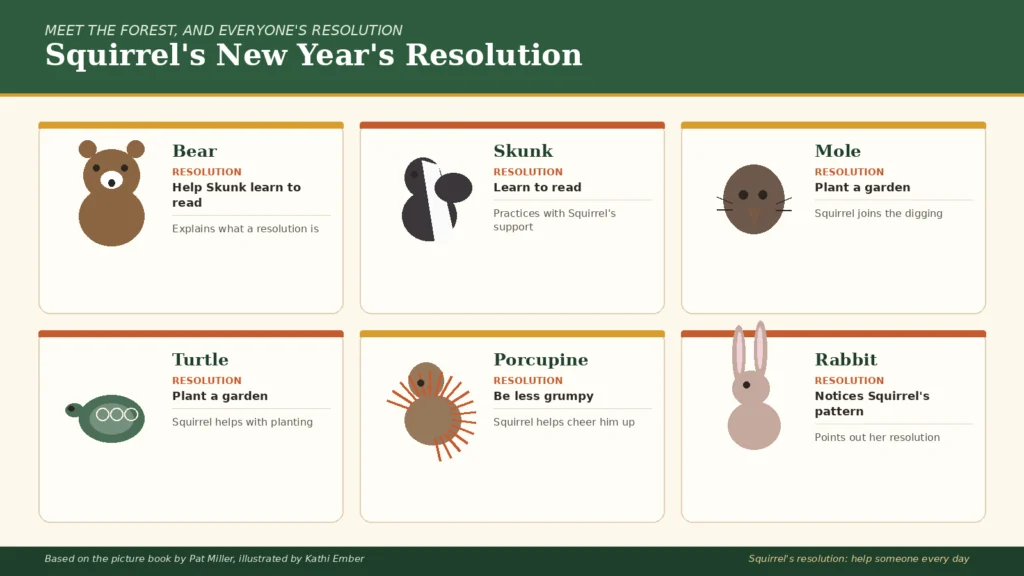
| Character | Resolution | Squirrel’s Role |
|---|---|---|
| Bear | Help Skunk learn to read | Learns what a resolution is from Bear |
| Skunk | Learn to read | Receives encouragement from Squirrel |
| Mole and Turtle | Plant a garden | Helps with the digging and planting |
| Porcupine | Be less grumpy | Helps cheer him up |
| Rabbit | Not stated as a personal resolution | Points out Squirrel’s resolution at the end |
| Squirrel | Help someone every day | Discovers this through her own actions |
Squirrel
Squirrel opens the story without a resolution and without a clear idea of what one even is. Everything she does for the rest of the book, visiting friends, asking questions, pitching in, is really her searching for an answer she already has without knowing it.
Bear
Bear is the first animal Squirrel asks, and he is the one who defines the word for her: a promise to yourself, usually to help someone or improve something. His own resolution is to help Skunk learn to read, which sets the tone for the rest of the book, since nearly every other resolution in the story also involves helping someone.
Skunk
Skunk’s resolution is to learn to read. Squirrel’s visit to Skunk gives the reader the first real example of what “helping someone” looks like in practice, rather than just in Bear’s definition.
Mole and Turtle
Mole and Turtle share a resolution: planting a garden. Squirrel joins in rather than just observing, which keeps the pattern going, everywhere she goes, she ends up contributing instead of just asking questions.
Porcupine
Porcupine’s resolution is to be less grumpy. This is the one goal in the book that is about the animal’s own behavior rather than a skill or a project, and Squirrel’s role here is emotional support rather than physical help.
Rabbit
Rabbit does not get a resolution storyline of his own. Instead, Rabbit’s job in the plot is to notice what Squirrel has missed: that she has spent the entire day helping someone, which means she already has a resolution, she just had not named it yet.
How Squirrel Discovers Her Resolution
Most of the story sets up an expectation that Squirrel needs to go find her resolution the way the other animals seem to have found theirs, as a deliberate choice made in advance. The ending quietly undoes that expectation.
Squirrel does not choose to help Skunk, Mole, Turtle, and Porcupine because she is testing out resolutions. She helps them because that is simply what she does when she visits a friend. The resolution is not the plan. It is the pattern Rabbit points out only after the fact.
That structure is what separates this book from a straightforward “how to pick a resolution” story. It suggests that some of the best goals are not new decisions at all, but things a person is already doing that just need to be recognized and kept up on purpose.
Themes and Lessons in the Story
Helping Others
Every resolution in the book, except Squirrel’s own, is either about helping someone else directly or about improving yourself in a way that makes you easier to be around. Helping is not treated as a one-time act. It shows up again and again as the thing that actually connects the animals to each other.
Friendship
Squirrel’s search for a resolution only works because she has friends to visit. Each stop in the story is also a small friendship scene: Bear teaching her something, Skunk trusting her enough to practice reading, Mole and Turtle letting her join their project, Porcupine allowing himself to be cheered up.
Discovering a Goal Through Action
The book’s clearest lesson for young readers is that you do not always need to plan a goal before you start working toward it. Squirrel’s resolution shows up as a description of what she already did, not as a plan she made at the start of the day.
New Beginnings
New Year’s Day gives the story its frame, but the book is not really about the calendar. It uses the holiday as a natural moment for Squirrel, and the reader, to stop and look at what kind of person she already is.
Why the Book Works for Young Readers
The book takes an idea that is genuinely abstract for a four to eight year old, a promise you make to yourself about the future, and turns it into something concrete: visiting a friend and doing something specific to help them. A child does not need to understand the concept of “resolution” in the abstract to follow what Squirrel is doing at each stop.
The 32-page format and P to 3 grade range also make the book short enough for a single read-aloud sitting, while still leaving room for a full cast of animal characters, each with a distinct and simple goal.
Classroom and Read-Aloud Ideas
- Make a resolution chart. List each animal alongside their resolution, then have students guess what Squirrel’s resolution might be before the ending reveals it.
- Sequence the animals’ resolutions. Ask students to put Squirrel’s visits to Bear, Skunk, Mole and Turtle, and Porcupine in the order they happened, as a simple story-structure exercise.
- Write a personal resolution. After discussing Squirrel’s resolution, have students write one thing they already do to help someone, rather than inventing a brand-new goal from scratch.
- Discuss everyday ways to help someone. Use Skunk, Mole and Turtle, and Porcupine as three different examples of what “helping” can look like: teaching a skill, doing physical work together, and offering encouragement.
Frequently Asked Questions
What is Squirrel’s New Year’s Resolution about?
It is a picture book about a squirrel who does not know what a New Year’s resolution is, so she visits her friends in the forest to find one, and ends up discovering that she has already been living out her resolution all day.
What is Squirrel’s New Year’s resolution?
Her resolution is to help someone every day. She realizes this only after Rabbit points out that she spent the whole day helping her friends without planning to.
Who wrote Squirrel’s New Year’s Resolution?
The book was written by Pat Miller and published by Albert Whitman & Company.
Who illustrated the book?
Kathi Ember illustrated Squirrel’s New Year’s Resolution.
What age group is the book for?
The publisher lists the book for ages 4 to 8, covering grades P through 3.
What are the main themes of the story?
The book centers on helping others, friendship, self-discovery, and the idea of starting something new, all built around the framework of New Year’s Day.
What resolutions do the other animals make?
Bear resolves to help Skunk learn to read, Skunk resolves to learn to read, Mole and Turtle resolve to plant a garden together, and Porcupine resolves to be less grumpy.
What does Squirrel learn by the end?
Squirrel learns that a resolution does not have to be a plan made in advance. Sometimes it is a pattern in how you already treat people, once someone points it out.
How can teachers use the book in the classroom?
Teachers commonly use it for reading comprehension, story sequencing, character and resolution mapping, and as a starting point for students to write their own resolution based on something they already do to help others.
Leave a Reply
You must be logged in to post a comment.