
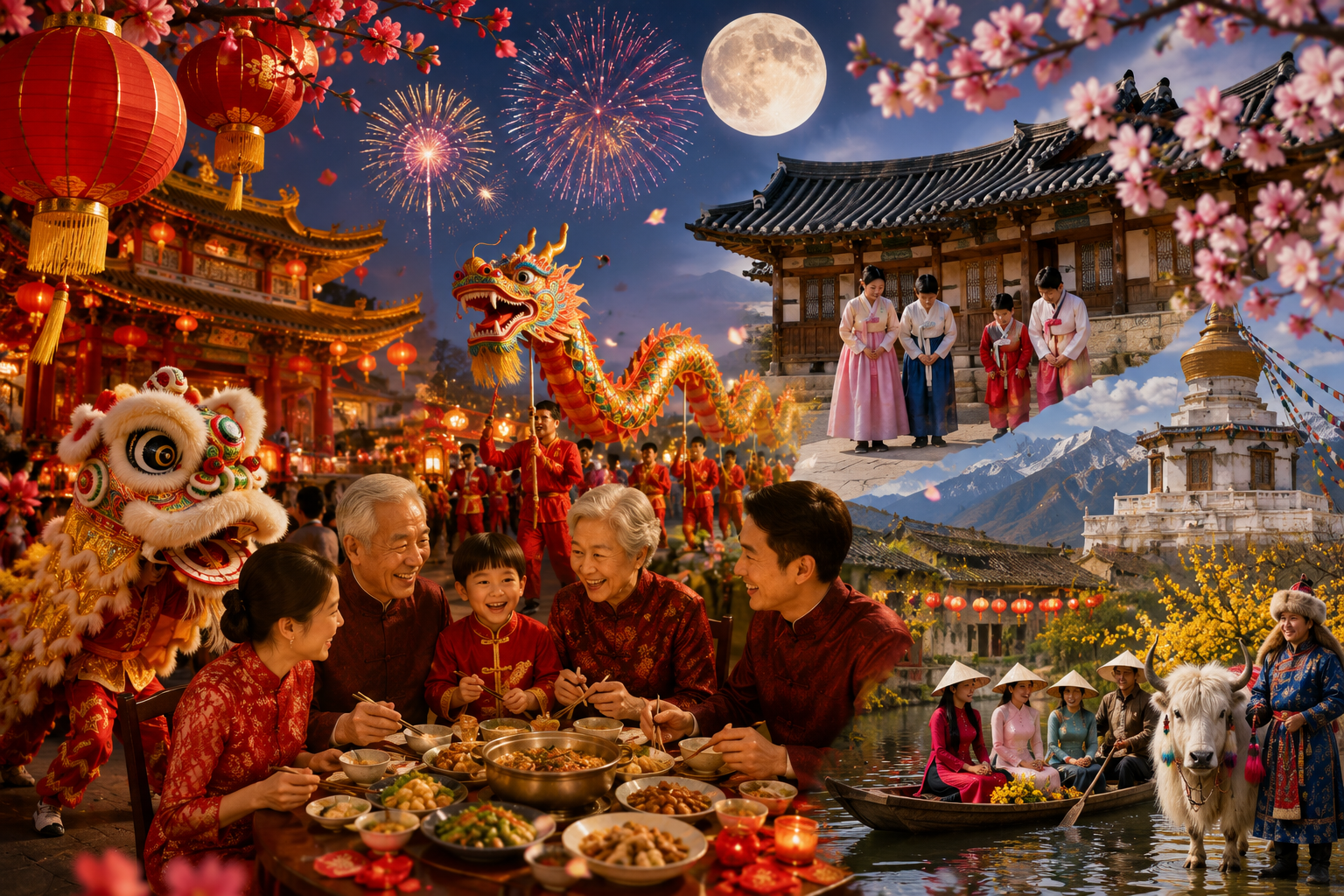
Lunar New Year is celebrated by multiple East and Southeast Asian cultures, most prominently Chinese, Korean and Vietnamese communities, along with groups such as Tibetan and Mongolian communities. It’s also observed by Asian diaspora communities around the world. It is not one identical holiday. Each culture has its own name, customs, and in some cases its own calendar calculations.
That last point matters more than most articles admit. Calling the holiday “Chinese New Year” for everyone erases how Korean, Vietnamese, Tibetan and Mongolian communities actually celebrate their own new year traditions.
Who Celebrates Lunar New Year?
At the broadest level, Lunar New Year is observed by cultures that follow a lunisolar calendar and mark the start of a new year around the first new moon of that calendar. The Library of Congress makes an important distinction here: many cultures use lunar or lunisolar calendars, but only some of them treat this particular point in the calendar as New Year’s Day.
The clearest, best-documented examples are:
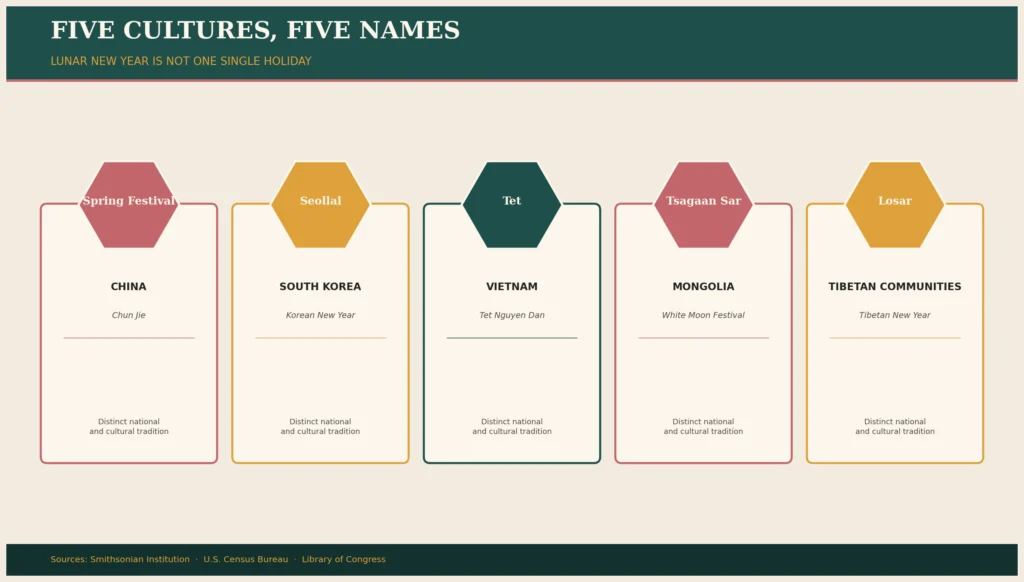
- China, where the holiday is the Spring Festival
- South Korea, where it’s called Seollal
- Vietnam, where it’s called Tết
- Mongolia, where it’s called Tsagaan Sar
- Tibetan communities, where it’s called Losar
Beyond these, Lunar New Year has strong community and cultural presence in places like Singapore, Malaysia, Indonesia and the Philippines, plus Chinese, Korean and Vietnamese diaspora communities in countries such as the United States, Canada, Australia and the United Kingdom.
Not everyone in every country listed here celebrates it. This is a cultural and community observance layered on top of national geography, not a blanket national holiday everywhere it appears.
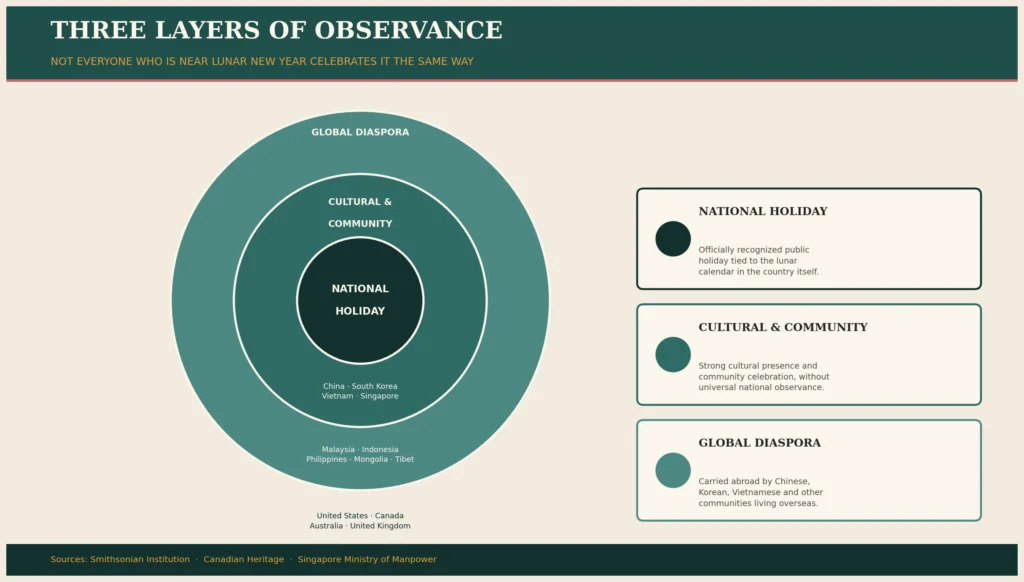
Which Countries and Cultures Celebrate Lunar New Year?
Each culture on this list treats Lunar New Year as its own tradition, shaped by its own history, even though the calendar timing overlaps.
China and Chinese Communities
In China, Lunar New Year is called Chun Jie, the Spring Festival, and the Smithsonian Institution describes it as the country’s most important holiday. It centers on family reunions, a New Year’s Eve reunion dinner, and traditions that carry through to the Lantern Festival roughly two weeks later. Chinese communities outside China, from Chinatowns to smaller diaspora networks, maintain versions of these same traditions.
South Korea and Seollal
Seollal is South Korea’s Lunar New Year, and the Smithsonian identifies it as a major family-centered holiday in its own right. Seollal involves ancestral rites, traditional Korean foods like tteokguk, and multi-generational family gatherings. It’s not a Korean version of Chinese New Year. It’s a distinct Korean holiday that happens to fall on the same lunar date.
Vietnam and Tết
Vietnam celebrates Tết Nguyên Đán, commonly shortened to Tết. The U.S. Census Bureau identifies Tết as the Vietnamese name for this New Year celebration, separate from China’s Spring Festival and Korea’s Seollal. Tết includes its own customs, foods, and family traditions, and even its zodiac calendar has a notable difference from China’s: the Smithsonian notes that the Vietnamese zodiac replaces the rabbit with the cat in the relevant year.
Mongolia and Tsagaan Sar
Mongolia observes Lunar New Year as Tsagaan Sar, the “White Moon” festival. It’s tied to Mongolian cultural and pastoral traditions, distinct from the customs found in China, Korea or Vietnam, even though it shares the same lunar calendar foundation.
Tibetan Communities and Losar
Tibetan communities celebrate Losar, Tibetan New Year, which carries its own religious and cultural significance rooted in Tibetan Buddhist practice. Losar shouldn’t be described as a version of Chinese New Year. It’s a separate tradition with its own rituals and timing conventions.
Lunar New Year in Southeast Asia
Singapore, Malaysia, Indonesia and the Philippines all have visible Lunar New Year celebrations, primarily connected to their Chinese communities, though the level of formal recognition varies by country.
Singapore is a strong example of formal recognition: Singapore’s Ministry of Manpower lists the first and second days of Chinese New Year among the country’s gazetted public holidays. In Malaysia, Indonesia and the Philippines, celebrations are widely visible and culturally significant, especially in Chinese communities, without necessarily meaning the entire population treats it as a personal holiday.
Is Lunar New Year the Same as Chinese New Year?
Not exactly. “Chinese New Year” refers specifically to China’s Spring Festival tradition. “Lunar New Year” is the broader umbrella term that also covers Korea’s Seollal, Vietnam’s Tết, Mongolia’s Tsagaan Sar and Tibet’s Losar, among others.
| Culture/community | Common name | Where commonly observed |
|---|---|---|
| Chinese | Spring Festival / Chinese New Year | China and Chinese communities worldwide |
| Korean | Seollal | South Korea and Korean communities worldwide |
| Vietnamese | Tết | Vietnam and Vietnamese communities worldwide |
| Mongolian | Tsagaan Sar | Mongolia and Mongolian communities |
| Tibetan | Losar | Tibetan communities and Himalayan regions |
Using “Chinese New Year” as a catch-all term for every culture on this list flattens real cultural distinctions that communities themselves maintain.
Do Lunar New Year Celebrations Differ by Culture?
Yes, in several ways. Names differ, as shown above. Foods differ: tteokguk in Korea, banh chung in Vietnam, dumplings and nian gao in China. Family customs differ, including which ancestral rites are performed and how. Zodiac systems can differ too, as with Vietnam’s cat-instead-of-rabbit substitution.
Public holiday status differs as well. Some countries formally gazette Lunar or Chinese New Year, like Singapore. In others, it’s a major cultural event without the same official status. Celebration length can also vary, from a single core day to a multi-day or two-week period depending on the culture and country.
Is Lunar New Year Celebrated Outside Asia?
Yes. Chinese, Korean, Vietnamese and other East and Southeast Asian diaspora communities carry Lunar New Year traditions with them wherever they settle. Canadian Heritage specifically describes Chinese, Korean, Vietnamese and other East and Southeast Asian communities in Canada, and around the world, continuing these celebrations.
This shows up in cities across the United States, Canada, Australia and the United Kingdom, through community festivals, family gatherings, temple and cultural center events, and public parades in cities with established Asian communities. It’s community-based rather than nationwide: most of the general population in these countries doesn’t personally observe the holiday, even where public festivals draw large crowds.
Do You Have to Be Asian to Celebrate Lunar New Year?
Cultural observance and public participation are two different things. Lunar New Year as a personal or family tradition belongs to the cultures that carry it: Chinese, Korean, Vietnamese, Mongolian, Tibetan and related communities.
At the same time, public Lunar New Year festivals, parades and cultural events are generally open to everyone, and plenty of people outside those cultures attend respectfully each year. Being invited into a friend’s or neighbor’s family celebration is also common in mixed communities. The distinction worth keeping in mind is between attending or appreciating a public celebration and claiming a cultural tradition as your own background.
What Do People Who Celebrate Lunar New Year Usually Do?
Practices vary by culture, but a few broad patterns show up across several of the traditions covered here:
- Family reunions, often built around a specific New Year’s Eve or New Year’s Day meal
- Cultural or religious observances, including ancestral rites in some communities
- Traditional foods specific to each culture
- Decorations and symbolic items tied to luck or the new year
- Gifts, including red envelopes in Chinese and some other traditions
- Community festivals, parades and public events, especially in diaspora cities
Not every practice applies to every culture. Whether a given family performs ancestral rites, gives red envelopes, or attends a public parade depends heavily on which tradition they follow.
Frequently Asked Questions
Who celebrates Lunar New Year?
Chinese, Korean, Vietnamese, Mongolian and Tibetan communities are the most prominent groups, along with Asian diaspora communities worldwide and broader cultural participation in countries like Singapore, Malaysia, Indonesia and the Philippines.
Is Lunar New Year only Chinese?
No. While China’s Spring Festival is the most widely known version, Korea’s Seollal, Vietnam’s Tết, Mongolia’s Tsagaan Sar and Tibet’s Losar are distinct traditions observed by their own cultures.
Which countries celebrate Lunar New Year?
China, South Korea and Vietnam have the most prominent national traditions. Singapore formally recognizes Chinese New Year as a public holiday, and Malaysia, Indonesia and the Philippines have significant community celebrations, mainly among Chinese communities.
Do Koreans celebrate Lunar New Year?
Yes, as Seollal, a distinct Korean holiday with its own ancestral rites, foods and family customs.
What is Lunar New Year called in Vietnam?
Tết, short for Tết Nguyên Đán.
What is Korean Lunar New Year called?
Seollal.
Is Lunar New Year the same as Chinese New Year?
Not exactly. Chinese New Year refers specifically to China’s Spring Festival tradition. Lunar New Year is the broader term covering related but distinct holidays like Seollal and Tết.
Do people outside Asia celebrate Lunar New Year?
Yes. Chinese, Korean, Vietnamese and other Asian diaspora communities in countries such as the United States, Canada, Australia and the United Kingdom continue their own Lunar New Year traditions.
Do all Lunar New Year cultures use the same zodiac?
No. Most follow a related zodiac system, but there are differences, such as Vietnam’s use of the cat instead of the rabbit in the corresponding year.
Can non-Asian people participate in Lunar New Year celebrations?
Yes, public festivals, parades and cultural events are generally open to everyone. Attending respectfully is different from claiming the tradition as your own cultural background.
Leave a Reply
You must be logged in to post a comment.