
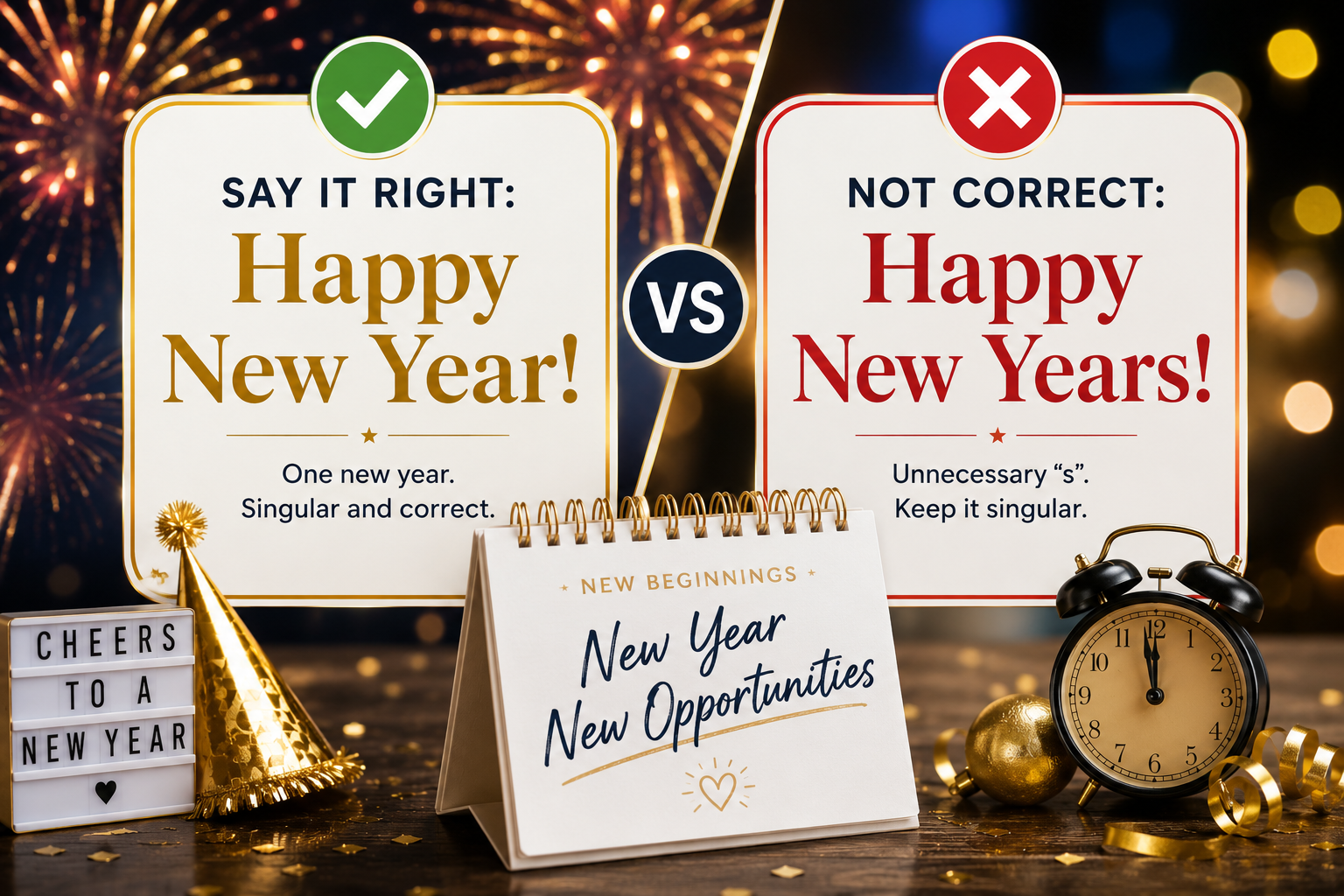
“Happy New Year” is correct. “Happy New Years” is not the standard form, even though plenty of people say it out loud. The confusion makes sense once you see why: “New Year” refers to the single calendar year that is about to begin, so the greeting stays singular. There’s no “New Years” to wish anyone, since only one year starts at a time.
There’s a second twist that trips people up even more: “New Year’s” (with an apostrophe) is a real and correct phrase, just not as a stand-alone greeting. It shows up in “New Year’s Eve” and “New Year’s Day.” That’s a different grammatical job than the one “Happy New Year” is doing, and mixing the two is where most of the confusion starts.
Here’s how to keep all of it straight.
“Happy New Year” vs. “Happy New Years”
| Phrase | Correct? | Why |
|---|---|---|
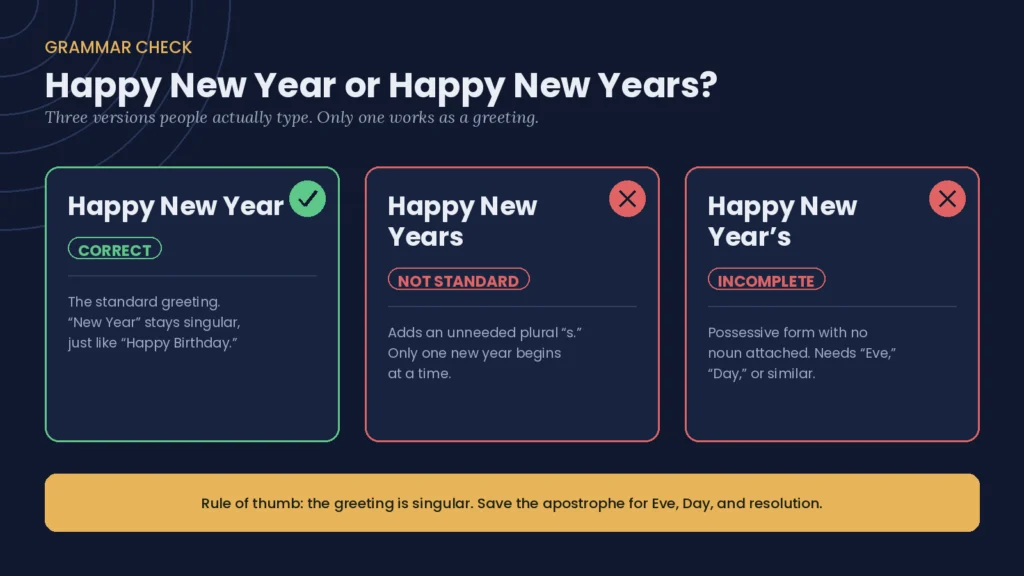
| Happy New Year! | Yes | Standard greeting; “New Year” stays singular |
| Happy New Years! | No | Adds an unnecessary plural “s” |
| Happy New Year’s! | Not as a greeting | Possessive form belongs with a noun (Eve, Day), not on its own |
| Wishing you a Happy New Year! | Yes | Common, natural variation |
The short version: when you’re wishing someone well, you’re wishing them a good new year, singular. “Happy New Year” is the greeting equivalent of “Happy Birthday,” not “Happy Birthdays.” Nobody has more than one birthday at a time, and nobody is entering more than one new year at a time either.
“Happy New Years” isn’t a different, more casual spelling of the same greeting. It’s a different word choice that changes what the sentence is technically saying, even if listeners understand the intended meaning either way.
Why Do So Many People Say “Happy New Years”?
If “Happy New Year” is correct, why does “Happy New Years” sound so familiar? A few reasons:
- It sounds natural out loud. In fast, casual speech, the difference between “year” and “years” can blur, especially before another word.
- “New Year’s” is everywhere. Between New Year’s Eve, New Year’s Day, and New Year’s resolutions, people hear the apostrophe-S version constantly. It’s easy to carry that pattern into the greeting without noticing.
- Repetition reinforces it. Once someone hears or says “Happy New Years” a few times, it starts to feel normal, even though it isn’t the standard written form.
None of this makes “Happy New Years” a formal alternative. It’s a common slip, not a second correct option, and it’s worth knowing the difference if you’re writing a card, a caption, or a message you want to get right.
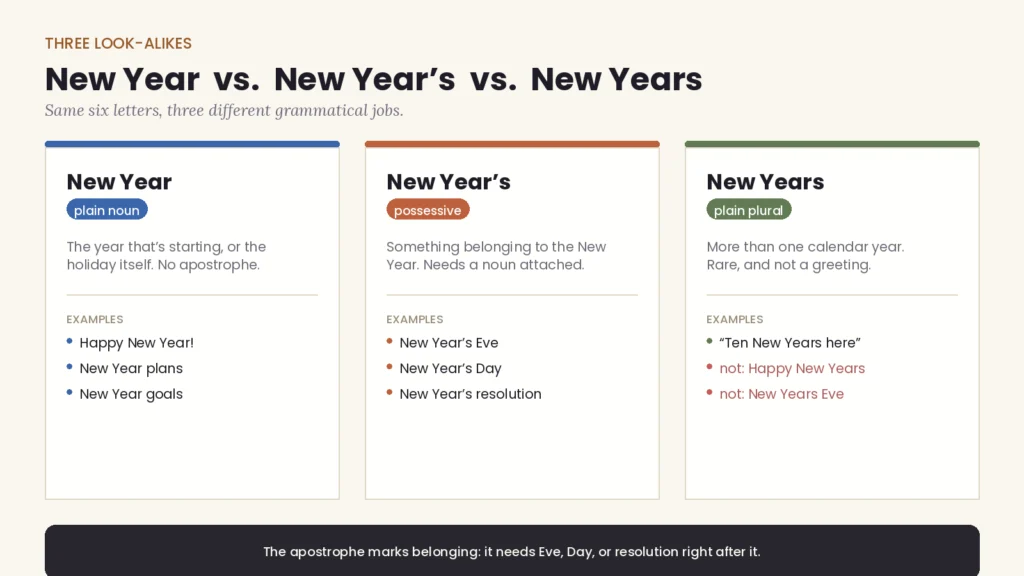
New Year, New Year’s, and New Years: What Actually Separates Them
These three look nearly identical but do three different jobs in a sentence.
New Year (no apostrophe, no extra “s”)
This is the plain noun phrase referring to the year that’s starting, or to the general idea of a fresh calendar year. It’s what you use in the greeting itself.
Examples:
- Happy New Year!
- We’re setting New Year goals this week.
- Our New Year plans include a small dinner with friends.
New Year’s (possessive, apostrophe before the “s”)
This form shows that something belongs to, or is associated with, the New Year. The apostrophe marks that connection, the same way it does in “today’s forecast” or “the year’s biggest event.” It needs a noun attached to it to make sense.
Examples:
- New Year’s Eve (the evening belonging to the New Year, meaning December 31)
- New Year’s Day (the day belonging to the New Year, meaning January 1)
- New Year’s resolution (a resolution tied to the New Year)
New Years (plural, no apostrophe)
This spelling is grammatically valid, just rare, and only when you’re actually talking about more than one calendar year in the plural sense.
Example:
- “I’ve celebrated ten New Years in this apartment” is describing ten separate years, so the plain plural fits.
What “New Years” is not is a casual stand-in for “New Year’s” or a shortcut for the greeting. Outside of a sentence that’s genuinely counting multiple years, it’s usually just a typo.
Is “Happy New Year’s” Correct?
This one deserves its own answer, because it’s a different mistake from “Happy New Years.”
“New Year’s” is a legitimate possessive form, but it’s built to attach to a noun: Eve, Day, resolution, celebration. On its own, right after “Happy,” it doesn’t have anything to attach to, so the sentence is left grammatically incomplete. “Happy New Year’s” reads like the start of a phrase that got cut off before the noun it needed.
That doesn’t mean every use of “New Year’s” is wrong, far from it. “New Year’s Eve,” “New Year’s Day,” and “New Year’s resolution” are all standard, correctly punctuated phrases. The issue is specifically using “New Year’s” by itself as a greeting, where “New Year” (no apostrophe) is what the sentence calls for.
Is “New Year” Capitalized?
Capitalization here depends on what job the phrase is doing.
- In the greeting, capitalize it: “Happy New Year!” reads as a set phrase, almost like a title, so both words are capitalized.
- As the name of the holiday period, capitalize it: “Our New Year celebration starts at 9 p.m.” treats New Year as a proper reference to the holiday.
- As a general, lowercase concept, it can stay lowercase: “Every new year brings something different” is using the phrase generically, describing a recurring idea rather than naming the specific holiday.
Style guides vary slightly on the generic case, but “Happy New Year,” “New Year’s Eve,” and “New Year’s Day” are consistently capitalized because they function as specific, named occasions.
When Do You Actually Say “Happy New Year”?
There’s no strict cutoff written into English grammar, but there’s a practical window most people follow:
- December 31, especially close to midnight, as the countdown builds
- Right at midnight on January 1, the most common moment for the greeting
- Throughout January 1, in person, by text, or on social media
- The first time you see or speak with someone in the new year, even if that’s January 5 or later
That last point matters more than people expect. If you haven’t talked to a coworker, relative, or friend since December, “Happy New Year” still works as your first greeting to them, even a couple of weeks in. It stops feeling natural once “new” no longer applies, generally by the time January is well underway, but there’s no hard rule that shuts it off at a specific hour or date.
Examples of Correct New Year Greetings
Short and simple
- Happy New Year!
- Happy New Year to you and your family!
- Wishing you a wonderful New Year!
A little more formal
- Wishing you a healthy and successful New Year.
- Best wishes for the year ahead.
- May the New Year bring you continued success.
Warmer, for people you know well
- Happy New Year! Hope this year treats you well.
- Sending love and a very Happy New Year to you both.
- Wishing you and your family a joyful New Year together.
Each of these keeps “New Year” singular and reserves the apostrophe-S form for phrases like Eve, Day, or resolution, where it belongs.
Common New Year Grammar Mistakes
A quick reference for the errors that show up most often in messages, captions, and cards:
| Incorrect / Common Form | Correct Form | Usage |
|---|---|---|
| Happy New Years | Happy New Year | Stand-alone greeting |
| Happy New Year’s | Happy New Year | Stand-alone greeting |
| New Years Eve | New Year’s Eve | December 31 |
| New Years Day | New Year’s Day | January 1 |
| New Years resolution | New Year’s resolution | A resolution for the new year |
| New Year’s | New Year | When used generically without a noun |
Rule: “New Year’s” is correct when it modifies a noun such as Eve, Day, or resolution. For the stand-alone greeting, use “Happy New Year.”
Quick Answer: Is it Happy New Year or Years?
- Greeting someone: use “Happy New Year,” singular, no apostrophe
- Talking about December 31: use “New Year’s Eve”
- Talking about January 1: use “New Year’s Day”
- Talking about a goal for the year: use “New Year’s resolution”
- Talking about multiple calendar years: “New Years” is valid, but only in that specific plural sense
If you remember one thing, remember that the greeting is singular. Everything else follows from there.
Frequently Asked Questions
Is it correct to say “Happy New Years”?
No. The standard greeting is “Happy New Year,” singular. “Happy New Years” is a common spoken slip, not an accepted written alternative.
Is “Happy New Year’s” grammatically correct?
Not as a stand-alone greeting. “New Year’s” is a possessive form that needs a noun attached, as in “New Year’s Eve” or “New Year’s Day.” Without one, “Happy New Year’s” is incomplete.
Why does “New Year’s” have an apostrophe?
The apostrophe shows possession or association, the same way it works in “today’s news” or “the year’s final week.” “New Year’s Eve” means the evening belonging to, or leading into, the New Year.
Is “New Year” capitalized?
Yes, when it’s part of the greeting (“Happy New Year”) or refers to the specific holiday period. In casual, general references to “a new year,” lowercase is also acceptable.
Can I still say “Happy New Year” after January 1?
Yes, especially the first time you see or contact someone in the new year. It’s commonly used through early January and doesn’t have a strict expiration date.
What’s the difference between New Year’s Eve and New Year’s Day?
New Year’s Eve is December 31, the last evening of the outgoing year. New Year’s Day is January 1, the first day of the new year.
Is it “New Years Eve” or “New Year’s Eve”?
“New Year’s Eve,” with the apostrophe before the “s.” The possessive form is what turns “New Year” into the name of that specific evening.
Leave a Reply
You must be logged in to post a comment.