
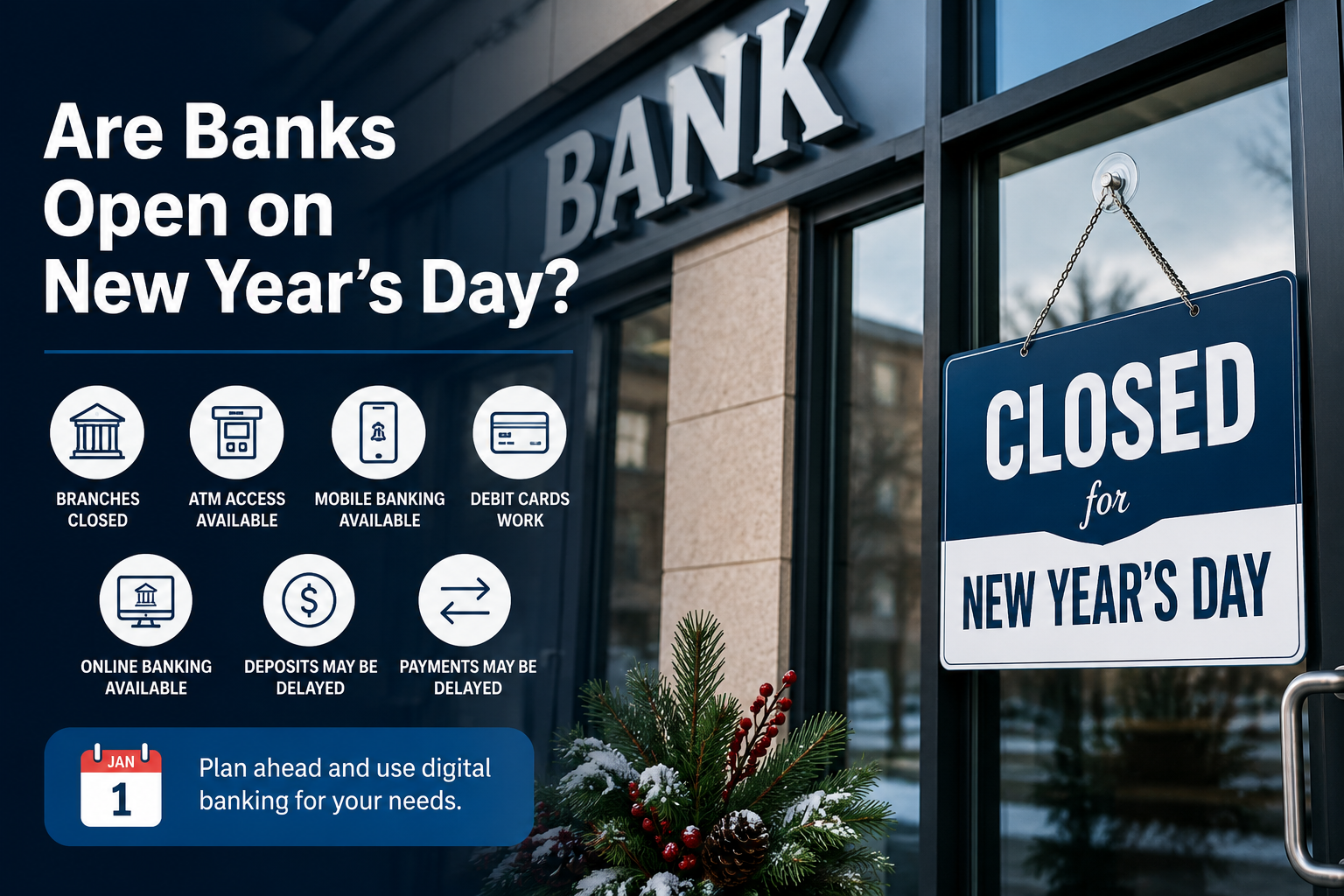
Most traditional bank branches in the United States are closed on New Year’s Day. January 1 sits on the U.S. federal holiday calendar, and the Federal Reserve’s holiday schedule lists it as well, which is why branch lobbies and teller windows shut down nationwide. That said, a closed branch doesn’t mean your money is out of reach. Online banking, mobile apps, ATMs, and debit cards typically keep working, even while in-person service pauses.
This article focuses on U.S. banking, since federal holiday status and Federal Reserve scheduling are what drive the closure. The sections below break down exactly what’s open, what’s closed, and what to do if you need money on the holiday.
| Service | Typical Status on Jan 1 |
|---|---|
| Physical branch lobby | Closed |
| Teller service | Closed |
| ATM withdrawals | Usually available |
| Mobile banking app | Usually available |
| Online banking portal | Usually available |
| Debit card purchases | Usually available |
| Deposit processing/settlement | May be delayed to next business day |
| ACH/wire settlement | May be delayed to next business day |
Why Are Most Banks Closed on New Year‘s Day?
January 1 is designated a federal holiday in the United States, and the Federal Reserve’s official holiday schedule includes New Year’s Day. Because the Federal Reserve system underpins so much of the country’s banking infrastructure, including check clearing and interbank payment processing, most banks align their branch calendars with it.
That doesn’t mean every bank is legally forced to close every location. Federal holiday status affects federal offices and the Federal Reserve’s own operations directly; it doesn’t create a blanket law compelling every private bank branch to shut its doors. In practice, though, nearly all major banks and community banks choose to close on this date because:
- Federal Reserve Banks are closed, which limits interbank settlement anyway
- Staffing a branch on a holiday most customers also observe isn’t practical
- Aligning with the federal calendar keeps back-office processing consistent
A small number of branches, particularly in retail locations like grocery stores, may keep limited hours. That’s the exception, not the rule.
What Banking Services Are Available on New Year’s Day?
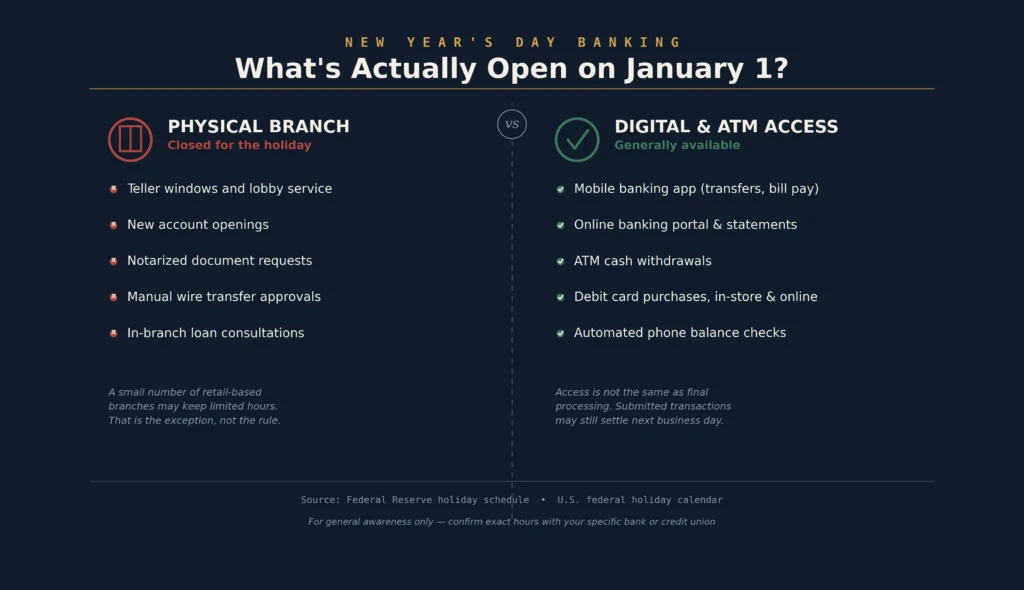
The clearest way to think about New Year’s Day banking is to separate physical access from digital access. The branch building is closed, but the systems behind your account are largely still running.
Services that generally remain accessible:
- Online banking portals for checking balances, viewing statements, and scheduling future payments
- Mobile banking apps for transfers, mobile check deposit, and bill pay
- ATMs for cash withdrawals and balance inquiries
- Debit card transactions at stores and online checkouts
- Automated phone banking for balance and recent-activity checks
Services that pause or slow down:
- In-branch transactions requiring a teller
- New account openings or notarized document requests
- Wire transfers requiring manual bank staff approval
- Final processing and settlement of certain payments (covered below)
The distinction that trips people up is this: a service being accessible isn’t the same as a transaction being fully processed. You can submit a mobile deposit at 9 a.m. on January 1, but the bank’s internal processing of that deposit follows its normal business-day schedule, not the holiday.
Can You Use an ATM on New Year’s Day?
Yes, in most cases. ATMs run on separate infrastructure from branch staffing, so withdrawals and balance checks are generally available on the holiday. That said, availability isn’t guaranteed everywhere:
- Cash replenishment schedules can shift around holidays, occasionally leading to an out-of-cash machine
- ATMs outside your bank’s network may charge higher holiday-period fees, same as any other day
- Machines located inside closed branch lobbies may be inaccessible even if the drive-up ATM works
Don’t assume every ATM will be stocked and operational; check your bank’s app for the nearest working machine if you’re relying on cash.
Can You Deposit Money on New Year’s Day?
You can typically submit a deposit through an ATM or a mobile banking app on January 1. What happens after submission depends on your bank’s posted deposit policy:
- Mobile check deposits usually have a cutoff time; anything submitted after that cutoff, or on a non-business day, is often treated as received the next business day
- ATM cash deposits may be credited to your available balance sooner, but full clearance can still follow standard holds
- Funds availability rules published by your bank, not the holiday itself, determine exactly when the money is usable
In short: you can act on the holiday, but don’t expect same-day funds availability as a rule.
Do Direct Deposits and Bank Transfers Go Through?
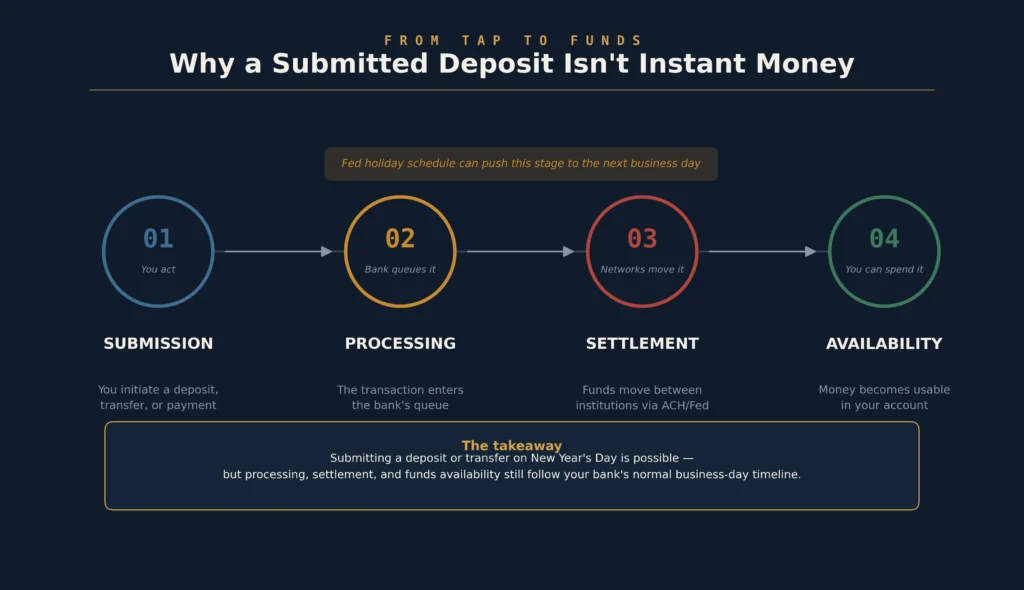
This is where four separate concepts matter, and conflating them causes most of the confusion:
- Submission: you or your employer initiate a payment
- Processing: the payment enters the banking network’s queue
- Settlement: funds actually move between institutions
- Funds availability: the money is usable in your account
The Federal Reserve’s holiday schedule affects processing and settlement, particularly for FedACH, the network many direct deposits and ACH transfers run through. If January 1 falls on a processing day that the Fed observes as closed, transactions that would normally settle that day typically settle on the next business day instead.
What this means practically:
- If your payroll provider submitted your deposit before the holiday, timing depends on their submission schedule and your bank’s posting policy
- A transfer initiated on January 1 through your app will usually still be accepted, but settlement follows the next available processing day
- Wire transfers, which run on a different system than ACH, follow their own holiday calendar and can also be delayed
There’s no universal rule guaranteeing a specific arrival date. Confirm timing directly with your employer’s payroll department or your bank if a payment is time-sensitive.
Are Credit Unions Open on New Year’s Day?
Credit unions generally follow the same pattern as banks: most branch locations close on January 1, while digital tools stay online. Because credit unions are separately chartered institutions, each one sets its own holiday calendar rather than following a single centralized rule.
- Branch lobbies: typically closed
- Shared branching networks: often closed as well, since partner credit unions usually observe the same federal holiday
- Mobile and online banking: usually available
- ATMs: usually available, subject to the same cash-replenishment caveats as bank ATMs
If you belong to a credit union, checking its app or website for a holiday notice is the fastest way to confirm its specific schedule.
What About Banks in Different Countries and Cities?
This article addresses the United States specifically, because the closure pattern here is tied directly to the federal holiday calendar and the Federal Reserve’s schedule. Banking holidays are not standardized worldwide:
- Other countries set their own bank holiday calendars, and January 1 closures elsewhere follow local regulation, not U.S. federal rules
- Even within the U.S., individual banks and individual branch locations can set schedules that differ slightly from the broader norm
- No single nationwide list of exact branch hours exists, since each institution manages its own locations
Rather than searching for a citywide or countrywide hours list, the more reliable approach is to verify directly with your specific bank or credit union.
How to Check Your Local Bank Branch
- Open your bank’s official website or app
- Use the branch locator tool and search your specific branch address
- Look for a posted holiday-hours notice, often shown on the branch locator page itself
- Call the branch directly if you have a time-sensitive visit planned
- Check the app’s alerts or notifications section for any temporary service updates
This five-step check takes a few minutes and avoids a wasted trip.
What Do Banks Provide and How Can They Help Around New Year?
Banks handle the core financial functions people rely on year-round: deposits, withdrawals, payments, transfers, account management, card services, and savings tools. None of that changes because of the calendar date, but the start of a new year is a natural point to use those tools more deliberately.
- Review account balances after holiday spending
- Check upcoming bill due dates before regular business resumes
- Look at automatic payments and subscriptions still running
- Set or adjust a savings goal inside your banking app
- Start a January budget using your bank’s spending-categorization tools if available
These are practical uses of existing account features, not new services tied to the holiday itself.
What to Do If You Need Banking Help on New Year’s Day
- Use your bank’s ATM network for cash needs
- Handle transfers, bill pay, and balance checks through the mobile app
- Use your debit card for purchases as usual
- Check whether your bank has a 24/7 fraud or lost-card hotline, which typically stays staffed even on holidays
- Plan any in-branch task, like a notarized document or new account, for the next business day
Tips to Prepare Before the New Year’s Holiday
- Withdraw any cash you expect to need before December 31
- Schedule time-sensitive bill payments a day or two early
- Check your specific branch’s holiday hours in advance, not on the day itself
- Understand your bank’s stated funds-availability policy if you’re depositing a large check
- Review any transfers already scheduled to land on or around January 1
- Confirm your app login and card access are working before the holiday, when support lines are lighter
FAQs
Are banks open on New Year’s Day?
Most traditional bank branches in the U.S. are closed on January 1, though digital banking services like apps, online banking, and ATMs are generally still available.
Are bank branches closed on January 1?
Yes, the majority of physical branch lobbies and teller windows close for the federal holiday, though a limited number of retail-based branches may keep reduced hours.
Can I use an ATM on New Year’s Day?
Generally yes. ATMs typically operate independently of branch staffing, though individual machines can be temporarily out of service or out of cash.
Can I deposit money on New Year’s Day?
You can usually submit a deposit through an ATM or mobile app, but processing and full funds availability may follow your bank’s standard business-day timeline.
Will my direct deposit arrive on New Year’s Day?
There’s no universal answer. Arrival depends on your employer’s submission timing, your bank’s posting policy, and Federal Reserve processing schedules for the holiday.
Do bank transfers process on New Year’s Day?
Transfers can usually be initiated, but processing and settlement, especially for ACH transactions, may shift to the next business day when the Fed observes the holiday.
Are credit unions open on New Year’s Day?
Many credit union branches close for the holiday, though each credit union sets its own schedule, and digital services typically remain accessible.
Is online banking available on New Year’s Day?
Yes, online and mobile banking generally remain available for balance checks, transfers, and bill pay, even while branch processing pauses.
How can I check whether my local bank branch is open?
Use your bank’s official branch locator or app, look for a posted holiday notice, or call the branch directly to confirm its exact status.
Leave a Reply
You must be logged in to post a comment.