
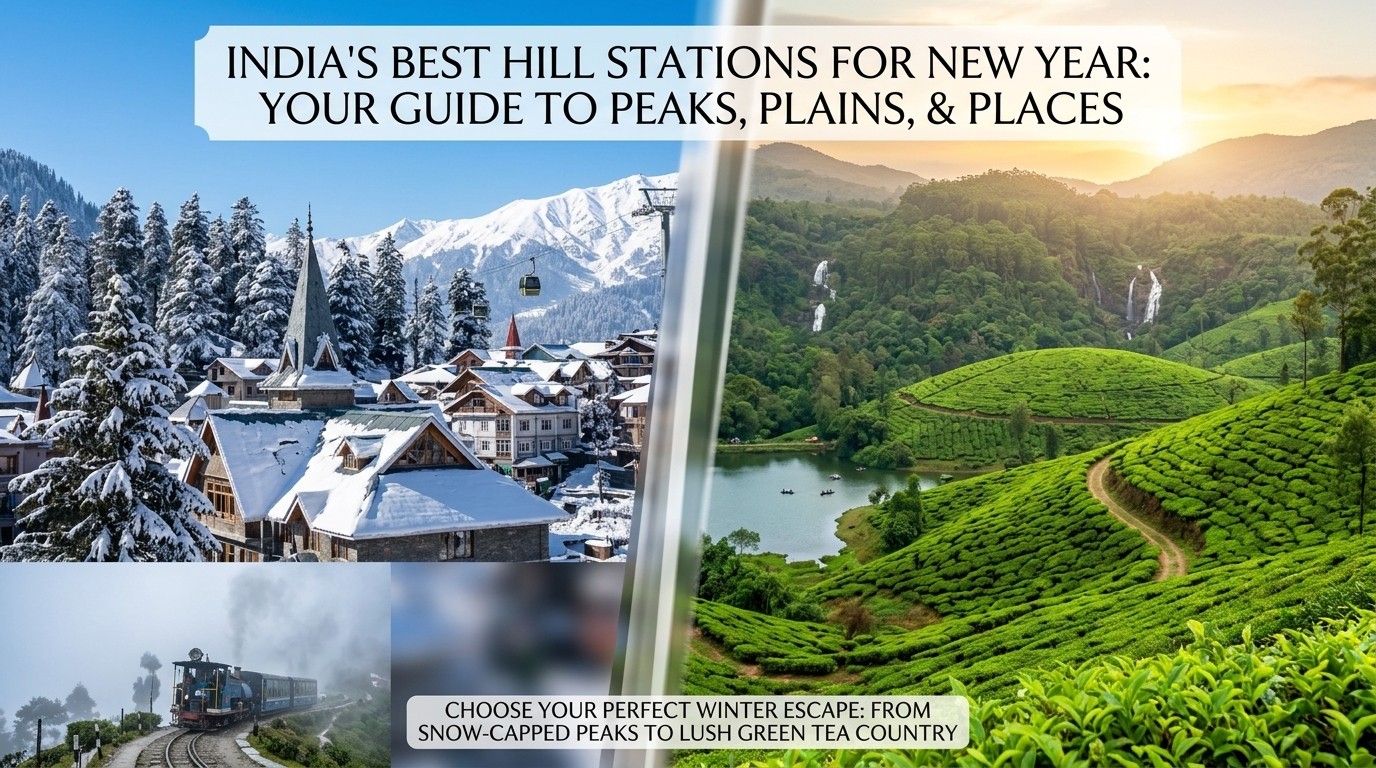
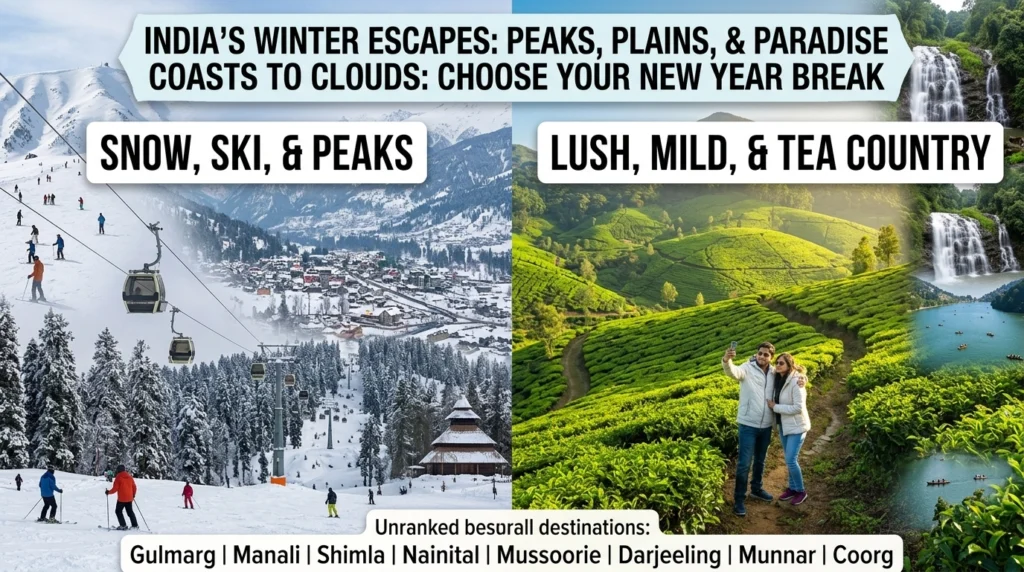
Snow in Manali, tea gardens in Munnar, a toy train in Darjeeling: “best hill station” means something different depending on which one you’re picturing. This guide covers eight of them, chosen because each offers something the others don’t. It’s not a ranked top-10 and it’s not a party guide. If you’re looking for New Year’s Eve events, countdowns or club listings, this isn’t that article. What follows is what you’d actually see and do at each destination, what it costs, how long to allow, and what changes specifically because you’re visiting in the last week of December or the first week of January.
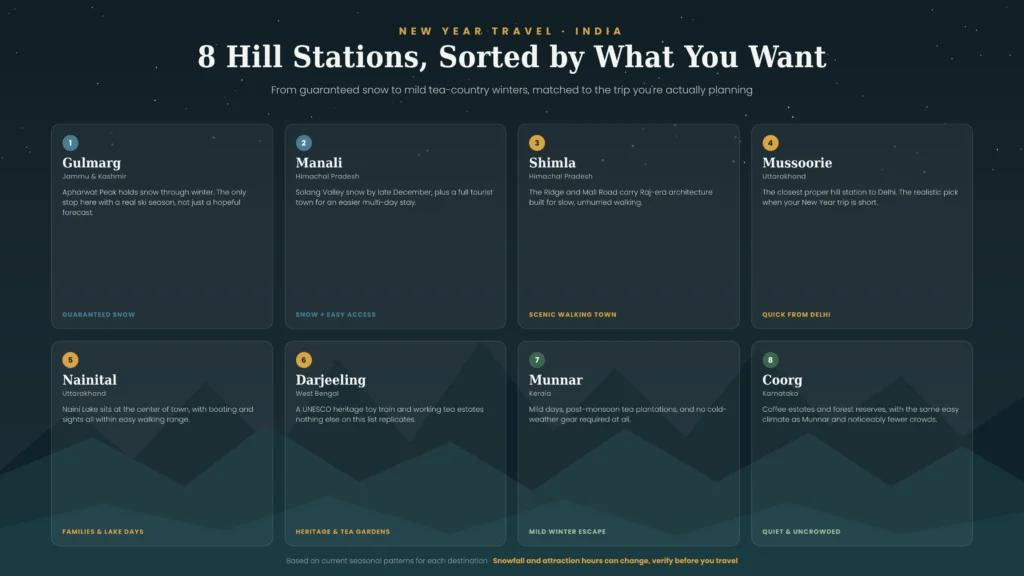
Which Hill Station Depends on What You Want
Best for Guaranteed Snow and Skiing
Gulmarg, Jammu & Kashmir. At nearly 4,000 metres, Apharwat Peak holds snow reliably through winter, and it’s the only destination on this list built around an actual ski season rather than the hope of a passing snowfall.
Best for a Snow Trip That’s Easier to Reach
Manali, Himachal Pradesh. Snow at Solang Valley is common by late December, the town has a full tourist infrastructure, and it’s reachable by an overnight bus or a short flight to Bhuntar, without the permit requirements that come with Kashmir.
Best for Scenic Walks and Colonial-Era Architecture
Shimla, Himachal Pradesh. The Ridge and Mall Road are built for unhurried walking, and the town’s Raj-era buildings give it a character the newer hill stations don’t have.
Best for Families and a Lake-Centered Day
Nainital, Uttarakhand. Naini Lake sits at the center of the town, boating is inexpensive, and most of the major sights are within walking distance of each other.
Best for a Quick Trip from Delhi
Mussoorie, Uttarakhand. It’s the closest proper hill station to Delhi, which makes it realistic for a short New Year trip without burning most of your holiday on travel.
Best for a Heritage Train and Tea Garden Views
Darjeeling, West Bengal. The UNESCO-listed Darjeeling Himalayan Railway and the tea estates around the town aren’t replicated anywhere else on this list.
Best for a Milder Winter and Tea Country Scenery
Munnar, Kerala. Daytime temperatures stay comfortable, the tea plantations are at their most photogenic after the monsoon, and there’s no cold-weather gear required.
Best for a Quieter Nature-Focused Escape
Coorg, Karnataka. Coffee estates, waterfalls and forest reserves make it a slower, less crowded alternative to Munnar with a similar winter climate.
Manali: Where the Snow Trip Meets an Established Tourist Town
Manali sits in the Kullu Valley at around 2,050 metres, and by late December, snow is common at elevation even when the town itself only sees occasional flurries. What makes it a strong New Year pick is the combination: a real snow experience nearby, plus a town with enough restaurants, markets and accommodation to make a multi-day stay comfortable.
Solang Valley, about 14 km from Manali, is where most visitors go for snow activities. Ropeway rides, snow scooters and short skiing lessons are available seasonally, run by local operators rather than a single official body, so prices and quality vary. Expect to pay for each activity separately.
Hidimba Devi Temple, a wooden temple set inside a cedar forest in Old Manali, is free to enter and takes about 30 to 45 minutes to see properly. It’s one of the few attractions in Manali that works well regardless of weather.
Rohtang Pass, the high-altitude route north of Manali, is frequently closed in winter due to snow accumulation, and even when open requires a permit issued in limited daily numbers. Don’t build a New Year itinerary around reaching Rohtang. Treat it as a bonus if conditions allow, not a plan.
Old Manali and Mall Road are free to walk and cover cafes, shops and river views along the Beas. This is the easiest way to spend an unstructured afternoon.
| Attraction | Cost | Booking | Realistic time |
|---|---|---|---|
| Solang Valley activities | Paid, per activity | Walk-in, prices vary by operator | Half a day |
| Hidimba Devi Temple | Free | Walk-in | 30-45 min |
| Rohtang Pass | Permit fee, when open | Permit required, subject to closure | Full day if it happens |
| Old Manali / Mall Road | Free | Walk-in | 2-3 hours |
What changes around New Year: Manali is one of the most heavily booked hill stations for this exact travel window, so hotel and taxi prices rise and Mall Road gets genuinely crowded in the evenings. Snow at Solang is more reliable in late December than in November, but not guaranteed at any specific date. Book accommodation and any Solang Valley transport well ahead if you’re traveling December 28 through January 2.
Gulmarg: The One Destination Where Snow Isn’t a Gamble
Gulmarg is different from every other entry on this list because its winter appeal doesn’t depend on a lucky snowfall. Apharwat Peak, reached via the Gulmarg Gondola, holds snow for most of the winter season, which is why Gulmarg functions as India’s most serious ski destination rather than a hill station that happens to get cold.
The Gulmarg Gondola runs in two phases: Phase 1 to Kongdoori at around 3,050 metres, and Phase 2 continuing to the Apharwat shoulder near 3,980 metres. Recent pricing has run roughly ₹740 to ₹810 for Phase 1 and ₹900 to ₹1,010 for Phase 2, with a combined ticket around ₹1,800.
Tickets are sold in timed slots rather than open boarding, and the gondola has a scheduled maintenance closure on the second and fourth Monday of each month. Phase 2 in particular is weather-dependent and can close on short notice even when Phase 1 is running. Prices and schedules should be confirmed on the official JKCCC booking portal before you travel, since they shift by season.
Skiing and snowboarding are the main draw at Apharwat, with equipment rental and instruction available locally rather than through a single operator. This is not a casual, walk-up activity for beginners without some orientation, and costs vary depending on gear and instructor.
Strolling Gulmarg’s meadow area itself, when it’s under snow, is free and doesn’t require the gondola at all. It’s a reasonable option if you’d rather not spend on lift tickets.
| Attraction | Cost (approximate, verify current rate) | Booking | Notes |
|---|---|---|---|
| Gondola Phase 1 | ₹740-810 | Timed slot, book online in advance | Base to Kongdoori |
| Gondola Phase 2 | ₹900-1,010 | Requires valid Phase 1 ticket | Kongdoori to Apharwat, weather-dependent |
| Skiing/snowboarding | Paid per session | Local operators, no central booking | Beginner lessons available |
What changes around New Year:
This is peak season, and gondola tickets can sell out, especially Phase 2 slots. Reaching Gulmarg means routing through Srinagar first, and winter road conditions between Srinagar and Gulmarg can be affected by snowfall, so build in flexibility rather than a tight same-day return. Because Gulmarg sits at high altitude, some visitors notice the thinner air at Apharwat. Pace yourself on the first day rather than planning an intensive schedule immediately after arrival.
Shimla: A Walking Town Built Around a Ridge
Shimla doesn’t offer a snow guarantee the way Gulmarg does, but it’s built differently from the other Himachal destinations on this list: the town center itself, not a nearby valley, is the main attraction.
The Ridge and Mall Road form the pedestrian spine of Shimla, lined with colonial-era buildings, including the Gaiety Theatre and Christ Church. Both are free to walk, and this is realistically where most visitors spend the bulk of their time, whether or not they’re doing anything else.
Jakhoo Temple, on Shimla’s highest point, is a hilltop temple accessible by a walkable trail or a short ropeway ride. It’s free to enter. The site has a resident population of macaques used to visitors carrying food, so keep bags closed and don’t offer food by hand.
Kufri, about 16 km from Shimla, is the town’s usual day-trip answer to “where’s the snow.” It has a small amusement-park feel with pony rides, snow activities in season and the Himalayan Nature Park, which charges a modest entry fee. It works well as a half-day add-on rather than a full destination in itself.
The Kalka-Shimla Railway, a UNESCO World Heritage narrow-gauge line, connects Shimla to the plains and is worth knowing about if you’re arriving by train rather than road, since the journey itself is part of the appeal.
| Attraction | Cost | Best for |
|---|---|---|
| The Ridge & Mall Road | Free | Everyone, all ages |
| Jakhoo Temple | Free | Walkers; watch for monkeys |
| Kufri | Paid entry to Nature Park, activities extra | Families wanting snow without a long drive |
| Kalka-Shimla Railway | Paid, varies by class | Travelers arriving from the plains |
What changes around New Year: Shimla’s Mall Road gets crowded in the evenings during this period, and hotel rates climb accordingly. Snowfall in Shimla town itself is possible but not annual, so don’t count on it; Kufri, at higher elevation, is a more consistent bet if snow is the priority.
Nainital: A Town Organized Around Its Lake
Nainital’s geography does most of the planning work for you. Naini Lake sits in the middle of town, ringed by Mall Road, and nearly everything worth seeing is within a short walk or a quick cab ride of it.
Naini Lake is free to visit and walk around. Boating is the main paid activity, with rates that vary by boat type: rowboats and paddleboats typically run in the ₹150 to ₹300 range for a set duration, with gondola-style boats priced separately. Boating hours generally run 6 a.m. to 6 p.m. in summer and shift to a shorter winter window, roughly 8 a.m. to 5 p.m. Confirm current rates at the boat club counter, since they’re adjusted periodically.
Naina Devi Temple, on the lake’s northern edge, is free to visit and takes 20 to 30 minutes for a typical visit.
Snow View Point, reached by a separate cable car from the one used for lake boating, offers a Himalayan panorama on clear days. This is a paid ropeway ride, distinct from the lake boats, and works best in the morning before haze builds up.
| Attraction | Cost | Time needed | Family fit |
|---|---|---|---|
| Naini Lake (walking) | Free | 30-60 min | Strong |
| Boating | Paid, ₹150-300 range depending on boat | 30 min per ride | Strong, rowboats are the steadiest option |
| Naina Devi Temple | Free | 20-30 min | Strong |
| Snow View Point ropeway | Paid | 1-2 hours round trip | Good, some walking at the top |
What changes around New Year:
Nainital is a popular short break for Delhi and the wider NCR region, and this specific week is one of its busiest. Mall Road and the lakefront get genuinely crowded, and boating queues build up by midday. Early morning is the more comfortable time to be at the lake. December and early January bring cold, clear weather and occasional snowfall in the surrounding hills, which is part of the appeal for visitors coming from warmer parts of the country.
Mussoorie: The Practical Choice When Time Is Short
Mussoorie’s main advantage isn’t a unique attraction, it’s proximity. As the closest major hill station to Delhi, it’s realistic to fit into a New Year trip of three or four days total, including travel, in a way that Kashmir or Darjeeling simply aren’t.
Gun Hill, Mussoorie’s second-highest point, is reached either by a short ropeway from Mall Road or a 20 to 30 minute uphill walk. The ropeway round trip has been priced anywhere from roughly ₹75 up to ₹220 depending on the season and the source quoting it, so check the current rate at the counter rather than assuming a fixed figure. Ropeway hours are generally 10 a.m. to 6 p.m., with some seasonal variation. The walking route is free and takes about the same amount of time as waiting in a ropeway queue during a busy period.
Mall Road itself is Mussoorie’s central promenade, free to walk, lined with shops, cafes and viewpoints over the Doon Valley.
Kempty Falls, about 15 km outside town, is a popular waterfall stop with paddle boating and pool access, though water flow is naturally reduced outside monsoon season, so temper expectations for a December visit compared to photos taken in July.
| Attraction | Cost | Notes |
|---|---|---|
| Gun Hill ropeway | Paid, roughly ₹75-220 round trip, confirm current price | Or walk up free in 20-30 min |
| Mall Road | Free | Central promenade |
| Kempty Falls | Paid activities on site, area access largely free | Reduced water flow in winter |
What changes around New Year:
Mussoorie’s road from Dehradun can see heavy weekend and holiday traffic during this period, so allow extra time for the drive up. The town itself is at a modest altitude and doesn’t reliably get snow every winter, so if snow is the specific goal, Gulmarg or Manali are more dependable choices.
Darjeeling: The Toy Train and the Tea Gardens
Darjeeling’s identity is built on two things nothing else on this list has: a UNESCO World Heritage railway and hillsides genuinely covered in working tea estates rather than ornamental gardens.
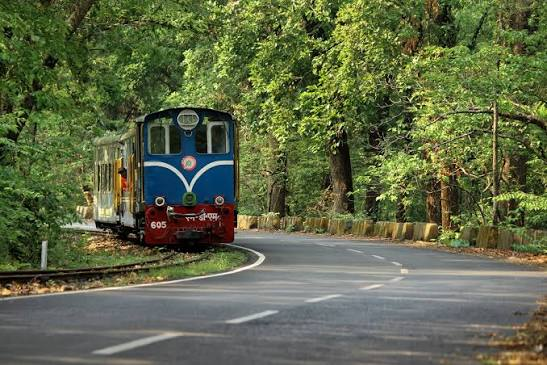
The Darjeeling Himalayan Railway, known locally as the toy train, has run since 1881 and earned UNESCO World Heritage status in 1999. The most common visitor experience is the Darjeeling-to-Ghoom joy ride, a roughly two-hour round trip that stops at the Batasia Loop viewpoint and the DHR museum at Ghoom station, the highest railway station in India.
Diesel-hauled joy rides have recently run around ₹800 to ₹1,000 per person, while the steam-hauled version costs more, typically ₹1,200 to ₹1,500, reflecting its higher maintenance cost. Booking through IRCTC in advance is strongly advisable in peak season, since seats sell out and there’s no guarantee of same-day availability.
Tea estate visits around Darjeeling range from informal walks along estate roads to organized tours with tastings. Access and pricing vary by estate, and some working plantations don’t offer formal visitor programs at all, so it’s worth confirming with a specific estate or a local operator rather than assuming open access everywhere.
Tiger Hill, outside town, is the traditional sunrise viewpoint for Kanchenjunga, the world’s third-highest peak, on clear mornings. It requires an early departure, typically before dawn, and clear visibility isn’t guaranteed, particularly if winter haze has settled in.
| Attraction | Cost | Booking | Duration |
|---|---|---|---|
| Toy train, diesel joy ride | ₹800-1,000 | Advance booking recommended | About 2 hours |
| Toy train, steam joy ride | ₹1,200-1,500 | Advance booking recommended | About 2 hours |
| Tea estate visits | Varies by estate | Varies, some require prior arrangement | 1-2 hours |
| Tiger Hill sunrise | Free viewpoint, transport cost separate | Early departure, no guaranteed visibility | Half a morning |
What changes around New Year:
Darjeeling’s peak season overlaps directly with this travel window, so toy train seats and hotel rooms both tighten up. Mornings are cold enough for proper winter layers even though Darjeeling doesn’t reliably see snow in town. Roads from Siliguri and Bagdogra can be affected by fog, which sometimes delays the drive up.
Munnar: Winter Without the Cold-Weather Gear
Munnar sits in the Western Ghats in Kerala, and its winter appeal has nothing to do with snow. Daytime temperatures stay mild, the tea plantations are lush after the monsoon, and it’s a realistic New Year destination for travelers who want scenery and cooler air without needing a jacket built for the Himalayas.
Eravikulam National Park, home to the endangered Nilgiri tahr, is Munnar’s signature natural attraction and is directly relevant to New Year timing: the park closes for roughly 45 to 60 days starting around February 1 each year for the tahr’s calving season. A New Year visit falls comfortably within the open window, but anyone pushing a trip into late January should double-check the year’s specific closure dates.
Entry fees have varied by source in recent listings, generally in the range of ₹100 to ₹200 for Indian nationals with a separate, higher rate for foreign nationals, plus a small advance reservation fee. Private vehicles aren’t permitted inside; visitors travel via forest department buses from the entry gate. Online booking a few days ahead is recommended in peak season, since daily visitor numbers are capped.
Tea plantation walks and the Tata Tea Museum give a working look at how Munnar’s estates actually operate, distinct from simply photographing green hillsides from the road.
Top Station and Pothamedu Viewpoint are scenic overlooks with sweeping views across the valley and, at Top Station, into neighboring Tamil Nadu. Both are largely about the view rather than a structured activity, and both are free or low-cost to access.
| Attraction | Cost | Booking | Seasonal note |
|---|---|---|---|
| Eravikulam National Park | Roughly ₹100-200 for Indian nationals, higher for foreign nationals, plus reservation fee | Book online a few days ahead, forest buses only | Closed roughly Feb 1 to late March for calving season |
| Tea Museum / plantation walks | Paid, modest | Walk-in at most estates | Best after monsoon through winter |
| Top Station / Pothamedu | Free or minimal fee | Walk-in | Best in clear morning light |
What changes around New Year:
This is Munnar’s high season, driven partly by domestic travelers seeking a break from summer heat elsewhere in India during the northern hemisphere’s cold months, which is a different crowd dynamic than the Himalayan hill stations. Roads into Munnar from Kochi can be slow due to holiday traffic, so a same-day arrival-and-sightseeing plan is optimistic. Mornings can carry a light chill at elevation, but nothing close to what Manali or Gulmarg see.
Coorg: The Quieter Alternative
Coorg, officially Kodagu, sits in Karnataka’s Western Ghats and offers a similar mild winter climate to Munnar, but with a different character: coffee estates instead of tea, and generally lighter crowds even during peak season.
Abbey Falls, close to Madikeri town, is a short walk from the parking area to a viewing platform, with a modest entry fee. Flow is strongest just after monsoon and gradually decreases through winter, so expect a solid but not overwhelming waterfall by late December.
Raja’s Seat, a garden viewpoint in Madikeri, is popular at sunset and charges a small entry fee. It’s an easy, low-effort stop rather than a destination requiring a half-day commitment.
Dubare Elephant Camp, on the banks of the Kaveri River, involves a boat crossing to reach the camp, where visitors can observe elephants used in forest department work and, depending on the program, participate in supervised interaction activities. Advance booking is worth doing in peak season, since group sizes and boat crossings are managed.
Nagarhole National Park, on Coorg’s edge, offers jeep safaris for wildlife viewing, run in fixed timed slots, typically early morning and late afternoon. Advance booking is strongly recommended during this period, since safari slots are limited and demand rises sharply around the New Year holiday.
| Attraction | Cost | Booking | Time needed |
|---|---|---|---|
| Abbey Falls | Modest entry fee | Walk-in | 30-45 min |
| Raja’s Seat | Modest entry fee | Walk-in | 30-45 min |
| Dubare Elephant Camp | Paid, activity-dependent | Advance booking recommended | Half a day |
| Nagarhole safari | Paid, per jeep/seat | Advance booking recommended, timed slots | 2-3 hours |
What changes around New Year:
Coorg draws less traffic than Munnar for the same travel window, which makes it a reasonable option for travelers who want a similar climate with a calmer pace. Safari and Dubare bookings still tighten up during this specific week, so don’t leave those two reservations for the last minute even if the rest of the trip is unplanned.
Planning a Hill-Station Trip Around New Year
Snow Is Not Guaranteed Everywhere
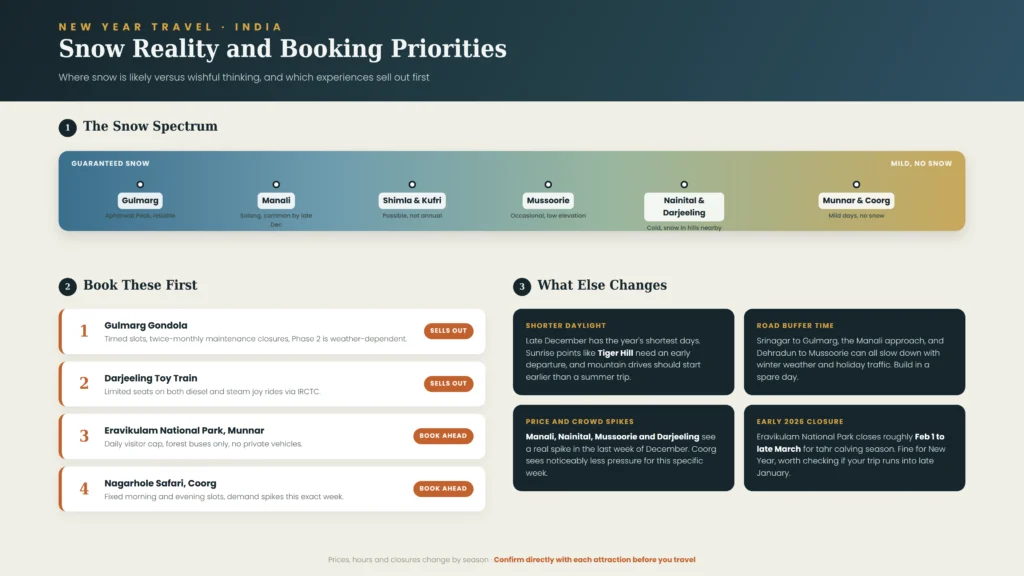
Of the eight destinations here, only Gulmarg offers snow as a near-certainty in this window, because Apharwat Peak sits high enough to hold it through the season. Manali and Kufri, near Shimla, see snow often enough by late December to be a reasonable bet, but not a guarantee for any specific date. Shimla and Mussoorie towns themselves see snow some years and not others. Munnar and Coorg don’t get snow at all; their winter appeal is mild temperatures and post-monsoon scenery, not cold weather.
Check Attraction Schedules Before You Leave
Holiday hours, maintenance closures and weather-dependent operations all vary by destination. The Gulmarg Gondola has a scheduled Monday maintenance closure twice a month, on top of possible weather closures for Phase 2. Eravikulam National Park’s calving-season closure starts around February 1, which sits just after this travel window but is worth confirming if your trip extends into late January. Don’t assume every attraction runs full hours simply because it’s a holiday period; in several cases, holiday demand and operational schedules move independently of each other.
Roads and Mountain Transport Need Buffer Time
Winter road conditions can affect any of the higher-altitude routes: Srinagar to Gulmarg, Manali’s approach roads, and the Dehradun-to-Mussoorie climb during high-traffic periods. Build a buffer day into multi-destination itineraries rather than scheduling back-to-back travel days with no slack.
Book High-Demand Experiences Early
Some experiences on this list operate with capped daily numbers rather than open access: the Gulmarg Gondola’s timed slots, the Darjeeling toy train’s limited seating, Eravikulam National Park’s daily visitor cap, and Nagarhole’s timed safari slots. All four of these can sell out during the New Year period specifically, so book them as soon as your travel dates are fixed rather than waiting until you arrive.
Plan Around Shorter Winter Daylight
Late December has the shortest days of the year, which matters for sunrise viewpoints like Tiger Hill and Top Station, and for any itinerary that includes travel between towns. Build in earlier start times than you would for a summer trip.
Expect Higher Demand at Popular Destinations
Manali, Nainital, Mussoorie and Darjeeling all see a genuine spike in visitor numbers during the last week of December specifically, driven by New Year travel from nearby metro areas. This translates into higher hotel and taxi prices, slower service, and busier viewpoints in the late morning and afternoon. Coorg and Munnar see less of this specific spike, since their high season is broader and less concentrated on this exact week.
Free vs. Paid: A Quick Reference
| Destination | Strong free options | Notable paid experiences | Advance booking needed |
|---|---|---|---|
| Manali | Hidimba Temple, Old Manali, Mall Road | Solang Valley activities, Rohtang permit | Rohtang permit, peak-season accommodation |
| Gulmarg | Walking the meadow under snow | Gondola Phase 1 & 2, skiing | Gondola tickets, strongly advised |
| Shimla | The Ridge, Mall Road, Jakhoo Temple | Kufri Nature Park, Kalka-Shimla Railway | Railway tickets in peak season |
| Nainital | Naini Lake walk, Naina Devi Temple | Boating, Snow View Point ropeway | Not usually required, but expect queues |
| Mussoorie | Mall Road, walking to Gun Hill | Gun Hill ropeway, Kempty Falls activities | Not usually required |
| Darjeeling | Tiger Hill viewpoint (transport not free) | Toy train, tea estate tours | Toy train, strongly advised |
| Munnar | Top Station, Pothamedu Viewpoint | Eravikulam National Park, Tea Museum | Eravikulam, advised in peak season |
| Coorg | Raja’s Seat area, Abbey Falls trail | Dubare Elephant Camp, Nagarhole safari | Both, strongly advised |
Frequently Asked Questions
What are the best hill stations to visit for New Year?
It depends on what you’re looking for. Gulmarg is the strongest choice for guaranteed snow, Manali balances snow with an established tourist town, Shimla and Mussoorie suit travelers who want walkable colonial-era towns, Nainital works well for families around a lake, Darjeeling offers a heritage train experience, and Munnar and Coorg are the best options if you’d rather skip the cold entirely.
Which hill station is best for snow around New Year?
Gulmarg, because Apharwat Peak sits high enough to hold snow reliably through the winter season. Manali and Kufri near Shimla see snow often by late December, but it isn’t guaranteed for any specific date. Munnar and Coorg don’t receive snow.
Which hill station is best for families?
Nainital is a strong fit because most of its main attractions sit close together around Naini Lake, and boating is an easy, low-effort activity for children. Munnar and Shimla also work well for families who prefer walkable towns over long transfers between sights.
Where can I visit a hill station without extreme cold?
Munnar and Coorg both offer mild winter temperatures without the layers of clothing needed for the Himalayan destinations. Neither gets cold enough to require serious winter gear.
Are hill stations crowded around New Year?
Manali, Nainital, Mussoorie and Darjeeling see a noticeable spike in visitors during the last week of December, driven largely by short trips from nearby cities. Coorg and Gulmarg see less of this specific spike, though Gulmarg still gets busy due to limited gondola capacity rather than sheer visitor volume.
Should I book hill-station attractions in advance?
For anything with capped daily numbers, yes. That includes the Gulmarg Gondola, the Darjeeling toy train, Eravikulam National Park in Munnar, and Nagarhole’s safari slots near Coorg. Attractions with open access, like Naini Lake or Mall Road in Shimla, don’t need advance booking, though boating queues can build up by midday during this period.
Is snowfall guaranteed around New Year?
No, outside of Gulmarg’s high-altitude ski area. Snow at lower elevations, including most hill station towns themselves, depends on that particular winter’s weather pattern and isn’t something any destination can promise for a fixed set of travel dates.
What should I check before visiting a hill station in winter?
Confirm current attraction hours and any maintenance closures, check whether the specific activity you want requires advance booking, and build extra time into mountain road travel in case of weather delays. For Munnar specifically, confirm Eravikulam National Park’s exact closure dates if your trip extends past mid-January.
Leave a Reply
You must be logged in to post a comment.