
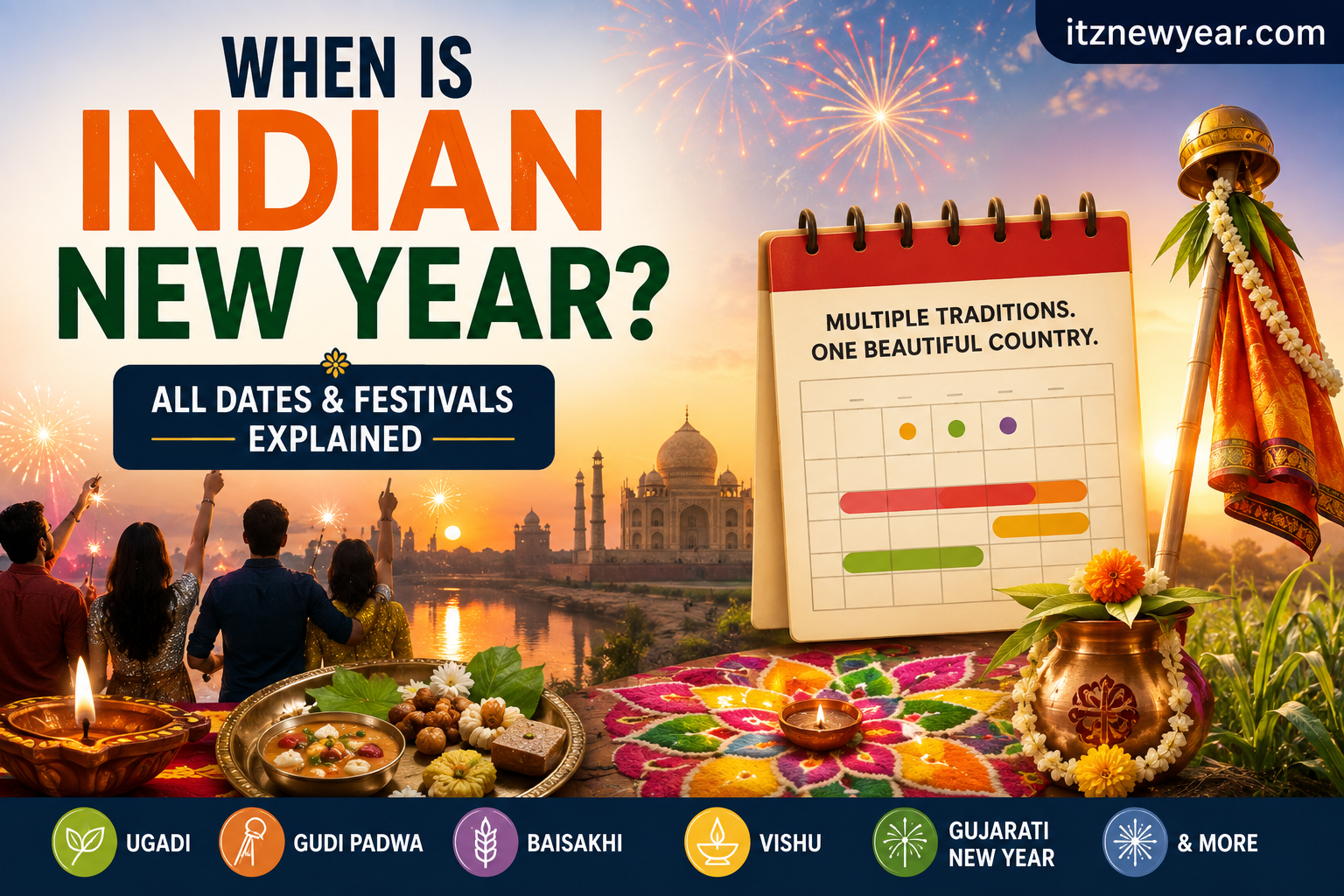
Yes, Indians celebrate New Year. Most people across India mark January 1 in some way, but the country also has regional and religious New Year observances that fall on entirely different dates. There is no single New Year that every Indian shares.
India celebrates New Year in more than one form, and the two most common forms are not the same thing.
January 1, the start of the Gregorian calendar year, is widely observed in Indian cities and towns with parties, family time and public countdowns. Alongside it, many communities follow a separate traditional New Year tied to their own religious or regional calendar, on a completely different date each year.
This isn’t a contradiction. India runs on multiple calendar systems at once:
- The Gregorian calendar governs the civil year, banking, school terms and government business nationwide.
- Hindu lunisolar and solar calendars set the timing for festivals like Ugadi and Baisakhi.
- The Sikh Nanakshahi calendar and the Jain Vira Nirvana Samvat each mark their own new year.
A person in Mumbai might ring in January 1 with friends and also celebrate Gudi Padwa with family months later. Neither one cancels out the other. So the honest answer has two parts: yes to January 1 as a widely shared modern occasion, and yes to a separate set of traditional New Years that carry deeper cultural and religious weight for the communities that observe them.
Is January 1 New Year’s Day in India?
January 1 is recognized in India, but it is not a mandatory national holiday.
It isn’t one of India’s three national holidays (Republic Day, Independence Day and Gandhi Jayanti), and it isn’t a gazetted holiday required for all central government offices. Instead, it’s classified as a restricted holiday: employees can choose to take it as one of their limited optional days off, but no employer is required to close.
Whether offices, banks and schools close on the day depends on the state:
| Status | What it means |
|---|---|
| Gazetted holiday | Mandatory closure for central government offices nationwide (example: Republic Day) |
| Restricted holiday | Optional; employees pick a limited number of these days, including January 1 |
| State-specific holiday | Set by individual state governments; some states include January 1, others don’t |
Banks in states such as Tamil Nadu and West Bengal may close for the day, while government offices and stock markets in most of the country stay open. Private companies and the hospitality industry often adjust hours around the late-night celebrations instead of closing outright.
None of that limits how visible the day is culturally. January 1 shows up on every calendar, dominates news coverage each December 31, and is treated as a real occasion in urban India regardless of its holiday status. The distinction worth keeping: January 1 is calendar-recognized and popularly celebrated, but it isn’t the traditional cultural New Year for most Indian communities.
Why Does India Have More Than One New Year?
India has more than one New Year because it never operated on a single calendar system to begin with.
The Gregorian calendar arrived through British colonial administration and became the standard for government, business and international dealings. Regional and religious calendars, however, were already in place long before that and never disappeared.
A few reasons the dates diverge:
- Different calendar traditions. Some Hindu communities follow a lunisolar calendar (Vikram Samvat) that starts the year at different points depending on regional convention; others follow a solar calendar tied to the sun’s position, which is why several festivals cluster around mid-April under different names.
- Distinct religious calendars. Sikh communities use the Nanakshahi calendar, and Jain communities date their year from the Vira Nirvana Samvat, tied to Mahavira’s nirvana.
- Regional and agricultural context. A calendar built around a harvest cycle in Punjab doesn’t necessarily match the seasonal or astronomical markers used in Tamil Nadu or Assam.
Over centuries, each region built its New Year observance around what mattered locally, whether that was a harvest, a planetary alignment or a religious milestone. The result: “New Year” in India isn’t one date, it’s a category that different communities fill in differently based on faith, region and family custom.
What Other Traditional New Years Are Celebrated in India?
Beyond January 1 and the Diwali-adjacent observances, several regional New Years cluster around mid-April, when the sun enters a new solar position, or around the spring lunar month of Chaitra.
| Festival | Main region/community | Approximate time | What it marks |
|---|---|---|---|
| Ugadi | Andhra Pradesh, Telangana, Karnataka | March/April (Chaitra) | First day of the Hindu lunisolar year in the Deccan region |
| Gudi Padwa | Maharashtra, Goa | March/April (Chaitra) | Same lunar new year, marked with a Gudi flag outside homes |
| Puthandu | Tamil Nadu | Mid-April | Tamil solar calendar New Year, first day of Chithirai |
| Vishu | Kerala | Mid-April | Malayalam solar New Year, centered on an auspicious first sight |
| Pohela Boishakh | West Bengal, Bengali communities | Mid-April | First day of the Bengali solar calendar year |
| Navreh | Kashmiri Pandit community | March/April (Chaitra) | Kashmiri Hindu New Year, same lunar cycle as Ugadi |
| Baisakhi | Punjab, Sikh community | Mid-April | Solar New Year and the founding of the Khalsa in Sikh history |
Most of these fall around the same lunar or solar turning point, just under different regional names and rituals. None is celebrated nationwide, and none outranks the others in official status. Each is central to its own region rather than to India as a whole. (For detailed rituals, food and customs behind each of these, see our full guide to New Year traditions in India.)
How Do Indians Celebrate January 1?
Modern January 1 celebrations in India look a lot like New Year’s Eve and Day anywhere else, shaped by whatever setting a person is in:
- Parties and countdowns in restaurants, clubs and public spaces, especially in cities like Mumbai, Delhi, Bangalore and Goa
- Family gatherings and meals, often quieter than the night before
- Travel, with hill stations and beach towns seeing a seasonal spike in visitors
- Resolutions, made and shared much like anywhere else
- Religious visits to a temple, gurdwara or church as a moment of reflection
- Quiet, low-key days for people who treat it as an ordinary day off, or a regular working day depending on the state’s holiday calendar
- Social media activity, with greetings and photos shared widely regardless of whether someone attended a big event
There’s no single template. Age, city size, religion and personal preference all shape how January 1 unfolds, from loud celebration to quiet reflection to a completely ordinary day. (For city-by-city ideas on where to celebrate, see our New Year destinations guide.)
Is January 1 the Most Important New Year in India?
It depends entirely on who’s answering. There’s no national ranking between January 1 and the traditional New Years.
For many urban and younger Indians, January 1 carries real social importance as the New Year they actively plan around. For others, particularly those with strong ties to a regional or religious calendar, the traditional New Year, whether that’s Ugadi, Baisakhi or Bestu Varas, holds more personal, family and religious weight.
A Gujarati business family may treat Bestu Varas as the more consequential date because it marks a new financial year and carries ritual significance. A young professional in a metro city might treat January 1 as the bigger social occasion simply because it’s when friends gather and work calendars reset. Both are legitimate answers, and neither cancels out the other.
India Celebrates New Year More Than Once
Indians celebrate New Year, including January 1, now a widely recognized occasion even though it isn’t a mandatory national holiday. Regional and religious calendars add their own New Years throughout the year, from Ugadi and Baisakhi in spring to Bestu Varas after Diwali. Diwali itself is not India’s universal New Year; that role belongs to the day after Diwali, and only for Gujarati and Jain communities. No single date or tradition captures how all of India marks a new year, and that plurality is the real answer.
FAQs
Do Indians celebrate New Year on January 1?
Yes. It’s widely observed with parties and gatherings, though it’s a restricted rather than mandatory holiday, so whether offices and banks close depends on the state.
Is Diwali considered New Year in India?
Not for most people who celebrate it. Diwali is a festival of lights. Only the day after it functions as New Year, and only in Gujarat and within Jain tradition.
What is the traditional New Year in India?
There isn’t one shared traditional New Year. The date depends on region and religion, from Ugadi in spring to Bestu Varas after Diwali.
Why does India have different New Year dates?
India runs on multiple calendar systems at once, including Hindu lunisolar and solar calendars, the Sikh Nanakshahi calendar and the Jain Vira Nirvana Samvat. Each community’s New Year follows its own calendar’s starting point.
Do all Indians celebrate the same New Year?
No. It varies by region, religion and family. Some people mainly mark January 1, others prioritize their community’s traditional New Year, and many observe both.
Is January 1 a holiday in India?
It’s a restricted holiday, not a gazetted national one. Some states and employers treat it as a day off; government offices and markets in much of the country stay open.
What is Gujarati New Year called?
Bestu Varas, also known as Varsha Pratipada. It falls on the day after Diwali and marks the start of the Gujarati calendar year.
Which Indian festivals mark the beginning of a new year?
Ugadi, Gudi Padwa, Puthandu, Vishu, Pohela Boishakh, Navreh, Baisakhi and Bestu Varas each open a new year for a specific region or community.
Leave a Reply
You must be logged in to post a comment.