
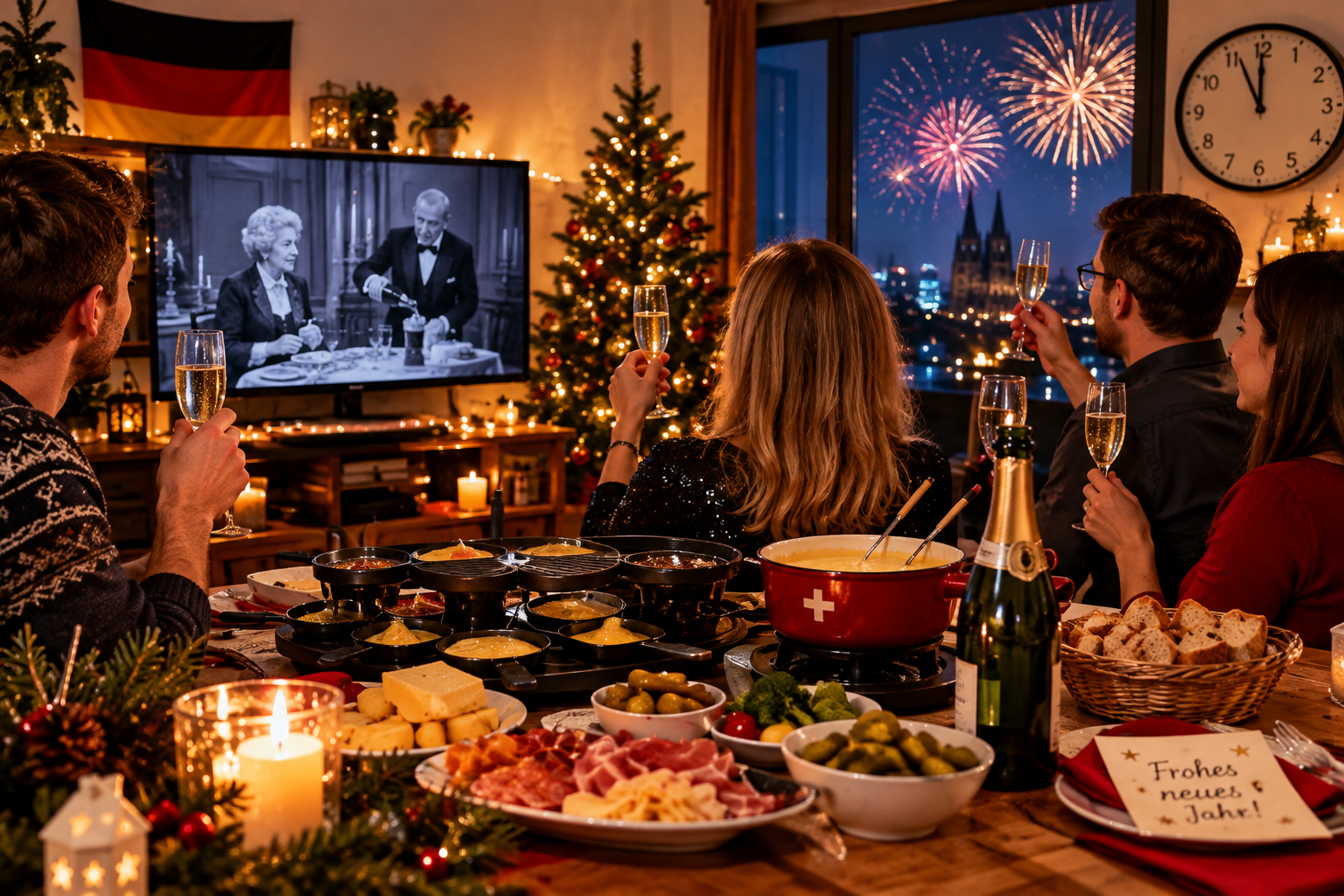
Germans celebrate the turn of the year on Silvester, December 31, not on January 1. A typical Silvester brings people together with family or friends for a long dinner, often raclette or fondue, followed by drinks, the cult TV sketch Dinner for One, a midnight toast, an exchange of New Year’s wishes, and fireworks. January 1, known as Neujahrstag, is a public holiday and is generally much quieter, reserved for rest and recovery rather than celebration.
That’s the short version. Here’s what actually happens during the evening, and why.
What Is Silvester in Germany?
Silvester is simply the German word for New Year’s Eve. It isn’t a separate festival from “New Year,” it’s the name Germans use for December 31 itself, the day and night leading into the new year.
Why Is New Year’s Eve Called Silvester?
The name traces back to Pope Sylvester I, whose feast day in the Catholic calendar falls on December 31. Over time, the date became associated with his name in German-speaking countries, and “Silvester” stuck as the everyday term for New Year’s Eve. Modern Silvester celebrations, though, have little to do with the pope himself; they’re largely secular, built around food, television, friends, and fireworks rather than religious observance.
Germans also distinguish clearly between the two dates:
- Silvester: December 31, the main celebration
- Neujahrstag: January 1, New Year’s Day, a quieter public holiday
What Does a Typical German New Year’s Eve Look Like?
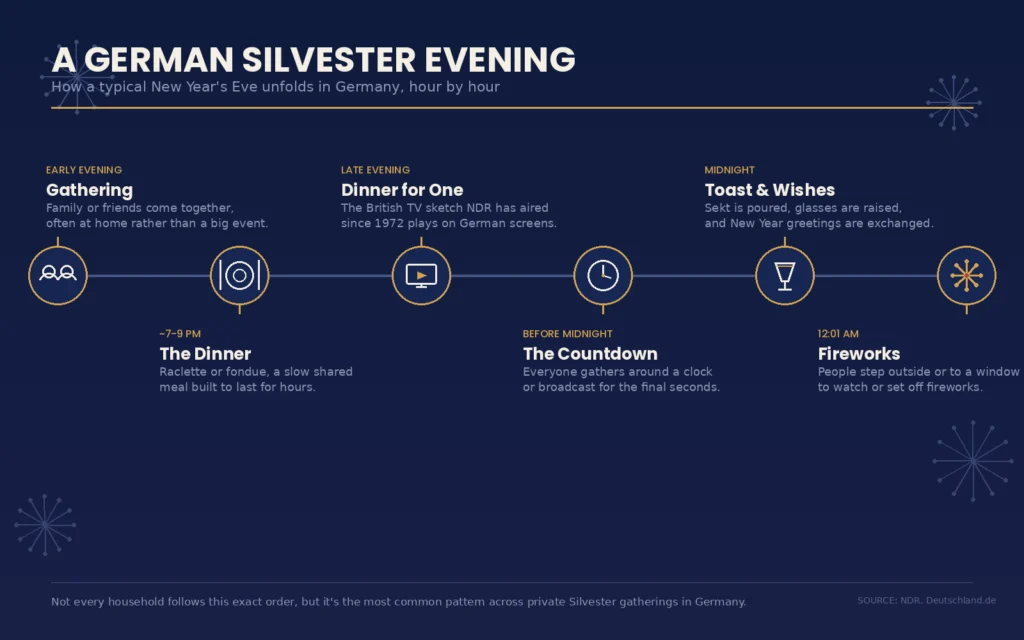
There’s no single script that every household follows, but a common pattern shows up again and again across private Silvester celebrations in Germany.
Gathering With Family or Friends
Many Germans spend Silvester at home or at a friend’s place rather than out at a large public event. Small, informal gatherings, sometimes just a handful of people, are common. Others head to organized parties or public squares where cities host countdown events, but the private, low-key version is widespread, particularly outside major cities.
Eating a Long, Festive Dinner
Dinner on Silvester tends to stretch out over the evening rather than being a quick meal. Two dishes come up constantly in German sources describing the night:
- Raclette: a Swiss-style dish where guests melt cheese in small individual pans at the table, often alongside potatoes, pickles, and cured meats
- Fondue: guests cook meat, bread, or vegetables in a shared pot of hot oil, broth, or melted cheese
Both work well for a New Year’s Eve dinner because they’re built around the table staying occupied for hours, which suits an evening meant to last until midnight. Some families in certain regions also serve lentil soup, tied to older beliefs about lentils symbolizing coins and financial luck for the year ahead, though this is a regional custom rather than something practiced nationwide.
Watching Television Before Midnight
As dinner winds down, television becomes part of the evening for many households, and one broadcast in particular has become inseparable from German Silvester: Dinner for One.
Counting Down to Midnight
As the clock nears midnight, attention shifts away from the meal and the television toward the countdown itself. People gather around a clock, radio, or television broadcast, and the final seconds are counted down together before midnight arrives.
Not every household follows this exact order. Some skip the formal dinner, some skip the television, and some spend the whole evening at a public event instead. But this sequence, gathering, eating, watching TV, counting down, captures how a large share of private Silvester celebrations unfold.
Why Do Germans Watch Dinner for One on New Year’s Eve?
This is one of the more surprising facts about German New Year traditions for outsiders: the show isn’t German at all.
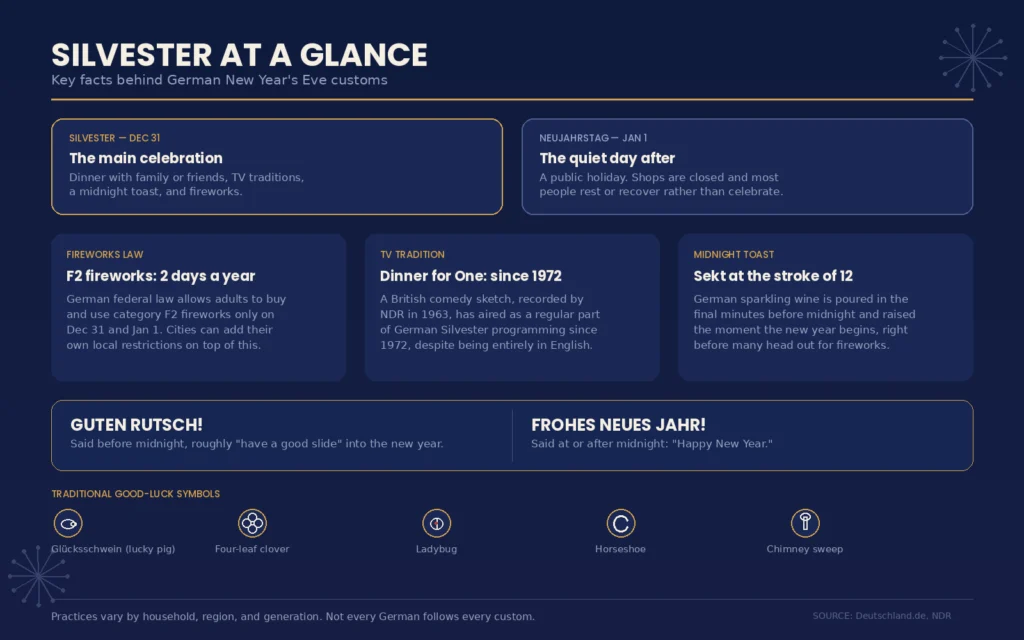
Dinner for One is a British comedy sketch, performed entirely in English, about an elderly woman named Miss Sophie hosting a birthday dinner for four imaginary guests while her increasingly drunk butler, James, serves each course and toasts on their behalf. NDR, the German public broadcaster, recorded the sketch in 1963 with British performers Freddie Frinton and May Warden. It began airing as part of NDR’s regular Silvester programming in 1972 and has run nearly every year since.
Despite being a foreign, English-language production, it became one of the most-watched pieces of television in Germany on Silvester night, often shown more than once and in more than one version across different channels. Its most repeated line, “same procedure as every year,” has become a kind of shorthand for the tradition itself.
What Do Germans Eat and Drink for New Year?
Food and drink on Silvester center on a few recurring items rather than a large fixed menu.
Raclette and Fondue
As covered above, these two communal dishes dominate Silvester dinners in many households, largely because they suit a long, social evening rather than a quick sit-down meal.
Lentils and Other Lucky Foods
Lentil soup appears in some regional traditions as a symbol of prosperity for the coming year, tied to the resemblance between lentils and coins. It isn’t universal, and plenty of Germans have never made it part of their Silvester meal.
Sekt and the Midnight Toast
Sekt, German sparkling wine, is closely associated with the moment midnight arrives. Many people pour a glass in the final minutes before midnight and raise it the instant the new year begins, toasting each other with good wishes before or right after heading outside for fireworks.
What Happens at Midnight in Germany?
Midnight itself is short but eventful. In most households and gatherings, it typically includes:
- A final countdown, often shared aloud with whoever is in the room
- A toast, usually with Sekt or another sparkling wine
- An exchange of New Year’s greetings
- Hugs or a kiss between partners or close family, where that’s the norm for the people involved, though this isn’t an obligatory ritual for everyone
- Heading outside, or to a window or balcony, to watch or set off fireworks
Do Germans Set Off Fireworks on New Year’s Eve?
Fireworks are one of the most recognizable parts of German Silvester, but not every person or household takes part directly. Many people watch fireworks set off by neighbors or by the city rather than buying their own.
Under German federal law, adults are permitted to buy and use category F2 consumer fireworks on December 31 and January 1 only; they aren’t legally sold or used on other days of the year without special permission. That said, local authorities can and do impose additional restrictions on top of the federal rules, including designated no-fireworks zones in certain city centers or near historic buildings. Federal rules also prohibit setting off fireworks close to certain sensitive locations, such as churches, hospitals, and care homes, regardless of the date.
Because these local rules vary by city and even by neighborhood, there’s no single nationwide “fireworks are allowed from this hour to that hour” rule that applies everywhere. Anyone looking for exact local timing or restricted zones needs to check with the relevant city or police authority rather than relying on a blanket national rule.
What German New Year Traditions Are About Luck and the Future?
Alongside food and fireworks, Silvester carries a set of older, superstition-based customs focused on luck for the coming year. These aren’t practiced by every household, but they’re common enough to be widely recognized.
Lucky Charms
Small good-luck symbols, often given as gifts or used as table decorations around Silvester, include:
- Glücksschwein (lucky pig), a small pig figurine or marzipan treat symbolizing prosperity
- Four-leaf clover, a general symbol of good fortune
- Ladybug, associated with luck in German folklore
- Horseshoe, traditionally hung to bring good fortune
- Chimney sweep (Schornsteinfeger), historically linked to protection from fire and bad luck
Bleigießen and Its Modern Alternatives
Bleigießen, literally “lead pouring,” is a traditional New Year fortune-telling custom: a small piece of metal is melted over a flame and dropped into cold water, and the resulting shape is interpreted as a sign of what the new year holds. It’s an older tradition, not something every family still practices, and it isn’t recommended with actual lead today because of health and safety concerns. Modern versions typically use wax or tin instead, sold specifically for this purpose around the holiday.
What Do Germans Say at New Year?
Two phrases come up throughout the Silvester and New Year period, used at different times:
| Phrase | Meaning | When it’s used |
|---|---|---|
| Guten Rutsch! | Roughly “have a good slide (into the new year)” | Before midnight, in the days or hours leading up to Silvester |
| Frohes neues Jahr! | “Happy New Year” | At or after midnight, once the new year has started |
Both are common, everyday greetings rather than formal expressions, and it’s normal to hear “Guten Rutsch” from coworkers or friends in the last days of December well before the actual celebration begins.
Do All Germans Celebrate New Year the Same Way?
No. Germany doesn’t have one fixed Silvester ritual that everyone follows. What actually happens on December 31 depends on the household, the region, the generation, and personal preference:
- Some people stay home with a small group; others go to large public celebrations or organized parties
- Some attend a church service, particularly in more religious communities, while others treat the evening as entirely secular
- Fireworks participation ranges from setting off a personal display to simply watching from a window to skipping it altogether
- Older customs like Bleigießen or lentil soup are kept alive in some families and unfamiliar in others
- City centers, such as those in Berlin, often host large public countdown events that look very different from a quiet evening at home in a smaller town
Because of this variation, it’s more accurate to describe these as common or widespread customs rather than universal ones.
What Is New Year’s Day Like in Germany?
January 1, Neujahrstag, is a nationwide public holiday, and the mood is noticeably different from the night before. Most shops and businesses are closed. Many people spend the day recovering from a late night, cleaning up after hosting, or simply resting at home. Some attend a church service or take a walk, especially if the weather allows, but large organized celebrations are rare on January 1 itself. In short, Silvester is the celebration; New Year’s Day is the recovery.
Frequently Asked Questions
What is New Year’s Eve called in Germany?
It’s called Silvester, named after Pope Sylvester I, whose feast day falls on December 31.
How do Germans celebrate New Year’s Eve with fireworks?
Fireworks are a widespread part of Silvester and are legal for adults to buy and use on December 31 and January 1 under federal law, though local restrictions can limit where and how they’re used. Not everyone sets off their own fireworks; many simply watch.
What do Germans eat on New Year’s Eve?
Raclette and fondue are the most commonly mentioned dishes, both suited to a long, shared evening meal. Some regions also include lentil soup as a symbol of financial luck.
Why do Germans watch Dinner for One on New Year’s Eve?
It’s a British comedy sketch that NDR recorded in 1963 and began airing as a regular part of its Silvester programming in 1972. Despite being in English and featuring British performers, it became a long-running German television tradition.
What does Guten Rutsch mean?
It’s a common way to wish someone well ahead of the new year, roughly translating to “have a good slide” into January 1. It’s used before midnight, while “Frohes neues Jahr” is used once the new year has actually begun.
Do Germans celebrate New Year’s Day?
Not in the same way as Silvester. January 1 is a public holiday, but it’s generally a quiet day for rest, recovery, and settling back in, rather than a day of celebration.
Do all Germans celebrate New Year the same way?
No. Practices differ by household, region, generation, and personal or religious background. Some traditions, like raclette dinners or a midnight toast, are widespread; others, like Bleigießen or lentil soup, are regional or generational rather than universal.
Leave a Reply
You must be logged in to post a comment.