
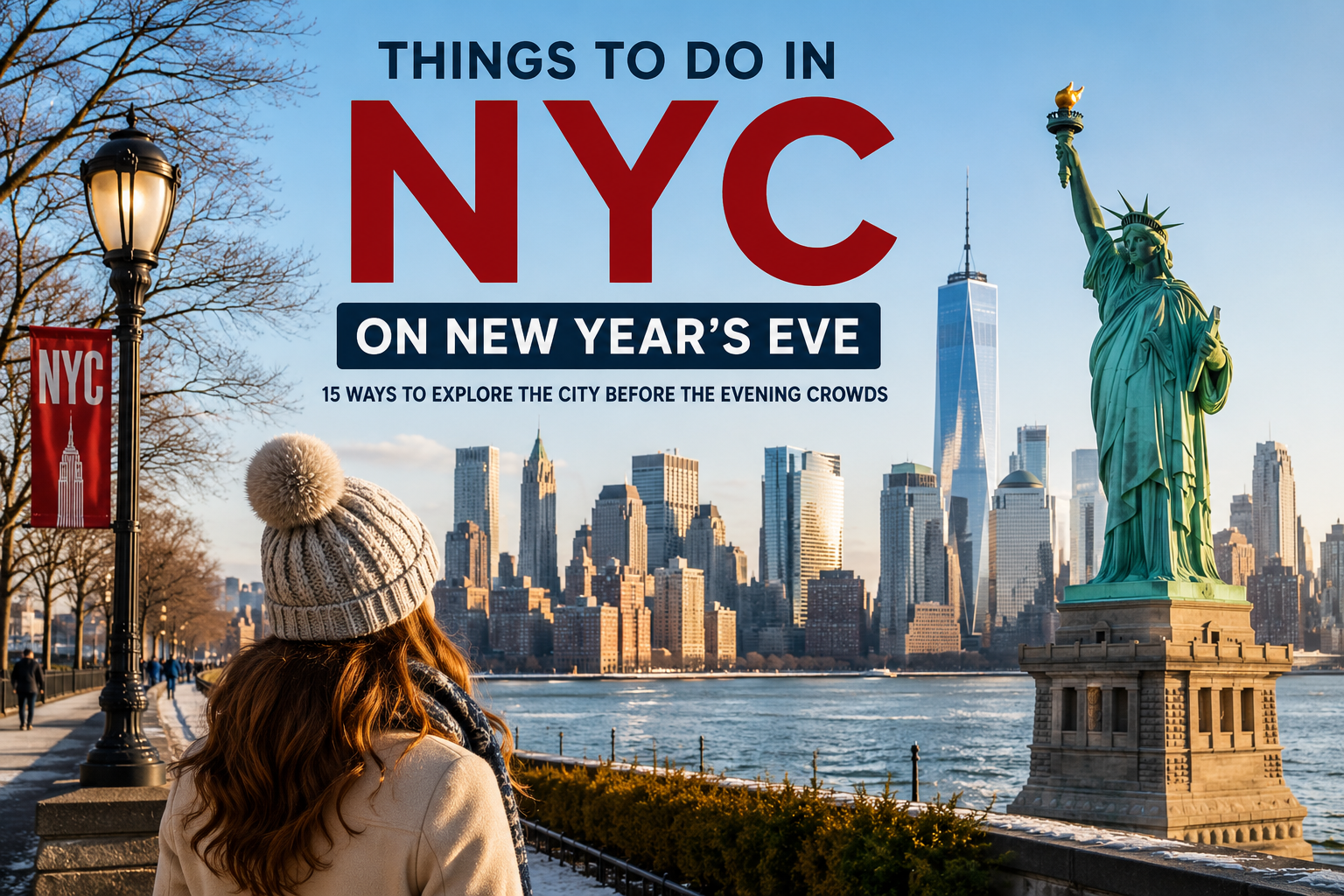
Search “things to do in NYC for New Year’s Eve” and you’ll mostly find the Ball Drop: viewing areas, security lines, and advice on when to show up in Times Square. That’s a real plan for some travelers. It’s not useful if you’re in New York City on December 31 and want to know what to actually do with the day.
New York is unusual among New Year’s Eve destinations because one small stretch of Midtown absorbs an enormous amount of planning attention, while the rest of a five-borough city keeps functioning normally. This guide skips the Ball Drop entirely and focuses on a different, more useful question: what can you realistically see in New York City on December 31 before parts of Midtown become harder to reach, and how do you build a day that doesn’t waste hours crossing the city?
Don’t plan December 31 like an ordinary NYC sightseeing day
A typical NYC itinerary bounces between neighborhoods because the subway makes that easy most days. December 31 changes the math, specifically around Times Square and the blocks that feed into it.
Why Midtown gets harder as the day goes on
Streets around Times Square close to vehicle traffic in stages well before the evening, and pedestrian movement through the area becomes more restricted as barricades go up and crowds arrive early to claim viewing space. This doesn’t affect the entire island, but it does mean treating Midtown as a normal, walk-through-anytime neighborhood on this specific date is a mistake. If your hotel is in Midtown, that’s fine; just don’t plan to cut through the Times Square core in the afternoon expecting normal conditions.
The smarter strategy: pick one zone and explore it well
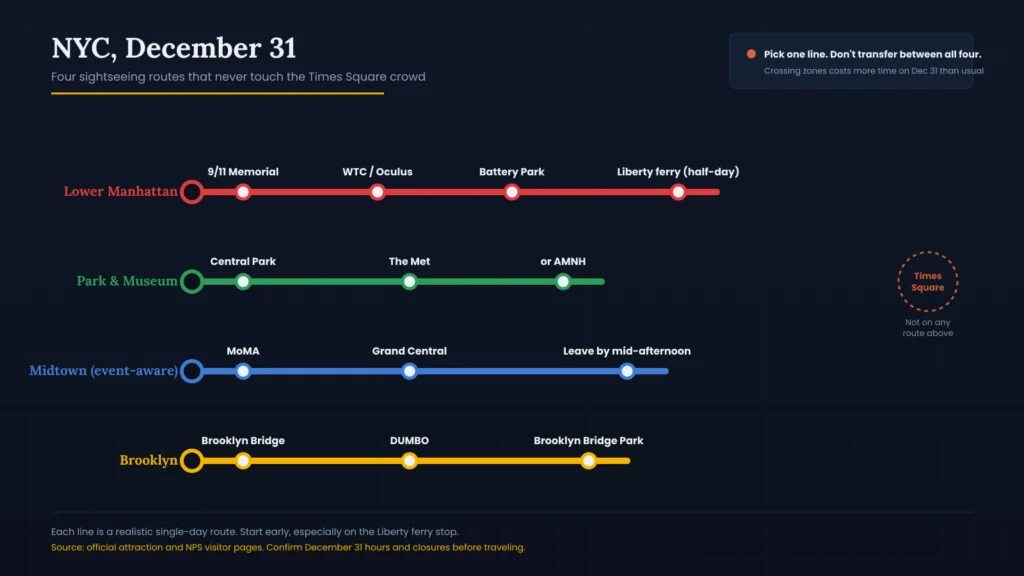
Rather than stringing together five distant attractions, this guide is organized around zones you can actually cover without backtracking across the island: Lower Manhattan, Central Park with a major museum, Midtown away from the event core, and Brooklyn. Choose one as the spine of your day and add a second only if the timing genuinely works.
How winter weather should change your plans
December in New York means real cold, wind, and a decent chance of rain. The National Park Service specifically notes that New York Harbor tends to run colder and windier than inland parts of the city, which matters if the Statue of Liberty or a Brooklyn waterfront walk is on your list. Build at least one indoor option into any outdoor-heavy day, rather than assuming you’ll tough it out.
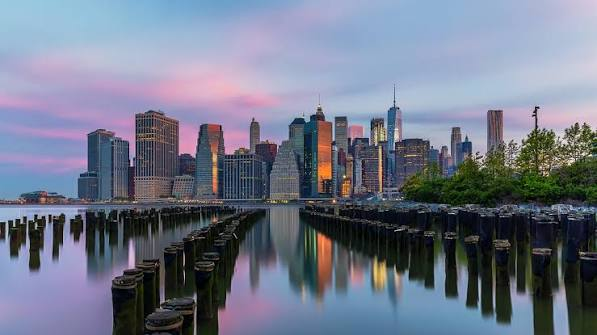
Lower Manhattan: history, harbor views, and distance from the event zone
Lower Manhattan works well specifically because it’s geographically and logistically separate from the Times Square footprint. It’s dense enough that you don’t need a car or a long subway ride between stops.
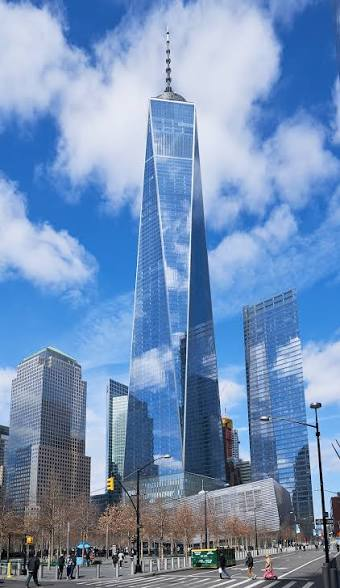
The 9/11 Memorial and Museum
The 9/11 Memorial sits at the World Trade Center site, 180 Greenwich Street, and it anchors this entire route. The outdoor Memorial, the two reflecting pools marking the tower footprints, is free to visit. The Museum requires paid, timed-entry tickets: adult admission is currently $36, ages 13 to 17 are $30, ages 7 to 12 are $24, seniors are $30, and children six and under are free but still need a ticket reserved in advance.
The Museum recommends planning at least 45 to 90 minutes, though a thorough visit runs longer. This is not a light entertainment stop, and it’s worth being direct about that with kids: it’s appropriate for older children who can engage with difficult history, less so for very young children expecting an interactive museum. Accessibility is well documented, with elevators, accessible restrooms, limited seating, and assistive listening and captioning resources. Only service animals are permitted; it isn’t a pet-friendly stop.
Because this sits well outside the Midtown event zone, it’s a strong candidate for the morning or early afternoon of December 31 specifically. Confirm the Museum’s exact December 31 hours directly before you go, since holiday schedules shift.
The World Trade Center area and the Oculus
From the Memorial, the surrounding World Trade Center plaza and the Oculus, the striking white transit hub and shopping complex, are a short walk and free to explore from the outside and public areas. This is a natural connector between the Memorial and the rest of your Lower Manhattan route rather than a separate destination requiring its own planning.
Continue toward Battery Park
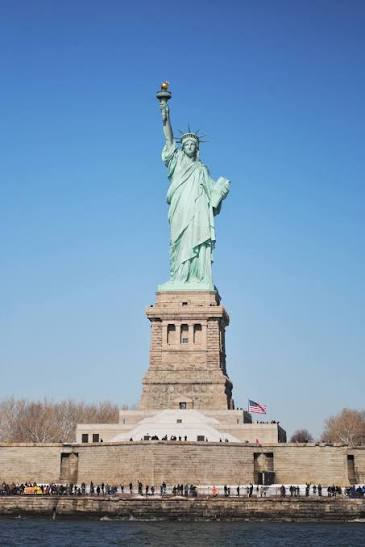
Battery Park sits a short walk south, at the tip of Manhattan facing New York Harbor. It’s free, outdoor, and gives you the closest land view of the Statue of Liberty without boarding a ferry. If you’re not committing to the full Liberty Island trip, this is a reasonable substitute for seeing the harbor.
Deciding whether the Statue of Liberty is worth a half-day
The Statue of Liberty deserves a clear warning: this is not a quick stop. The National Park Service site itself has no entrance fee, but reaching it requires paid official ferry transportation, and pedestal or crown access needs its own reservation. Current park hours run 8:30 a.m. to 6:30 p.m., with last entrance to the Statue at 5 p.m., though the exact December 31 ferry schedule should be checked for the specific year of travel.
Visiting Liberty Island and Ellis Island together can take most of a day once you account for ferry queues, security screening, and travel time. If you have a full day and want to start early, this is a legitimate December 31 plan. If you have a half-day or less, or an evening commitment that requires you back in Midtown, skip it this trip rather than rushing it.
Pets aren’t permitted on the ferry system or in the park; ADA-compliant service animals are allowed, with some restrictions on crown access. The NPS notes that visitors using mobility devices should bring their own, since distances and ferry queues can be substantial, though limited wheelchairs are available after arrival on the islands.
Central Park and a major museum: the classic cold-weather pairing
This route works because it solves two problems at once: it gets you outside for part of the day, and it puts a weather-proof museum right next door for when you’ve had enough cold air.
Walking Central Park in December
Central Park runs free, 6 a.m. to 1 a.m., between Fifth Avenue and Central Park West, from 59th Street up to 110th Street. That’s a lot of park, more than most visitors realize, so don’t treat it as one attraction you knock out in twenty minutes. Pick a section near whichever museum you’re pairing it with rather than trying to walk the whole length. Accessibility varies by path and section, so don’t assume every route is equally manageable for a wheelchair or stroller; plan around a specific, shorter stretch if mobility is a concern.
Dogs are subject to New York City and park-specific leash and access rules that vary by area, so check the current Central Park Conservancy guidance for your planned route rather than assuming blanket access.
Spending the afternoon at The Met
The Met sits right on the park’s edge at 1000 Fifth Avenue on the Upper East Side. General admission is $30 for adults, $22 for seniors, $17 for students, and free for children 12 and under; New York State residents and qualifying New Jersey and Connecticut students get pay-what-you-wish pricing. Current hours run 10 a.m. to 5 p.m. Sunday, Monday, Tuesday, and Thursday, and 10 a.m. to 9 p.m.
Friday and Saturday; the museum is closed Wednesdays and on January 1. That January 1 closure says nothing about December 31, so verify the actual New Year’s Eve hours rather than assuming either way.
The museum is genuinely too large to see in one visit, so plan for two to four hours around a specific collection rather than an open-ended wander, especially with kids in tow. Step-free entrances and routes are available, and manual wheelchairs are offered on a first-come basis. Service dogs are welcome; ordinary pets are not. Limited parking exists nearby at certain times but isn’t guaranteed, so public transit is the more reliable way to arrive.
Choosing AMNH instead if you’re traveling with kids
The American Museum of Natural History, at 200 Central Park West on the Upper West Side, is arguably the single strongest family choice in this entire guide, and one of the best options if December 31 turns cold or wet. Standard adult admission is $37, seniors $30, students $22, and ages 3 to 12 are $30; children under three are free, and New York State residents have pay-what-you-wish general admission.
Ticketed special exhibitions cost more depending on the package, and current hours run daily 10 a.m. to 5:30 p.m., closed only for Thanksgiving and Christmas among the fixed holidays; still confirm December 31 hours directly.
Dinosaur halls, the Blue Whale, space exhibits, and sensory-friendly resources make this genuinely engaging for kids rather than just tolerable. Plan 2.5 to 5 hours, and go in with two or three priority halls picked out, since the building is large enough to overwhelm a family trying to see everything. Accessible entrances, stroller-friendly routes, and a physically accessible Sensory Room are documented.
Only service animals are permitted, not emotional support animals or ordinary pets. Parking is expensive: current garage rates start around $33 for up to two hours and climb from there, so weigh that against a subway or rideshare option.
How much of this can you realistically fit in one day?
Central Park plus one museum is a full, satisfying day on its own. Central Park plus both The Met and AMNH is not realistic without cutting each one short, since they sit on opposite sides of the park. Pick one museum based on your traveling companions: The Met for art-focused adults and older kids, AMNH for families with younger children or anyone who wants a stronger bad-weather anchor.
Midtown for museums and landmarks, not an all-day Times Square plan
If your hotel is in Midtown, you don’t need to avoid the neighborhood entirely, just plan around the parts that get complicated later in the day.
MoMA for a fully indoor afternoon
MoMA, at 11 West 53rd Street, is a genuinely useful Midtown option precisely because it lets you stay central without spending the day drifting toward Times Square. Adult admission is $30, seniors $22, students $17, and 16 and under free. The museum is generally open daily, closed only on Thanksgiving and Christmas per its official hours; confirm December 31 specifically before you go. Plan 1.5 to 3 hours.
Wheelchairs and rollators are available at no cost, along with seating and sensory resources. Pets and emotional support animals aren’t permitted; trained service animals are welcome.
Grand Central Terminal and nearby architecture
Grand Central, a short distance from MoMA, is free to walk through and worth twenty to thirty minutes for the main concourse and its architecture, whether or not you’re catching a train. It’s a reasonable connector stop between MoMA and other Midtown errands, not a destination that needs its own block of time.
Keeping the Midtown route flexible
Because road and pedestrian restrictions expand through the afternoon and evening as Times Square prepares for the event, build slack into a Midtown day rather than a tight back-to-back schedule. If a planned walk between two points suddenly runs into a closed block, you want time to reroute rather than a itinerary that falls apart.
When to leave Midtown before things get complicated
If you’re not attending the evening event, a reasonable rule is to finish Midtown sightseeing by mid-to-late afternoon and either head to a different neighborhood or back to your hotel before restrictions expand further. Check official city and MTA notices close to your travel date rather than relying on a typical Tuesday’s conditions.
Brooklyn: skyline views and a genuine break from the Midtown atmosphere
Crossing into Brooklyn gives you a real change of scenery, both visually and in terms of crowd pressure, since none of this route touches the Times Square footprint at all.
Walking the Brooklyn Bridge earlier rather than later
The bridge itself is free and takes 45 to 90 minutes to walk depending on your pace and how often you stop for photos. Cross in the morning or early afternoon for the best winter daylight rather than saving it for late in the day. Route-specific accessibility for pedestrian ramps and approaches should be checked directly rather than assumed, since not every entry point is equally convenient for a wheelchair or stroller.
Exploring DUMBO
DUMBO, on the Brooklyn side of the bridge, is a walkable neighborhood with cobblestone streets and well-known skyline photo spots. There’s no admission cost involved; budget your time here loosely rather than treating it as a checklist stop, since wandering is most of the point.
Spending time in Brooklyn Bridge Park
The park runs along the waterfront between DUMBO and Brooklyn Heights, and it’s free to enter. Plan for one to two hours. The official park states that entrances and pathways are accessible, with accessible play equipment and seating documented, which makes it one of the more reliably accessible outdoor stops in this entire guide. Leashed dogs are welcome on pathways but not on lawns, and are prohibited from playgrounds. Parking is limited, so public transit is the more practical way to arrive.
Why this route suits families and travelers with dogs
Brooklyn Bridge Park’s combination of open space, documented accessibility, and dog-friendly pathways makes this route a strong fit for families needing a break from museum pacing, and for anyone traveling with a leashed dog who wants an outdoor afternoon rather than another indoor stop.
Choosing an attraction based on how much time you actually have
NYC visitors consistently overestimate how much ground they can cover on December 31. Match your plan to your actual available hours rather than an ideal itinerary.
| Time available | Best area | What to prioritize | Booking needed |
|---|---|---|---|
| About 2 hours | Lower Manhattan or Brooklyn Bridge | 9/11 Memorial (outdoor) or a Brooklyn Bridge walk | No |
| Half a day | Central Park and one museum, or Lower Manhattan with the 9/11 Museum | Pick one museum, don’t split time between two | Yes, for the museum |
| Most of the day | Statue of Liberty and Ellis Island | Start on the first ferry | Yes, ferry and monument access |
| Need to be back by late afternoon | Midtown (MoMA, Grand Central) or Brooklyn | Stay in one compact zone | Only for MoMA if you want guaranteed timed entry |
The best things to do in NYC on New Year’s Eve with kids
Not every stop on this list holds a child’s attention equally, and it’s worth being specific rather than calling everything family-friendly.
- Best for science and hands-on curiosity: American Museum of Natural History. Dinosaur halls, the Blue Whale, and sensory-friendly resources give kids something to actively engage with, not just look at.
- Best for outdoor space: Central Park or Brooklyn Bridge Park, either of which gives kids room to move after a museum visit.
- Best for a short, attraction-heavy day: Brooklyn Bridge, DUMBO, and Brooklyn Bridge Park together, since none require long museum stretches or advance tickets.
- Best when the weather is bad: AMNH first, MoMA second. Both are fully indoor and large enough to fill an afternoon without repeating exhibits.
Free things to do in NYC on December 31
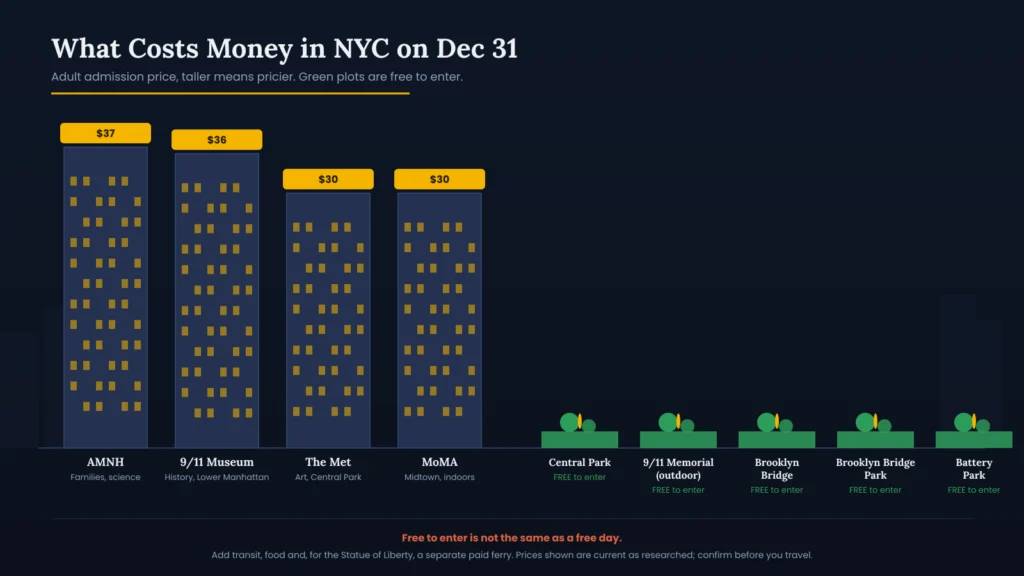
Several genuinely free stops anchor a low-cost December 31, though “free to enter” isn’t the same as a free day.
| Place | What’s free | What still costs money |
|---|---|---|
| 9/11 Memorial (outdoor) | Memorial plaza and reflecting pools | Museum ticket, audio guide, or guided tour |
| Central Park | All public paths and open space | Transport, food, optional paid activities inside the park |
| Brooklyn Bridge | The bridge walk itself | Transportation to and from |
| Brooklyn Bridge Park | Park entry and pathways | Some independently operated attractions inside the park |
| Battery Park | Waterfront views and open space | The Statue of Liberty ferry, which is separate and paid |
Budget for transit fares, food, and the fact that several “free” stops sit near attractions that aren’t free at all, like Battery Park’s proximity to the Liberty ferry terminal.
What’s actually worth booking before New Year’s Eve in NYC
Requires advance tickets: the 9/11 Memorial Museum, the Statue of Liberty ferry and any pedestal or crown access.
Has separate ticketed experiences on top of general admission: the 9/11 Memorial (audio guides and guided tours), AMNH (special exhibitions beyond the general ticket).
Strongly recommended but not always required: The Met and MoMA both sell advance tickets and recommend them during busy periods, though walk-up entry is often possible outside peak times.
Why waiting until December 31 reduces your options: timed-entry slots for the Museum and the Liberty ferry can sell out on a busy holiday travel day, and same-day availability is far less reliable than booking even a few days ahead.
How to plan your route around NYC on December 31
- The Lower Manhattan route: 9/11 Memorial (and Museum, if booked) in the morning, the World Trade Center plaza and Oculus, then Battery Park. Add the Statue of Liberty only if you started the day on the first ferry instead.
- The museum and Central Park route: Central Park in the morning, then The Met or AMNH depending on who’s traveling with you.
- The Brooklyn waterfront route: Brooklyn Bridge in the morning, DUMBO for a late morning wander, Brooklyn Bridge Park into the early afternoon.
- The rainy-day route: AMNH or The Met first, MoMA as a second indoor option if you’re staying in Midtown, skipping outdoor stops entirely.
- The family route: AMNH in the morning, Central Park for a break, home or hotel by mid-afternoon rather than pushing into a second major attraction.
What to know before sightseeing in NYC on New Year’s Eve
Check December 31 hours directly, not January 1 hours. The Met and several other attractions on this list list January 1 as a closure date. That tells you nothing about December 31 hours, which need separate confirmation.
Expect real cold and wind near the water. The NPS specifically flags New York Harbor as colder and windier than inland parts of the city; dress for that if the Statue of Liberty or Brooklyn Bridge Park is part of your day.
Finish long-distance sightseeing before late afternoon. Whether it’s the Liberty ferry or a trip out to Brooklyn, don’t leave the far end of your route until the last hour of daylight, especially if you need to get back toward Midtown afterward.
Use the subway and walking routes strategically. NYC’s subway makes cross-neighborhood travel easy most days, but check for any December 31 service changes or station closures related to the Times Square event before finalizing a route that runs anywhere near it.
Keep one indoor backup plan. Whatever your primary route, know which nearby museum you’d swap in if the weather turns. AMNH, The Met, MoMA, and the 9/11 Museum all work as backups depending on which zone you’re already in.
If you’re planning more U.S. city getaways beyond New York, you can also explore our guide to things to do in Nashville for ideas on music, food, neighborhoods, museums, and outdoor attractions.
Quick comparison of the best NYC attractions for December 31
| Attraction | Area | Free or paid | Best for | Main caution |
|---|---|---|---|---|
| 9/11 Memorial & Museum | Lower Manhattan | Memorial free, Museum paid | History-focused visitors, Midtown avoidance | Museum needs advance timed tickets |
| Statue of Liberty | New York Harbor | Park free, ferry paid | Full-day, first-time visitors | Treat as most of a day, not a quick stop |
| Central Park | Central Manhattan | Free | Everyone, especially paired with a museum | Too large to see in full; pick a section |
| The Met | Upper East Side | Paid for most | Art lovers, adults, older kids | Closed Wednesdays; confirm Dec 31 hours |
| AMNH | Upper West Side | Paid for most | Families and bad weather | Parking is expensive; book special exhibits ahead |
| MoMA | Midtown | Paid for most | Midtown visitors avoiding Times Square | Confirm Dec 31 hours before relying on it |
| Brooklyn Bridge & DUMBO | Lower Manhattan to Brooklyn | Free | Photographers, budget travelers, couples | Cold and windy on the bridge itself |
| Brooklyn Bridge Park | Brooklyn waterfront | Free | Families, dog owners, accessibility | Limited parking; use transit |
Frequently asked questions
Is New York City worth visiting on New Year’s Eve if you don’t want to party?
Yes. The city’s museums, parks, harbor, and neighborhoods operate close to normally away from the Times Square footprint. Plan sightseeing by zone, pick one route from this guide, and treat the evening event as entirely optional.
What can you do in NYC on New Year’s Eve besides Times Square?
The strongest options are the 9/11 Memorial and Lower Manhattan, Central Park paired with The Met or AMNH, MoMA if you want to stay in Midtown without joining the event crowd, and a Brooklyn Bridge and DUMBO walk. All five sit outside the Times Square event zone.
What are the best free things to do in NYC on December 31?
Central Park, the 9/11 Memorial’s outdoor plaza, the Brooklyn Bridge, Brooklyn Bridge Park, and Battery Park are all free to enter, though transit and food costs still apply.
Are NYC museums open on New Year’s Eve?
Most operate on close to normal hours, but exact December 31 schedules vary by museum and should be checked directly. A listed January 1 closure, which several museums on this list have, does not mean the museum is closed on December 31 as well.
What’s best for families visiting NYC on New Year’s Eve?
The American Museum of Natural History is the strongest single choice, especially in cold or wet weather, thanks to its interactive halls and documented sensory and accessibility resources. Pair it with a shorter Central Park stop rather than a second major museum on the same day.
What should you do in NYC if it rains on New Year’s Eve?
Prioritize AMNH, The Met, MoMA, or the 9/11 Memorial Museum. All four are fully indoor, don’t depend on weather, and can be combined with a short covered walk like Grand Central if you want a change of scenery.
Should you visit the Statue of Liberty on New Year’s Eve?
Only if you have most of the day free and can start on an early ferry. Between ferry queues, security screening, and the trip itself, this isn’t a stop you can fit into a couple of spare hours, and it doesn’t pair well with an evening commitment back in Midtown.
How do you avoid wasting the day in crowds?
Pick one zone from this guide, Lower Manhattan, Central Park and a museum, Midtown away from the event core, or Brooklyn, and build your day within it rather than trying to touch multiple distant neighborhoods. If your priority is the evening event itself rather than daytime sightseeing, that’s a separate planning question covered in a dedicated New Year’s Eve events guide rather than this one.
Leave a Reply
You must be logged in to post a comment.