
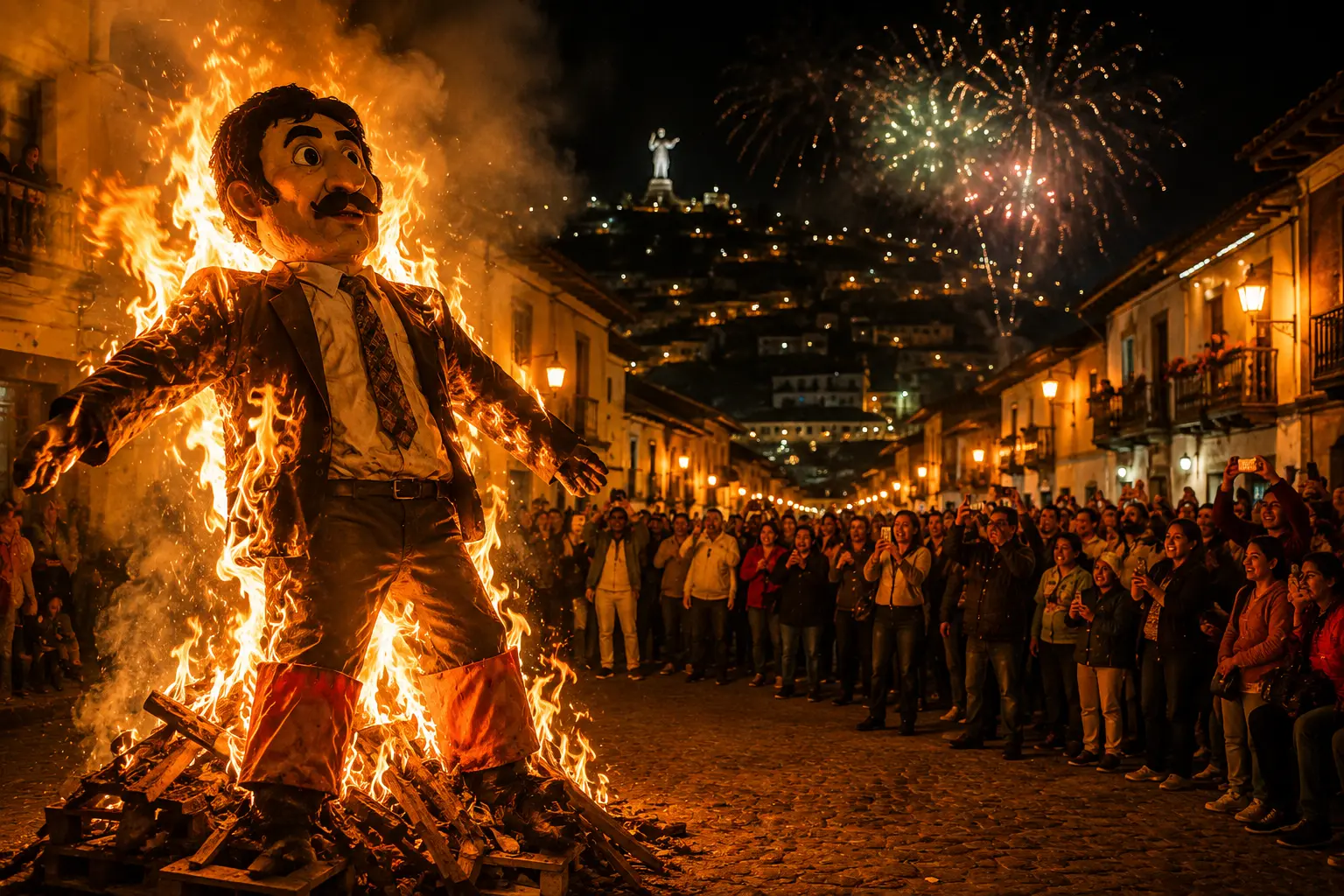
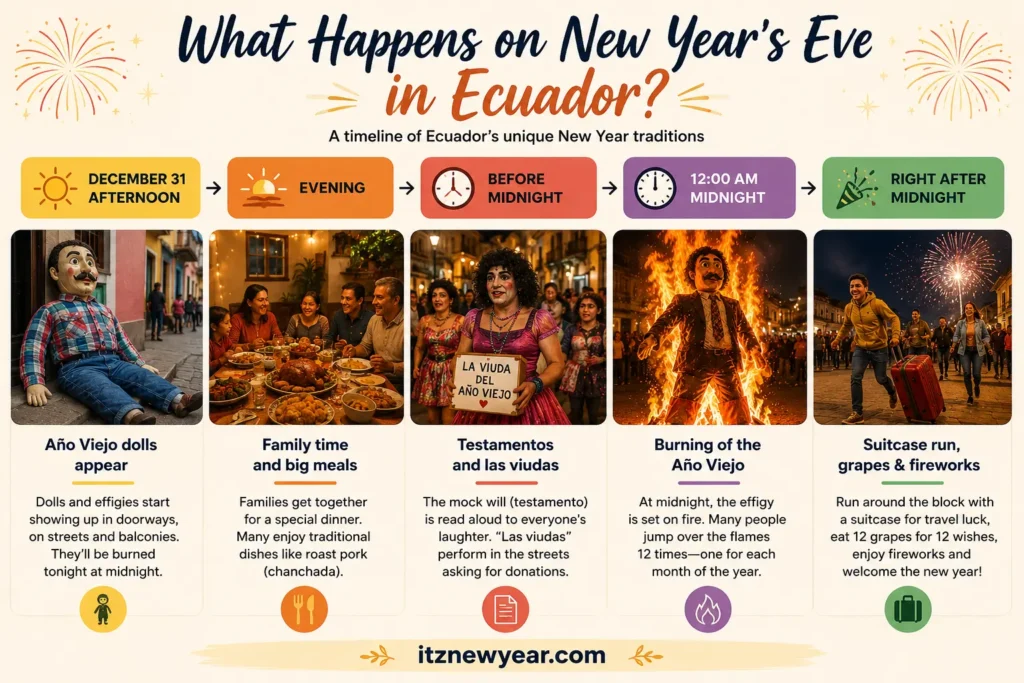
Walk around an Ecuadorian city on the afternoon of December 31 and you’ll probably start spotting some unusual characters. Dolls are sitting on sidewalks, leaning against doorways, or hanging from balconies, usually dressed in old clothes with a mask covering the face.
And by midnight, many of them will be burning.
These are Año Viejo, or “Old Year,” effigies, and they are at the heart of Ecuador’s New Year celebrations. The idea is pretty simple: put the bad parts of the old year into a figure, then burn it and start fresh.
But the burning doll is only part of the fun. New Year’s Eve in Ecuador also comes with yellow underwear, twelve grapes, suitcase races around the block, and groups of men dressed as dramatic “widows” asking people for money for the funeral.
What exactly is an Año Viejo?
An Año Viejo is usually a life-sized figure made from old clothes and stuffed with things like sawdust, newspaper, or pieces of cardboard. The face comes from a mask, and that’s often where the fun really starts.
You’ll see masks based on politicians, celebrities, cartoon characters, and other recognizable figures. Sometimes the choice is clearly meant to make a political point. Other times, it’s simply a funny face or an ugly old man representing all the bad luck people want to leave behind.
In the weeks before New Year’s Eve, vendors sell these masks in large numbers in cities such as Quito, Guayaquil, and Cuenca. Looking through the different characters has become part of the experience itself.
Some families make a small effigy and leave it outside their home. Neighborhoods and community groups can go much bigger, building elaborate figures and competing to make them taller, funnier, or more detailed. The subject is often whatever dominated the news that year, whether that means a politician, a scandal, or some viral event everyone remembers.
Then comes midnight.
The Año Viejo is set on fire, symbolically taking the problems and frustrations of the past year with it. In some households, people jump over the flames twelve times, with each jump representing one month of the year that has just ended.
Where did the tradition come from?
The history of Año Viejo is not quite as straightforward as the celebration itself.
Sources trace the practice back to the late 19th century and connect an important part of its history to a yellow fever outbreak in Guayaquil in 1895. According to accounts of the tradition, grieving families used clothing belonging to people who had died to fill coffins or effigies, which were then burned in the streets. It served partly as a farewell and partly as an attempt to drive the disease away.
Over time, the meaning changed.
The figures gradually became less about mourning and more about humor, criticism, and public satire. Political figures and other controversial characters became common subjects, turning the burning into a kind of street theater as well as a New Year ritual.
There are also suggestions of older influences. Some cultural writers connect the tradition with indigenous Andean customs and Spanish colonial influence. In places such as Otavalo, for example, there are accounts of effigies representing feudal landowners being burned before the modern Año Viejo tradition took shape.
Exactly how all these traditions connect is still debated, and different sources tell the story somewhat differently. What is clear is that the modern celebration developed from several cultural influences and eventually became the mixture of humor, criticism, spectacle, and fresh starts that people recognize today.
The testamento: one last roast before the fire
The Año Viejo often gets its own testamento, or mock last will and testament.
Before the effigy goes up in flames, families or neighborhood groups may read the testamento aloud. Instead of leaving money or possessions to relatives, the “will” pokes fun at the person or character represented by the doll.
It can list their supposed mistakes, bad habits, scandals, or ridiculous moments from the past year.
And yes, it can get pretty political.
Some communities even hold contests to see who can come up with the funniest or sharpest testamento. The whole point is to have a laugh while saying goodbye to the year.
Meet the Año Viejo widows
Then there are las viudas, or the widows.
Groups of men, often teenagers or young adults, dress up in exaggerated women’s clothing, wigs, makeup, and padded costumes. They act heartbroken over the Año Viejo that is about to be “buried” in the fire.
It is usually anything but serious.
The viudas dance in the streets, perform for passing cars, and sometimes stop traffic while asking drivers for money to help pay for the “funeral.” In cities such as Quito, the performances can attract plenty of attention of their own.
It’s one of those traditions that makes much more sense when you see an entire street joining in than when someone tries to explain it to you beforehand.
Twelve grapes, yellow underwear, and a little bit of gold
The Año Viejo gets most of the attention, but Ecuadorian New Year’s Eve has plenty of other traditions going on at the same time.
At midnight, many people eat twelve grapes, one for each chime of the clock. Each grape represents a month in the coming year, with people making wishes or setting intentions as they eat them.
Some families also put a small piece of gold jewelry, such as a ring or earring, into a glass of champagne before the toast. The idea is to drink the champagne without swallowing the jewelry and, symbolically, invite prosperity into the new year.
Then there’s the underwear.
Yellow underwear is associated with luck, money, and prosperity for the year ahead. It’s popular enough that markets can see plenty of yellow underwear sales during the final days of December.
Some people also put a bill inside their left shoe before midnight for a little extra financial luck.
And if traveling is one of your goals for the coming year, there’s a tradition for that too.
Grab an empty suitcase and run around the block after midnight.
Some people put a little money inside the suitcase as well. It probably looks slightly ridiculous if you’re standing on the sidewalk watching someone sprint past with an empty suitcase, but that’s part of the fun. When half the neighborhood is doing it too, nobody looks particularly strange.
Food and family come first
For all the fireworks, costumes, and burning effigies, New Year’s Eve usually starts in a much quieter way: with family.
Many Ecuadorian households spend the day together before the celebrations really get going. Extended families may gather for a large meal, including a roast pork feast sometimes known regionally as a chanchada.
In smaller towns, music and dancing often take place in the main square and can continue long after midnight. Larger cities tend to put on bigger public celebrations, with fireworks filling the sky after the Año Viejo burns.
Quito can be particularly impressive at midnight, with fireworks appearing from different parts of the city.
If you’re in Ecuador for New Year’s Eve
There are a few things worth knowing before you join the celebrations.
First, the noise can be intense. Fireworks and other celebrations can get very loud after midnight, particularly in busy residential areas, and there can be quite a bit of smoke too.
Driving around midnight can also be frustrating. Residential streets may fill with people, bonfires, and celebrations, so a journey that normally takes a few minutes can take considerably longer.
And if someone invites you to take part in their Año Viejo tradition, don’t be surprised if they ask you to help with the testamento or jump over the fire. These are generally friendly invitations to join the celebration.
Just remember that the jokes can sometimes be very political, so it helps to understand who or what the effigy is making fun of before joining in.
The celebration also isn’t identical everywhere.
Coastal cities such as Guayaquil are known for larger public effigies, elaborate displays, and competitions. In many Andean towns, the tradition can feel more centered around families and local communities.
The details change from place to place, but the basic idea remains remarkably consistent.
Take everything that went wrong during the year, give it a face, dress it up, make fun of it one last time, and then set it on fire.
Then start the new year fresh.
Leave a Reply
You must be logged in to post a comment.