
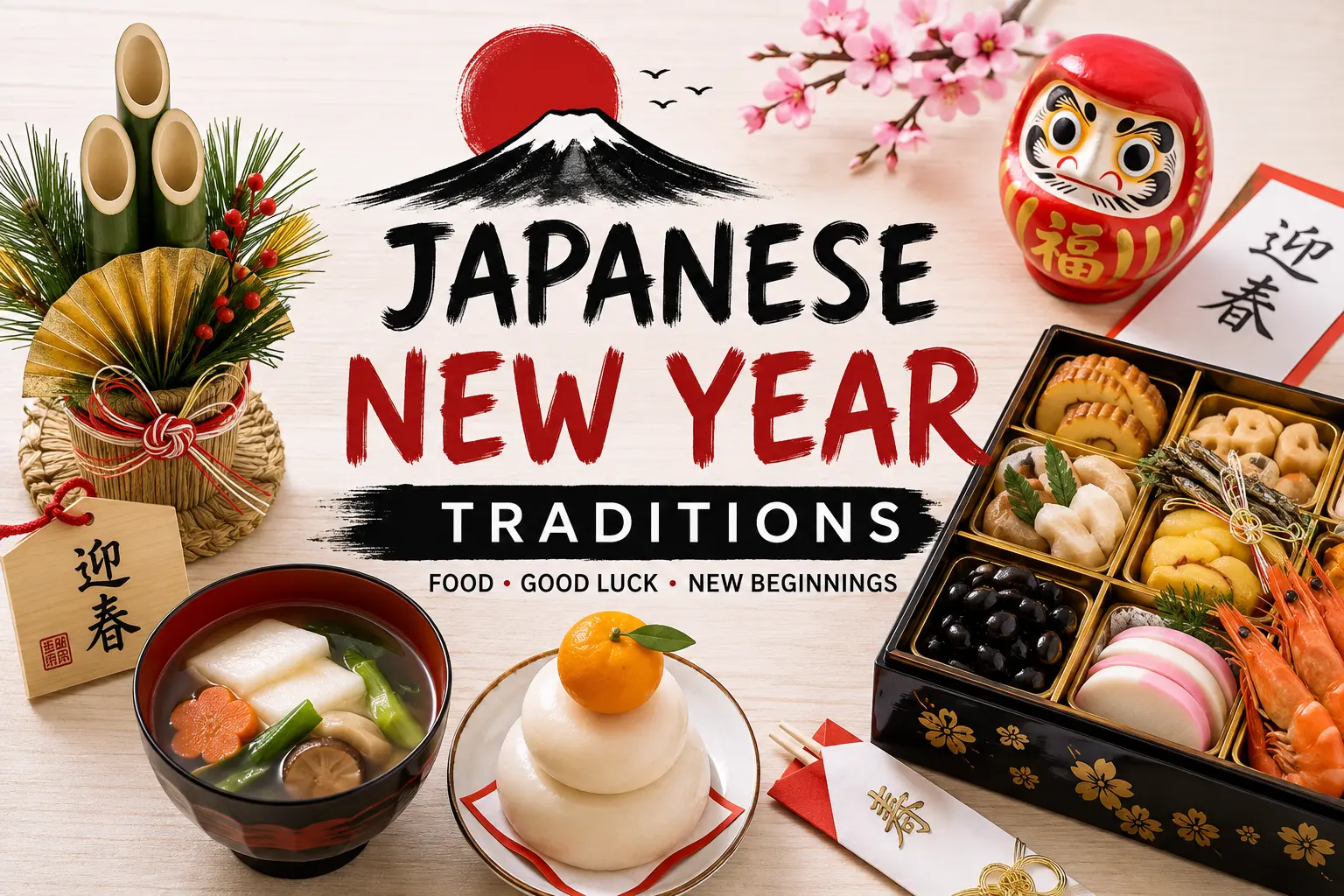
Japanese New Year traditions are full of small rituals with meaningful stories behind them. Families clean their homes, prepare special foods, decorate their entrances, visit shrines and temples, exchange greetings, and spend time together during Shogatsu, Japan’s New Year celebration.
Food plays an especially important role during this season. You will find beautifully arranged osechi ryori, warm bowls of ozoni, long strands of toshikoshi soba, and different kinds of mochi appearing around Japanese homes.
There are also traditions connected with good fortune, health, long life, family prosperity, and a fresh start. Even decorations can carry wishes for the year ahead, while the first shrine visit gives people a chance to pray for happiness and good luck.
If you want to understand Japanese New Year traditions, looking only at New Year’s Eve will leave out quite a lot. In Japan, the celebration stretches across several days and brings together food, family, spirituality, seasonal customs, and some wonderfully simple everyday rituals.
What Is New Year Called in Japan?
The Japanese New Year celebration is commonly called Shogatsu, written as 正月. The word refers to the first month of the year, although people often use it when talking specifically about the New Year holiday period.
New Year’s Eve is called Omisoka, while January 1 is known as Ganjitsu or Gantan, depending on the context. The first three days of January are often described as Shogatsu Sanganichi, a particularly important period for family celebrations and traditional meals.
The modern Japanese New Year follows the Gregorian calendar, so the main celebration takes place around December 31 and January 1. Before Japan adopted the Western calendar in 1873, New Year followed a lunisolar calendar and fell at a different time of year.
Today, January 1 remains one of the most important holidays on the Japanese calendar. Many people return to their hometowns, visit relatives, and spend several quiet days with family.
Why Is New Year So Important in Japan?
New Year has a deeper cultural role in Japan than simply marking the end of December. Traditionally, the season has been connected with welcoming Toshigami, a New Year deity associated with good fortune, harvests, and the beginning of a new year.
This older belief helps explain many Japanese New Year customs. Cleaning the house, putting up decorations, preparing offerings, and staying together during the holiday all became ways of preparing for the arrival of the new year.
The season also has strong connections with rice and agriculture. Rice has historically held an important place in Japanese culture, so foods made from rice became closely connected with annual celebrations and offerings.
That history still shows up on modern New Year’s tables.
When you see mochi, sake, rice dishes, and carefully prepared foods during Shogatsu, you are seeing part of a much older relationship between food, community, nature, and celebration.
Japanese New Year Traditions at a Glance
If you are looking for the most important Japanese New Year traditions, this quick list gives you the bigger picture before we explore each custom in detail.
| Tradition | What it involves | Common meaning |
| Osoji | Thorough year-end house cleaning | Starting fresh |
| Kadomatsu | Pine and bamboo entrance decoration | Welcoming good fortune |
| Shimekazari | Sacred straw rope decoration | Marking a protected space |
| Kagami mochi | Two stacked round rice cakes | Offering and good fortune |
| Toshikoshi soba | Buckwheat noodles on New Year’s Eve | Long life and leaving the old year |
| Joya no kane | Temple bells rung 108 times | Letting go of worldly troubles |
| Hatsumode | First shrine or temple visit | Prayers for the new year |
| Osechi ryori | Assorted New Year foods | Health, prosperity, family wishes |
| Ozoni | Mochi soup eaten during New Year | Blessings and celebration |
| Otoshidama | Money given to children | New Year gift |
| Nengajo | New Year greeting cards | Sending good wishes |
| Hatsu-hinode | First sunrise of the year | A meaningful new beginning |
1. Cleaning the House Before New Year
One of the first things you may notice about Japanese New Year preparations is the amount of cleaning that happens beforehand.
The practice is known as Osoji, meaning a large-scale cleaning. Families traditionally clean their homes thoroughly before the New Year because the holiday represents a fresh beginning and because the home should be prepared for the arrival of Toshigami.
This can include cleaning places that normally receive little attention throughout the year. People may wipe doors, windows, floors, shelves, kitchens, and other parts of the house before the holiday begins.
The idea goes beyond ordinary housekeeping.
Starting the year with a clean home reflects the wish to leave behind the dirt, clutter, and problems of the previous year. It gives the household a physical and symbolic fresh start.
2. Putting Up Kadomatsu
Kadomatsu is one of the most recognizable Japanese New Year decorations.
These arrangements commonly use pine and bamboo and are placed near entrances to homes, businesses, and other buildings. Traditionally, they serve as markers that welcome Toshigami to the household.
Pine has long been associated with longevity because it stays green throughout winter. Bamboo also carries auspicious associations and is valued for its strength and upright growth.
There is even an interesting word connection involving pine.
The Japanese word matsu can mean pine, while another use of the same sound means waiting. This gives the decoration an additional symbolic connection with waiting for the New Year deity’s arrival.
Today, kadomatsu can range from elaborate traditional arrangements to smaller modern versions used outside apartments and shops.
3. Decorating With Shimekazari
Another common New Year decoration is shimekazari, made with sacred straw rope and often decorated with paper strips and other auspicious elements.
The rope helps mark a space as sacred or protected. Traditionally, it signals that the home has been prepared to welcome Toshigami.
You may notice shimekazari displayed around entrances during the New Year period.
The decoration is more than seasonal ornament.
It connects the household with older Japanese beliefs about purity, protection, and welcoming good fortune into the home.
4. Displaying Kagami Mochi
If you are looking for a traditional rice cake snack on Japanese New Year, you will quickly come across mochi.
One particularly important New Year form is called kagami mochi.
Kagami mochi usually consists of two round mochi rice cakes stacked together, with a small citrus fruit placed on top. The arrangement is traditionally displayed as an offering connected with the New Year.
The name means “mirror mochi.”
Its round shape is connected with old Japanese sacred mirrors, which were traditionally regarded as objects associated with divine presence. The decoration therefore has a deeper symbolic role than simply looking attractive on a shelf.
The mochi used for kagami mochi eventually becomes hard because it sits out during the holiday period. It is traditionally broken and eaten later in a custom called kagami-biraki, with the exact date varying by region and tradition.
5. Eating Toshikoshi Soba on New Year’s Eve
New Year’s Eve has its own famous food tradition called toshikoshi soba.
These are buckwheat noodles traditionally eaten around the end of the year. The name can be translated roughly as “year-crossing soba,” making the dish closely connected with the transition from one year into the next.
The long noodles are commonly associated with long life and longevity. Their ability to break easily has also been connected with leaving behind the difficulties of the old year.
There is no single required topping.
Depending on the region and household, you may find shrimp tempura, green onions, fish, tofu, or other ingredients served with the noodles.
Some areas even favor udon instead of soba, showing once again that Japanese New Year food traditions can change considerably from one region to another.
6. Listening to Joya no Kane
As December 31 comes to an end, Buddhist temples across Japan take part in Joya no Kane, the traditional New Year’s Eve bell ringing.
The temple bell is traditionally struck 108 times.
The number is associated with the Buddhist concept of 108 worldly desires or sources of suffering. Ringing the bell is therefore connected with leaving those troubles behind as the old year ends.
The sound can be deeply atmospheric.
Instead of fireworks filling the sky, many Japanese New Year scenes are much quieter. You may hear temple bells, see people walking toward shrines, and watch families beginning the first hours of the new year together.
7. Making the First Shrine Visit With Hatsumode
One of the most important Japanese New Year traditions is hatsumode, the first visit of the year to a shrine or temple.
People visit to pray for health, happiness, safety, prosperity, family well-being, and other hopes for the year ahead. Hatsumode can take place at a Shinto shrine, Buddhist temple, or another spiritual site.
Some people go immediately after midnight.
Others wait until January 1 during the day, while many choose another day during the first few days because the most popular locations become extremely crowded.
Famous places such as Meiji Shrine in Tokyo, Fushimi Inari Taisha in Kyoto, and other major temples and shrines attract enormous crowds during the New Year period.
You may also see people buying charms, drawing fortunes, making offerings, and purchasing food from temporary stalls outside the shrine grounds.
8. Seeing the First Sunrise
Another beautiful New Year custom is watching the first sunrise, known as hatsu-hinode.
People may travel to mountains, beaches, coastlines, observation points, or other locations where they can watch the sun rise on January 1. The first sunrise is traditionally viewed as an auspicious moment and can be connected with prayers for a good year.
You do not need to attend a major event to understand the appeal.
There is something naturally symbolic about standing outside in the early morning and watching the first sunlight of the year appear.
9. Eating Osechi Ryori
Now we reach the heart of Japanese New Year traditions food.
Osechi ryori is the traditional assortment of New Year dishes prepared especially for the holiday. It is usually arranged inside stacked boxes called jubako, creating a colorful meal where individual foods carry different meanings.
Osechi developed from older seasonal offerings and celebratory foods, with the New Year becoming its most important modern association.
The dishes are often prepared ahead of time and made with ingredients that keep well. This arrangement allows families to spend less time cooking during the first days of the New Year.
That practical side is easy to appreciate.
After spending days cleaning, preparing decorations, shopping, and getting ready for the holiday, having food already prepared gives everyone more time to relax together.
What Foods Are in Osechi?
There is no single osechi box that looks exactly the same everywhere.
However, several foods appear frequently because of their traditional meanings.
| Osechi food | Japanese name | Traditional meaning |
| Black soybeans | Kuromame | Health and diligence |
| Herring roe | Kazunoko | Family prosperity and descendants |
| Dried sardines | Tazukuri | Abundant harvest |
| Burdock root | Tataki gobo | Stability and strength |
| Shrimp | Ebi | Long life |
| Datemaki | Datemaki | Learning and knowledge |
| Sweet chestnuts | Kuri kinton | Wealth and prosperity |
| Kombu | Kombu | Happiness |
| Red and white fish cake | Kamaboko | Celebration and good fortune |
The meanings sometimes come from the food’s appearance, traditional use, or wordplay in Japanese.
For example, kazunoko is associated with many offspring because herring roe contains many eggs. Kuro-mame, or black beans, are connected with health and working diligently. Tazukuri, made from dried sardines, is associated with a good harvest.
That is one reason osechi makes such an interesting traditional Japanese New Year’s food.
The meal is not simply a collection of dishes.
Each small portion can carry a wish for the family.
10. Eating Ozoni on New Year’s Day
If osechi is the beautifully arranged centerpiece, ozoni is the comforting bowl that brings warmth to the New Year’s table.
Ozoni is a Japanese soup containing mochi, along with vegetables, broth, and other ingredients that vary greatly between regions and households.
This is one of the most important traditional Japanese New Year foods, but there is no single national recipe.
The Japanese Ministry of Agriculture, Forestry and Fisheries explains that ozoni varies in broth, seasoning, mochi shape, cooking method, and additional ingredients throughout Japan.
Some versions use a clear soy sauce-based broth. Others use miso.
Some families grill the mochi before adding it to the soup, while other recipes cook it directly in the broth. Even the shape changes.
Eastern Japan commonly uses square or rectangular mochi, while many areas in western Japan traditionally use round mochi.
Why Is Mochi Important in Ozoni?
Mochi has a long connection with Japanese celebrations and offerings.
During New Year, mochi is associated with receiving blessings and strength for the year ahead. Traditional accounts connect the food with offerings made to Toshigami and older rice-centered customs.
That makes ozoni much more than an ordinary winter soup.
For many families, the first bowl of ozoni is part of the feeling that the New Year has truly arrived.
11. Enjoying Mochi During New Year
Mochi deserves special attention because it appears in several Japanese New Year traditions.
Mochi is made by steaming and pounding glutinous rice until it becomes soft, sticky, and elastic. The resulting rice cake can be shaped, cooked, filled, grilled, or added to soup.
During Shogatsu, mochi appears in kagami mochi, ozoni, grilled dishes, and other seasonal preparations.
The food also has an important historical connection with rice culture and New Year offerings. Government cultural sources explain that mochi became associated with New Year celebrations many centuries ago, replacing earlier practices involving steamed white rice.
If you are looking for a traditional treat in Japanese New Year celebrations, mochi is one of the clearest answers.
There is one important practical point, though.
Mochi is very sticky and chewy, so it can be difficult to swallow safely, particularly for older adults. Japanese authorities regularly warn about choking risks around New Year, especially when mochi is eaten quickly or in large pieces.
12. Giving Otoshidama to Children
Japanese New Year traditions also include a special gift for children called otoshidama.
Adults usually give children money inside small decorative envelopes called pochibukuro.
The custom has an older connection with the idea of receiving a “year spirit” or toshidama from Toshigami. Over time, that concept developed into the modern custom of giving children money during New Year.
The amount varies widely depending on the child’s age, family relationships, and household customs.
For children, however, the meaning is usually straightforward.
New Year arrives, relatives gather, and suddenly there is money in a small envelope.
That part of the tradition has remained remarkably popular even as other older customs have changed.
13. Sending Nengajo New Year Cards
Before smartphones and social media changed the way people communicate, nengajo played a major role in Japanese New Year greetings.
These are special New Year’s greeting postcards sent to friends, relatives, coworkers, teachers, and other acquaintances.
The goal is to send good wishes for the new year while maintaining social connections.
Historically, nengajo became an important part of Japanese New Year communication, and many people traditionally tried to have them delivered on January 1.
The custom has declined in some households because digital communication is now so convenient.
Still, nengajo remains a recognizable part of Japanese New Year culture, especially among people who enjoy maintaining traditional forms of greeting.
14. Taking Part in Family Gatherings
New Year in Japan is strongly associated with family.
Many people travel back to their hometowns during the holiday period, especially if they normally live or work in another city.
Families may eat together, visit relatives, go to a shrine, exchange gifts, and spend quiet time at home.
This is one reason the New Year period can feel noticeably different from ordinary weeks in Japan.
The pace slows down.
People take time away from work and school, businesses close for several days, and families often prioritize being together.
15. Playing Traditional New Year Games
New Year has also traditionally been a time for games and simple family entertainment.
Some traditional activities include karuta, a Japanese card game, hanetsuki, a badminton-like game played with wooden paddles, and takoage, or kite flying.
These activities are less universal today than they once were.
Still, they remain part of the cultural picture of Japanese New Year, particularly when families want to introduce children to older customs.
Modern families may combine these traditions with television, video games, movies, travel, shopping, and other contemporary forms of entertainment.
16. Watching Kohaku Uta Gassen
One of Japan’s best-known New Year’s Eve television traditions is Kohaku Uta Gassen, often simply called Kohaku.
The annual music program features popular Japanese singers performing in two competing teams, traditionally represented by red and white.
The program has become a major part of New Year’s Eve television culture and typically runs through much of the evening before midnight.
For many households, watching Kohaku while preparing or eating food has become part of the rhythm of Omisoka.
It gives the evening a shared national feeling, much like other countries have major holiday broadcasts that families watch together.
Japanese New Year Food Traditions and Their Meanings
Food may be the most interesting part of Japanese New Year because almost every important dish has a story.
Here is a quick guide to the main foods.
| Traditional Japanese New Year food | When it is eaten | Main association |
| Toshikoshi soba | December 31 | Long life and leaving the old year |
| Osechi ryori | January 1 and following days | Good fortune and family wishes |
| Ozoni | New Year’s Day | Blessings and celebration |
| Mochi | Throughout New Year | Rice, strength, offerings, good fortune |
| Kagami mochi | Displayed during New Year | Offering and protection |
| Kuromame | Osechi | Health |
| Kazunoko | Osechi | Family prosperity |
| Tazukuri | Osechi | Good harvest |
| Ebi | Osechi | Long life |
| Kuri kinton | Osechi | Wealth |
| Datemaki | Osechi | Learning and knowledge |
This is why searches for Japanese New Year foods, traditional Japanese New Year food, and Japanese New Year food traditions often lead back to the same core dishes.
The food is inseparable from the celebration itself.
Why Osechi Foods Are Considered Lucky
The lucky meanings inside osechi are one of the most fascinating parts of Japanese New Year.
Kazunoko, or herring roe, represents hopes for many descendants because of its many eggs.
Tazukuri, made from dried sardines, carries an agricultural association with abundant harvests.
Kuromame, or black soybeans, traditionally represents health and diligence.
Tataki gobo, made from burdock root, represents stability because the root grows firmly into the ground.
Shrimp often symbolizes long life because its curved shape resembles an elderly person with a bent back.
Datemaki, a sweet rolled omelet mixed with fish paste, is traditionally connected with learning and knowledge because its rolled appearance resembles old scrolls.
These meanings can differ somewhat between sources, regions, and households.
Regional Differences in Japanese New Year Food
One of the biggest content gaps in many articles about Japanese New Year traditions is regional food.
Japan has a huge range of local cuisines, so New Year food naturally changes from place to place.
Ozoni provides the clearest example.
In Tokyo and much of eastern Japan, square mochi and clear soup are common.
In Kyoto and parts of western Japan, round mochi and white miso-based soup are traditional choices.
Other regions add local vegetables, seafood, chicken, mushrooms, fish cakes, or regional specialties.
Some versions grill the mochi first.
Others simmer it directly in the soup.
Some families use miso, while others prefer a clear broth.
This means asking someone about their family’s ozoni can reveal where they grew up.
That is one of the most charming things about Japanese traditional New Year’s food.
Japanese New Year Traditions for Good Luck
Good luck is woven throughout Shogatsu.
You can see it in food, decorations, prayers, gifts, and even the way people prepare their homes.
Here are some of the most recognizable examples.
Pine and Bamboo
Kadomatsu uses pine and bamboo because both plants carry auspicious associations, including longevity and strength.
Twelve-Month Fresh Start
The New Year represents a chance to leave behind the previous year and begin again with renewed hopes.
Osechi Foods
Many osechi dishes carry wishes for health, prosperity, knowledge, family growth, or a good harvest.
Shrine Prayers
Hatsumode gives people a chance to pray for good fortune and safety during the coming year.
First Sunrise
Hatsu-hinode provides another symbolic opportunity to welcome the first morning of the new year.
Otoshidama
Money given to children has roots in older ideas surrounding the New Year spirit and receiving another year of life.
Japanese New Year Eve Traditions
If you want to understand what happens specifically on December 31, the evening has its own set of customs.
People may finish their year-end cleaning and preparations before settling down for the evening.
Many households eat toshikoshi soba, while television programs such as Kohaku provide entertainment.
As midnight approaches, some people prepare to visit a shrine or temple.
At Buddhist temples, Joya no Kane bells ring through the night.
Others simply stay home with family and welcome January 1 together.
Unlike some Western New Year celebrations, huge fireworks are not the defining image of Japanese New Year.
The atmosphere can feel much quieter and more reflective.
What Happens on New Year’s Day in Japan?
January 1 is known as Ganjitsu, and it is one of the most important days of the holiday.
Families may begin the morning with New Year greetings, traditional foods, and drinks.
Osechi and ozoni are commonly served during the New Year period, while children may receive otoshidama from relatives.
Many people also make their hatsumode visit.
Some families dress more formally, including wearing kimono for special visits and photographs.
The day can feel peaceful because many businesses close during the holiday.
For visitors, that quiet atmosphere can be beautiful, but it can also require some planning.
What Is Shogatsu Sanganichi?
Shogatsu Sanganichi refers to the first three days of January.
These days have traditionally been treated as an important period for New Year celebrations, family gatherings, meals, and rest.
Many businesses and restaurants close during part of this period. That means Japan can feel unusually quiet compared with its normal busy pace.
Major shrines and temples are the exception because they can become extremely crowded with people making their first visits of the year.
Japanese New Year Decorations and Their Meanings
Japanese New Year decorations can look beautiful even when you know nothing about their symbolism.
| Decoration | Where you may see it | Traditional association |
| Kadomatsu | Home or business entrance | Welcoming Toshigami |
| Shimekazari | Door or entrance | Sacred protection |
| Kagami mochi | Inside the home | Offering and good fortune |
| Pine branches | Decorations and arrangements | Longevity |
| Bamboo | Kadomatsu | Strength and auspiciousness |
| Shide paper strips | Sacred decorations | Marking sacred space |
New Year Charms, Fortunes, and Shrine Visits
Hatsumode is not only about standing quietly at a shrine.
Visitors may buy omamori protective charms, draw omikuji fortunes, make offerings, and purchase small New Year souvenirs.
If an omikuji predicts bad luck, people may tie it at a designated place at the shrine rather than taking it home.
Shrines can also have food stalls and temporary New Year decorations, creating a festive atmosphere around the religious visit.
For visitors, hatsumode can be one of the easiest ways to experience Japanese New Year culture directly.
The crowds can be enormous, however, especially at famous locations.
New Year Customs That Are Changing
Japanese New Year traditions are old, but they are not frozen in time.
Families now buy osechi from department stores, supermarkets, restaurants, and specialist food companies instead of preparing every dish themselves.
Nengajo has declined as messaging apps and social media have become more common.
Some traditional games are less popular with children than they once were.
Apartments also make large traditional decorations more difficult, so smaller modern versions of kadomatsu and kagami mochi are widely available.
At the same time, many of the core customs remain remarkably strong.
People still clean their homes, eat special foods, visit shrines, exchange greetings, and spend time with family.
That balance between old and new is one of the most interesting things about Japanese New Year.
What Is a Traditional Treat in Japanese New Year Celebrations?
Mochi is one of the most important traditional treats associated with Japanese New Year. However, mochi is not really one single snack. It can be grilled, placed in soup, shaped into kagami mochi, filled with sweet ingredients, or prepared in other regional ways.
During the New Year period, you may also encounter seasonal sweets and wagashi, along with foods prepared specifically for family celebrations.
The important distinction is that mochi has a particularly strong New Year connection because of its historical role in offerings and annual celebrations.
A Simple Japanese New Year Timeline
If you want to picture the celebration from beginning to end, this timeline helps bring everything together.
| Date | Tradition or activity |
| Early December | New Year preparations gradually begin |
| Late December | Osoji and food preparation |
| Around December 30 | Decorations are traditionally completed |
| December 31 | Omisoka and final preparations |
| December 31 evening | Toshikoshi soba |
| Around midnight | Joya no Kane and shrine visits |
| January 1 morning | New Year greetings and traditional food |
| January 1 | Hatsumode and first sunrise traditions |
| January 1 to 3 | Shogatsu Sanganichi |
| Early January | Family gatherings and New Year visits |
| Around January 11 | Kagami-biraki in many traditions |
Traditional timing can vary by region and household.
For example, the date for kagami-biraki differs in some areas, while people may choose different days for hatsumode depending on crowds and personal schedules.
What Should You Expect If You Visit Japan During New Year?
If you are planning to visit Japan during the New Year period, expect a very different travel experience from an ordinary winter trip.
Many businesses, restaurants, offices, and tourist attractions close for several days around New Year.
Japan’s national tourism organization specifically warns visitors that many places can close from around December 29 through January 3.
At the same time, shrines and temples can become incredibly busy.
Major hatsumode destinations attract huge crowds, particularly during the first hours and days of January.
Transportation can also become crowded around major holidays because people travel back to their hometowns.
If you are visiting during this period, book accommodation and transportation early.
You should also check opening hours rather than assuming your favorite restaurant or attraction will operate normally.
Bringing Japanese New Year Traditions Into Your Own Celebration
You do not need to travel to Japan to enjoy a small piece of Oshogatsu at home this year. Several of these customs are simple enough to try wherever you happen to be celebrating.
- Give your home a proper deep clean before New Year’s Eve, echoing the spirit of osoji and starting the year with a fresh, welcoming space.
- Cook a bowl of soba noodles on New Year’s Eve, letting the long noodles represent your own wish for longevity in the coming year.
- Try a simple version of osechi by preparing even one or two symbolic dishes, such as sweet simmered black beans or candied chestnuts.
- Make or buy mochi and enjoy it in a warm soup, bringing a taste of that traditional rice cake snack on Japanese New Year into your own kitchen.
- Write down a personal goal or intention for the year ahead, borrowing a bit of the reflective spirit found in kakizome.
- Send a handwritten New Year card to someone you care about, much like the nengajo tradition still practiced across Japan today.
Frequently Asked Questions About Japanese New Year Traditions
What is the most important Japanese New Year tradition?
There is no single tradition that everyone considers most important. Hatsumode, osechi ryori, family gatherings, New Year decorations, and other customs all play important roles during Shogatsu.
Why do temple bells ring 108 times on New Year’s Eve in Japan?
This ritual, called joya no kane, is tied to Buddhist teachings about 108 earthly desires, with each bell ring symbolically clearing away one of those desires before the New Year begins.
What food do Japanese people eat on New Year’s Eve?
Many people eat toshikoshi soba, or year-crossing buckwheat noodles, on December 31. The long noodles are traditionally associated with longevity and moving from the old year into the new one.
What is traditional Japanese New Year food?
The best-known traditional Japanese New Year foods include osechi ryori, ozoni, mochi, and toshikoshi soba. Osechi contains many small dishes with auspicious meanings, while ozoni is a New Year’s soup containing mochi.
What is the traditional rice cake eaten during Japanese New Year?
Mochi is the traditional Japanese rice cake strongly associated with New Year. It appears in dishes such as ozoni and decorations such as kagami mochi.
Why do Japanese people eat soba noodles on New Year’s Eve?
Toshikoshi soba is eaten because its long noodles symbolize longevity, while cutting through them represents letting go of the past year’s hardships and worries.
What is a traditional treat in Japanese New Year celebrations?
Mochi is one of the most recognizable traditional treats associated with Japanese New Year celebrations. It can be grilled, added to soup, or prepared in several other ways depending on the region and household.
What Japanese New Year food is considered lucky?
Many osechi foods are considered auspicious because they symbolize wishes for health, prosperity, family growth, stability, longevity, and a good harvest. Kazunoko, kuromame, tazukuri, shrimp, and kuri kinton are some well-known examples.
What is osechi ryori?
Osechi ryori is an assortment of traditional Japanese New Year dishes arranged in stacked boxes called jubako. Individual foods often carry symbolic meanings connected with good fortune and happiness.
What is ozoni?
Ozoni is a Japanese New Year soup containing mochi and other ingredients. Recipes vary greatly by region, with differences in broth, seasoning, mochi shape, vegetables, seafood, and meat.
Why do Japanese people eat mochi during New Year?
Mochi has a long association with Japanese New Year offerings and celebrations. Eating mochi during Shogatsu is connected with receiving blessings and strength for the coming year.
What is hatsumode?
Hatsumode is the first shrine or temple visit of the New Year. People go to pray for health, safety, happiness, prosperity, and other wishes for the year ahead.
What is Joya no Kane?
Joya no Kane is a Buddhist New Year’s Eve bell-ringing tradition. Temple bells are traditionally struck 108 times, representing the worldly desires or troubles that people hope to leave behind.
What do Japanese children receive during New Year?
Children commonly receive otoshidama, which is money given in small envelopes by parents, grandparents, relatives, and sometimes family friends. The modern custom has roots in older New Year beliefs surrounding toshidama.
What is kagami mochi?
Kagami mochi consists of two round mochi rice cakes stacked together and traditionally topped with a citrus fruit. It is displayed as a New Year offering and carries symbolic connections with Toshigami and sacred mirrors.
What is kadomatsu?
Kadomatsu is a New Year decoration made primarily with pine and bamboo. It is traditionally placed near entrances as a marker welcoming Toshigami into the household.
Do Japanese people celebrate New Year with fireworks?
Fireworks are not the defining feature of traditional Japanese New Year celebrations. The holiday is more strongly associated with family gatherings, food, temple bells, shrine visits, decorations, and quiet reflection.
Leave a Reply
You must be logged in to post a comment.