
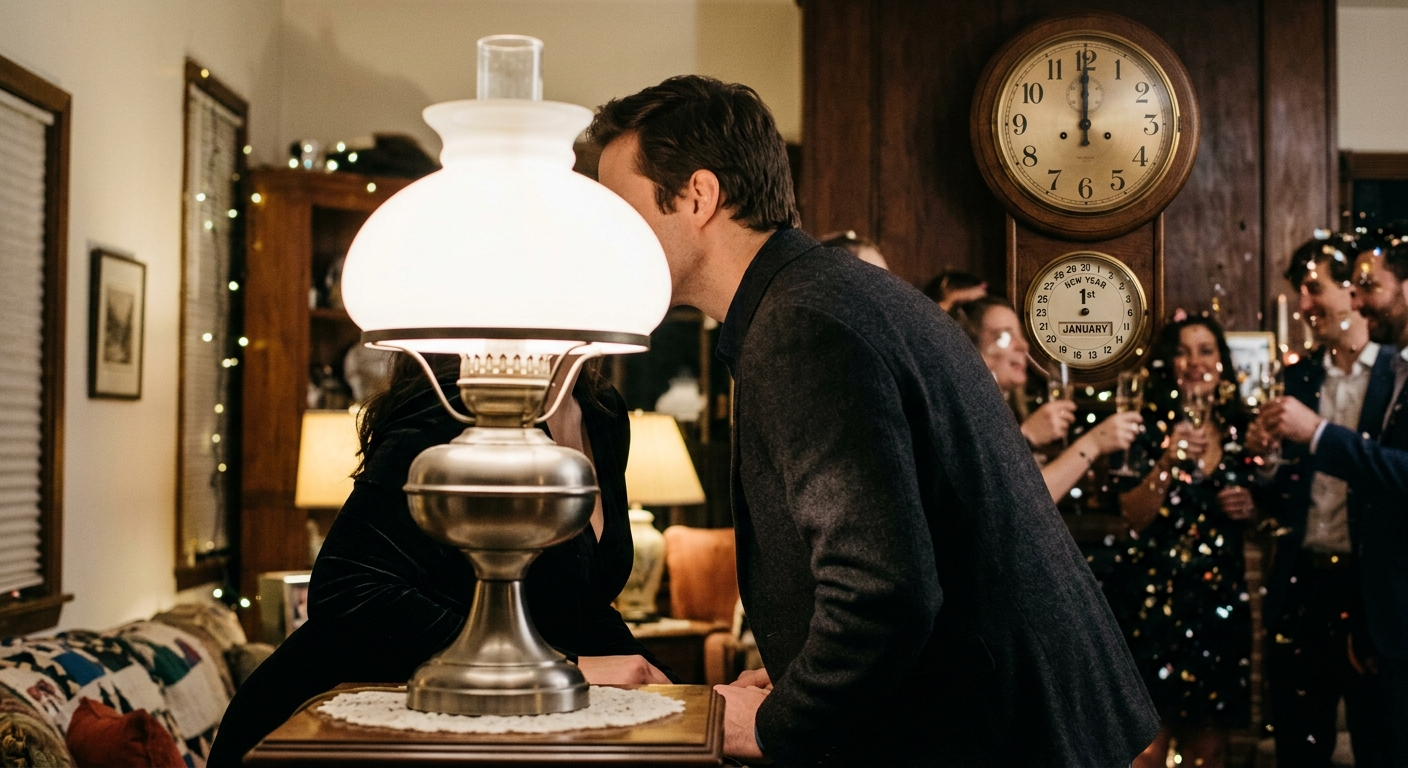
The short answer traces back to old English and German folklore: whoever you’re standing next to when the clock strikes midnight is supposed to set the tone for your whole year ahead. A kiss at that exact moment was believed to lock in good luck, close out any bad blood from the year before, and give the new one a warm, affectionate start. German immigrants carried the custom to the United States in the 1800s, and it’s been part of American New Year’s celebrations ever since.
The roots go back even further than that, though, stretching all the way to winter festivals in ancient Rome. What’s actually happening at midnight on December 31st is less a single invented tradition and more several old customs from different cultures that ended up landing on the same idea: a kiss at the turn of the year means something.
The Ancient Roman and Viking Roots
Historians point to two separate winter festivals as likely early ancestors of the tradition. In ancient Rome, Saturnalia was held every December, an enormous, boundary-dissolving party where social hierarchies briefly loosened and people exchanged kisses as gestures of reconciliation and unity. It wasn’t a New Year’s celebration in the modern sense, but the timing and the spirit, drinking heavily and getting affectionate with the people around you, line up closely with what a lot of December 31st parties still look like.
The other likely ancestor comes from further north. Hogmanay, a Viking-rooted winter festival still celebrated in Scotland today, involved wishing everyone in sight a happy new year, kiss included. Between Saturnalia’s loosened inhibitions and Hogmanay’s genuine goodwill gesture, the basic ingredients of the modern midnight kiss were already in place long before anyone called it a “New Year’s tradition.”
The Superstition Behind Who You’re Kissing
Beyond the general goodwill, English and German folklore added a more specific layer of superstition: whoever you’re with the moment midnight hits supposedly predicts how your whole year will go. A kiss in that instant wasn’t just a nice gesture, it was thought to actually lock in good fortune for the twelve months ahead.
That belief carried real weight for a long time. Some versions of the folklore went as far as suggesting that a couple who skipped the midnight kiss was signaling a weaker bond, one that might not hold up through the coming year. Whether or not anyone still takes that literally, it explains why so many people still scramble to find someone, anyone, in the final seconds of a countdown rather than let midnight pass without one.
Also Read: Why is it bad luck to clean on New Year’s Day
How German Immigrants Brought It to America
The custom’s popularity in the United States traces most directly to German immigrant communities in the 19th century. One of the earliest documented mentions of the American midnight kiss appears in a New York Times article from January 3, 1863, describing a German New Year’s Eve celebration in New York City. As the paper described it, when the clock finished striking twelve, the whole gathering, “big and little, old and young,” pushed into each other’s arms for a round of kisses with the exclamation “Prost’s Neujahr,” essentially “cheers to the New Year.”
Historian Alexis McCrossen, who has studied the holiday’s American history, notes that German immigrant New Year’s parties in the mid-1800s were likely what actually spread the custom into wider American culture. From there, it stopped being a specifically German import and just became something everyone did.
Electricity and Hollywood Made It a Fixture
Two later developments helped cement the midnight kiss as a permanent fixture rather than a passing German-American custom. The spread of electric lighting made staying up and gathering until midnight far more practical for ordinary people, which meant more parties, more countdowns, and more chances for the tradition to repeat itself year after year.
Hollywood did the rest. Once midnight kisses started showing up as a plot device in movies and television, the tradition stopped being something only certain communities did and became a cultural expectation baked into how New Year’s Eve is supposed to look, whether you’re at a party, watching the ball drop on television, or just standing near someone you like when the countdown ends.
What the Tradition Actually Means Today
Folklore expert Daniel Compora has pointed out, only half-joking, that the whole custom can double as a convenient excuse: kissing someone at midnight who might not otherwise let you kiss them, wrapped in the cover of tradition. There’s some truth in that. A lot of the modern version of the midnight kiss has less to do with predicting the year ahead and more to do with a socially acceptable moment to show affection, whether that’s with a longtime partner, a first date, or a total stranger caught in the same countdown.
Whatever the reason behind it, the one thing worth keeping in mind is that the tradition only works when it’s mutual. A kiss that isn’t wanted doesn’t become fine just because a clock happened to strike twelve.
FAQs
Do you have to kiss someone romantically at midnight, or does it count with friends?
The tradition doesn’t require a romantic kiss specifically. Many people kiss friends, family members, or even a stranger standing nearby on the cheek as a way of exchanging good wishes for the new year, closer to the original goodwill gesture behind Hogmanay than a romantic ritual.
What happens if you don’t kiss anyone at midnight?
Nothing, beyond the old folklore claim that it might affect your luck for the year. It’s a superstition, not a rule, and plenty of people spend New Year’s Eve without kissing anyone and have a perfectly good year regardless.
Is the New Year’s kiss tradition specific to the United States?
No. Versions of it show up across multiple cultures, from Hogmanay in Scotland to the general English and German folklore that shaped the American custom. The specific belief that your midnight kiss predicts the year ahead is most strongly tied to English and German tradition, but the general idea of marking the new year with a gesture of affection or goodwill appears more broadly.
Where does the belief that your midnight kiss predicts the year come from?
It comes from English and German folklore holding that whoever you’re with at the exact moment the new year begins sets the tone for your luck over the following twelve months. German immigrants brought this belief to the United States in the 1800s, where it merged with the broader custom of celebrating midnight with a kiss.
Leave a Reply
You must be logged in to post a comment.