
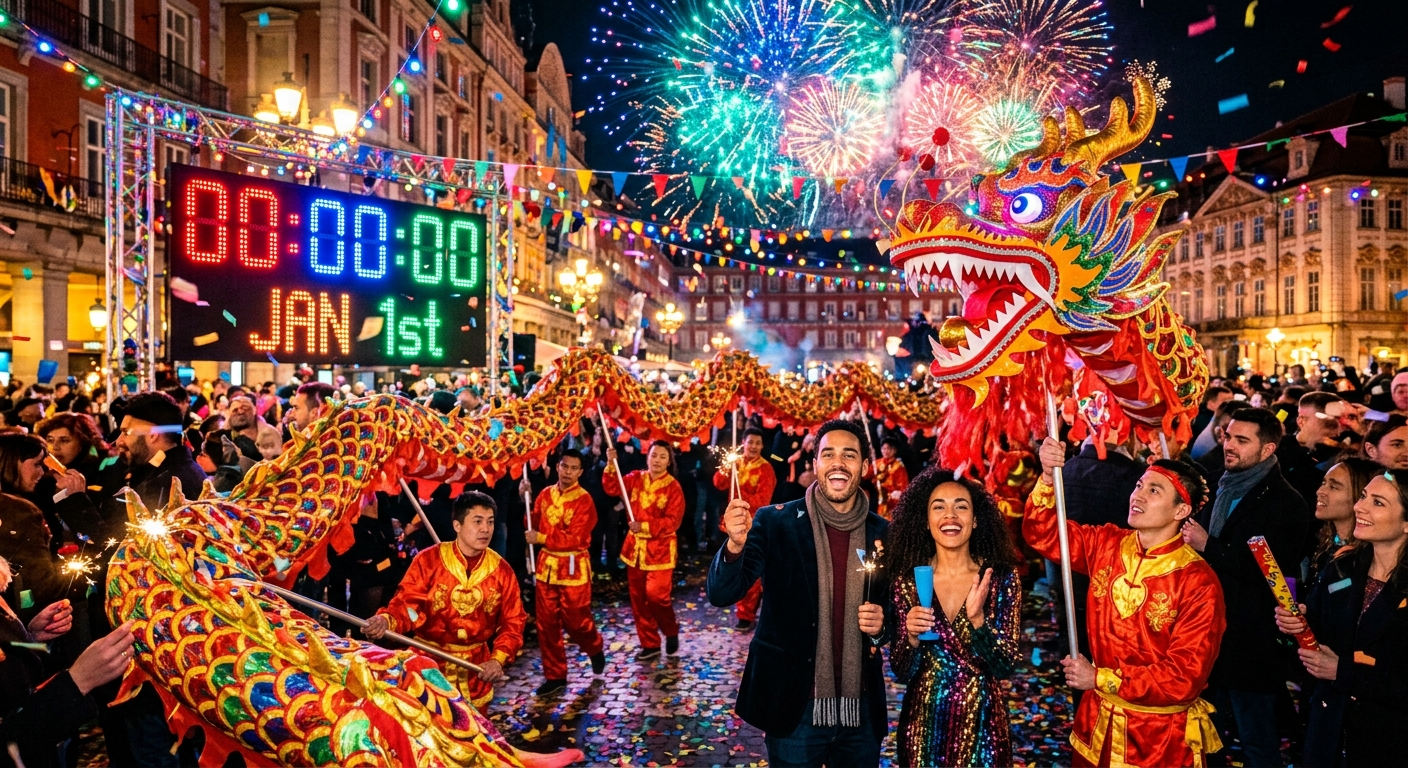
Dragon dances started as a way to pray for rain, not to celebrate a new year at all. The tradition goes back to China’s Han Dynasty, roughly 206 BCE to 220 CE, when farming communities performed the dance during droughts to call on the dragon, believed to control weather and water, for rain their crops badly needed. Over the following centuries, that rain ritual gradually folded into New Year celebrations, and the dragon kept its old meaning even as the occasion around it changed: good fortune, protection, and a strong start to the year ahead.
By the time the Tang and Song Dynasties rolled around, several centuries later, Chinese farming had become more stable and less dependent on desperate weather rituals. The dragon dance shifted with it, moving from an urgent request for rain into more of a festival tradition, performed at Lunar New Year and other major occasions as a way to invite luck rather than beg for survival.
Why the Dragon Specifically
The Chinese dragon isn’t the fire-breathing, village-terrorizing creature that shows up in Western stories. It’s a snake-bodied, clawed figure associated with wisdom, power, dignity, and fertility, and in Chinese mythology it’s the master of wind and rain rather than a symbol of destruction. That distinction matters for understanding the dance itself. Inviting a dragon into a celebration wasn’t inviting danger, it was inviting the one figure believed to control the resources an entire farming society depended on.
Because of that connection to water and weather, the dragon became tied to prosperity more broadly. A good dragon dance wasn’t just entertainment, it was treated as an actual appeal for a fertile, fortunate year, backed by a figure powerful enough to deliver it.
How the Ritual Turned Into a Celebration
The shift from religious ceremony to public celebration didn’t happen overnight, and it didn’t erase the ritual meaning either. Dragon dances kept a foot in both worlds: still performed to invite good fortune and ward off bad luck, but increasingly staged as a genuine spectacle meant to entertain a crowd.
One popular legend, passed down through generations rather than recorded as history, tells of a village near a lotus pond where a woman gave birth after an unusually long pregnancy. The child grew up to bring rain to the village during a drought, and afterward, the grateful villagers built a dragon out of 999 lotus petals and danced with it every Lunar New Year to honor him. Stories like this one vary from region to region, but they point to the same underlying idea: the dragon dance is a thank-you as much as a request, honoring a protective force and asking it to keep watching over the community.
Southern and Northern Dragons Aren’t the Same Dance
China actually has two distinct dragon dance traditions, and they look and move quite differently. The southern dragon, from the regions south of the Yangtze River, is heavier and more elaborately decorated, traditionally built from bamboo and cloth with painted scales, and typically needs around ten people to carry it. Southern performances lean into strength and grand, deliberate movement rather than speed.
The northern dragon, by contrast, is smaller and lighter, often built from paper or plant fiber, which lets performers move it with more agility and quicker, snappier motions. Neither style is more “correct” than the other. They developed separately, in different regions, and both are still performed today depending on where the celebration is happening and which regional tradition a community follows.
What the Colors and Numbers Actually Mean
A dragon dance costume isn’t randomly decorated. Color choice carries its own symbolism: green dragons are associated with a strong harvest, yellow with respect for imperial authority, and gold or silver with wealth and prosperity. Red, probably the most common color seen in dragon dance performances, ties into the same luck and happiness associations red carries throughout Chinese New Year decorations more broadly.
The number of segments making up the dragon’s body matters too. Odd numbers are considered auspicious in Chinese tradition, so dragon puppets are usually built with an odd number of joints rather than an even one. Longer dragons, which require more dancers to operate, are traditionally believed to bring more luck than shorter ones, which is part of why some public celebrations compete to stage increasingly massive dragons stretching well over a hundred feet.
Dragon Dance Isn’t the Same as Lion Dance
The two get mixed up constantly, especially outside China, but they’re distinct traditions with different origins and different meanings. The lion dance, performed by one or two dancers inside a single lion costume, is far more common at everyday celebrations like business openings and smaller community events. The dragon dance, needing an entire team of dancers moving in coordination under one long body, is the bigger, rarer spectacle usually saved for major occasions like Lunar New Year itself.
If you’re watching a troupe of dancers hoist a single, boxy costume with big blinking eyes and a snapping jaw, that’s a lion dance. If you’re watching a long, snaking body held up on poles by a whole line of performers moving in a wave, that’s the dragon.
How the Tradition Spread Around the World
Chinese immigrants carried the dragon dance well beyond China during the 19th century, and it’s now a fixture of Lunar New Year celebrations in cities with large Chinese communities worldwide. San Francisco’s Chinese New Year Parade, one of the largest celebrations of its kind outside Asia, features dragons that can stretch past 200 feet and require close to 200 dancers to operate. Similar large-scale performances have become annual traditions in London, Sydney, and Toronto, often with local government support turning what started as a community ritual into a major public event.
What hasn’t changed, even as the dragon dance became a global spectacle, is the reason it’s performed in the first place. It’s still a request, however symbolic, for good fortune, protection, and a strong start to the year ahead, carried by a figure the tradition has trusted with exactly that job for over two thousand years.
Leave a Reply
You must be logged in to post a comment.