

Academic resolutions fail for a predictable reason. Students write down something like “get better grades” or “study more,” and by February there is no way to tell whether it actually happened. A resolution only holds up if it describes a specific behavior you can start and a way to know if it worked, whether you are setting it in January or at the start of a new semester.
What Makes an Academic Resolution Worth Keeping?
Most academic resolutions fail before they start, because they describe a result instead of a behavior. “Get better grades” and “study more” sound like goals, but neither one tells you what to actually do on a Tuesday afternoon.
There is a useful distinction between an outcome goal and a process goal. An outcome goal names the result you want: a higher grade, a better GPA, an accepted application. A process goal names the behavior that produces that result: reviewing notes twice a week, starting essays three days early, redoing missed practice problems. Outcome goals tell you where you are headed. Process goals tell you what to do this week. A resolution built only around the outcome gives you nothing to act on until the grade already shows up, by which point it is too late to change it.
Research on student goal setting, reviewed and approved by the U.S. Institute of Education Sciences, found promising evidence that setting goals is linked to stronger self-regulated learning, self-efficacy, and engagement in schoolwork. That evidence supports process-based goals in particular, since they are the version a student can actually monitor and adjust.
A resolution also needs realistic scope. Five or six specific goals are more useful than fifteen vague ones, because each one competes for the same limited attention. Most students do better picking one or two academic problems that are actually getting in the way this year, rather than trying to fix everything about how they learn at once.
It helps to treat academic resolutions as adjustable rather than permanent. A goal set in January can be revised in March once you know more about what is working. That is not failure. It is closer to how the goal was supposed to function in the first place.
Academic New Year Resolutions Students Can Actually Use
These resolutions are grouped by the academic problem they solve, not by subject or grade level, since the same problem shows up across very different students.
Resolutions for Better Study Habits
- Review class notes within 24 hours of each lesson, while the material is still fresh
- Replace single long cram sessions with three shorter study sessions spread across the week
- Study the most difficult subject first, before energy and focus start to drop
- Rewrite one page of notes from memory each week to test what actually stuck
- Practice a skill you already understand, not only the material you are still confused about, so it stays sharp
Resolutions for Better Grades
Grades themselves are not something a student directly controls day to day. The behaviors behind them are.
- Check the grade portal every Friday and identify one assignment or topic that needs attention before it becomes a bigger problem
- Redo every missed question on a graded test or quiz and write out why the correct answer is right
- Identify the one class currently pulling down your average and give it two extra focused sessions a week
- Ask a teacher for feedback on one assignment before turning in the next similar one
None of these promise a specific grade. They describe the behavior that tends to move a grade in the right direction, which is a more honest and more useful kind of resolution.
Resolutions for Organization and Deadlines
- Keep every assignment and due date in a single place, whether that is a planner, a phone calendar, or a school portal, instead of spread across memory and scattered notes
- Break any assignment worth more than 10 percent of a grade into smaller steps with your own internal deadlines
- Set aside 10 minutes each Sunday to preview the coming week’s assignments and tests
- Clear out and organize digital and physical school files once a month so nothing important gets lost
Resolutions for Beating Academic Procrastination
- Begin major assignments at least three days before their due dates, even if that means starting with a rough outline
- Use a five-minute starting rule: commit to working on a task for five minutes, since starting is usually the hardest part
- Remove one specific distraction, such as a phone or a noisy environment, during a set block of homework time
- Set a personal deadline that lands a day or two before the real one, so there is room to fix mistakes
Resolutions for Class Participation and Learning
- Ask one genuine question per week in a class where you tend to stay quiet
- Answer at least once during class discussions, even when you are not fully certain of the answer
- Talk to a teacher directly when a concept is unclear, instead of waiting to figure it out alone
- Take notes that summarize ideas in your own words rather than copying slides word for word
Resolutions for Reading, Writing, and Research Skills
- Read outside of assigned material for at least 15 minutes several times a week
- Learn five new vocabulary words a week from your reading and actually use them in writing
- Draft essays in two passes: get ideas down first, then revise for clarity and structure separately
- Practice citing sources correctly before a paper is due, not while writing the final draft
Resolutions for Exam and Test Preparation
- Start reviewing for major exams at least a week ahead, using short daily sessions instead of one long one
- Use spaced review: revisit material a few days after first learning it, then again before the test
- Work through practice questions and review every wrong answer, since that is where the most useful information is
- Prepare specific questions for a teacher or tutor before asking for help, rather than starting with “I don’t get this”
New School Year Goals by Student Level
The academic problems above matter differently depending on how independent a student already is expected to be.
Academic Goals for Elementary Students
Keep goals simple and observable: reading for a set number of minutes each day, completing homework before a set time, keeping a backpack and desk organized, raising a hand to ask a question, and practicing a specific skill, like multiplication facts, a little each day.
Academic Goals for Middle School Students
This is usually the first year juggling multiple teachers and subjects at once, so goals tend to center on independence: tracking assignments across classes in one place, building a study routine that works for more than one subject, starting test prep earlier, and speaking up when something is confusing instead of letting it slide.
Academic Goals for High School Students
Goals here often connect to GPA, harder coursework, and longer-term planning: choosing one class to actively raise a grade in, building a study system that works under a heavier workload, starting long-term projects earlier, and preparing for exams with spaced review rather than a single late-night session. College or career planning can be part of this, but it should not take over an academic resolutions list that is really about this year’s coursework.
Academic Goals for College Students
The jump here is managing coursework with far less built-in structure: reading a syllabus and mapping every deadline at the start of the term, studying independently without daily reminders, visiting office hours before a problem becomes urgent, and building a research and writing process that works across different classes.
None of these levels need a separate article’s worth of ideas. The resolution categories above apply at every level. What changes is how much structure the student needs to build for themselves versus how much already exists around them.
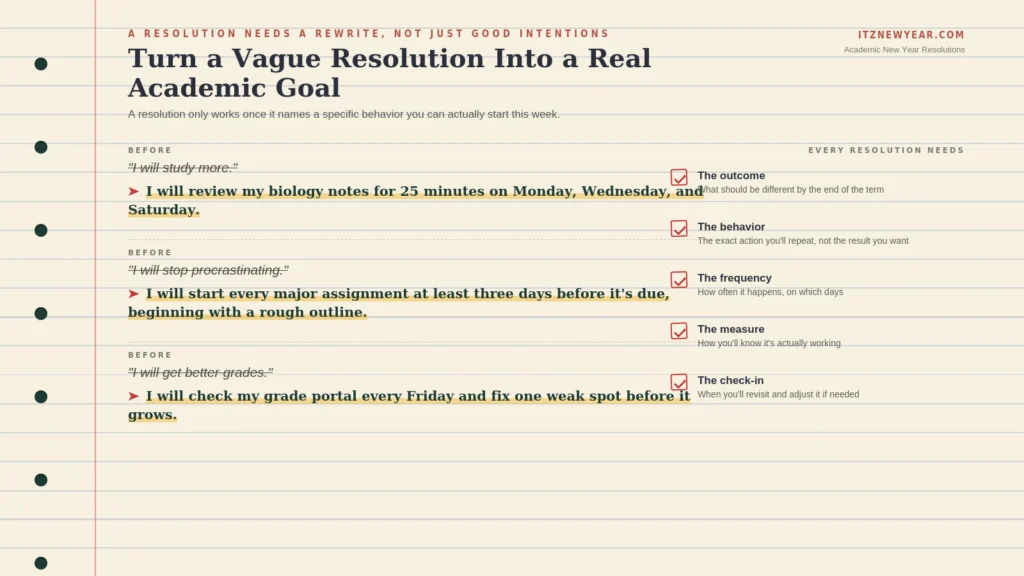
Turn a Vague Resolution Into a Real Academic Goal
A resolution becomes usable once it has five parts: what you want to happen, the specific behavior that gets you there, how often you’ll do it, how you’ll know it’s working, and when you’ll check.
Take a vague version first:
Vague: “I will study more.”
That tells you nothing about what to actually do this week. Compare it with a specific version:
Specific: “I will review my biology notes for 25 minutes on Monday, Wednesday, and Saturday.”
The second version has an outcome (stronger grasp of biology material), a behavior (reviewing notes), a frequency (three set days), and an implied way to measure it (did the sessions happen, and did quiz scores move). That is close to what people mean by a SMART goal: specific, measurable, achievable, relevant, and time-bound. The label matters less than the habit of checking a resolution against each of those five questions before writing it down.
A second example shows the same shift:
Vague: “I will stop procrastinating.”
Specific: “I will start every major assignment at least three days before it’s due, beginning with a rough outline.”
Once a goal is this specific, adjusting it becomes easy. If three days turns out to be too little buffer, change it to four. If Saturday study sessions keep getting skipped, move them to a different day. A specific goal can be corrected. A vague one can only be abandoned.
Choose Goals Based on Your Biggest Academic Problem
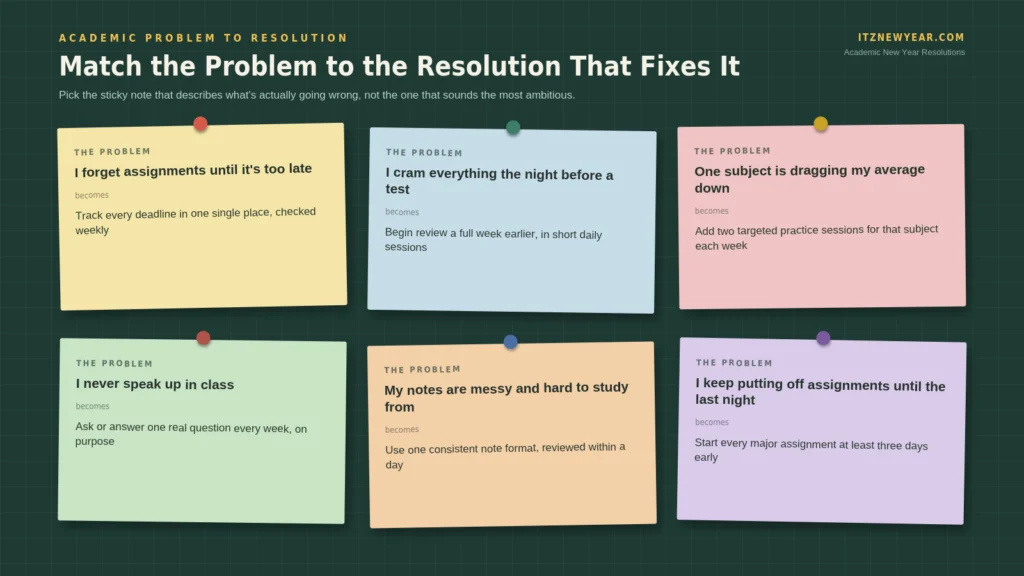
Trying to fix everything about how you learn in one semester usually means fixing nothing. It works better to identify the one or two problems actually costing you the most, and build a resolution around those first.
| If your problem is… | Consider a resolution about… |
|---|---|
| I forget assignments | Tracking every deadline in one place |
| I cram before tests | Beginning review several days earlier |
| I struggle in one subject | Targeted practice sessions each week |
| I don’t participate in class | Asking or answering one question regularly |
| My notes are messy or incomplete | A consistent note-taking system |
| I put off starting assignments | Starting on a set day, not the night before |
| I lose track of school materials | A weekly file and folder check |
| I don’t understand lessons in time | Asking for clarification before the next test |
A student showing more than one of these patterns should still pick the one causing the most damage right now. The rest can wait for next semester.
How to Keep Your Academic Goals Alive Beyond January
An academic resolution set in January and never revisited tends to quietly disappear by spring. What keeps it alive is a habit of checking in, not motivation.
A short weekly check-in works better than a single dramatic New Year’s commitment. That can be as simple as five minutes on a Sunday: did the planned study sessions happen this week, and is the goal still the right one. A monthly check against actual grades and teacher feedback adds a second layer, since it shows whether the behavior is actually producing the intended result.
This lines up with what education researchers call self-regulated learning. The Education Endowment Foundation’s guidance on metacognition describes stronger student outcomes when learners are explicitly taught to plan their approach, monitor how it’s going, and evaluate the result, rather than relying on effort alone. Applied to a resolution, that looks like: plan the specific behavior, monitor whether it’s happening, evaluate whether it’s working, and adjust.
Adjustment is normal, not a sign of failure. If a goal turns out to be unrealistic, too vague, or aimed at the wrong problem, replace it rather than forcing it to work as written. A goal that gets revised in March based on real information is more useful than one that gets abandoned in silence.
Involving a teacher, tutor, or mentor in this check-in process can help too, mainly because an outside perspective catches patterns a student might miss on their own, such as consistently underestimating how long an assignment will take.
Academic Resolutions That Support Better Learning, Not Just Better Grades
Grades measure a narrow slice of what actually makes someone a stronger student. A resolutions list focused only on GPA misses habits that build real academic ability over time.
Curiosity is one of them. A resolution to read or explore one topic outside the required curriculum each month builds background knowledge that pays off across subjects, not just the one it came from.
How a student responds to mistakes matters just as much. Stanford’s student learning materials describe a growth mindset as treating setbacks and challenges as chances to try a different strategy rather than evidence of a fixed limit. A resolution built around this might be as simple as reviewing every wrong answer on a test instead of only checking the score, or replacing “I’m bad at this” with “I haven’t figured this out yet.”
Seeking feedback before it’s required, rather than only receiving it after a grade is final, is another habit worth its own resolution. So is choosing to work through a difficult topic instead of quietly avoiding it, since avoided material has a way of resurfacing on a final exam.
These goals are harder to measure than a grade, but they are the habits that make future academic goals easier to hit.
Quick List of Copy-Ready Academic New Year Resolutions
Use any of these as written, or adjust the specifics to fit your own schedule and classes.
Study and learning
- I will review my notes within a day of each class instead of waiting until the week of the test.
- I will study my hardest subject first each day, while my focus is strongest.
- I will rewrite key concepts from memory once a week to check what I actually understand.
Grades and subject improvement
- I will check my grade portal every Friday and address one issue before it grows.
- I will redo every missed test question and write out the correct reasoning.
- I will give my weakest subject two extra focused sessions each week.
Organization
- I will track every assignment and due date in one single place.
- I will preview the coming week’s deadlines every Sunday evening.
- I will clean out my school files and folders once a month.
Reading and writing
- I will read something outside of class for 15 minutes, several times a week.
- I will draft essays in two separate passes: content first, then revision.
- I will learn and actively use five new vocabulary words each week.
Participation and confidence
- I will ask one real question in class each week, even in classes where I usually stay quiet.
- I will talk to a teacher directly the same week a concept confuses me.
- I will treat one mistake per week as something to study rather than something to hide.
Procrastination and exams
- I will start major assignments at least three days before they’re due.
- I will begin exam review a full week ahead using short daily sessions.
- I will set my own deadline a day or two before the real one.
Frequently Asked Questions
What are good academic New Year’s resolutions for students?
The strongest ones target a specific academic behavior rather than a general outcome. That includes reviewing notes on a set schedule, tracking every assignment in one place, starting projects several days early, asking one question a week in a quiet class, and beginning exam review before the week it’s due. The right resolution depends on which of these areas is actually holding a student back right now.
What are some realistic school goals for the new year?
Realistic goals describe a behavior a student can actually start this week and keep up for months, not a dramatic change in identity. “Review notes for 20 minutes three times a week” is realistic. “Never procrastinate again” is not. Choosing one or two goals instead of an entire list also makes a goal far more realistic to sustain.
How do I set academic goals for the new school year?
Start by naming the one academic problem causing the most trouble, whether that’s missed deadlines, weak test scores, or messy notes. Turn it into a specific behavior with a frequency attached, decide how you’ll know if it’s working, and set a regular time to check in on it. Adjust the goal if it turns out to be unrealistic once you’re a few weeks in.
What is a good SMART goal for a student?
A SMART goal is specific, measurable, achievable, relevant, and time-bound. An example: “I will complete 15 extra practice problems for algebra every week and review every mistake, to raise my next unit test score.” It names the subject, the exact action, the frequency, and what success would look like.
Should students focus on grades or learning goals?
Both matter, but they work differently. Grade-focused goals show where you’re headed. Learning-focused goals, like reviewing mistakes or trying a new study strategy, describe what to actually do to get there. A resolutions list built entirely around grades tends to leave a student with nothing to act on until report cards arrive, which is too late to matter.
How many academic resolutions should a student make?
There’s no fixed number that works for everyone, but one or two well-defined goals are usually more sustainable than a long list. A short list makes it realistic to actually track progress and adjust when something isn’t working, which matters more than how many resolutions get written down in January.
What are good academic goals for high school students?
High school goals often center on GPA in specific classes, building a study system that holds up under a heavier course load, starting long-term assignments earlier, and preparing for exams with spaced review instead of last-minute cramming. College and career planning can factor in, but the resolution itself should stay focused on this year’s coursework.
Can I start a new school-year goal after January?
Yes. A goal doesn’t need to start on January 1 to count. A new semester, a new term, or simply the week after a disappointing test result are all reasonable points to set or reset an academic resolution. What matters is picking a real starting point and sticking with the check-in habit from there.
Leave a Reply
You must be logged in to post a comment.