
Becoming a better version of yourself does not mean becoming a different person. It means getting more intentional about the person you already want to be, and building a year around a few changes that actually matter instead of a long list you abandon by February. This guide walks through that process: figuring out what to focus on, turning it into real behavior, and adjusting as the year goes on.
Start by Defining What Your “Best Self” Actually Means
“Best version of yourself” gets used so often that it has started to mean everything and nothing. For some people it quietly becomes a stand-in for thinner, richer, more productive, or more impressive than everyone else. That version of the phrase sets people up to feel behind no matter what they accomplish.
A more useful definition: your best self is the version of you that is living closer to your own values, handling your actual responsibilities well, and making room for the people and things that matter to you. It is not about matching someone else’s routine or output.
That means two people can both be working on becoming their best selves and end up doing completely different things. One might be learning to rest without guilt after years of overworking. Another might be building the discipline to finish things they start. Neither is more “correct.” The right target depends on where you actually are, not on a generic standard borrowed from social media or a productivity book.
Realistic expectations matter here too. Growth this year does not mean fixing every flaw or reaching some final, finished version of yourself. It means making a set of changes that move you in a direction you actually care about.
Look Back Before You Decide What to Change
Deciding what to work on is easier once you have looked honestly at the year behind you. This does not need to be an elaborate journaling exercise, just a few direct questions, answered in a notes app or on paper, that take ten minutes and give you something real to work from instead of a vague sense that things should be different.
What worked well?
Note the habits, decisions, or periods of the past year that actually made things better, even briefly. If a specific routine, relationship, or change worked for a few months before it slipped, that is useful information about what fits your life, not a failure to feel bad about.
What drained you?
Look for the patterns that consistently left you tired, resentful, or stretched too thin. This might be a work habit, an overcommitted schedule, a relationship dynamic, or simply not enough sleep. Naming it clearly is the first step toward addressing it.
What do you want more of this year?
This could be more time with specific people, more focus on a skill, more physical energy, or more space in your schedule. Being specific here matters more than being ambitious.
What needs to change?
This is where you name the one or two things that, if they stayed exactly the same, would make next December feel a lot like this one.
These four questions, answered honestly, usually surface more useful direction than a generic list of resolutions ever could.
Choose the Few Areas That Deserve Your Attention
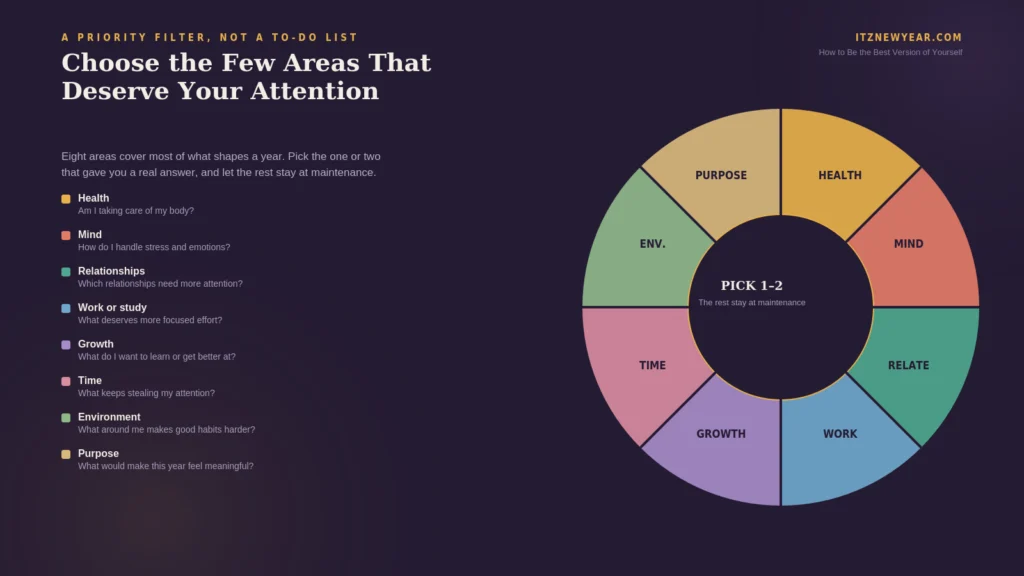
Trying to improve everything at once is one of the most common reasons personal growth plans fall apart. A more realistic approach is to look across a small set of life areas and identify which ones genuinely need attention right now.
| Area | Ask yourself |
|---|---|
| Health | Am I taking care of my body? |
| Mind | How do I handle stress and emotions? |
| Relationships | Which relationships need more attention? |
| Work or study | What deserves more focused effort? |
| Growth | What do I want to learn or get better at? |
| Time | What keeps stealing my attention? |
| Environment | What around me makes good habits harder? |
| Purpose | What would make this year feel meaningful? |
You do not need a plan for all eight. Read through the list and notice which two or three questions actually gave you a real answer, not a vague one. Those are the areas that deserve your attention this year.
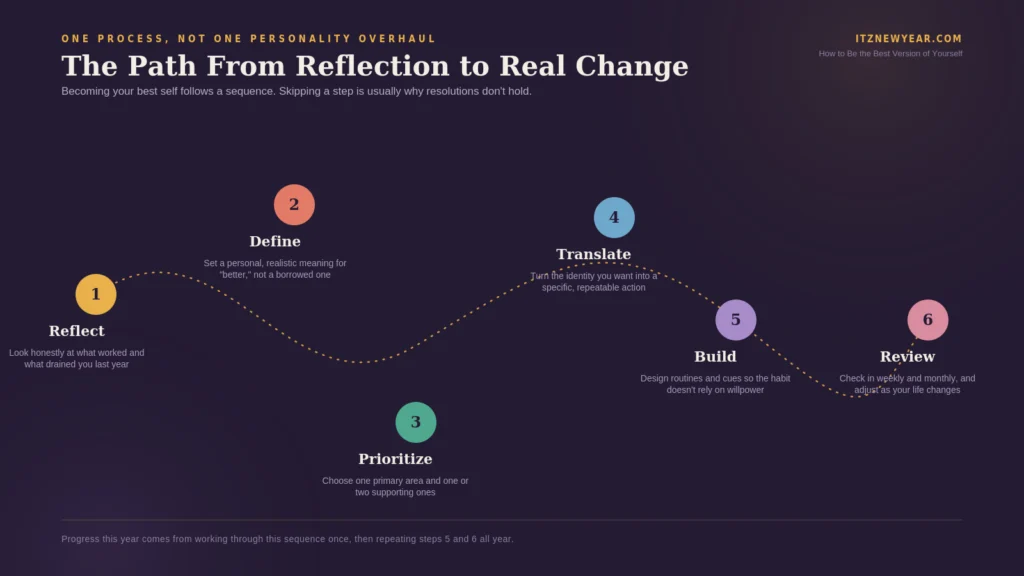
From there, pick one primary area to focus most of your energy on, one or two supporting areas you’ll make smaller improvements in, and treat everything else as maintenance: keep it steady, but don’t try to overhaul it right now. This is what actually separates a workable plan from an overwhelming one.
Turn the Person You Want to Become Into Specific Behaviors
Once you know which area matters most, the next step is translating that into something you can actually do. This is where most personal growth plans quietly fall apart, because “be healthier” or “be more confident” cannot be acted on directly.
Replace vague goals with observable actions
A useful way to bridge this gap is to ask what the person you want to become would actually do on a regular Tuesday.
“I want to be healthier” becomes: this person prepares food ahead of time, moves their body most days, and protects their sleep.
“I want to be more confident” becomes: this person speaks up in meetings even when unsure, follows through on commitments to themselves, and stops over-apologizing.
“I want to be more present” becomes: this person puts their phone in another room during meals, finishes conversations without checking notifications, and gives people their full attention for short stretches.
Each of those descriptions can be broken into a specific action you could start this week.
Use small actions that are easy to repeat
Behavior that is easy to repeat tends to outlast behavior that depends on a burst of motivation. A ten-minute walk after dinner is more sustainable than an hour-long workout you can only manage a few times before skipping it entirely.
Research on habit formation, including work by USC psychologist Wendy Wood featured by the American Psychological Association, points out that much of daily behavior runs on automatic routines shaped by context and repetition rather than ongoing willpower. That is good news: it means the goal is not to summon more discipline, but to pick an action small enough to repeat until it becomes automatic.
Create if-then plans
A specific plan closes the gap between intending to do something and actually doing it. Instead of “I should walk more,” try: “If I finish dinner, then I will walk for ten minutes.” Instead of “I should read more,” try: “If I get into bed, then I will read two pages before checking my phone.” This approach, known as an implementation intention, works because it attaches the new behavior to something that already happens reliably, instead of relying on remembering to do it.
Here is how a few common vague goals translate into this format:
| Vague goal | Better behavioral version | Example cue |
|---|---|---|
| Become healthier | Walk after dinner 4 days a week | After dinner |
| Read more | Read 10 pages before bed | After brushing teeth |
| Be more organized | Spend 10 minutes resetting your workspace | Before ending work |
| Improve relationships | Call one family member each week | Sunday afternoon |
| Learn something new | Practice a skill for 20 minutes, three times a week | After breakfast |
Build a Daily Life That Makes Your Goals Easier
Motivation gets people started, but it is unreliable for keeping something going over months. Your environment does a lot of the work motivation gets credit for.
Make good choices easier
If you want to eat better, keep prepared food visible in the fridge instead of buried behind everything else. If you want to read more, leave the book on your pillow instead of on a shelf. Reducing the number of steps between deciding to do something and actually doing it makes the behavior far more likely to happen.
Add friction to habits you want to reduce
The same principle works in reverse. If you want to spend less time scrolling before bed, charge your phone in another room. If you want to stop snacking mindlessly at your desk, don’t keep the snacks at your desk. Small amounts of friction are often enough to interrupt an automatic habit, since most of these behaviors happen without much conscious decision-making in the first place. The point is not to rely on willpower in the moment, since that is exactly the resource that tends to run low by the end of a long day.
Use routines, reminders, and environmental cues
Wendy Wood’s research, discussed in APA’s coverage of habit science, emphasizes redesigning your surroundings to cue better habits rather than relying on remembering to act. A gym bag by the door, a recurring calendar block, or a sticky note on the coffee maker all serve the same function: they make the desired behavior the obvious next step instead of one more thing to remember.
Work on the Parts of Life That Shape How You Feel
A few consistent habits tend to affect how you feel across every other goal you’re working on, which is why they’re worth a baseline level of attention even if they are not your primary focus this year.
- Sleep is one of them. Consistently poor sleep makes it harder to manage stress, stay focused, and follow through on other goals, which is part of why it deserves protection rather than being the first thing sacrificed to a busy schedule.
- Movement is another. The CDC notes that physical activity has both immediate effects, like reduced anxiety and better sleep quality, and longer-term effects on heart health, brain health, and chronic disease risk. None of this requires an intense workout plan. Regular, moderate movement is enough to get most of these benefits.
- Relationships and connection matter just as much as physical health. The World Health Organization includes connecting with others alongside sleep and physical activity as part of its guidance on self-care and well-being. A short check-in call or a recurring dinner with a friend does more for how you feel over a year than most standalone wellness habits.
- Learning and recreation round this out. Making time for a skill you’re curious about, or simply an activity you enjoy without a productivity purpose attached, keeps the year from feeling like an extended obligation.
- None of these need a dedicated program. A short walk, a protected bedtime, one meaningful call a week, and an hour for something you enjoy cover a lot of ground without turning into a second set of resolutions to manage.
Protect Your Time, Energy, and Attention
Adding new goals is only half of the picture. Most people also need to remove something to make room for what they actually want.
This often looks like:
- Saying no to a commitment that no longer fits your priorities
- Setting a boundary around time that keeps getting absorbed by other people’s requests
- Cutting back on a digital habit that quietly eats hours without adding much
- Protecting a block of focused time instead of letting it get filled by whatever comes up
A calendar and a to-do list that are already full leave no space for anything new, no matter how well-designed the new habit is. Before adding another commitment, it is worth asking what you are willing to let go of to make room for it.
Stop Measuring Your Progress Against Other People
Comparing your year to someone else’s highlight reel is one of the fastest ways to feel like you’re falling behind, regardless of how much progress you’re actually making. Social media in particular shows curated moments, not the ordinary stretches in between, which makes any real comparison inaccurate from the start.
People are also working with different circumstances: different responsibilities, health, financial situations, and starting points. A pace that looks slow next to someone else’s might be exactly right given what you’re actually managing.
A more useful comparison is your own life a few months ago. Are you handling the thing that used to stress you out more calmly? Did you follow through on something you used to put off? That comparison is grounded in your actual circumstances, and it’s the only one that tells you anything real about your progress.
Other people’s progress can still be useful as inspiration, showing you what’s possible, without needing to become the standard you judge yourself against.
Know What to Do When You Fall Off Track
At some point this year, something will interrupt whatever routine you’ve built. A busy week, a trip, an illness, or just a stretch of low motivation will get in the way. What you do next matters more than the interruption itself.
Missing a few days is not the same as abandoning the goal, even though it can feel that way in the moment. The more useful response is to get specific: what actually caused the disruption? A schedule change, an unrealistic plan, or simply exhaustion all call for different fixes.
If the original version of the habit isn’t working, scale it down rather than dropping it. A ten-minute walk is easier to restart than a full workout routine you’ve been avoiding for two weeks. The goal is to keep the behavior alive in some form, even a small one, rather than waiting for the conditions to be perfect again. Restarting at a smaller scale still counts as consistency. It is not a downgrade of the goal, just a more realistic entry point back into it.
Research on behavior change, including guidance from the American Psychological Association, points to realistic goals and self-compassion after setbacks as more effective than harsh self-criticism. Treating one missed week as proof that the whole effort has failed is usually what turns a temporary lapse into a permanent one.
Review Your Progress Instead of Waiting Until Next December
A plan set in January and never revisited tends to drift. Regular, low-effort check-ins keep it relevant.
Weekly check-in
A few minutes at the end of the week is enough to ask whether the planned actions actually happened, and whether anything got in the way.
Monthly reset
Once a month, take a slightly longer look:
- What’s working?
- What isn’t?
- What should I stop?
- What should I continue?
- What needs adjusting?
This monthly rhythm catches problems early, before a habit that isn’t working quietly disappears without ever getting fixed.
Let your goals change when your life changes
A goal set in January might not fit by June, especially if your circumstances shift. A new job, a health issue, or a change in a relationship can all reasonably change what deserves your attention. Adjusting the goal is not giving up on it. It’s keeping the goal connected to your actual life instead of an outdated plan.
Simple Questions to Help You Become a Better Version of Yourself This Year
Come back to these periodically, not just in January:
- What do I want more of this year?
- What do I need less of?
- What single habit would make several areas of my life easier at once?
- What am I avoiding?
- Which relationship deserves more attention right now?
- What skill would genuinely improve my life or work?
- What boundary do I need to set?
- What would make me proud when I look back at this year?
FAQs
What does it mean to be the best version of yourself?
It means living in closer alignment with your own values and priorities, not matching a generic standard of productivity, appearance, or success. It’s a personal definition, and it looks different for everyone depending on their circumstances and what actually matters to them.
How can I become the best version of myself this year?
Reflect honestly on the year behind you, choose one or two areas that genuinely need attention, translate that into specific, repeatable behaviors, build an environment that supports them, and check in regularly so you can adjust as your life changes.
What are good goals for personal growth?
Rather than a fixed list, good personal growth goals usually fall into a few categories: physical and mental well-being, relationships, learning, and how you spend your time and attention. The right goal depends on which of these areas is actually holding you back right now.
How do I start improving myself?
Start with one behavior that connects to the area of your life you most want to change, and make it small enough to repeat consistently. Trying to change everything at once is a common reason people give up within a few weeks.
How can I become a better version of myself without getting overwhelmed?
Pick one primary focus area for the year, one or two supporting areas, and let everything else stay at maintenance level. Overwhelm usually comes from trying to improve too many things simultaneously, not from having high standards.
Can I become a better version of myself without changing everything?
Yes. Meaningful growth usually comes from a small number of consistent changes, not a complete overhaul. Most of who you are and how you live is probably already working. The goal is refining a few specific things, not replacing your entire life.
Leave a Reply
You must be logged in to post a comment.