
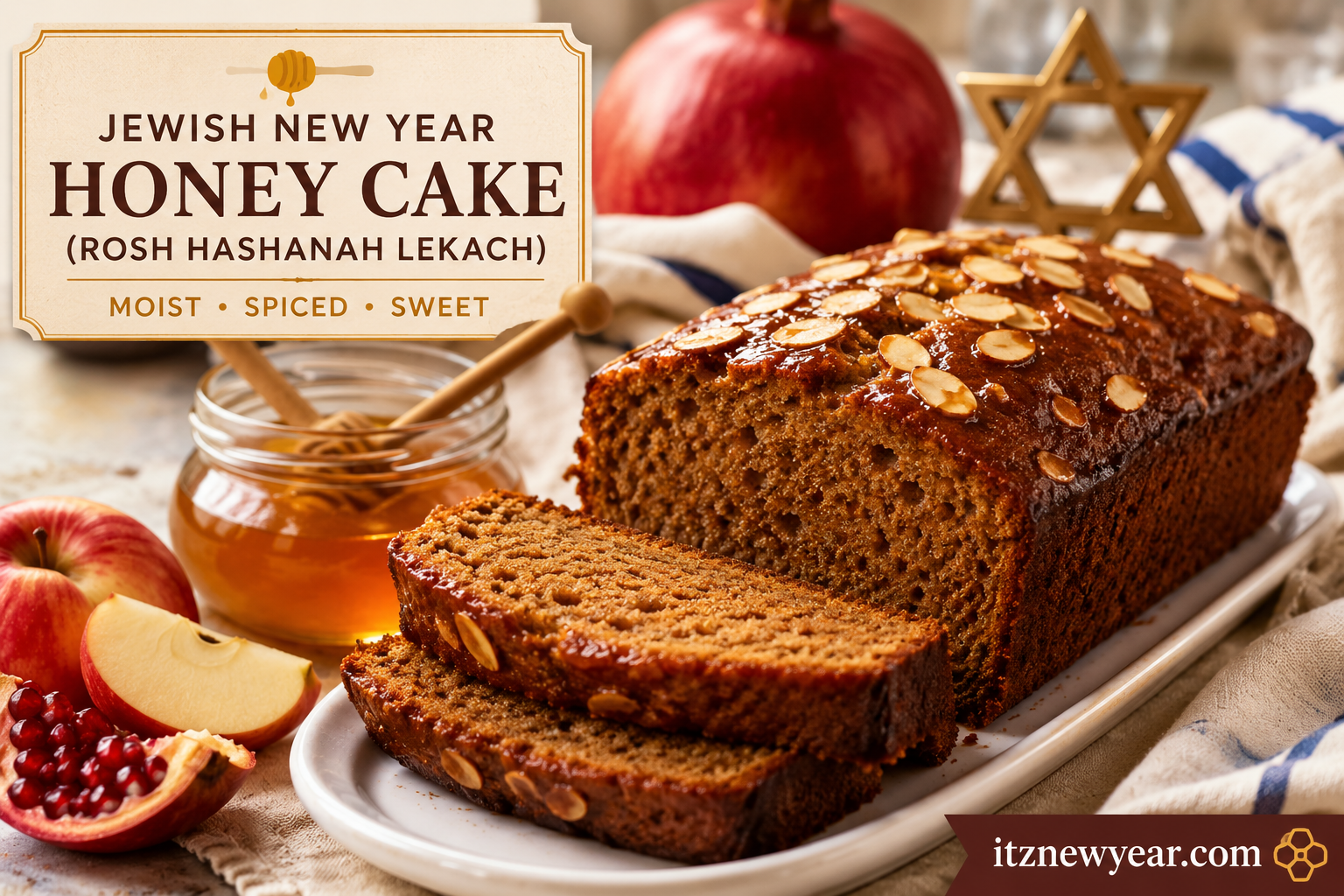
This honey cake is a moist, deeply spiced loaf made with honey, brown sugar, oil, and warm spices, baked low and slow so it stays dense and sliceable rather than dry. It’s traditionally associated with Rosh Hashanah, the Jewish New Year, where honey on the table represents the hope for a sweet year ahead. In Yiddish it’s often called lekach. The full recipe, with exact quantities and timing, is below, along with six variations, a troubleshooting guide, and storage instructions.
Quick Recipe Summary
| PREP TIME | COOK TIME | TOTAL TIME | SERVINGS | PAN | OVEN |
| 15 min | 60 min | 1 hr 40 min* | 12 slices | 9×5 in loaf | 350°F (175°C) |
Total time includes about 25 minutes of cooling before slicing.
What Is Jewish New Year Honey Cake?
Honey cake is a spiced, honey-sweetened loaf cake traditionally associated with Rosh Hashanah, the Jewish New Year, which falls in the Hebrew month of Tishrei, usually in September or October. Rosh Hashanah is not connected to January 1, since the Hebrew calendar is lunisolar and the holiday shifts each year on the Gregorian calendar.
In Yiddish, this cake is often called lekach. The word appears in Ashkenazi Jewish baking traditions going back generations, traditionally served at Rosh Hashanah meals and sometimes at other honey-associated occasions, such as after a baby naming, where a sweet taste is meant to represent a sweet start.
Not every Jewish family serves honey cake, and recipes vary widely by family, country of origin, and personal preference. Sephardic, Mizrahi, and Ashkenazi households don’t all follow the same food customs, and even within Ashkenazi families, recipes for lekach differ from house to house. What stays consistent is the symbolism: honey stands in for the wish for a sweet year, most commonly expressed by dipping apple slices in honey and by baking it into this cake.
Note: Rosh Hashanah and January 1 are separate holidays on separate calendars. This article uses Rosh Hashanah dates and customs throughout and does not refer to the Gregorian New Year.
The recipe below is an original recipe, developed using the flavor logic and technique common to Ashkenazi-style lekach (honey, brown sugar, warm spices, coffee for depth), rather than a copy of any specific family’s heirloom recipe or a published recipe from another source. Treat it as one workable version of honey cake, not the definitive one.
The Recipe: Classic Rosh Hashanah Honey Cake
This version leans into deep spice and a moist, tight crumb, using brewed coffee to round out the honey’s sweetness without tasting like coffee once baked. It keeps well, which is part of why honey cake is often made a day or two ahead of the holiday meal.
Ingredients
Dry ingredients:
- 2 1/2 cups (300 g) all-purpose flour
- 1 teaspoon baking powder
- 1 teaspoon baking soda
- 1/2 teaspoon fine salt
- 1 1/2 teaspoons ground cinnamon
- 1/2 teaspoon ground ginger
- 1/4 teaspoon ground cloves
Wet ingredients:
- 1 cup (340 g) honey
- 3/4 cup (150 g) packed light brown sugar
- 1/2 cup (120 ml) neutral vegetable oil, plus more for the pan
- 3 large eggs, room temperature
- 3/4 cup (180 ml) brewed coffee, cooled (or see substitutions)
- 1/4 cup (60 ml) orange juice
- 1 teaspoon vanilla extract
Optional topping: 2 tablespoons sliced almonds or 1 tablespoon coarse sugar, scattered over the batter before baking.
Instructions
- Set a rack in the center of the oven and preheat to 350°F (175°C). Grease a 9×5 inch loaf pan and line it with parchment paper, leaving an overhang on the long sides for easy removal.
- In a medium bowl, whisk together the flour, baking powder, baking soda, salt, cinnamon, ginger, and cloves. Set aside.
- In a large bowl, whisk the honey, brown sugar, and oil until the sugar begins to dissolve and the mixture looks glossy, about 1 minute.
- Whisk in the eggs one at a time, then whisk in the cooled coffee, orange juice, and vanilla. The batter will look thin at this stage, which is expected.
- Add the dry ingredients to the wet ingredients in two additions, folding gently with a spatula just until no streaks of flour remain. Do not overmix, or the cake will bake up tough instead of tender.
- Pour the batter into the prepared pan and scatter the almonds or coarse sugar on top, if using.
- Bake for 55 to 65 minutes, tenting the top loosely with foil after 35 minutes if it’s browning quickly. The cake is done when a toothpick inserted in the center comes out with a few moist crumbs, not wet batter, and the top springs back when pressed lightly.
- Cool the cake in the pan on a wire rack for 20 minutes, then lift it out using the parchment overhang and cool completely on the rack, about 1 hour, before slicing.
Doneness Cues
- A toothpick inserted in the thickest part comes out with a few moist crumbs clinging to it, not raw batter.
- The top of the cake springs back slowly when pressed gently in the center.
- The edges have pulled away slightly from the sides of the pan.
- An instant-read thermometer inserted in the center reads about 200 to 205°F (93 to 96°C).
Food safety note: this batter contains raw eggs, so avoid tasting it before baking. Once the cake reaches the doneness cues above, it’s fully baked and safe to eat.
Substitutions
- No coffee on hand: replace the 3/4 cup brewed coffee with 3/4 cup strongly brewed black tea, or 3/4 cup additional orange juice for a caffeine-free version. The flavor shifts slightly toward brighter and less deep, but the texture holds.
- Honey swap: any pourable honey works. Very thick or raw honey can be warmed for 15 seconds in the microwave so it mixes in easily.
- Oil swap: melted and cooled unsalted butter or melted coconut oil can replace the vegetable oil in equal amount, though the crumb will be slightly less moist with butter.
- Spice adjustment: 1 1/2 teaspoons of a pre-mixed pumpkin pie spice can replace the cinnamon, ginger, and cloves in a pinch.
Storage and Freezing
Store the cooled cake wrapped tightly in plastic wrap, or in an airtight container, at room temperature for up to 5 days. Honey cake is one of those bakes that tends to taste better on day two, once the spices and honey have had time to settle into the crumb. Refrigeration isn’t necessary and can dry the cake out faster, but it will keep refrigerated for up to 10 days if your kitchen is warm.
To freeze, wrap the fully cooled, unsliced cake tightly in plastic wrap, then in a layer of foil, and freeze for up to 3 months. For easier portioning later, you can also freeze individual slices separated by parchment in a freezer bag. Thaw overnight at room temperature, still wrapped, so condensation forms on the wrapping instead of the cake.
Nutrition (Estimated, Per Slice)
| Calories | Carbs | Sugar | Protein | Fat | Fiber | Sodium |
| about 330 | about 55 g | about 36 g | about 4 g | about 10 g | about 1 g | about 230 mg |
Nutrition is an estimate calculated from the ingredients and quantities in this recipe, divided across 12 slices. Actual values will vary based on specific brands and any substitutions used.
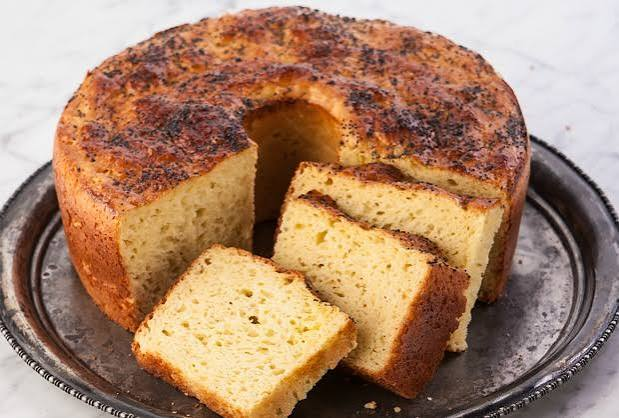
Honey Cake Variations at a Glance
Six ways to adapt the classic recipe above, each changing the cake for a specific reason rather than just swapping one ingredient for the sake of variety.
| Variation | Key Change | Best For | Bake Time |
| Gluten-Free Honey Cake | 1:1 gluten-free flour blend | Gluten-free guests | 55 to 65 min, same pan |
| Egg-Free Honey Cake | Flax eggs replace whole eggs | Egg allergies | 60 to 70 min, same pan |
| Whiskey-Spiked Honey Cake | Part of the coffee replaced with whiskey | An adults-only version | 55 to 65 min, same pan |
| Apple-Honey Cake | Grated apple folded into the batter | Extra moisture, apple-and-honey symbolism | 60 to 70 min, same pan |
| Mini Loaves or Muffins | Same batter, smaller pans | Gifting and portion control | 18 to 22 min, muffin tin |
| Nut-Free Gift Cake | Seed topping instead of almonds | Schools, synagogues, shared tables | 55 to 65 min, same pan |
Honey Cake Variations
Gluten-Free Honey Cake
Replace the all-purpose flour with 300 g (about 2 1/2 cups) of a 1:1 gluten-free baking blend that already contains xanthan gum. Everything else in the classic recipe stays the same. Because gluten-free blends absorb liquid differently, check the cake at 50 minutes and expect it to finish closer to 55 to 65 minutes, with a slightly more delicate, tighter crumb than the wheat-flour version.
Stats: Prep 15 min, cook 55 to 65 min, total about 1 hr 40 min, 12 slices, same 9×5 in pan, 350°F (175°C).
Doneness: same toothpick and springback test as the classic recipe; gluten-free crumb can look slightly wetter even when done, so rely on the toothpick over visual color.
Storage: keeps 3 to 4 days at room temperature, slightly shorter than the wheat version since gluten-free bakes tend to dry out faster; freezes well for up to 3 months.
Nutrition estimate per slice: about 335 calories, 56 g carbs, 36 g sugar, 3 g protein, 10 g fat, 230 mg sodium.
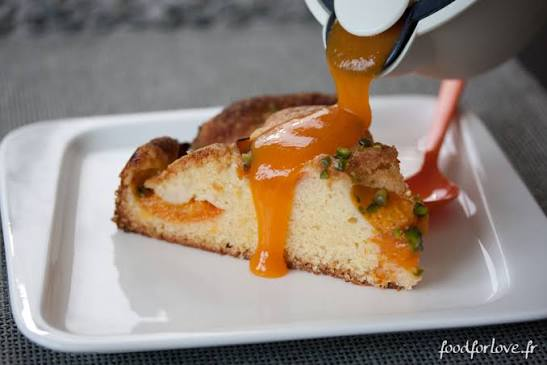
Egg-Free Honey Cake
Replace the 3 eggs with 3 flax eggs, made by whisking 3 tablespoons of ground flaxseed with 9 tablespoons of water and letting the mixture sit for 5 minutes until gel-like. Whisk the flax eggs in where the recipe calls for eggs. The batter will be slightly thicker going in, and the baked cake will be a touch denser, with a subtly nuttier flavor from the flax.
Stats: Prep 20 min (includes flax-egg resting time), cook 60 to 70 min, total about 1 hr 50 min, 12 slices, same 9×5 in pan, 350°F (175°C).
Doneness: toothpick test still applies, but expect a slightly longer bake since flax eggs hold more moisture than whole eggs.
Storage: keeps 4 to 5 days at room temperature; freezes well for up to 3 months.
Nutrition estimate per slice: about 315 calories, 56 g carbs, 36 g sugar, 3 g protein, 9 g fat, 2 g fiber, 225 mg sodium.
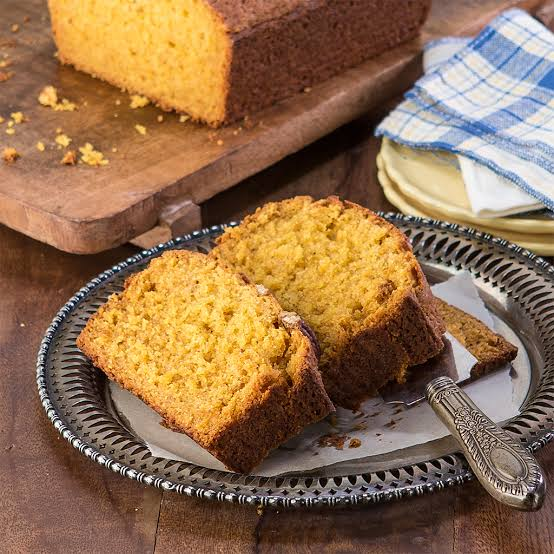
Whiskey-Spiked Honey Cake
Replace 1/4 cup of the brewed coffee with 1/4 cup whiskey or bourbon, keeping the remaining 1/2 cup coffee as in the classic recipe. The alcohol mostly bakes off in the oven, leaving a warm, slightly boozy background note rather than a strong alcohol flavor. This version is meant for an adult-only table and should be labeled clearly if served alongside the classic cake.
Stats: Prep 15 min, cook 55 to 65 min, total about 1 hr 40 min, 12 slices, same 9×5 in pan, 350°F (175°C).
Doneness: identical to the classic recipe; the whiskey does not change bake time in any meaningful way.
Storage: keeps 5 days at room temperature, slightly longer than the classic version since alcohol acts as a mild preservative; freezes well for up to 3 months.
Nutrition estimate per slice: about 340 calories, 55 g carbs, 36 g sugar, 4 g protein, 10 g fat, 230 mg sodium.
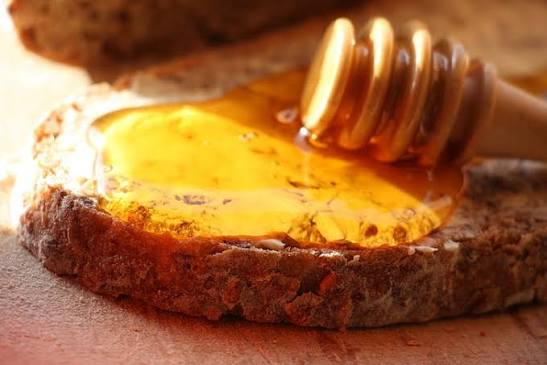
Apple-Honey Cake
Fold 1 cup (about 1 medium apple) of peeled, finely grated apple into the batter after combining the wet and dry ingredients, and reduce the oil to 6 tablespoons (90 ml) to account for the extra moisture the apple adds. This version leans into the apples-and-honey pairing served at many Rosh Hashanah tables and bakes up noticeably moister than the classic loaf.
Stats: Prep 20 min (includes grating the apple), cook 60 to 70 min, total about 1 hr 50 min, 12 slices, same 9×5 in pan, 350°F (175°C).
Doneness: check at 55 minutes; the added moisture from the apple means it can need a few extra minutes, and the toothpick may show a slightly moister crumb even when fully baked.
Storage: keeps 3 to 4 days at room temperature due to the added moisture; freezes well for up to 3 months.
Nutrition estimate per slice: about 320 calories, 57 g carbs, 37 g sugar, 4 g protein, 8 g fat, 2 g fiber, 225 mg sodium.
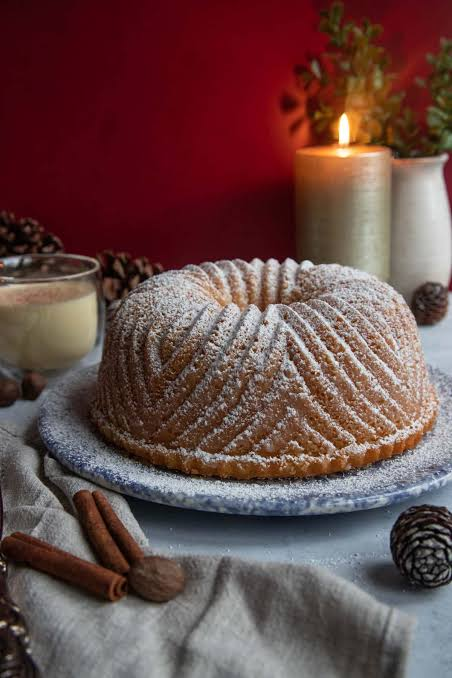
Mini Loaves or Muffins
Divide the classic batter among a standard 12-cup muffin tin, filling each cup about two-thirds full, or among 3 mini loaf pans. This version is useful for gifting, since individual portions travel and wrap more easily than slices from a full loaf, and it’s a common way to share honey cake with neighbors or synagogue members before the holiday.
Stats: Prep 15 min, cook 18 to 22 min for muffins (30 to 35 min for mini loaves), total about 50 min for muffins, yields 18 muffins, 350°F (175°C).
Doneness: same toothpick test, checked at the low end of the time range first since smaller portions bake faster and can dry out if left too long.
Storage: keeps 4 to 5 days at room temperature in an airtight container; freezes well for up to 3 months, and individual muffins thaw in under an hour.
Nutrition estimate per muffin (of 18): about 220 calories, 37 g carbs, 24 g sugar, 3 g protein, 7 g fat, 155 mg sodium.
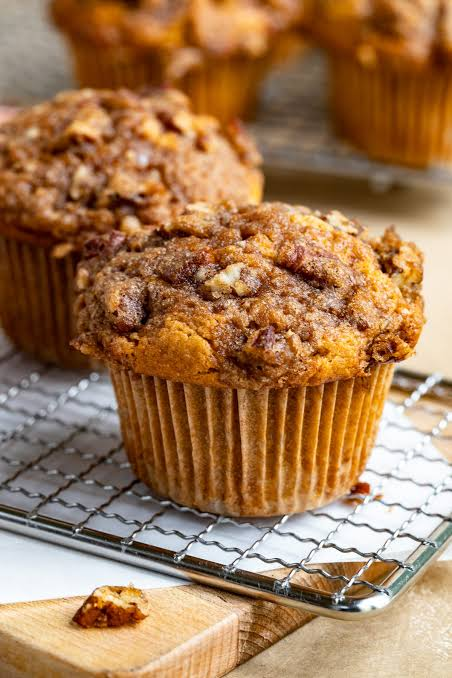
Nut-Free Gift Cake
The classic recipe already contains no nuts in the batter itself, so this version is about the topping and packaging rather than the batter. Skip the almond topping and use 1 tablespoon of sesame seeds or coarse sugar instead, and confirm any shared kitchen surfaces are nut-free if this cake is headed to a school or synagogue potluck where allergies need to be taken seriously.
Stats: Prep 15 min, cook 55 to 65 min, total about 1 hr 40 min, 12 slices, same 9×5 in pan, 350°F (175°C).
Doneness: identical to the classic recipe.
Storage: identical to the classic recipe, up to 5 days at room temperature or 3 months frozen.
Nutrition estimate per slice: about 328 calories, 55 g carbs, 36 g sugar, 4 g protein, 10 g fat, 230 mg sodium, essentially the same as the classic recipe since only the topping changes.
Troubleshooting Common Honey Cake Problems
- Cake sank in the middle: usually means it came out of the oven too early. Honey cake batter is dense and needs the full bake time to set; pull it 5 minutes after the toothpick test looks clean rather than at the first sign of doneness. Old baking soda or baking powder can also cause this, since weak leaveners let the center collapse as it cools.
- Cake is dry or crumbly: usually overbaking, or too much flour packed into the measuring cup. Spoon flour into the cup and level it off rather than scooping directly from the bag, and start checking doneness at the low end of the bake time range.
- Cake is too dense or gummy: usually undermixing the dry and wet ingredients unevenly, or underbaking. Fold just until no streaks of flour remain, and confirm doneness with a thermometer (200 to 205°F) rather than relying on time alone, since ovens vary.
- Top is dark or burnt before the inside is done: common with honey cakes because the sugar content browns quickly. Tent the top loosely with foil around the 30 to 35 minute mark, and consider dropping the oven temperature to 325°F (163°C) and extending the bake time by 10 to 15 minutes if this happens consistently in your oven.
- Cake sticks to the pan: parchment paper with an overhang solves this almost every time. If you’re not using parchment, grease the pan generously, including the corners, and let the cake cool for the full 20 minutes in the pan before attempting to unmold it.
- Cake tastes flat despite all the honey: usually a spice or salt issue. Salt sharpens sweetness rather than making the cake taste salty, so don’t skip it, and check that your ground spices are still fragrant. Cinnamon and ginger lose potency after about a year in the pantry.
Frequently Asked Questions
What is Jewish New Year honey cake called?
It’s commonly called lekach, a Yiddish word used in Ashkenazi Jewish baking traditions. The English name honey cake and the Yiddish name lekach refer to the same style of cake and are often used interchangeably.
Why is honey cake eaten for Rosh Hashanah?
Honey is traditionally associated with the hope for a sweet year ahead, and it appears at Rosh Hashanah meals in more than one form, most commonly apple slices dipped in honey and this baked honey cake. The custom is symbolic rather than religiously mandatory, and not every family includes it.
Is Rosh Hashanah the same as January 1?
No. Rosh Hashanah is the Jewish New Year and follows the Hebrew calendar, typically falling in September or October. January 1 marks the start of the Gregorian calendar year and is a separate holiday with no connection to Rosh Hashanah.
Can I make honey cake ahead of time?
Yes, and many bakers prefer to. The cake tends to taste better on its second day once the spices settle, so baking it 1 to 2 days before serving is common. It keeps well at room temperature, tightly wrapped, for up to 5 days.
Why did my honey cake sink in the middle?
The most likely cause is pulling it from the oven before the center fully set, since honey cake batter is dense and needs the full bake time. Weak or expired baking soda or baking powder can cause the same problem. See the troubleshooting section above for the full fix.
Can I substitute the coffee in this recipe?
Yes. Strongly brewed black tea or additional orange juice both work in place of the coffee in equal amounts. The coffee itself doesn’t come through as a coffee flavor once baked; it mostly deepens the honey and spice notes.
Does every Jewish family make honey cake the same way?
No. Honey cake recipes vary by family, country of origin, and personal taste, and not every Jewish household serves it at all. Ashkenazi, Sephardic, and Mizrahi food traditions differ, and even among Ashkenazi families, lekach recipes are passed down with plenty of individual variation.
Can honey cake be frozen?
Yes. Wrap the fully cooled cake tightly in plastic wrap and then foil, and freeze whole or in individual slices for up to 3 months. Thaw it overnight at room temperature while still wrapped.
What pan works best for honey cake?
A 9×5 inch loaf pan is standard for the classic version in this recipe. A bundt pan also works, though bake time typically runs 10 to 15 minutes longer since the batter is deeper in the center; check doneness with a toothpick rather than relying on the time alone.
Leave a Reply
You must be logged in to post a comment.