
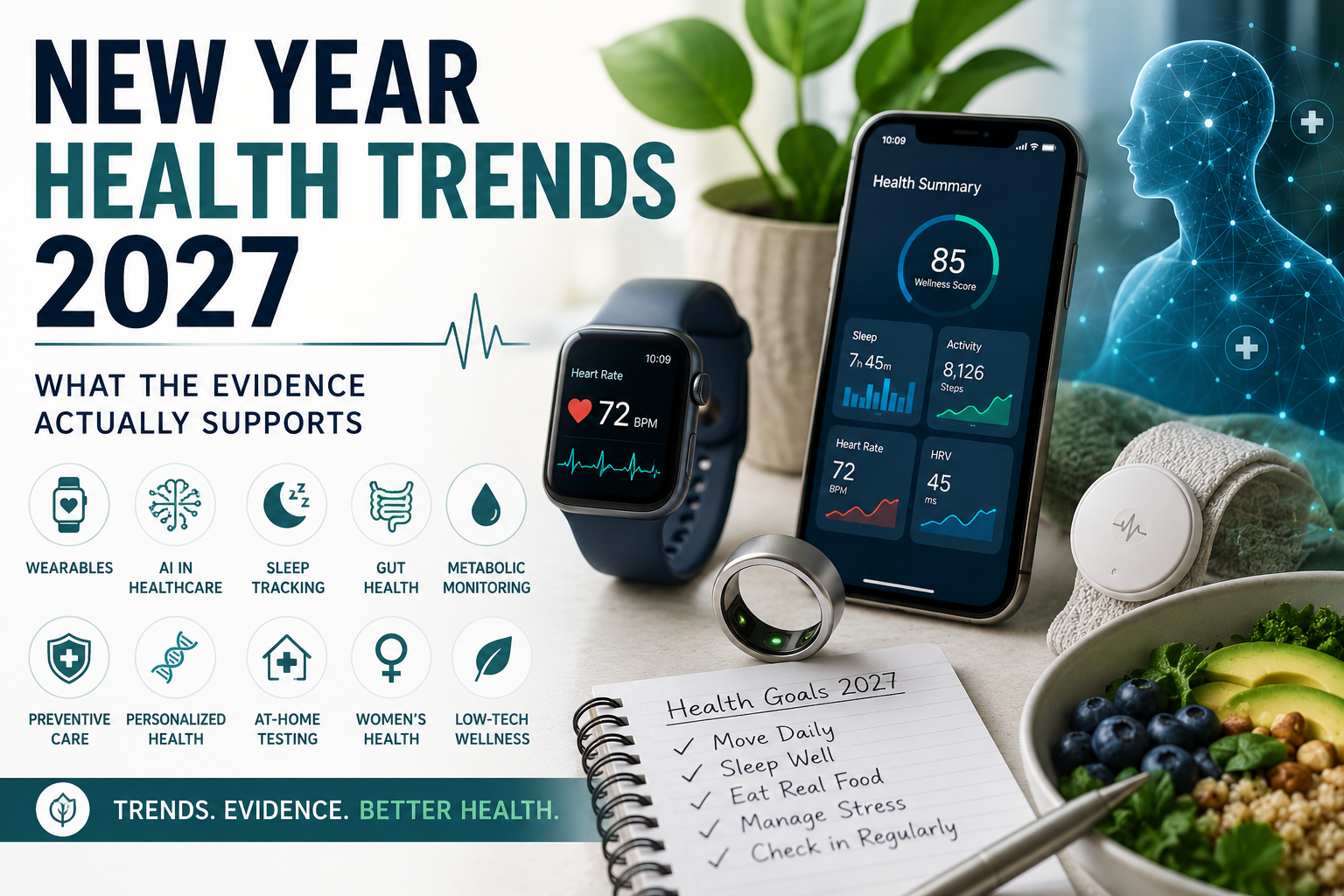
Health trends and health resolutions are not the same question. A resolution asks what you should personally change. A trend asks what is actually shifting in medicine, technology and consumer behavior right now, whether or not any individual reader adopts it. This article covers the second question heading into 2027, and it applies one rule throughout: something can be popular without being proven, and something can be well-supported without ever trending on social media.
The past year gave that distinction real weight. Wearable technology and AI-enabled medical devices kept moving deeper into actual clinical use, the FDA opened a formal process to regulate generative-AI medical tools, and research on gut health, metabolic monitoring and healthspan matured considerably. At the same time, consumer wellness marketing kept borrowing the language of that science, often faster than the science itself could keep up. Sorting one from the other is the point of this guide.
The New Year Health Trends landscape at a glance
| Trend | What’s changing | Evidence status | Main caution |
|---|---|---|---|
| Preventive, data-informed care | Earlier risk detection using screening and monitoring | Established direction, emerging tools | Overtesting, false positives |
| Wearables as health monitors | Tracking to physiological monitoring | Emerging, established for some fitness use | Accuracy varies by device and metric |
| Sleep tracking | Consumer sleep data goes mainstream | Emerging | Not a diagnostic substitute |
| Healthspan and longevity | Function over lifespan | Established concept | Heavy commercial overreach |
| Metabolic health monitoring | Glucose and cardiometabolic tracking outside diabetes care | Emerging | Overinterpreting single readings |
| Gut health science | Moving past probiotics into a broader microbiome field | Emerging, strain-specific | Generic “gut balance” claims |
| Protein and functional foods | Mainstream nutrition category | Established concept, low-certainty on newer claims | “More is always better” framing |
| AI in healthcare | Moving from chat tools into regulated devices | Rapidly emerging | Validation, bias, hallucination |
| Personalized health data | Genetics, wearables, AI combined for individual insight | Emerging | Personalization overstated |
| At-home testing | More tests performed outside clinics | Established category, uneven oversight | Clinical validity varies by test |
| Women’s health | Longitudinal, evidence-based lifespan approach | Evidence-backed | Access and equity gaps |
| Low-tech wellness | Pushback against constant optimization | Consumer/social trend | Framed as lifestyle, not treatment |
Prevention and monitoring are converging
The clearest shift in health care is a move from occasional checkups toward continuous, data-informed risk assessment. The U.S. Preventive Services Task Force still anchors this work in specific, evidence-based recommendations tied to defined populations, not blanket “test everything” advice. What’s new is the layer of monitoring sitting alongside it. Wearable and remote monitoring tools are increasingly being evaluated for real clinical use, including physical activity, sleep and chronic cardiovascular disease management, though validation and workflow integration remain genuine limitations.
Wearables themselves are shifting from step-counting toward physiological monitoring. The American College of Sports Medicine named wearable technology the top fitness trend of 2026 for the second year running, based on its survey of thousands of exercise professionals worldwide. The FDA also maintains a list of authorized sensor-based digital health devices, including watches, rings, patches and bands used for continuous or spot-check monitoring. That’s a meaningful regulatory signal, but authorization applies to specific, validated uses, not to every metric a device happens to display.
Sleep sits inside this same shift and deserves its own caveat. Consumer sleep tracking has become mainstream, and the American Academy of Sleep Medicine has flagged it as a major development. But research keeps showing a gap between what wearables estimate and what a clinical sleep study measures.
A recent meta-analysis found wearables can give reasonable estimates of broad sleep metrics, while performing inconsistently on detailed sleep architecture, and a separate review found relatively weak agreement between wearable data and how people actually rate their own sleep quality, especially among people with insomnia. Useful for spotting patterns over time, not a substitute for a clinical diagnosis.
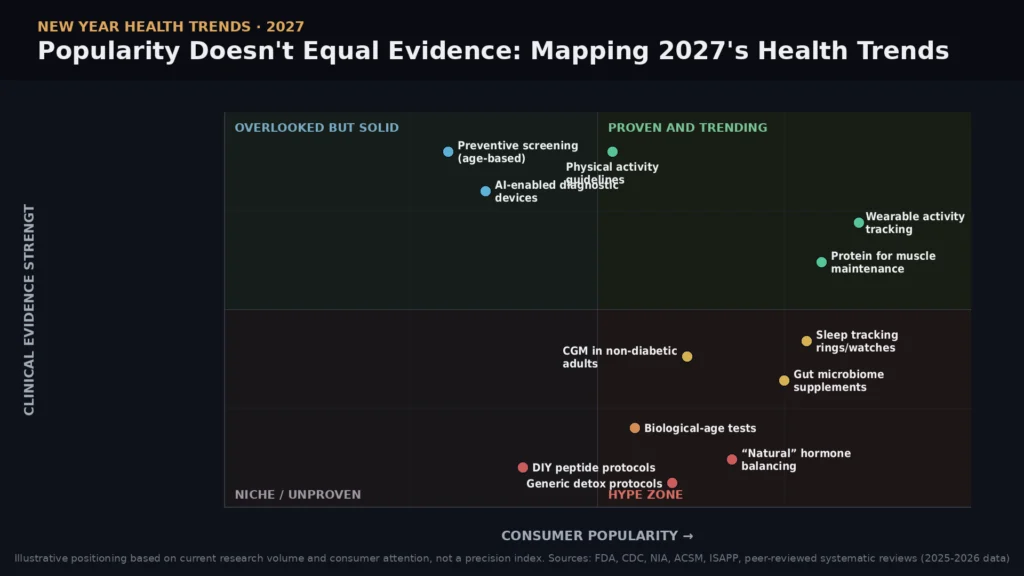
Metabolic health and gut health are becoming real scientific categories, not just labels
Metabolic health, covering glucose regulation, insulin sensitivity, blood pressure and lipids, has moved well beyond diabetes care into general wellness conversation. Continuous glucose monitors are now being studied and marketed to people without diabetes, and a recent systematic review specifically examined CGM use in non-diabetic populations, reflecting how new this evidence base still is. A single glucose spike on a CGM worn by someone without diabetes doesn’t carry the same clinical meaning it would for someone managing the condition, and reading too much into an isolated number is a common misstep.
Gut health has followed a similar arc, evolving from “take a probiotic” into a genuinely broader research field covering probiotics, prebiotics, postbiotics, fiber and fermented foods. A 2026 consensus statement from the International Scientific Association for Probiotics and Prebiotics tried to formally clarify what “gut health” even means, which itself signals a field still settling its own definitions.
A recent systematic review found some potential benefit from postbiotics for IBS symptoms, but rated the certainty of that evidence as low and called for larger, more standardized trials. Effects also vary meaningfully by probiotic strain and health outcome, so there’s no single product that “fixes” gut health across the board.
Protein and functional foods keep expanding, with real limits on the claims
Protein has moved from sports nutrition shelves into mainstream food and drink marketing, and the underlying science does support a role for adequate protein in maintaining muscle, particularly alongside resistance exercise. But that support isn’t uniform.
A review focused on adults 50 and older with multiple chronic conditions found limited direct evidence connecting protein intake to muscle outcomes in that population, and a separate network meta-analysis on protein supplementation combined with exercise in older adults at risk of sarcopenia rated its own certainty of evidence as very low, even while noting potential benefit.
The practical story is adequate nutrition and muscle maintenance, not protein maximization. Needs shift with age, kidney function, activity level and overall diet, so a beverage or bar marketed as “high protein” isn’t automatically doing more for any given person than food they’re already eating.
Functional foods more broadly, meaning products built around added fiber, probiotics or plant bioactives, are a consumer trend built on top of some genuinely evidence-backed nutrients. The nutrient itself having research behind it doesn’t automatically mean a specific packaged product delivers a measurable clinical effect. Those are two different claims, and marketing often blurs them together.
Exercise and longevity are reframing around function, not appearance
Physical activity guidance itself hasn’t changed dramatically. The CDC continues to link regular activity to cardiovascular health, diabetes prevention, cancer risk reduction, brain health, bone health, balance and mental health, and the World Health Organization recommends 150 to 300 minutes of moderate activity, or 75 to 150 minutes of vigorous activity, per week for adults. What has changed is the framing: exercise and broader “longevity” conversation increasingly center on healthspan, meaning years lived with good function, rather than lifespan or appearance alone.
The U.S. National Institute on Aging has been explicit about this shift, emphasizing healthspan and function across the life course as a research priority. That’s a meaningfully different framework from anti-aging marketing, which tends to sell reversal rather than maintenance.
The evidence-based version of this trend is genuinely useful: physical activity, cardiovascular risk management, sleep, nutrition and prevention all support healthy aging with solid research behind them. Many specific commercial longevity interventions, on the other hand, particularly supplements and protocols promising to slow or reverse biological aging, remain investigational rather than established.
AI and personalized health are moving into regulated territory
AI in healthcare has quietly moved past chatbots and symptom checkers into actual regulated medical devices. The FDA maintains a growing list of authorized AI-enabled devices spanning radiology, cardiovascular medicine, neurology, gastroenterology and other specialties.
In August 2026, the FDA’s Digital Health Center of Excellence went further, releasing a discussion paper specifically addressing how generative-AI medical devices should be evaluated, covering risk assessment, premarket evaluation and ongoing monitoring after a device reaches the market, with public comments due in October 2026. That’s a meaningful signal that regulators see generative AI in medicine as different from earlier, more predictable software, not just a faster version of it.
This matters because it separates two very different things people mean by “AI health tool.” An AI system embedded in a diagnostic device that has gone through FDA review is a different category from a general-purpose chatbot answering health questions. The device has been evaluated for a specific, defined use. The chatbot has not, and its output quality depends heavily on the data and guardrails behind it, with real risks around inaccurate or overconfident answers.
Personalized health is the broader trend AI sits inside, using an individual’s genetics, wearable data, lab results and history to tailor recommendations. It’s a genuine direction in medicine, and research on wearables in women’s health, for example, points to real potential for better individual-level data, while researchers are equally clear that validation, equity and clinical rigor still need work. Personalized doesn’t automatically mean more accurate. It means more specific to the inputs used, which are only as good as their own validation.
At-home testing sits in the same family. The FDA distinguishes between tests that have gone through formal review and others sold direct to consumers with less oversight, and it separates a test’s analytical validity (does it measure what it claims to measure) from its clinical validity (does that measurement actually predict or reflect a health outcome). A technically accurate result can still have limited practical meaning if nobody has established what an out-of-range value should lead to.
Before trusting any at-home test’s results, it’s worth checking:
- Whether the test has gone through FDA review, or is a direct-to-consumer product with less oversight.
- What exactly it measures, and whether that measurement has established clinical meaning.
- What action, if any, an abnormal result should reasonably lead to.
- Whether a clinician needs to interpret the result rather than the consumer alone.
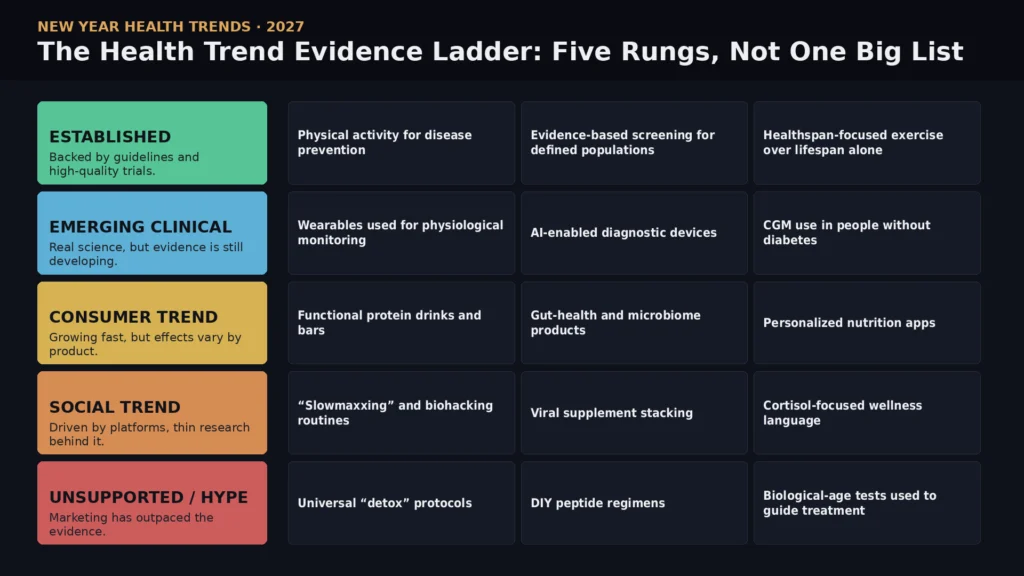
Women’s and men’s health are both becoming more preventive
Women’s health is shifting toward a longitudinal, evidence-based framework rather than a narrow focus on reproductive years alone. The U.S. Office on Women’s Health lists prevention, early detection, sex-specific biology, midlife health and data-driven care among its current priorities, and the International Menopause Society has published detailed recommendations covering menopause alongside cardiometabolic health, bone health, cancer risk, dementia and sexual wellbeing. This is a genuine healthcare development, not simply a wellness-market trend, though access and equity gaps remain real limitations.
Men’s health is moving in a parallel direction, away from a narrow focus on testosterone and sexual health toward broader preventive care: cardiovascular risk, blood pressure, metabolic health, appropriate cancer screening, mental health and healthy aging. Telehealth and expanded men’s health services are widening what that category of care typically covers, though commercialization, particularly around hormone optimization, is a real risk to watch.
The pushback: low-tech wellness as a countertrend
Not every trend points toward more tracking. A visible countertrend has emerged around digital boundaries: phone-free evenings, device-free stretches of the day, simpler routines and more emphasis on in-person social connection. The World Health Organization has acknowledged that digital environments carry both benefits and mental-health risks, and this consumer reaction reads as a response to tracking and optimization fatigue rather than a new medical treatment. It’s worth naming as a real trend, just not one that needs a clinical evidence base to be a reasonable personal choice.
Trends that deserve real skepticism
Some ideas circulating under the “health trend” umbrella don’t hold up well when checked against evidence. A few are worth naming directly.
| Claim or product | Why it deserves caution |
|---|---|
| Generic “detox” programs | No defined medical mechanism; the body already has organs that do this job |
| “Hormone balancing” foods or supplements | Meaningless without a specific diagnosed condition and matching evidence |
| DIY peptide protocols | Popularity in longevity circles doesn’t establish safety or effectiveness |
| Biological-age tests | Scientifically interesting, but their ability to guide individual treatment decisions isn’t established |
| Universal microbiome testing | Not everyone needs this, and interpretation of results is still an evolving science |
| Proprietary “metabolic scores” | A branded score isn’t automatically a validated clinical measure |
| Extreme or prolonged fasting protocols | Popularity doesn’t equal proven benefit across different people and health conditions |
| Red-light therapy marketed as a general health fix | Some specific uses have evidence; blanket wellness claims go beyond it |
| Ice baths marketed as a longevity intervention | Popular and tolerable for many people, but not proven to prevent disease long-term |
| NAD, NMN and resveratrol supplements | Legitimate research topics; not established longevity treatments just because they’re sold as such |
The pattern across this list is the same one that shows up everywhere in wellness marketing: a real scientific concept exists somewhere underneath the claim, but the specific product or protocol has jumped ahead of what that science actually supports.
How to tell health evidence from health marketing
A short mental checklist helps before trusting any specific health claim:
- Is this based on a defined population and clinical outcome, or general enthusiasm about a concept?
- Is the claim about market growth and popularity, or about a measured health effect? Those are different questions, and marketing often answers the first while implying the second.
- Has an independent systematic review or clinical guideline looked at this, or is the main evidence a company’s own study?
- Does the device or test have regulatory authorization for the specific claim being made, not just for existing on the market at all?
- Is the language hedged appropriately (“may help,” “evidence is still developing”) or does it promise certainty a single study can’t support?
What’s genuinely different heading into 2027
Put together, the throughline isn’t any single product or diet. It’s the growing overlap between prevention, continuous personal health data, AI-assisted analysis and a research push toward function and healthspan rather than lifespan alone. Wearables, at-home tests, CGMs and AI tools are all pieces of the same shift: healthcare gaining access to more information outside the clinic.
That shift is real and, in specific validated uses, genuinely useful. It is also moving faster in the consumer market than the underlying clinical evidence, which is exactly why distinguishing an established practice from an emerging one, and both from a marketing trend, matters more than it used to.
Frequently asked questions
What are the biggest health trends heading into 2027?
The strongest evidence-backed themes are more proactive prevention, wearable and at-home health monitoring, AI moving into regulated medical devices, growing attention to metabolic and gut health, and a longevity framework built around healthspan rather than anti-aging. Consumer wellness marketing is amplifying all of these faster than the research behind each one is settling.
What’s the difference between a health trend and a wellness trend?
A health trend reflects a shift in medical research, clinical practice or disease prevention. A wellness trend mainly reflects consumer behavior and lifestyle culture. The two overlap constantly, but a product or habit being popular doesn’t establish that it’s medically effective.
Are wearable health trackers accurate?
They can provide useful trends over time for things like activity and heart rate, but accuracy varies by device, brand and the specific metric being measured. Current evidence doesn’t support treating consumer wearables as a replacement for clinical diagnostic testing, particularly for sleep architecture or heart rhythm diagnosis.
Is gut health actually backed by science?
Gut health as a research field is legitimate and expanding, but that doesn’t mean every probiotic, supplement or microbiome test on the market has equal evidence behind it. Benefits tend to be specific to the strain, the condition and the outcome studied, not universal.
Is metabolic health a real medical concept, or just marketing?
It’s a real one. Metabolic health covers clinically meaningful measures like blood glucose, blood pressure and lipids. What’s newer, and less established, is continuous consumer monitoring of these markers, especially in people without diagnosed conditions, where interpreting a single reading can be misleading without clinical context.
Is AI actually changing healthcare, or is it mostly hype?
Both, depending on the application. The FDA has authorized a growing number of AI-enabled medical devices for specific clinical uses, and it opened a formal process in 2026 to regulate generative-AI medical tools specifically. That’s real regulatory movement. A general-purpose AI chatbot answering health questions, by contrast, hasn’t gone through that kind of evaluation and shouldn’t be treated the same way.
Are at-home health tests reliable?
Some have gone through FDA review for both what they measure and what that measurement means clinically. Others are sold direct to consumer with less oversight. It’s worth checking a test’s regulatory status and understanding what an abnormal result should actually lead to before acting on it.
Is longevity medicine evidence-based?
Parts of it strongly are, particularly physical activity, cardiovascular risk reduction, sleep and general disease prevention. Many specific commercial longevity products and protocols, especially supplements marketed to slow biological aging, remain investigational rather than proven.
What health trends should people be most skeptical of?
Be cautious of anything promising to reverse aging, “detox” the body, universally balance hormones, diagnose a disease from consumer wearable data, or produce dramatic results without a clinical study behind the specific product or protocol being sold.
Leave a Reply
You must be logged in to post a comment.