
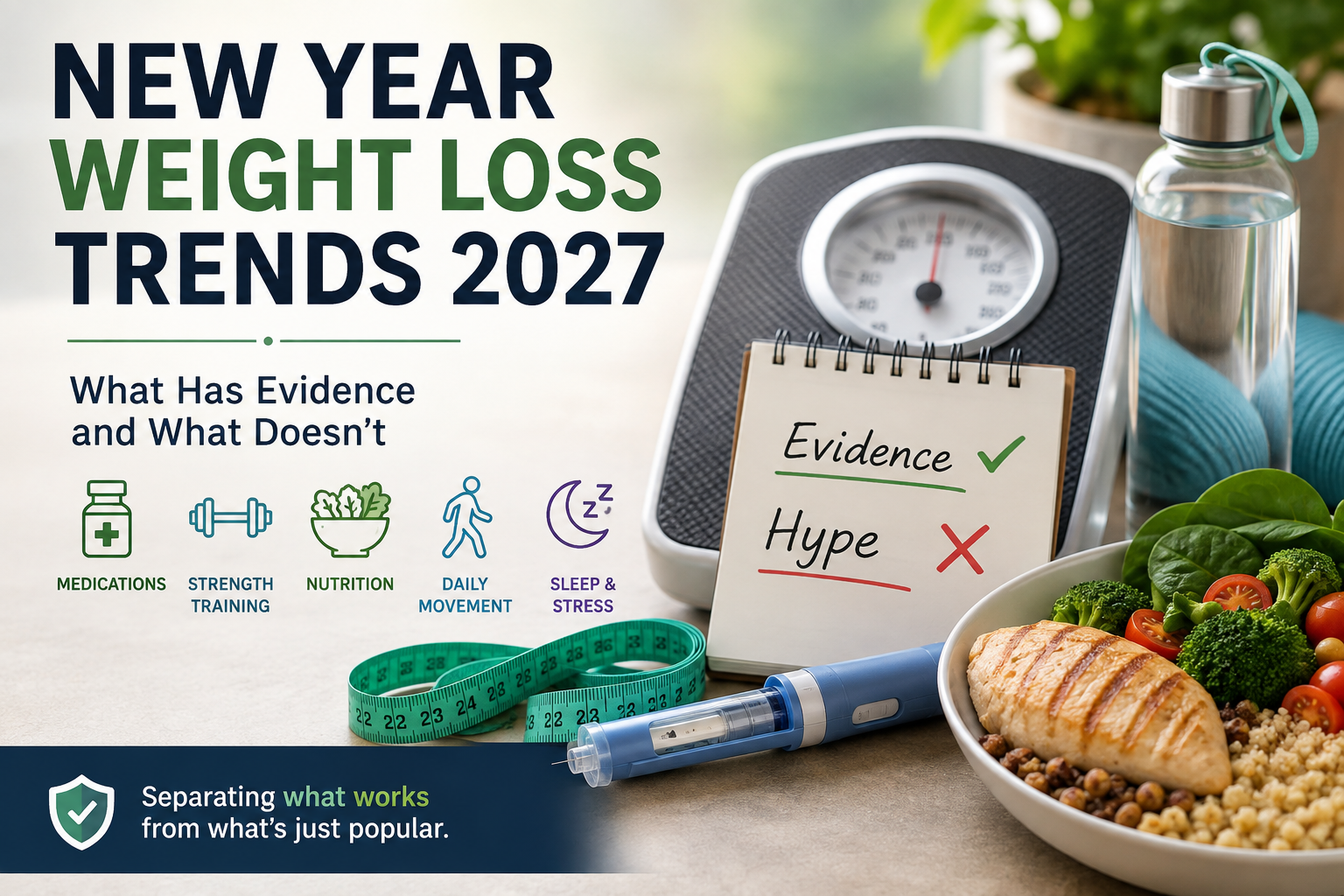
“New year weight loss trends” can mean two different things. It can mean the methods gaining attention heading into the new year, or the habits people pick up as part of a fresh start. This guide covers both, but it keeps one rule throughout: popularity and evidence are not the same thing. A method can be everywhere on social media and still have thin research behind it, and a method can be genuinely effective without ever going viral.
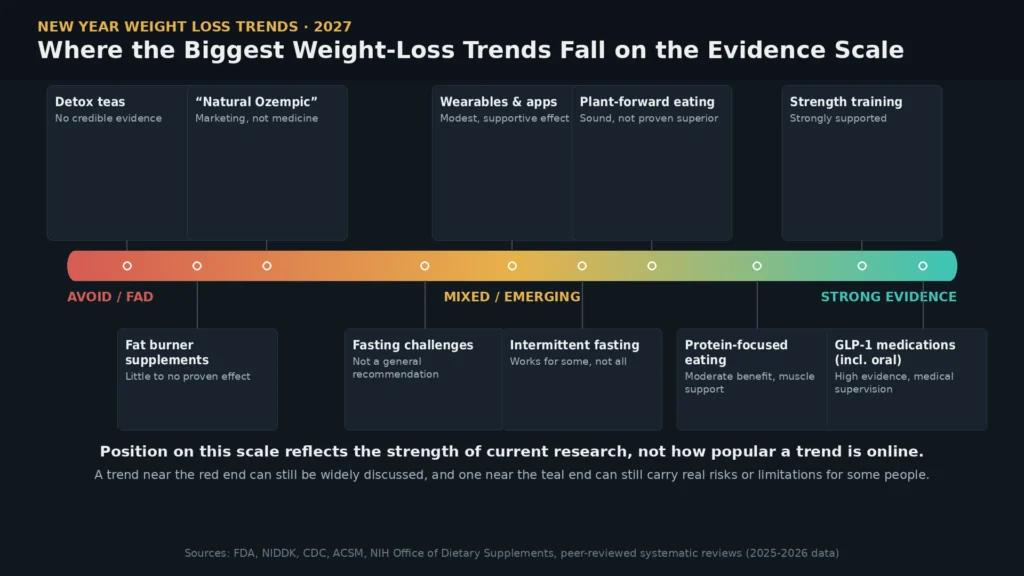
The past year reshaped this conversation more than usual. Prescription weight-management medications moved further into the mainstream, with an oral GLP-1 pill reaching pharmacies for the first time and a higher-dose injection and a second oral drug both winning approval. Protein and fiber kept dominating nutrition conversations, strength training earned a higher ranking in official fitness-trend reports than ever before, and regulators kept warning about unapproved products riding on that same wave of interest. Going into the new year, this article sorts what’s popular from what’s actually supported by research, using the most current data available.
Where things stand heading into 2027
| Trend | Popularity | Evidence level | Verdict |
|---|---|---|---|
| GLP-1 and related medications | Very high | High (for approved drugs, appropriate patients) | Medical treatment, not a lifestyle trend |
| Higher-protein eating | Very high | Moderate to high | Useful strategy, not a magic mechanism |
| Fiber and whole-food eating | High, rising | Moderate to high | Sound dietary direction |
| Plant-forward eating | High | Moderate | Legitimate option, not proven superior |
| Intermittent fasting / time-restricted eating | High | Moderate | Works for some, not universal |
| Strength training | Very high | High | Strongly supported |
| Walking and daily movement | Very high | High | Strongly supported |
| Wearables and tracking apps | Very high | Moderate | Helpful tool, not a treatment |
| Sleep and stress management | High | Moderate, mixed | Supportive, not a standalone fix |
| Detoxes, fat burners, “natural Ozempic” | High social visibility | Poor | Fad or safety concern |
GLP-1 medications are the biggest medical shift, not just a trend
Prescription weight-management medications, including GLP-1 receptor agonists and newer dual-acting drugs, are the single biggest reason the weight-loss conversation looks different going into this new year compared with previous ones. The National Institute of Diabetes and Digestive and Kidney Diseases (NIDDK) describes these medications as an option used alongside lifestyle changes for people with obesity or overweight plus related health conditions, not as a replacement for nutrition and physical activity.
Several regulatory developments matter here. The FDA approved an oral semaglutide pill (Wegovy) in December 2025, the first oral GLP-1 approved for weight management, which reached pharmacies in January 2026. In March 2026, the FDA approved Wegovy HD, a higher-dose 7.2 mg semaglutide injection, for certain adults with obesity or overweight who also have a weight-related condition. In April 2026, the FDA approved Foundayo (orforglipron), a second oral medication for chronic weight management, intended for use alongside reduced-calorie eating and increased physical activity. A combination injection pairing semaglutide with a newer amylin analogue was also under FDA review through 2026, with a decision expected later in the year, so its approval status is still worth checking before the new year.
At the same time, the FDA has continued warning about compounded versions of these drugs. As of May 31, 2026, the agency had logged 990 adverse-event reports tied to compounded semaglutide and more than 730 tied to compounded tirzepatide, while noting that adverse-event reporting has real limitations. The FDA has also confirmed that retatrutide and cagrilintide are not ingredients in any FDA-approved drug and cannot legally be used in compounded products.
What this means in practice:
- Approved GLP-1 and dual GIP/GLP-1 medications have solid clinical evidence for appropriately selected patients under medical supervision.
- They carry known risks, including gastrointestinal side effects, cost and access barriers, and the likelihood of some weight regain after stopping treatment, according to NIDDK.
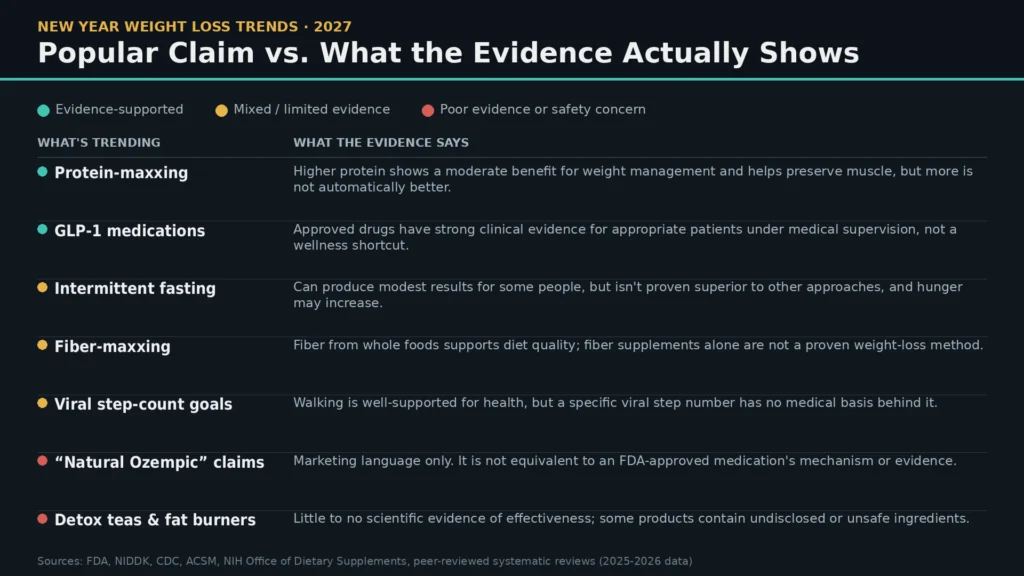
- Compounded or unapproved versions sold online are not the same as FDA-approved drugs, and claims about “natural” alternatives to these medications are marketing language, not pharmacology.
- None of this is prescribing or dosing guidance. Anyone considering these medications needs to talk to a licensed medical provider about whether they’re appropriate.
Protein is still the dominant nutrition trend, with real but limited evidence
Protein-focused eating remains one of the clearest consumer nutrition trends of the year. Johns Hopkins Medicine has flagged protein emphasis as a leading food trend, while also pointing out that many Americans already get enough protein and that fiber, not protein, is the more common nutritional gap.
The research backs a moderate role for protein. A systematic review and meta-analysis found that higher dietary protein intake produced a moderate benefit for body-weight management, though the underlying study designs varied widely. A separate systematic review found that increasing protein intake during weight loss significantly reduced the loss of muscle mass in adults with overweight or obesity.
That’s a real benefit, but it has limits worth stating plainly:
- Protein can support satiety for some people and help preserve lean muscle during weight loss.
- It does not automatically translate into fat loss on its own.
- Protein-rich foods can still be energy-dense, processed, or high in saturated fat depending on what’s chosen, so the source matters as much as the macro.
Fiber and whole foods matter more than any single “superfood”
The current 2025-2030 Dietary Guidelines for Americans emphasize whole, nutrient-dense foods, including protein, vegetables, fruits, healthy fats and whole grains, while limiting ultra-processed foods, added sugars and refined carbohydrates. That’s a sound long-term direction, but it doesn’t mean any individual food deserves fat-burning claims.
A network meta-analysis covering 152 randomized trials found that individual food groups generally produced no meaningful weight loss on their own, with low or very low certainty for several comparisons. In other words, the overall eating pattern matters far more than any single ingredient.
Fiber deserves a separate mention because it sits at the intersection of legitimate nutrition science and social-media trend. A 2025 systematic review looked at fiber supplements in adults with overweight or obesity, but that research doesn’t support the leap to “fiber supplements cause major weight loss.” Getting fiber from food, rather than a powder or gummy, remains the better-supported approach.
Plant-forward eating is a solid option, not a proven winner
Plant-forward diets, built around vegetables, fruits, legumes, whole grains, nuts and seeds, continue to gain attention. But a 2026 systematic review and meta-analysis found little to no difference between plant-based and omnivorous diets for body weight across available randomized trial evidence, with low-certainty findings for some secondary outcomes.
That means plant-forward eating can be a nutritionally sound choice for people who prefer it, but current evidence doesn’t establish it as superior to other healthy eating patterns specifically for weight loss.
Intermittent fasting: still popular, evidence has gotten more nuanced
Time-restricted eating keeps showing up in trend roundups, and the research picture has shifted since earlier hype cycles.
- A 2026 systematic review and meta-analysis of 30 studies involving 1,341 participants found reductions in body weight and fat mass with time-restricted eating, including in comparisons where energy intake was controlled.
- A 2025 meta-analysis, however, found that time-restricted eating was associated with increased hunger compared with isocaloric control approaches.
So it can produce modest results for some people, but it isn’t clearly better than other calorie-controlled approaches, and hunger can be a real trade-off. It also isn’t appropriate for everyone. People with a history of disordered eating, certain medical conditions, or specific medication schedules should get individualized guidance before restricting eating windows.
Strength training has moved from optional to central
This is one of the more meaningful shifts in recent fitness data. The American College of Sports Medicine (ACSM) ranked “Exercise for Weight Management” third among its 2026 fitness trends, its highest position to date, and specifically noted the importance of exercise alongside obesity medications. ACSM’s 2027 trends survey closed in June 2026, with results due in its November/December 2026 journal issue, so an updated ranking will land right around the new year.
A 2025 systematic review and meta-analysis found that resistance exercise during dietary weight loss protected against loss of fat-free mass, increased fat-mass loss, and improved muscular strength. It did not significantly change total body mass compared with diet alone.
That last point matters for how people judge progress. Strength training may not move the number on the scale much by itself, but preserving muscle and improving strength are meaningful outcomes in their own right, particularly for anyone also using weight-management medication, where muscle loss is a known concern.
Walking still works, and it doesn’t need a viral hook
Walking and general daily movement remain some of the most accessible tools for weight management. The CDC’s current guidance recommends at least 150 minutes of moderate-intensity aerobic activity per week for adults, plus muscle-strengthening activity on two or more days a week. NIDDK similarly recommends regular activity, with a gradual start for people who are new to exercise.
Viral step-count challenges (10k steps, 15k steps, and so on) aren’t backed by a specific medical threshold. Walking is genuinely valuable; a specific viral number attached to it is not a prescription.
Wearables and apps: useful support, not a treatment
Wearable technology ranked first overall in ACSM’s most recently published fitness trends report, and digital self-monitoring tools remain popular for tracking food, activity and weight.
The research on these tools is moderately supportive but modest in size. A 2025 umbrella review found that mobile app interventions produced statistically significant but modest reductions in body weight, with substantial variation between studies. A separate 2025 systematic review identified useful components of digital interventions, including goal setting, feedback, reminders, peer support and self-monitoring, without settling on one universal formula that works best.
The honest takeaway: these tools can support behavior change, but the technology itself isn’t the intervention. What people do with the data is what matters.
Sleep and stress: supportive, not standalone fixes
The CDC includes adequate sleep and stress management as part of healthy weight management. A 2026 systematic review found mixed evidence here. Sleep restriction may impair fat loss, evidence for sleep satisfaction and efficiency looks more promising, and evidence for sleep timing and regularity is still limited.
Adequate sleep is a reasonable part of a broader plan. It is not, on its own, a weight-loss intervention.
Trends that deserve a closer look before you try them
Social media has a large influence on what people perceive as trending, but visibility isn’t evidence. Several claims have been getting attention over the past year without the research to support them.
| What’s trending | What the evidence actually shows |
|---|---|
| Detox teas and cleanses | No credible evidence that these remove toxins or reset metabolism; some products have been flagged for hidden ingredients |
| Fat burners and slimming supplements | NIH’s Office of Dietary Supplements notes little scientific evidence that most weight-loss supplements work, and some interact with medications or cause harm |
| “Natural Ozempic” claims | Marketing language, not equivalent pharmacology to an approved GLP-1 medication |
| Extreme or prolonged fasting challenges | Not a sustainable general recommendation; NIDDK emphasizes realistic goals and appropriate eating plans instead |
| “Metabolism reset” and cortisol-focused programs | Not established consumer claims; treat with skepticism |
| Unregulated compounded GLP-1 products | Not the same as FDA-approved medications; tied to hundreds of adverse-event reports logged through 2026 |
The FDA’s weight-loss product warnings have also flagged supplements marketed as diet pills, fat burners and teas that were found to contain undeclared pharmaceutical or toxic ingredients, with new notifications issued throughout 2026.
A quick checklist for judging any weight-loss claim
Before trusting a trend, it helps to ask a few direct questions:
- Is there randomized-trial evidence, or is this based on testimonials?
- Has the finding been replicated, or is it a single study?
- Is the claim about weight, fat, muscle or overall health, and are those being mixed up?
- Was the research done in humans, under realistic conditions?
- If it’s a product, is it FDA-approved, or just marketed to sound like it is?
- Is the source a qualified expert, or an influencer with something to sell?
If a claim promises a specific amount of weight loss in a set number of days, promises results with no change to diet or activity, or calls itself “clinically proven” without pointing to an actual study, treat it as a red flag rather than a plan.
The bigger pattern behind this year’s trends
Looking at everything together, the biggest story isn’t one new diet or one viral method. It’s a shift toward combining approaches: an eating pattern built around whole foods and adequate protein, regular movement that includes strength training, behavioral support and monitoring, and, for people with obesity or weight-related health conditions, medical treatment when appropriate. NIDDK’s own guidance frames safe weight-management programs the same way: an appropriate eating plan, physical activity, behavioral support, monitoring and ongoing follow-up, working together rather than any single tactic carrying the whole load.
Frequently asked questions
What are the biggest weight-loss trends heading into 2027?
The most talked-about developments are GLP-1 and related weight-management medications, higher-protein and whole-food eating, strength training for muscle preservation, and digital tools like apps and wearables. Of these, GLP-1 medications and strength training currently have the strongest research support, while trends like extreme fasting or unregulated supplements do not.
Are GLP-1 medications the biggest weight-loss trend right now?
They’re one of the most consequential developments in weight management right now, but they’re prescription medical treatments, not a wellness trend. They require a doctor’s evaluation, come with known risks and limitations, and are meant to be used alongside, not instead of, nutrition and activity changes.
Is high-protein eating a good weight-loss strategy?
Research shows a moderate benefit for weight management and a clearer benefit for preserving muscle during weight loss. It’s a reasonable strategy, but higher protein intake alone doesn’t guarantee fat loss, and the quality of the protein source still matters.
Is intermittent fasting still worth trying in 2027?
It can produce modest results for some people, according to recent reviews, but it isn’t proven to work better than other calorie-controlled approaches, and some research links it to increased hunger. It’s a reasonable option for people who find it manageable, not a universal recommendation, and it isn’t appropriate for everyone without professional guidance.
Is plant-based eating better for weight loss than other diets?
Current evidence doesn’t support that claim. A 2026 review found little to no difference in weight outcomes between plant-based and omnivorous diets. Plant-forward eating can still be a nutritionally solid choice for people who prefer it.
Are weight-loss supplements effective?
Most have limited or poor supporting evidence, according to NIH’s Office of Dietary Supplements, and some products have been found to contain undisclosed or unsafe ingredients. Supplements should not be treated as a substitute for medically supervised treatment or evidence-based nutrition and activity changes.
What weight-loss trends should I avoid?
Be cautious with detox and cleanse products, fat burners, “natural Ozempic” claims, extreme or prolonged fasting challenges, unregulated compounded medications, and any product promising guaranteed or rapid results without medical supervision.
Is strength training becoming more important for weight management?
Yes. Official fitness-trend data ranks it higher than ever, and research shows it helps preserve muscle and improve strength during weight loss, even when it doesn’t dramatically change total body weight on its own.
Are wearables and fitness apps actually useful?
They can support monitoring and behavior change, and research shows modest benefits from app-based interventions. They work best as a support tool alongside other changes, not as a treatment by themselves.
Leave a Reply
You must be logged in to post a comment.