
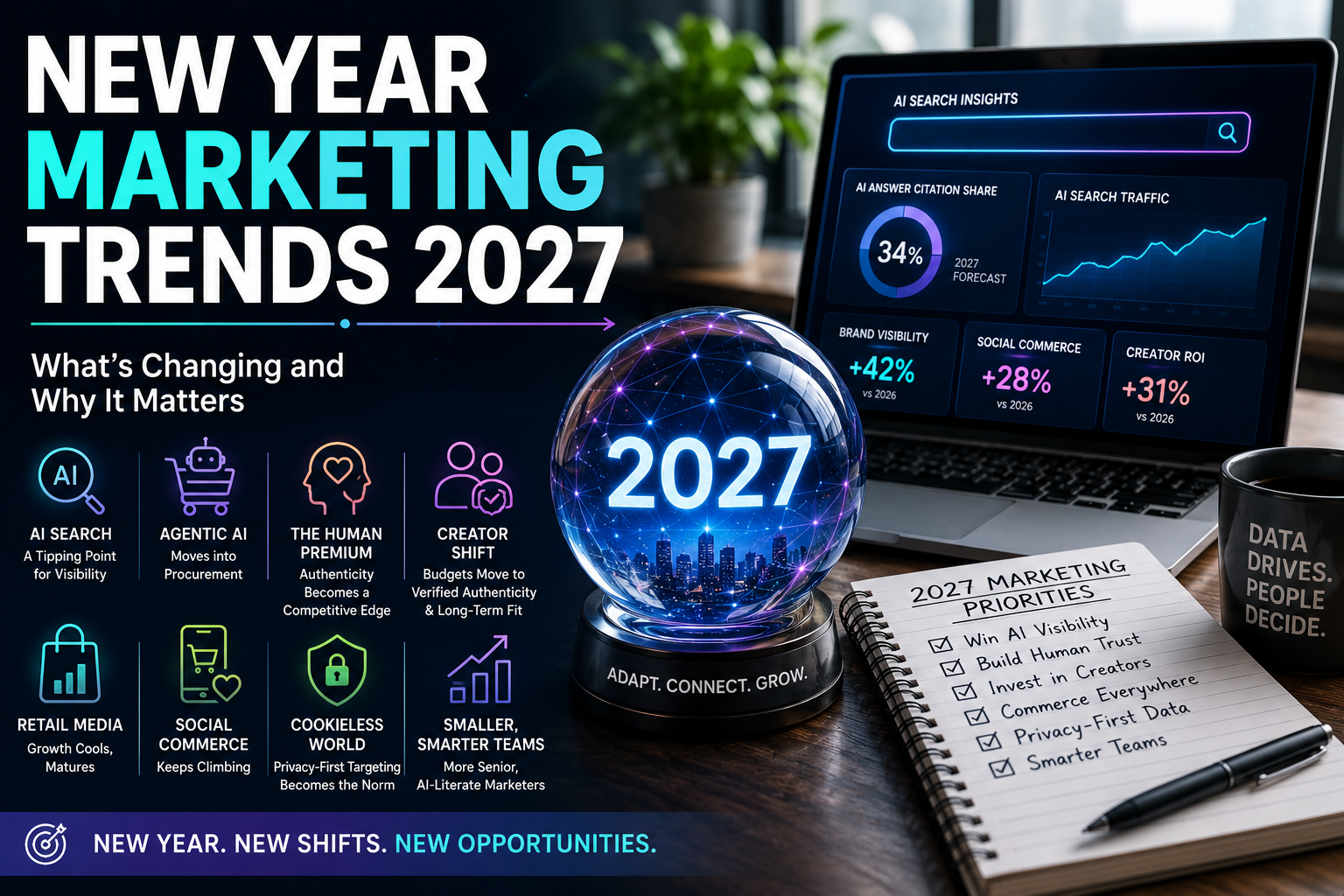
“New year marketing trends” covers two different searches: campaign ideas for a New Year’s sale, and the marketing shifts shaping the year ahead. This article is the second one. It covers what’s actually different in 2027 compared to 2026: AI search visibility becomes a measurable KPI instead of a side experiment, agentic AI starts touching real B2B spend, the AI-content backlash matures into a “human premium” brands can price, creator budgets shift toward verified authenticity, retail media growth cools while social commerce keeps compounding, and cookie-free targeting stops being optional.
Quick answer: the biggest 2027 shifts are AI-mediated search crossing a meaningful traffic-cannibalization threshold, agentic commerce moving from pilot to procurement, brands actively pricing “human-made” content as a trust signal, creator budgets reallocating toward identity verification and long-term fit, retail media growth slowing into single digits while social commerce keeps growing faster, and marketing teams getting smaller, more senior, and more AI-output-literate.
Jump to:
- AI search crosses a tipping point
- Agentic commerce moves into procurement
- The human premium
- Creator budgets reallocate
- Retail media matures, social commerce keeps climbing
- Cookies are actually gone
- Trend status table
- What to prioritize by business type
- FAQ
AI-mediated search crosses a real tipping point in 2027
What’s changing: In 2026, roughly 15% of search traffic ran through AI-generated answers rather than a traditional results page. Industry forecasts for 2027 put that share at 30 to 35%, with AI-driven cannibalization of organic clicks projected to hit a tipping point around 40% by the third or fourth quarter of the year.
The evidence:
- Google’s AI Overviews and AI Mode have both scaled past a billion monthly users, with AI Mode queries more than doubling every quarter since launch
- Forecasts put 2027 LLM-driven search traffic at double the 2026 share
- Analysts expect brands ranking #1 on Google to still be invisible inside AI-generated answers if they aren’t cited by the underlying model
Why it matters: The distinction that mattered in 2026, ranking on page one versus getting cited inside an AI answer, becomes the central visibility question in 2027 rather than a side conversation. Citation share (how often a brand gets referenced inside AI answers, not just indexed by search) is emerging as a metric marketing teams actually track, the way rank tracking used to work for SEO.
What this means for SEO, AEO, and GEO
SEO isn’t dead. AI search still relies on crawling, indexing, and ranking the open web. What’s changed since 2026 is how much weight sits on the layer above that foundation:
| Term | What it does in 2027 |
|---|---|
| SEO | Still the foundation: ranks pages in traditional results and feeds the index AI systems draw from |
| AEO (Answer Engine Optimization) | Structures content so it gets pulled directly into a conversational answer: direct answers near the top, clear definitions, well-labeled sections |
| GEO (Generative Engine Optimization) | Gets a brand cited and trusted by the models generating answers, now treated as a distinct budget line rather than an SEO add-on |
Who this affects: Everyone with a website, but the effect compounds for ecommerce, SaaS, and B2B companies whose buyers research extensively before contacting sales. B2B is a particular pressure point in 2027 since machine-readable product and pricing data (clear structure, documented specs, no login walls blocking basic information) increasingly determines whether an AI agent can even evaluate a company as an option.
Limitation to flag: Traffic-cannibalization percentages vary a lot between research firms and methodologies. Treat any single quoted number as directional, not exact, and watch your own referral and citation data rather than importing an industry-wide figure wholesale.
Agentic AI moves from shopping assistant to procurement layer
What’s changing: In 2026, AI agents were mostly framed as shopping assistants for individual consumers. In 2027, the more consequential shift is on the B2B side, where AI agents start taking a real, if partial, role in procurement: research, comparison, and even parts of the negotiation and purchasing workflow.
The evidence:
- Forecasts for 2027 point to a meaningful share of B2B procurement research and comparison work shifting to buyer-side AI agents, with full agent-intermediated B2B spend still expected to build toward the end of the decade rather than arrive all at once in 2027
- Consumer-side adoption of AI shopping assistants grew through 2026, but actual autonomous purchasing (an agent completing a transaction without a human confirming it) remains the minority behavior, not the default
- Retailers and platforms kept shipping agent-to-commerce infrastructure through 2026, meaning the technical rails exist even where consumer trust hasn’t fully caught up
Established by 2027:
- Brands actively structuring product data, specs, and pricing for machine readability, not just human readability
- AI agents playing a real role in B2B research and shortlisting
- A meaningful, but still minority, share of consumer purchases influenced by AI recommendation
Still a forecast, not yet the norm:
- Fully autonomous purchasing without human review becoming the default channel
- Agentic AI replacing most one-to-one customer interactions (a mid-decade target some analysts have set for 2028, not 2027)
Who cares most: Ecommerce, B2B software and services, travel, and any business with a large, comparable catalog or a long research-heavy sales cycle.
What to do about it: Treat product and pricing pages as documents an AI agent needs to parse correctly, not just a human shopper. Accurate specs, current pricing, clear availability, and structured data matter more in 2027 than they did in 2026, because an agent that misreads your page simply won’t shortlist you.
The AI content backlash matures into a human premium
What’s changing: The “AI slop” backlash that built through 2025 and 2026 isn’t a passing news cycle heading into 2027, it’s turned into a pricing dynamic. Visibly human-made content now commands measurably more trust and attention than generic AI output, and brands are starting to treat that gap as something worth paying for rather than something to wait out.
The evidence:
- Consumer enthusiasm for AI-generated creator content fell from roughly 60% in 2023 to around a quarter of consumers by 2025, and the trend line has kept falling rather than recovering
- Gartner predicts that by 2027, one in five brands in advanced economies will actively market the absence of AI in their product development, customer service, or content as a selling point
- Disclosure and provenance standards (content credentials that verify what was AI-generated versus human-made) are moving from a nice-to-have into something regulatory pressure, particularly out of the EU, is pushing toward becoming standard practice
Why it matters: This isn’t the generic “authenticity matters” advice that’s been repeated for a decade. The specific 2027 dynamic is that synthetic content became trivial and abundant enough that a distinct, disclosed, human voice turned into one of the few things a competitor genuinely can’t copy overnight. The brands treating this well aren’t going “anti-AI”, they’re using AI for the labor that doesn’t carry meaning and reserving disclosed human judgment for the parts that do: voice, perspective, and anything emotionally load-bearing.
Who this affects: Content marketers, brand and creative teams, and any business competing in a category where most competitors already publish similar AI-assisted content, which by 2027 is most categories.
How to respond:
- Let named, visible experts, founders, or frontline staff carry brand communication instead of an anonymous brand voice
- Adopt disclosure or content-provenance practices ahead of being forced to, since being early on this is itself a trust signal
- Don’t confuse “using less AI” with the actual goal, which is a visible human layer on the judgment calls, not the absence of AI tools entirely
Creator budgets shift toward verification and fit, not just reach
What’s changing: Creator marketing keeps growing into 2027, but the underlying discipline is maturing away from “how many creators can we work with” toward “which creators are verifiably real, verifiably aligned with the brand, and worth a longer-term relationship.”
The evidence:
- Gartner projects that by 2027, brands will allocate half of their influencer marketing budgets specifically to content and creator authenticity initiatives: identity verification, content provenance checks, and anti-deepfake measures
- That reallocation is a direct response to AI-generated content becoming more visible inside search results and feeds, which raises the cost of a brand accidentally amplifying fabricated or misattributed creator content
- The shift toward longer-term, more scrutinized partnerships (versus one-off sponsorships) that was already underway in 2026 continues, with more weight on audience overlap and brand safety before a deal is signed
Who this affects: Any brand with an existing influencer or creator budget, especially in beauty, fashion, food, and consumer tech, where creator content already drives a large share of discovery.
How to respond:
- Budget specifically for verification and provenance tooling, not just content production, since 2027 treats this as its own line item rather than a footnote
- Move remaining one-off sponsorship budget toward retained, longer relationships with creators you’ve actually vetted
- Set measurement criteria before a campaign starts, and weight brand fit as a filter rather than an afterthought
Retail media growth cools while social commerce keeps climbing
What’s changing: Retail media, one of the fastest-growing ad categories of the mid-2020s, is still growing in 2027, but growth is visibly slowing. Social commerce, by contrast, keeps compounding at a faster rate.
The evidence:
- Global retail media investment is forecast to reach roughly $223 billion in 2027, up about 11.5% year over year, but that’s down to single-digit growth (under 10%) once Amazon is excluded, the slowest annual rate recorded since tracking began
- Amazon alone captured the large majority of U.S. retail media spend in 2025, meaning the “retail media boom” story increasingly describes one company’s growth more than the category’s
- Social commerce is forecast to approach $119 billion in the U.S. by 2027, continuing to outpace retail media’s growth rate even as both categories mature
- Connected TV now represents close to a quarter of retail media spend, and video-on-demand is expected to overtake retail media in global ad investment by 2028
Why it matters: Retail media isn’t going away, but treating it as an automatic growth channel in 2027 the way brands did in 2024 to 2026 is no longer accurate. The category is consolidating around a handful of large players, and marketers who assumed retail media would keep compounding at 2024-era rates need to recalibrate the size of that bet.
Who this affects: Ecommerce brands, consumer packaged goods companies, and retailers deciding how much to invest in monetizing their own first-party shopper data versus buying into someone else’s retail media network.
How to respond:
- Don’t assume retail media growth in 2027 looks like it did in 2025; budget against the slower, Amazon-concentrated reality
- Weight social commerce execution (product feeds, in-app checkout, creator integration) at least as heavily as retail media spend
- If you’re a retailer sitting on unmonetized first-party data, retail media is still worth building, just with realistic growth assumptions
The post-cookie ecosystem stops being a transition and becomes the baseline
What’s changing: Third-party cookie deprecation, first-party data strategy, and contextual targeting were “the transition” in 2024 and 2025, and “adaptation” in 2026. By 2027, brands still leaning on third-party cookie-dependent targeting aren’t in a transition anymore, they’re simply behind.
Why it matters: This shift is less about a single dramatic cutover date and more about which brands quietly finished building first-party and zero-party data infrastructure during 2025 and 2026, versus which brands kept patching around cookie-dependent tools. By 2027, that gap shows up directly in targeting accuracy and measurement quality, not just in compliance risk.
Who this affects: Any brand running paid media, lifecycle marketing, or retargeting at scale.
How to respond:
- Audit whether your targeting and measurement still assume third-party cookie data anywhere in the stack
- Prioritize first-party data collection points (loyalty programs, account creation, zero-party preference data) over buying more point-solution targeting tools
- Treat contextual and cohort-based targeting as the default, not the fallback
What’s established, what’s emerging, and what’s still a forecast for 2027
| Trend | Status in 2027 | Confidence level |
|---|---|---|
| AI-mediated search crossing 30%+ of query share | Established, accelerating | High |
| GEO/citation share as a tracked KPI | Established, still standardizing | High |
| Human-made content commanding a measurable premium | Established | High |
| Creator budgets reallocating to verification | Established, growing | High |
| Retail media growth slowing to single digits (ex-Amazon) | Established | High |
| Social commerce outpacing retail media growth | Established | High |
| Agentic AI in B2B procurement | Emerging | Medium |
| Fully autonomous consumer purchasing at scale | Forecast, not yet the norm | Lower |
| Agentic AI as the default one-to-one customer channel | Forecast (more of a 2028 target) | Lower |
Where to focus, based on your business
| Business type | Where to put attention first in 2027 |
|---|---|
| Local or small business | AI-search visibility (accurate, structured business info) and genuinely human-made content, since both compete on clarity over budget |
| Ecommerce | Machine-readable product data for AI agents, social commerce execution, realistic retail media budgeting |
| B2B | Structured, agent-legible content and specs, GEO/citation tracking, first-party lead data |
| Enterprise | Unified customer data, agentic AI pilots in procurement or service, provenance and disclosure infrastructure |
| Creator-led or DTC brand | Creator verification and long-term fit, disclosed human content, community over pure reach |
What isn’t actually a new trend
A lot of “2027 trend” content just recycles what was already true a year or two earlier. Video, social media, email, and personalization all still matter, they just aren’t new information anymore. The same applies to generic “use AI” advice. By 2027, almost every competitor is already using AI somewhere in the stack, so “we use AI” stopped being a differentiator; the differentiator is what a brand does with the human layer on top of it, and whether its content and product data are actually legible to the AI systems mediating discovery.
FAQ
What are the biggest new year marketing trends for 2027?
AI-mediated search crossing roughly a third of query volume, agentic AI taking a real role in B2B procurement research, a measurable premium on disclosed human-made content, creator budgets shifting toward verification and long-term fit, retail media growth cooling while social commerce keeps climbing faster, and cookie-dependent targeting becoming a genuine liability rather than a transition issue.
Is AI search the biggest marketing shift in 2027?
It’s arguably the most consequential because it touches how customers discover every brand, regardless of industry, and forecasts put 2027 as the year AI-driven click cannibalization crosses a meaningful tipping point. But the practical response is specific (citation share, structured data, agent-legible product pages), not a vague mandate to “do more AI.”
Is agentic commerce actually happening in 2027, or is it still hype?
Both, depending on where you look. B2B procurement research and comparison work is genuinely shifting to AI agents. Fully autonomous consumer purchasing without a human confirming the transaction is still the minority case, expected to keep building toward the end of the decade rather than becoming the default in 2027 itself.
Why are brands advertising that they don’t use AI?
Because visible AI-generated content triggered a real, measurable consumer backlash through 2025 and 2026, and by 2027 a meaningful share of brands (Gartner projects around one in five in advanced economies) are treating “no AI” or “disclosed human-made” as a trust signal worth marketing directly, not just a production choice.
Is retail media still worth investing in for 2027?
Yes, but with different expectations than in 2025. Growth is slowing to single digits once Amazon is excluded, and the category is consolidating. It’s still a legitimate channel, just not the automatic high-growth bet it looked like a couple of years earlier.
Which 2027 marketing trends should small businesses prioritize?
AI-search visibility (clear, accurate, structured information about the business) and genuinely human-made content tend to offer the best return for smaller teams, since both compete on clarity and credibility rather than budget size.
The bottom line
Marketing in 2027 is defined less by new technology arriving and more by 2025 and 2026’s shifts actually maturing into measurable, budgeted line items: AI search visibility becomes a tracked KPI, agentic AI gets a real but partial foothold in B2B buying, human-made content earns a price premium instead of just a values statement, creator spend reallocates toward verification, and retail media’s growth story gets more realistic while social commerce keeps compounding. Treat the confident 2028-and-beyond forecasts (fully autonomous purchasing, agentic AI as the default service channel) as directional, not arrived, and put budget behind what’s already measurable this year.
Leave a Reply
You must be logged in to post a comment.