
Most “2027 fashion trends” content is written as if the year is a mystery. It isn’t, not entirely. Spring/Summer 2027 collections already showed at New York, Copenhagen, Milan, and Paris fashion weeks in August and September 2026, so parts of 2027’s direction are documented runway fact, not speculation. Separately, color forecasters have already named their official 2027 colors, more than a year ahead of the season, the way that industry always works. What’s still genuinely uncertain is how those runway ideas trickle down into what people actually buy, and that’s where online prediction culture, fashion bloggers, and forum chatter fill the gap with guesses.
This article keeps those two categories separate: confirmed runway and forecast evidence first, community and blogger predictions clearly labeled second.
The official 2027 color story, already named
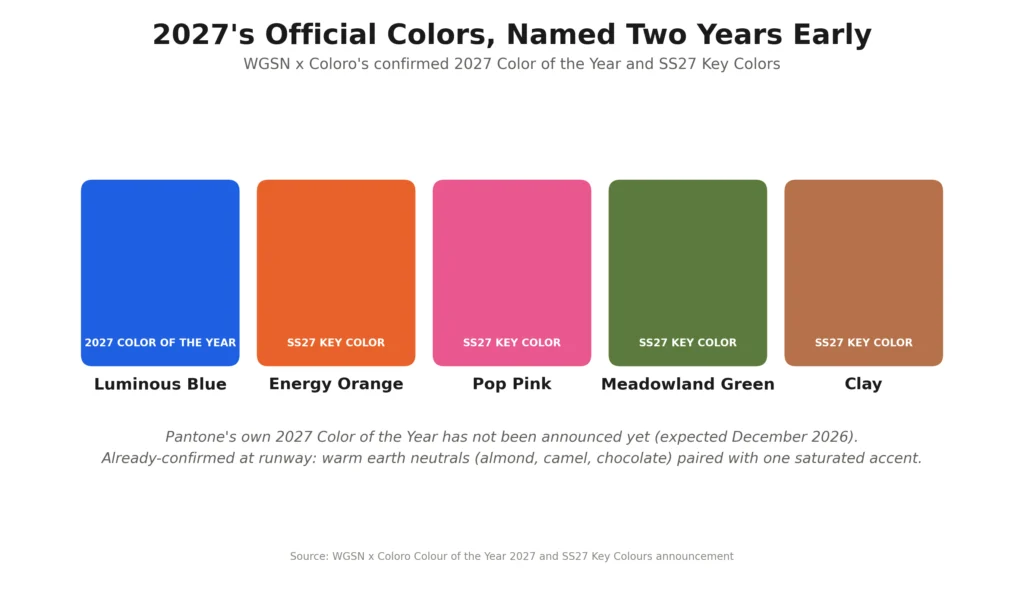
Color forecasting runs further ahead than any other part of fashion, and 2027’s headline color is already public. WGSN and Coloro, whose joint forecast has a long track record in the industry, named Luminous Blue as their Color of the Year for 2027, describing it as an electric, high-chroma blue that reads as both natural (bioluminescence, deep water) and technological (screen glow, interface light). Alongside it, they named five Key Colors for Spring/Summer 2027: Luminous Blue, Energy Orange, Pop Pink, Meadowland Green, and Clay.
Pantone’s own 2027 Color of the Year hasn’t been announced yet; it’s typically revealed in December, so as of now it’s an open question rather than a confirmed pick. That said, some color analysts tracking Pantone’s historical pattern and PANTONEVIEW seasonal reports have floated informed guesses, but those are explicitly predictions about a prediction, one layer more speculative than WGSN’s already-published call.
| Color | Status | Source |
|---|---|---|
| Luminous Blue | Confirmed, official 2027 Color of the Year | WGSN x Coloro |
| Energy Orange, Pop Pink, Meadowland Green, Clay | Confirmed, official SS27 Key Colors | WGSN x Coloro |
| Pantone’s 2027 Color of the Year | Not yet announced | Expected December 2026 |
| Warm earth tones (almond, camel, chocolate) | Confirmed, already shown on runway | NYFW Spring/Summer 2027 |
WGSN frames the 2027 color story around “interconnectedness,” pairing opposites: light and dark, nature and technology, old and new. That’s a deliberately broad theme, which means the practical takeaway is less “wear electric blue” and more “expect palettes this year to mix a warm, grounded neutral with one high-voltage accent,” a pattern that already shows up in the actual runway reporting below.
What actually showed at Spring/Summer 2027 fashion week
New York opened the season September 10 to 15, 2026, followed by Copenhagen, London, Milan, and Paris through early October. This is documented, not forecasted.
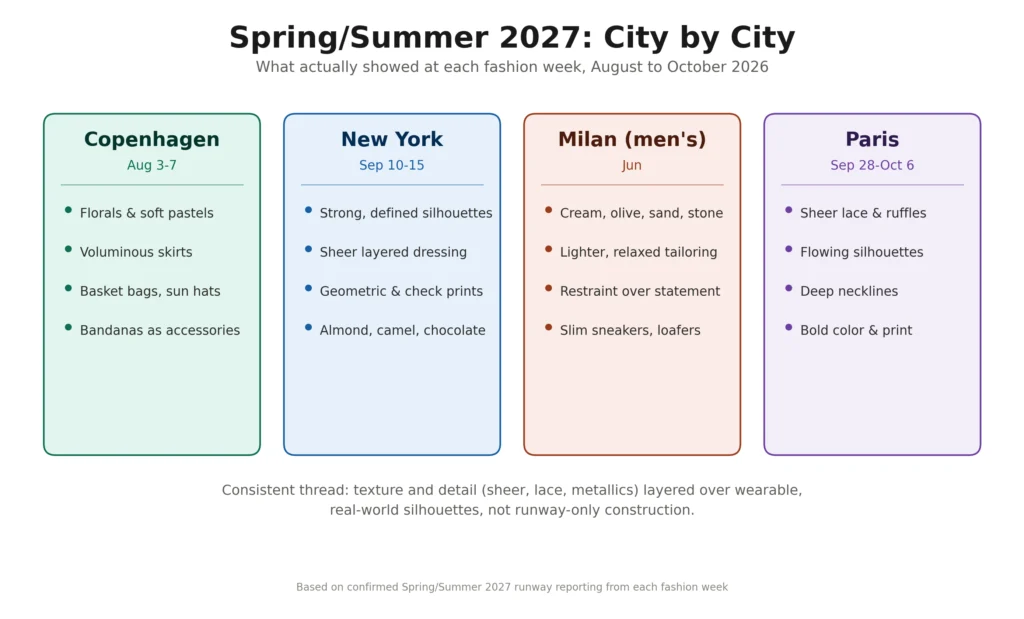
New York Fashion Week SS27 delivered a fairly wearable direction: strong, defined silhouettes, sheer layered dressing, geometric and check prints, metallic and plissé fabrics, and a warm earth-tone palette anchored in almond, camel, and chocolate. The season also included several notable debuts, Henry Zankov’s first collection as artistic director of Diane von Furstenberg among them, alongside newer names like Magda Butrym and Conner Ives joining the official CFDA calendar.
Copenhagen Fashion Week, which opened the international SS27 season in early August, leaned into a warmer, more considered mood: florals, soft pastels, bandanas, voluminous skirts, basket bags, and sun hats.
Paris and London’s SS27 previews point toward romantic detailing carried over from recent seasons: sheer lace, ruffles, flowing silhouettes, deep necklines, and statement accessories, alongside continued use of color and print rather than a return to minimalism.
What ties these together isn’t one silhouette or one color. It’s a consistent preference for texture and detail (sheer layers, metallics, lace, ruffles) sitting on top of wearable, real-world silhouettes, rather than runway-only construction that doesn’t translate to a closet.
Menswear goes quieter and more relaxed
Menswear’s SS27 story, shown earlier in the summer at Milan and Paris, ran in a different direction than the women’s shows. Reporting on the men’s collections described Milan as returning to restraint: neutral and earthy shades (cream, olive green, chocolate brown, sand, stone, faded blue) with tailoring that felt lighter and more relaxed than in recent seasons, familiar pieces reworked through styling rather than replaced with new silhouettes. Paris, by contrast, leaned into color and creative risk-taking in the same season, giving the two cities a genuine point of contrast rather than a single unified menswear direction.
Accessories told a consistent story across both cities: larger tote bags, slimmer crossbody bags, statement jewelry, silk scarves, and fashion-forward sunglasses all showed up repeatedly. Footwear moved toward slimmer, quieter shapes, with slim sneakers, leather sandals, loafers, and minimalist driving shoes replacing the chunkier silhouettes that had dominated recent years.
How to read this for an actual wardrobe: the menswear direction is one of the more genuinely accessible trend stories here. A neutral, well-cut piece with one statement accessory (a bag, a scarf, a pair of sunglasses) reflects the season’s actual direction more accurately than trying to chase a specific silhouette.
What bloggers and online fashion communities are predicting
This section is explicitly less certain than the sections above. It reflects independent fashion writers and online trend-prediction content rather than runway evidence or brand-side forecasting, and should be read as informed guessing, not documented fact.
One independent style blogger’s 2027 predictions, published in mid-2026, singled out a scoop-neck revival on basics, a peplum comeback (acknowledged in the piece itself as a look some readers may need to warm up to), cropped jackets paired with higher-rise bottoms, and funnel-neck jackets with a high, structured collar. The same piece frames its own predictions honestly, distinguishing between things “already starting to pop up” and things that are the writer’s own extrapolation from where fashion seems to be heading, which is a more careful approach than most trend content takes.
That kind of source is genuinely useful for gauging what’s circulating in fashion-interested online communities right now, but it carries far less weight than a runway collection or a published forecaster’s official call. Treat blogger predictions as a temperature check on consumer sentiment, not as evidence a trend will actually happen.
What’s worth watching, with appropriate skepticism:
- Scoop necklines returning to basics (tees, tanks, sweaters)
- Cropped jacket silhouettes, especially in leather and denim
- Funnel-neck jackets and coats
- Peplum details, described even by proponents as a trend some people will need time to warm up to
Confirmed vs predicted, side by side
| Trend | Evidence type | Confidence |
|---|---|---|
| Luminous Blue as 2027’s defining color | Official forecaster call | High |
| Warm neutrals + sheer/metallic detail (women’s) | Actual runway, SS27 | High |
| Quieter, earth-toned menswear tailoring | Actual runway, SS27 | High |
| Larger totes, statement accessories (menswear) | Actual runway, SS27 | High |
| Copenhagen’s soft pastel, floral direction | Actual runway, SS27 | High |
| Pantone’s specific 2027 color pick | Not yet announced | Unknown until December 2026 |
| Scoop necklines, funnel-neck jackets, peplum revival | Blogger/community prediction | Speculative |
| Full-scale return of 2010s ruffle and boho styling | Blogger/community prediction | Speculative |
FAQ
What is the official color of 2027 in fashion?
WGSN and Coloro have already named Luminous Blue as their 2027 Color of the Year, alongside four Spring/Summer 2027 Key Colors: Energy Orange, Pop Pink, Meadowland Green, and Clay. Pantone’s own Color of the Year for 2027 has not been announced yet and is typically revealed in December.
Has Spring/Summer 2027 fashion already been shown?
Yes. Copenhagen opened the international SS27 season in early August 2026, followed by New York, London, Milan, and Paris through early October 2026. The collections already exist and have been reported on; they aren’t a future prediction.
What are the biggest confirmed 2027 fashion trends?
Warm earth tones mixed with sheer and metallic detailing in womenswear, quieter and more relaxed tailoring in menswear with earthy neutral colors, and statement accessories, particularly larger bags and scarves, across both. These come directly from documented Spring/Summer 2027 runway reporting.
Are peplum and scoop necklines actually coming back in 2027?
That claim currently comes from independent style blogger predictions rather than runway or forecaster evidence. It’s a reasonable read of where casual online fashion sentiment is heading, but it hasn’t been confirmed by runway collections in the same way the color and silhouette trends above have.
How far in advance do fashion color forecasts actually go?
Officially, about two years. WGSN and Coloro name their Color of the Year and seasonal Key Colors roughly 24 months before the season, which is why a 2027 color call already existed while Fall/Winter 2026 was still the current season in stores.
The gap worth paying attention to
The honest read on “new year fashion trends 2027” is that the runway and forecasting side of the industry is unusually far ahead of itself, with real color and silhouette data already public well over a year out. What isn’t settled is how much of that translates into what shows up in ordinary closets, and that’s the part currently being filled in by blogger predictions and online fashion chatter rather than hard evidence.
Following the confirmed runway direction (warm neutrals, one saturated accent color, relaxed tailoring, statement accessories) is a safer bet than betting on any single micro-trend still circulating only in prediction posts.
Leave a Reply
You must be logged in to post a comment.