
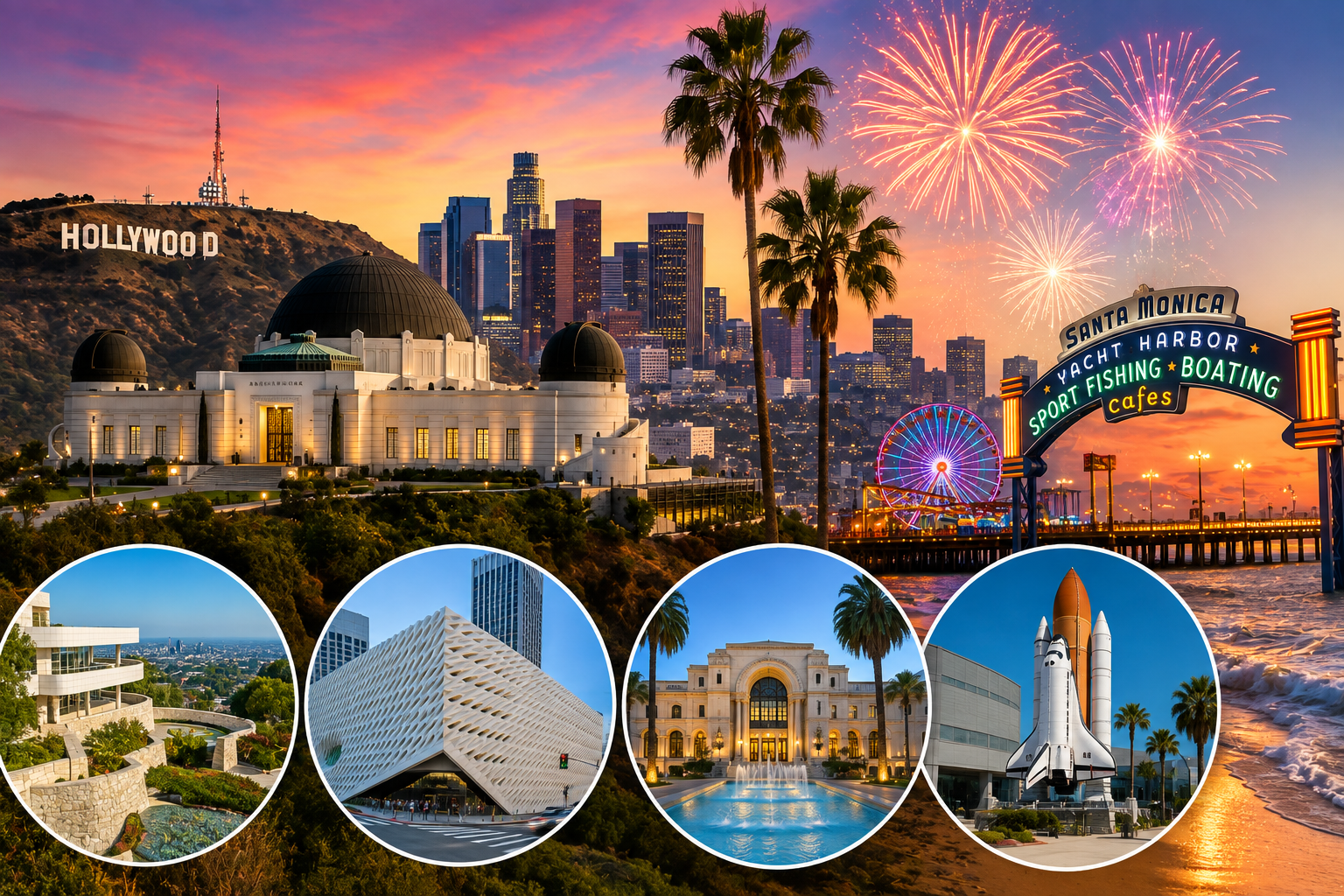
Los Angeles around New Year’s is really four or five separate cities stitched together by freeways, and the biggest planning mistake visitors make is trying to treat it like one compact downtown. Griffith Park, Downtown LA, the Westside and Exposition Park each hold a full day of sightseeing on their own. Pick one area, build the day around it, and add a second area only if the drive genuinely makes sense.
This guide is built around that reality. It groups the best New Year-period sightseeing by neighborhood, flags what is genuinely free versus what only sounds free, and tells you what needs a reservation before you land. It does not cover New Year’s Eve parties, countdowns or fireworks; those belong to a separate events guide, linked at the end.
How to Plan What to Do in Los Angeles Around New Year’s
Why Planning by Area Works Better Than Chasing Every Famous Attraction
A list of Los Angeles’s most famous attractions is not the same as a workable itinerary. Griffith Observatory, the Getty Center and Santa Monica Pier all show up on nearly every “top things to do” roundup, but they sit in three different parts of the city, and holiday traffic between them can turn a simple afternoon into a wasted one.
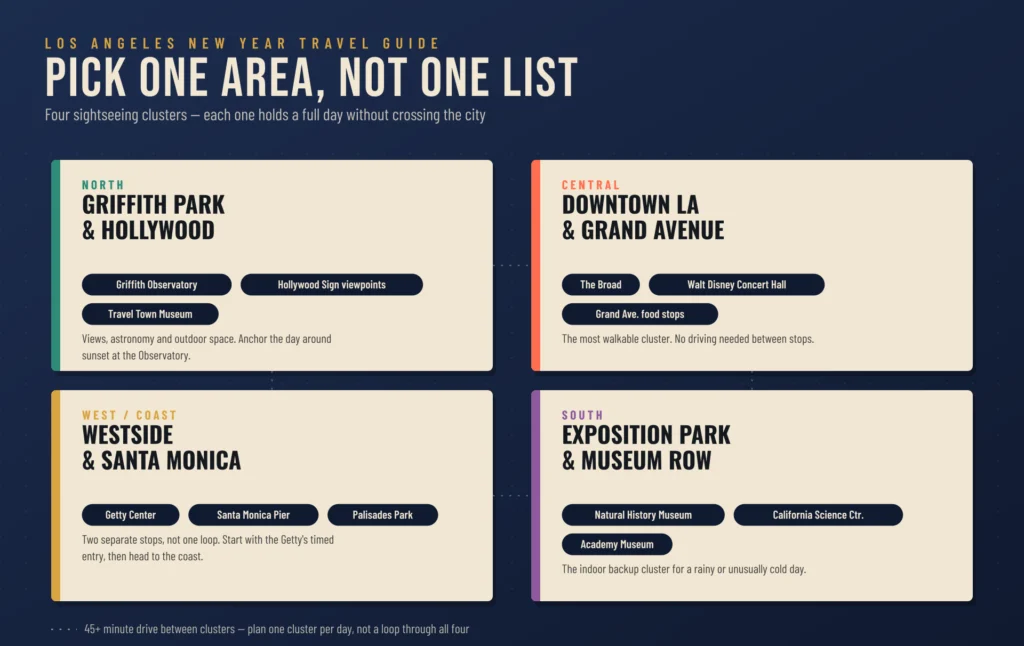
The more useful way to plan is by area cluster:
- Griffith Park and Hollywood for views, astronomy and classic LA scenery
- Downtown LA and Grand Avenue for museums, architecture and a walkable core
- The Westside and Santa Monica for art, gardens and the Pacific coastline
- Museum Row and Exposition Park for indoor, family-heavy science and history museums
Each cluster can fill a full day on its own. Trying to combine two clusters in one day usually means less time at each stop and more time in the car.
What to Book Before the Holiday Travel Period
New Year’s week is one of the busiest tourist weeks in Los Angeles, and several major attractions use timed entry even outside the holidays. Reserve these in advance if your dates are fixed:
- Getty Center timed-entry passes
- The Broad’s timed entry tickets, if you want to avoid the standby line
- Any planetarium show at Griffith Observatory
- Academy Museum of Motion Pictures tickets, especially for a specific exhibition
Everything else on this list (Griffith Observatory’s grounds, Santa Monica Pier, Grand Avenue) can be visited without a reservation, though arriving early still helps during the holiday week.
What to Check If You’re Visiting on January 1
Hours change on major holidays, and not every museum or attraction follows the same schedule. Some close entirely on January 1, others run reduced hours, and a few operate normally. Rather than assume any single rule applies citywide, check each attraction’s own holiday calendar for the exact date you plan to visit. This single step avoids more wasted time than any other piece of planning advice in this guide.
Start With Griffith Park for Views, Astronomy and Classic Los Angeles Scenery
Griffith Park is less a single attraction and more a destination cluster: an observatory, hiking trails, a historic train museum and some of the best skyline views in the city, all inside one park.
Visit Griffith Observatory
Griffith Observatory sits at 2800 East Observatory Road in Griffith Park and combines astronomy exhibits, public telescopes and panoramic views of the city and the Hollywood Sign in one stop.
- Cost: The Observatory building, grounds and public telescopes are free to enter. The Samuel Oschin Planetarium charges separately for shows.
- Parking: Paid parking operates near the Observatory during relevant hours; arriving without a parking plan during a holiday sunset is one of the more common visitor frustrations here.
- Booking: No reservation is needed for the building or grounds. Planetarium show times and any ticketing should be checked on the official site before you go.
- Duration: Plan on 1.5 to 3 hours, longer if you want a planetarium show or a sunset view.
- Best for: First-time visitors, families, photographers and anyone who wants a classic LA skyline shot.
- Accessibility: According to the Observatory’s official visitor information, all four public levels and the grounds have accessible routes using ramps and elevators.
- Pets: Pets and emotional-support animals are not permitted inside the building. Trained service animals are welcome.
- Holiday planning: The Observatory’s own site warns of congestion, limited parking and possible capacity control during busy periods, and sunset on any clear evening already draws a crowd. Add extra time if you’re visiting during the last week of December.
Explore the Observatory Grounds and Nearby Viewpoints
You don’t need a ticket to get the view. The terraces and lawns around the building are free and often less crowded than the interior exhibits, and they’re the better option if you’re short on time or traveling with a stroller. A short walk from the main parking area also brings you to viewpoints looking toward the Hollywood Sign, which is a separate photo stop from the Observatory itself and doesn’t require driving anywhere else.
Add Travel Town Museum if You’re Visiting With Children
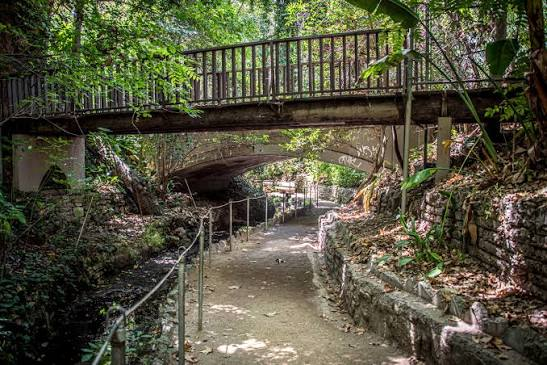
Travel Town Museum, also inside Griffith Park, is an outdoor railway museum with historic locomotives and rail cars that kids can walk around and, depending on current operations, ride. Basic access has historically been free, while train rides or special activities may carry a separate charge, so confirm current pricing before you go. Budget 1 to 2 hours, and don’t try to combine it with a rushed Observatory visit on the same afternoon. Griffith Park is large enough that the two sides of the park deserve separate time blocks, not a fast drive-through.
Spend a Downtown Day Where Free Culture Can Fill Most of Your Itinerary
Downtown LA, specifically the stretch around Grand Avenue, is the most walkable of the four clusters in this guide and the one where a genuinely low-cost day is easiest to build.
See Contemporary Art at The Broad
The Broad, at 221 S. Grand Avenue, is a contemporary art museum with general admission that’s free for everyone.
- Cost: Free general admission. Select exhibitions, events or special experiences may carry their own ticket price.
- Booking: Timed entry is recommended, and walk-up or standby access is also available depending on demand.
- Duration: 1.5 to 2.5 hours for the permanent collection.
- Kids: Children are welcome; visitors under 13 must be accompanied by an adult.
- Accessibility: All galleries and facilities are wheelchair accessible, and a limited number of wheelchairs are available on-site free of charge, first-come basis.
- Pets: Trained service dogs are allowed. Ordinary pets and emotional-support animals are not.
- Holiday planning: Reserve ahead if you can. Standby access becomes less predictable during the last week of December, when both tourists and locals treat it as a free holiday outing.
Walk Grand Avenue and See the Walt Disney Concert Hall Exterior
Grand Avenue connects The Broad to the Walt Disney Concert Hall, and the walk between them is short enough to do on foot in under ten minutes. The Concert Hall’s stainless steel exterior, designed by Frank Gehry, is worth seeing even if you’re not attending a performance inside, and it costs nothing to walk the plaza and photograph the building from outside.
Build in a Nearby Food Stop Instead of Crossing the City at Midday
Downtown LA has enough restaurants and quick food options within a few blocks of Grand Avenue that there’s rarely a reason to drive elsewhere for lunch. Staying local here matters more during the holiday week, when midday traffic on surface streets can eat up the time you saved by picking a walkable cluster in the first place.
What Requires Advance Planning in Downtown LA
The Broad is the one stop in this cluster where a reservation genuinely changes your visit. Everything else, Grand Avenue, the Concert Hall exterior, nearby food, works on a walk-up basis. If your New Year trip has only one fixed reservation to build a day around, this is a reasonable one to choose.
Choose the Westside for Art, Architecture and Pacific Views
The Westside cluster pairs the Getty Center in Brentwood with Santa Monica Pier and the beach, but these two stops are not next to each other, and treating them as one tight loop is the most common planning mistake for this part of the city.
Explore the Getty Center
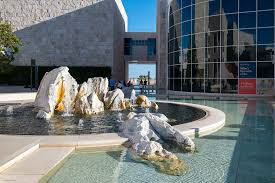
The Getty Center sits on a hilltop in Brentwood and combines an art museum, architecture and gardens with sweeping views out toward the ocean and the city.
- Cost: Admission is free. Parking costs extra and should be budgeted for separately.
- Booking: A timed-entry reservation is required; this is not optional the way it is at The Broad.
- Duration: Plan on 2.5 to 4 hours, more if you want to spend real time in the Central Garden.
- Best for: Art and architecture lovers, couples, and travelers who want a slower-paced day rather than a checklist of stops.
- Family suitability: Good, particularly for families who enjoy gardens and open outdoor space, though the art galleries themselves hold younger children’s attention less than the grounds do.
- Accessibility and pets: Check the Getty’s official accessibility and visitor policy pages for exact current details before your visit; don’t assume a blanket pet-friendly policy without verifying it first.
- Holiday planning: Confirm the timed-entry schedule and holiday hours for your specific date, since reservation windows can fill up faster during the last week of December.
Visit Santa Monica Pier and the Beach
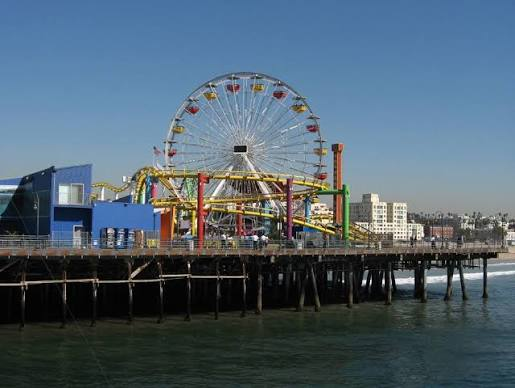
Santa Monica Pier gives the Westside day its outdoor, ocean-facing half. Walking the pier, the beach and Palisades Park costs nothing; the individual rides, pier attractions, food stalls and parking are what add to the bill.
- Duration: 1 to 3 hours depending on how much of the pier, beach and downtown Santa Monica you want to cover.
- Best for: Families, couples and anyone who wants a straightforward, low-effort outdoor stop.
- Kids: A strong option, though the rides and paid attractions on the pier should be planned for as an added cost, not treated as part of a free visit.
- Winter note: Daylight is shorter in late December, and the coast is noticeably cooler than inland LA, especially once the sun starts to drop. A jacket matters here even on a mild day.
- Accessibility and pets: Verify current pier and beach accessibility and pet policies with the official city and pier sources before your visit; don’t assume dogs are permitted on the sand without checking first.
How to Structure the Day Without Rushing Between the Two
Because the Getty requires a timed entry and Santa Monica does not, the more reliable sequence is to start at the Getty for your reserved window, then head toward Santa Monica for the back half of the day once you’re free of any fixed schedule. Trying to do Santa Monica first and then rushing to make a Getty reservation adds unnecessary pressure to a day that’s supposed to be the slower, scenery-focused one in this guide.
Use Museum Row and Exposition Park as Your Indoor-Weather Backup
Miracle Mile’s Museum Row and Exposition Park a few miles south form the strongest indoor cluster in this guide, and they’re the natural answer if rain or an unusually cold day changes your plans.
Academy Museum of Motion Pictures
The Academy Museum, on Museum Row in Miracle Mile, is dedicated to film history and gives this guide its most distinctly Los Angeles indoor stop.
- Cost: Treat this as a paid attraction unless a specific date-limited free program applies to your visit; confirm current pricing on the official site.
- Booking: Advance tickets are recommended, particularly on busy dates.
- Duration: 2 to 3 hours.
- Best for: Movie fans, older children, teenagers and adults; the immersive galleries tend to hold older kids’ attention better than very young children’s.
- Nearby: La Brea Tar Pits and the rest of Museum Row are close enough to combine on foot.
Natural History Museum of Los Angeles County
Also in Exposition Park, the Natural History Museum is one of the stronger family-focused indoor options in the city, with galleries covering natural history and rotating temporary exhibitions.
- Cost: Paid general admission; some temporary exhibitions may carry a separate charge.
- Duration: 2 to 3 hours.
- Best for: Families with children, and a reliable choice on a rainy or unusually cold day.
California Science Center
The California Science Center sits next to the Natural History Museum in Exposition Park and pairs naturally with it for a full family day. General admission structure and any charges for special exhibitions or timed experiences should be confirmed on the museum’s current official page before you visit, since this can change with whatever major exhibition is running.
- Duration: 2 to 4 hours.
- Best for: Children, families and anyone with an interest in hands-on science exhibits.
- Holiday planning: Holiday-week capacity and operating hours can affect entry; check ahead if your visit falls in the busiest days around New Year’s.
Which Museum Is Best for Your Travel Group
| Group | Best fit | Why |
|---|---|---|
| Film fans, teens and adults | Academy Museum of Motion Pictures | Immersive, movie-specific content that holds older visitors’ attention |
| Families with younger children | Natural History Museum or California Science Center | Hands-on and visually engaging exhibits |
| Mixed-age groups with a full day | Natural History Museum + California Science Center | Both sit in Exposition Park, so you can walk between them |
| Rainy or unusually cold day | Any of the three | All are fully indoor |
Free Things to Do in Los Angeles Around New Year’s
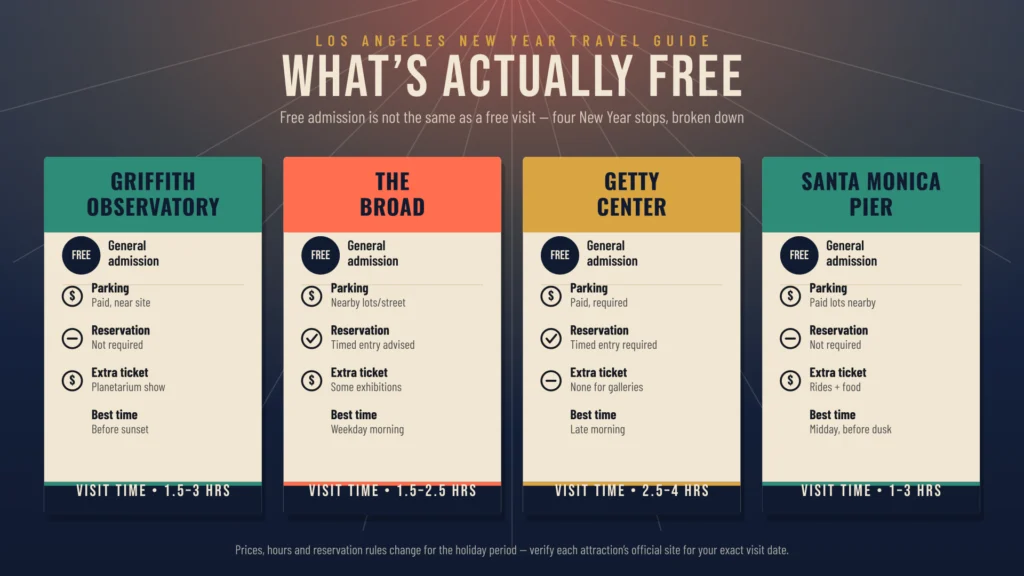
Free admission and a free visit are not the same thing, and this is where a lot of Los Angeles travel content gets misleading. The distinction matters most during a holiday trip, when parking and add-on costs can quietly stack up across several stops in one day.
Attractions With Free Admission but Extra Costs to Watch For
| Attraction | Admission | Extra costs to plan for |
|---|---|---|
| Griffith Observatory | Free | Parking, planetarium shows |
| The Broad | Free | Select exhibitions or special experiences |
| Getty Center | Free | Parking (and a required timed-entry reservation) |
| Santa Monica Pier | Free access | Parking, rides, food |
Free Outdoor Sightseeing
Some of the best sightseeing in this guide costs nothing beyond getting there:
- Griffith Observatory’s grounds and terraces
- The Hollywood Sign viewpoints near Griffith Park
- Grand Avenue and the Walt Disney Concert Hall exterior in Downtown LA
- Santa Monica Pier, the beach and Palisades Park
Free Attractions That Still Benefit From Advance Planning
Free does not mean walk-up-friendly. The Broad recommends timed entry to avoid a standby line, and the Getty Center requires a reservation despite charging nothing for the museum itself. Treat “free” and “no planning needed” as two separate questions when you’re building your itinerary.
The Best Choices for Families Visiting Los Angeles Over New Year’s
Family suitability depends less on whether a place is famous and more on how well it matches your kids’ ages and how much walking or waiting is involved.
Best Options for Younger Children
- California Science Center: hands-on exhibits designed for active engagement
- Natural History Museum: visually striking galleries that hold attention without requiring much reading
- Travel Town Museum: outdoor space to move around, plus trains, which is a reliable combination for younger kids
Better Choices for Teenagers
- Griffith Observatory: genuine science content plus a skyline view worth photographing
- Academy Museum of Motion Pictures: film history content that resonates more with older kids than toddlers
- California Science Center: current major exhibitions often skew toward older kids and teens depending on what’s running
Where Strollers, Breaks and Attention Spans Matter
Exposition Park’s museums are the easiest cluster for stroller access and indoor breaks, since the Natural History Museum and California Science Center sit next to each other with no driving required between stops. Griffith Observatory’s grounds are stroller-friendly, but the building’s crowds during peak sunset hours can make navigating with a stroller slower than expected. The Getty Center’s hillside layout and garden paths are manageable but involve more walking than a flat museum floor, worth factoring in in if nap schedules are tight.
Accessibility, Mobility and Pet Planning Before You Go
Accessibility and pet policies vary enough between attractions that a blanket assumption about either one isn’t reliable. This guide only states what’s confirmed by each attraction’s own official information.
Attractions With Strong Wheelchair Access
Griffith Observatory’s official visitor information documents accessible routes across all four public levels and the grounds, using ramps and elevators. The Broad states that all of its galleries and facilities are wheelchair accessible, and it also provides a limited number of free wheelchairs on-site along with accessible parking. For the Getty Center, Santa Monica Pier and the Exposition Park museums, confirm current accessibility details directly on each attraction’s official site before your visit, since specifics weren’t verified for this guide.
Where Trained Service Animals Are Allowed
Trained service animals are permitted at Griffith Observatory and The Broad, even though both restrict ordinary pets and emotional-support animals. Treat this as the general pattern for most indoor Los Angeles attractions, but confirm the exact policy for any museum before assuming it applies.
Why Outdoor Does Not Automatically Mean Pet Friendly
An outdoor attraction like Santa Monica Pier or the beach is not automatically open to pets. Sand access, leash rules and specific beach sections can all vary, and assuming a dog is welcome because a location is outdoors is one of the more common mistakes visitors make. Use three categories when you’re checking any attraction, rather than a single “pet friendly” label: pets allowed, pets not allowed, or only trained service animals allowed.
Easy Los Angeles Attraction Combinations for One Day
These routes follow the same area clusters used throughout this guide, so nothing on a given route requires crossing the city.
| Route | Morning | Afternoon | Optional add-on |
|---|---|---|---|
| Hollywood and Griffith Park | Griffith Observatory grounds and interior | Travel Town Museum or a Hollywood Sign viewpoint | Sunset return to the Observatory terraces |
| Downtown LA culture | The Broad | Grand Avenue walk and Walt Disney Concert Hall exterior | A nearby Downtown food stop |
| Westside and Santa Monica | Getty Center (timed entry) | Santa Monica Pier and beach | Downtown Santa Monica shops and restaurants |
| Exposition Park family day | Natural History Museum | California Science Center | Academy Museum, if energy and time allow |
Practical New Year Travel Planning for Los Angeles
Winter Weather and Rain Backup Plans
Outdoor sightseeing is genuinely enjoyable in Los Angeles in late December and early January, but the season isn’t guaranteed sun. Coastal areas like Santa Monica run cooler than inland neighborhoods, daylight hours are shorter than in summer, and rain, while not constant, does happen. Keep the Exposition Park museums or Academy Museum in your back pocket as an indoor option if the forecast turns on you, rather than assuming every day of your trip will be beach weather.
Holiday Hours and Temporary Closures
January 1 is the single date most likely to disrupt a Los Angeles itinerary. Some attractions close entirely, some run modified hours, and a few operate as usual, without a single rule that applies across the whole city. Check your exact date on each attraction’s official calendar before you build a schedule around it.
Parking Costs Versus Public Transportation
Every attraction in this guide with dedicated parking charges for it separately from admission, and holiday-week demand can make lots fill up earlier than usual. Los Angeles Metro rail and bus lines reach several of these clusters, including Downtown LA and parts of the Westside, and can be worth checking as an alternative to driving and paying for parking twice in one day, particularly for the Downtown route, where the distances between stops are walkable once you arrive.
How Much Travel Time to Leave Between Different Parts of LA
The clusters in this guide are deliberately kept separate because driving between them, say from Griffith Park to Santa Monica, can easily take 45 minutes to over an hour depending on time of day, and considerably longer during peak holiday travel windows. If your trip is short, it’s more realistic to fully commit to one cluster per day than to try to see a little of each.
FAQs
What are the best things to do in Los Angeles around New Year’s?
The strongest options are Griffith Observatory and Griffith Park, The Broad and Grand Avenue in Downtown LA, the Getty Center and Santa Monica Pier on the Westside, and the Natural History Museum, California Science Center and Academy Museum of Motion Pictures around Exposition Park and Museum Row. Grouping these by area, rather than trying to see all of them in one trip, makes for a more realistic itinerary.
Is Los Angeles worth visiting around New Year’s?
Yes, for travelers who want a mix of outdoor sightseeing, museums and coastal scenery without the deep crowds of summer. The trade-off is that some hours and reservation windows change over the holiday period, so a bit more advance checking is required than during an ordinary week.
What is free to do in Los Angeles in early January?
Griffith Observatory’s building and grounds, The Broad’s general admission, the Getty Center’s admission, and Santa Monica Pier’s pier and beach access are all free to enter. Parking, planetarium shows, special exhibitions and pier rides are separate costs that can apply even at these free attractions.
Are attractions open on New Year’s Day in Los Angeles?
It depends on the attraction. Some close on January 1, others operate on reduced hours, and some run a normal schedule. There’s no single rule that covers every museum or park in the city, so check the specific attraction’s official holiday hours for your visit date.
What can families do in Los Angeles around New Year’s?
The Exposition Park museums (Natural History Museum and California Science Center) are the most reliable family cluster, with Travel Town Museum in Griffith Park a strong option for younger kids who like trains. Griffith Observatory and the Academy Museum work well for families with older children or teenagers.
Do I need reservations for Los Angeles attractions during the holiday period?
The Getty Center requires a timed-entry reservation regardless of season. The Broad and Academy Museum recommend advance tickets, especially during the busy last week of December, even though walk-up access may still be available. Griffith Observatory’s grounds and Santa Monica Pier don’t require reservations, though planetarium shows at the Observatory should be checked separately.
Can you visit Griffith Observatory for free?
Yes. The Observatory building, its exhibits and the surrounding grounds are free to enter. The only paid components are the planetarium shows and, during relevant hours, nearby parking.
Is the Getty Center free?
Museum admission is free, but a timed-entry reservation is required, and parking is a separate paid cost. Many visitors expect “free” to mean no planning is needed, which isn’t the case here.
What should I do in Los Angeles if it rains?
Shift toward the indoor cluster around Exposition Park and Museum Row: the Natural History Museum, California Science Center and Academy Museum of Motion Pictures are all fully indoor and can absorb a full rainy day without losing much of your itinerary.
How should I group attractions to avoid spending too much time traveling?
Stick to one area cluster per day rather than mixing attractions from opposite sides of the city. The four clusters in this guide, Griffith Park and Hollywood, Downtown LA, the Westside and Santa Monica, and Exposition Park and Museum Row, are each built to hold a full day without requiring a long cross-city drive in between.
Leave a Reply
You must be logged in to post a comment.