

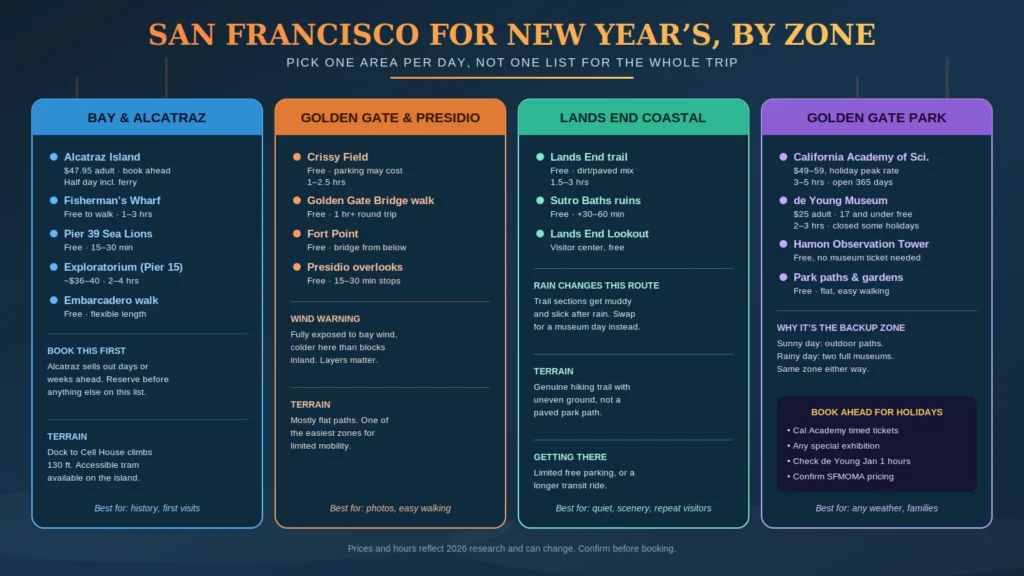
San Francisco around New Year’s is not one easy checklist. The city is compact on a map but built on hills, split by water, and shaped by microclimates that can put fog on one side of a ridge and sun on the other. This guide organizes the city the way it actually works for a visitor: by bay, landscape and neighborhood, so you can build days that make geographic sense instead of chasing scattered landmarks across town.
This is a sightseeing and trip-planning guide. It does not cover New Year’s Eve parties, fireworks, countdowns or nightlife listings. If you’re looking for that, it belongs in a separate events guide.
How to Plan a San Francisco Trip Around New Year’s
The best things to do in San Francisco around New Year’s fall into a few categories: Alcatraz and the northern waterfront, the Golden Gate Bridge landscape around the Presidio, the coastal walks at Lands End, the museums and open space of Golden Gate Park, and a handful of distinct neighborhoods worth exploring on foot. The single most important planning step is booking Alcatraz before anything else, since it sells out well ahead of the holiday period.
Why the City’s Hills and Microclimates Matter When Planning Your Days
San Francisco is about seven miles across, which sounds walkable, and often is. But the terrain is not flat, and treating it like a flat city leads to exhausting, frustrating days. Some routes involve genuine elevation change and require real planning around mobility, weather and time. This matters most at Alcatraz, where the walk from the dock to the Cell House climbs roughly 130 feet over a quarter mile, and in neighborhoods with steep residential streets. The practical fix is not to avoid hills entirely, it’s to group attractions by area rather than crossing the city back and forth in one day.
Which Attractions Should Be Booked Before You Arrive
- Alcatraz ferry tickets, which routinely sell out days or weeks ahead
- California Academy of Sciences, especially since the museum applies peak pricing during the November and December holiday period
- Any special museum exhibition with timed entry
- Popular guided tours if you want a specific date and time
What to Verify for New Year’s Day and Holiday Dates
Hours change on January 1, and some attractions close entirely on specific holidays. The de Young Museum, for example, closes on select holidays but stays open on others. Rather than assume a schedule, check the exact attraction’s website for your specific travel date before finalizing an itinerary.
Make Alcatraz the Centerpiece of a San Francisco Bay Day
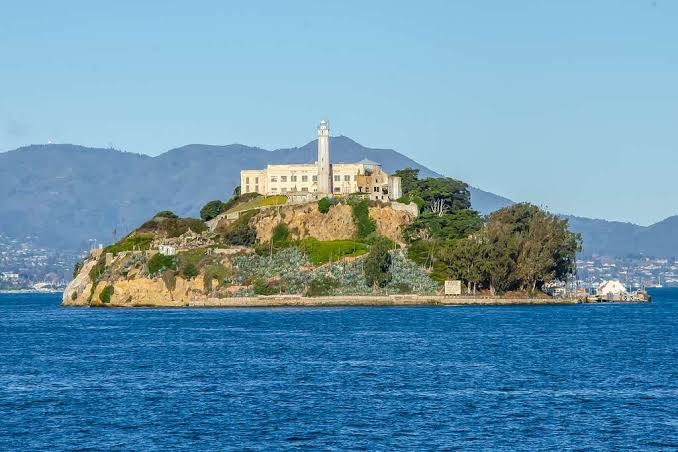
Alcatraz Island is the strongest anchor for a New Year-period San Francisco trip precisely because it requires planning. Building a day around it, rather than treating it as an afterthought, solves most of the scheduling problem for that day automatically.
What to See and Do on Alcatraz Island
Alcatraz sits in San Francisco Bay and is reached only by ferry from Pier 33. Once on the island, visitors explore the former federal penitentiary’s Cell House using a self-paced audio tour that includes recordings from former guards and inmates, walk the island’s gardens and bird colonies, and take in bay views not available from the mainland. Ranger-led programs run on a regular schedule and are included with admission.
Why the Ferry Ticket Should Be Booked Before Other Plans
Alcatraz City Cruises is the only National Park Service authorized ferry operator to the island, and a reservation is required. As of the most recent official pricing from the National Park Service, day tour tickets run $47.95 for adults and youth (12 to 17), $45.15 for seniors (62+), $29.15 for children 5 to 11, and are free for children under 5. Night tour tickets cost more. These prices come from nps.gov and can change, so confirm the current figure when you book. Book directly through Alcatraz City Cruises rather than third-party resellers, which commonly charge well above face value for the same tickets.
What’s included in every ticket:
- Round-trip ferry transportation
- The Cell House audio tour, available in 11 languages
- Regularly scheduled ranger-led or docent programs
Accessibility and the Steep Climb to the Cell House
The route from the dock to the Cell House climbs about 130 feet over roughly a quarter mile, on a mix of paved paths and some stairs. For visitors who cannot manage that climb, an accessible tram is available. The National Park Service also provides accessible parking near Pier 33, accessible restrooms, tactile models, audio description, assistive listening devices and Braille materials. Ordinary pets are not allowed on the island or ferry. Trained service animals meeting federal guidelines are permitted.
What to Combine With Pier 33 and the Waterfront
Plan at least half a day for Alcatraz once ferry timing, the island visit itself, and the return trip are factored in. Because the ferry departs from Pier 33, this pairs naturally with a walk along the Embarcadero toward the Ferry Building, rather than trying to also fit in Golden Gate Park or Lands End on the same day.
Follow the Waterfront for Classic San Francisco Sights
The northern waterfront is San Francisco’s most flexible sightseeing corridor. It doesn’t require reservations for the area itself, and it connects naturally to the Alcatraz ferry terminal.
Fisherman’s Wharf and Pier 39
Fisherman’s Wharf is a walkable stretch of the northern waterfront with bay views, seafood stands, and a concentration of family attractions. Walking the area and viewing the waterfront cost nothing; individual attractions inside the Wharf, such as museums or specific tours, are ticketed separately. Plan on 1 to 3 hours depending on how many paid attractions you add.
See the Sea Lions Without Treating the Area as an All-Day Itinerary
The sea lions that gather at Pier 39’s K-Dock are one of the few genuinely free wildlife-viewing experiences in the city and are worth 15 to 30 minutes on their own. They’re a strong stop for younger children specifically because the experience is visual, short and doesn’t require standing in line. Treat this as one stop within a waterfront day rather than the day’s entire plan.
Continue Toward the Embarcadero for a More Flexible Waterfront Walk
South of Fisherman’s Wharf, the Embarcadero runs along the bay toward the Ferry Building and offers a calmer, less commercial walk with piers, public art and water views. This stretch is a natural extension of an Alcatraz or Fisherman’s Wharf day and works well if you want unstructured time rather than another ticketed stop.
See the Golden Gate Bridge From the Presidio and Crissy Field
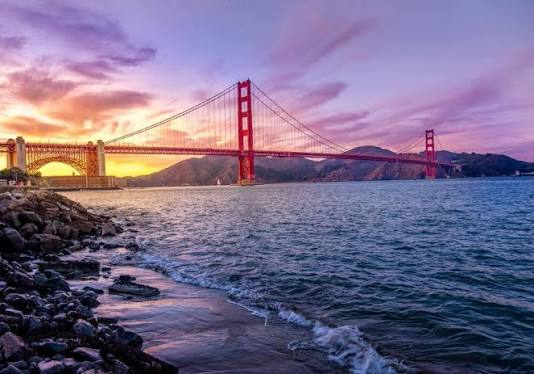
The Golden Gate Bridge is worth building an entire half-day around rather than treating as a five-minute photo stop, mainly because the surrounding Presidio parkland offers several distinct vantage points and a genuinely pleasant waterfront walk.
Walk Crissy Field for Bridge Views
Crissy Field is a reclaimed waterfront park along the Presidio’s bay side, east of the bridge, with an unobstructed walking and biking path facing both the bridge and the water. Outdoor access is free. Parking at Crissy Field is not always free, and public transit access adds its own time, so factor that into a “free” day’s actual cost. Plan 1 to 2.5 hours depending on how far along the path you walk.
Choose Your Golden Gate Bridge Experience
You can walk partway or fully across the bridge on the pedestrian path, view it from below at Fort Point, or take it in from a distance at Crissy Field or one of the Presidio’s overlooks. Each option has a different time commitment: a bridge walk can take an hour or more round trip depending on how far you go, while an overlook stop can be 15 to 30 minutes.
How Wind, Rain and Mobility Affect the Route
The bridge and Crissy Field are both fully exposed to bay wind, which is often stronger and colder than conditions a few blocks inland. Golden Gate National Recreation Area publishes accessibility information for Presidio sites including Crissy Field, though accessibility varies by specific route and should be checked for the exact path you’re planning rather than assumed for the whole park.
Spend a Different Kind of Day at Lands End and Sutro Baths
Lands End is the most distinctly San Francisco outdoor experience on this list, and it’s frequently skipped by first-time visitors who stay closer to downtown and the Wharf.
Walk the Coastal Landscape
Lands End sits at San Francisco’s northwestern edge, where the trail follows Pacific coastline with views toward the Golden Gate Bridge and the open ocean. The main trail is a mix of dirt path and some paved sections, with the Lands End Lookout visitor center as a natural starting point. Outdoor access is free.
Explore the Sutro Baths Ruins
Just below the main trail sit the concrete ruins of the Sutro Baths, a former 19th-century public bathhouse now open to the elements. Exploring the ruins adds 30 to 60 minutes to a Lands End walk and is one of the more photogenic, least crowded stops in the city.
When the Weather Makes This Route Impractical
This is an exposed coastal trail, and San Francisco’s winter weather can turn a scenic walk into an unpleasant one quickly. After heavy rain, sections of the trail can be muddy or slick, and wind off the ocean is common. If the forecast looks rough, this is one of the easiest sections to swap for an indoor alternative like Golden Gate Park’s museums.
Use Golden Gate Park for Museums, Gardens and a Flexible Weather Plan
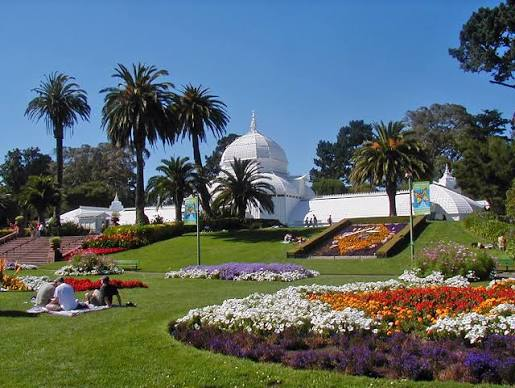
Golden Gate Park is not a single attraction. It’s roughly three miles of connected paths, gardens and museums, which makes it the most useful weather-flexible zone in the city: on a clear day it’s a park visit, on a rainy day it’s a museum day, and either way it doesn’t require crossing town.
California Academy of Sciences
The Academy combines a natural history museum, aquarium, planetarium and indoor rainforest under one living roof. General admission runs roughly $49 to $59 for adults depending on the date, with the museum’s own site noting that peak pricing applies during spring break, summer, and the November and December holiday period, which includes New Year’s. Youth and children’s rates are lower, and children 2 and under are free. Plan 3 to 5 hours; families with younger kids often stay closer to a full day. The Academy is open 365 days a year and is wheelchair accessible.
de Young Museum
Across the Music Concourse from the Academy, the de Young holds American art, textiles and international collections inside a distinctive copper-clad building. General admission is $25 for adults, $22 for seniors and $10 for students, with visitors 17 and under admitted free. The museum is closed on a handful of specific holidays, so check the exact date rather than assume standard hours apply. The Hamon Observation Tower is free to enter without a museum ticket and offers park and city views. Plan 2 to 3 hours.
Outdoor Areas Worth Visiting Without Paying Museum Admission
The park’s gardens, lakes and open meadows don’t require an admission ticket. A walk through the park’s less-visited paths, away from the museum concourse, is a genuinely free option on a mild day and doesn’t need to be booked in advance.
How to Choose Between a Museum Day and a Park Day
If rain or wind is in the forecast, lean toward the Academy or de Young and treat the outdoor paths as a bonus rather than the plan. On a clear, calm day, the park’s outdoor space can fill a half-day on its own, with a museum as an optional add-on rather than the anchor.
Choose Indoor Attractions When San Francisco’s Winter Weather Turns
Beyond Golden Gate Park’s museums, two other indoor options give you a genuine backup plan without requiring a trip across the city.
Exploratorium
The Exploratorium sits on Pier 15 along the Embarcadero, between Fisherman’s Wharf and the Ferry Building, which makes it easy to combine with a waterfront day rather than a separate trip to the park. It’s a hands-on science and human-perception museum spanning roughly 650 interactive exhibits, plus the Tactile Dome, a crawl-through experience in complete darkness that’s included with general admission (skippable for anyone with severe claustrophobia). General admission runs roughly $36 to $40 for adults, with discounted rates for youth, seniors and students.
All exhibition spaces, dining areas and restrooms are wheelchair accessible, and free loaner wheelchairs are available at the information desk. Most visitors spend 2 to 3 hours; families often stay 3 to 4.
San Francisco Museum of Modern Art
SFMOMA, downtown near Yerba Buena, holds modern and contemporary art across multiple floors and works well as an indoor anchor for a downtown day rather than a Golden Gate Park day. Current general admission and any special exhibition surcharges should be checked directly on the museum’s website before your visit, since exhibition-based pricing changes throughout the year.
Which Indoor Option Works Best for Families and Adults
The Exploratorium and California Academy of Sciences are built around hands-on interaction and animals, which tends to hold younger children’s attention better than a traditional art museum. SFMOMA and the de Young reward visitors with more interest in art itself and tend to work better for adults, couples, or older teens with a specific interest in the collections. Alcatraz sits in its own category: the subject matter and amount of walking make it a better fit for older children, teens and adults than for toddlers or very young kids.
Explore Neighborhoods When You Want to Experience the City Beyond Its Landmarks
Neighborhood walking is the least structured, lowest-cost way to spend part of a San Francisco day, and it gives repeat visitors something genuinely different from ticketed attractions.
Chinatown
San Francisco’s Chinatown is dense, walkable, and packed with markets, historic alleys and restaurants. Walking the neighborhood is free; individual restaurants, shops and any specific tours are not. Plan 1.5 to 3 hours depending on how much time you spend eating and browsing.
North Beach
Just north of Chinatown, North Beach is San Francisco’s traditionally Italian neighborhood, with cafes, bookstores and a different, more residential pace than the Wharf a few blocks away. It pairs naturally with a Chinatown walk since the two neighborhoods border each other.
Mission District
The Mission sits further south and has its own character entirely: murals, taquerias and a different architectural feel from downtown or the northern waterfront. It’s a better fit for a separate day or a half-day rather than an add-on to a Wharf or Golden Gate Park itinerary, since it’s not geographically close to either.
How to Choose One Neighborhood Rather Than Rushing Through All Three
Chinatown and North Beach connect well as a single walk. The Mission is far enough from both that combining all three in one day usually means rushing each of them. If you only have one extra half-day for neighborhood exploration, pick based on interest: historic density and food markets point toward Chinatown, a slower cafe-and-bookstore pace points toward North Beach, and murals and a younger, more contemporary feel point toward the Mission.
Free Things to Do in San Francisco Around New Year’s
Free Landmark Experiences
- Golden Gate Bridge viewpoints and pedestrian path
- Crissy Field waterfront walk
- Lands End coastal trail and Sutro Baths ruins
- Pier 39 sea lions
- Fisherman’s Wharf and Embarcadero walking
- Golden Gate Park’s outdoor paths and gardens
- Chinatown and North Beach neighborhood walking
- Hamon Observation Tower at the de Young (no museum ticket required)
Free Parks and Coastal Scenery
Golden Gate National Recreation Area manages several of San Francisco’s best free outdoor sites, including Crissy Field, Lands End and Fort Point, all without an entrance fee.
Costs That Can Still Make a “Free” Day Expensive
| Free Experience | Hidden Cost to Plan For |
|---|---|
| Crissy Field | Parking fees, or rideshare/transit fare |
| Lands End | Limited free parking, transit time from downtown |
| Golden Gate Bridge | Toll if you drive across, parking near the bridge |
| Fisherman’s Wharf | Food, individual paid attractions |
| Golden Gate Park | Museum admission if you add the Academy or de Young |
A day built entirely around free attractions can still cost real money once transportation and food are factored in. Budget for that rather than assuming “free” means the day costs nothing.
Family-Friendly Activities That Are Worth the Time With Children
Best Options for Younger Children
- Pier 39 sea lions, a short, visual stop with no lines
- California Academy of Sciences, with the aquarium, rainforest and penguins holding attention well
- Golden Gate Park’s open lawns and easy paths
Best Choices for Older Children and Teenagers
- Alcatraz, where the history and audio tour genuinely engage older kids
- Exploratorium, built specifically around hands-on interaction
- Lands End, for families comfortable with a longer outdoor walk
Attractions That Require More Walking Than Families May Expect
Alcatraz involves the steep climb from the dock to the Cell House (the accessible tram is the alternative for anyone who can’t manage it), and Lands End is a genuine hiking trail rather than a paved park path. Neither is a quick, low-effort stop, and both are worth planning around nap schedules or younger children’s walking stamina.
Accessibility, Mobility and Pet Planning
San Francisco Attractions With Useful Accessibility Resources
Alcatraz has the most detailed official accessibility information among the attractions in this guide: an accessible tram for the dock-to-Cell House route, accessible parking at Pier 33, accessible restrooms, tactile models, audio description and Braille materials. The Exploratorium and California Academy of Sciences are both fully wheelchair accessible with free loaner wheelchairs available on-site. Golden Gate National Recreation Area publishes accessibility information for its sites, including Crissy Field, Lands End and Fort Point, but accessibility varies by specific trail segment, so check the exact route rather than assuming the entire site is uniformly accessible.
Steep Terrain and Accessible Transportation Choices
San Francisco is compact, but compact does not mean flat. Residential neighborhoods, sections of Lands End, and Alcatraz’s interior route all involve real elevation change. Where an accessible alternative exists, such as Alcatraz’s tram, it’s worth planning around it directly rather than assuming a standard walking route will work for every visitor in your group.
Pets and Service Animals Are Not the Same Thing
Ordinary pets are not allowed on the Alcatraz ferry or island. Trained service animals meeting federal accessibility definitions are permitted there and generally at other attractions in this guide, though outdoor park sites, museums and individual businesses each set their own specific pet policy. Don’t assume an outdoor site is pet-friendly just because it’s outdoors; check the specific site’s current rules before bringing a dog along.
Four Practical Ways to Combine San Francisco Attractions
| Route | Anchor | Natural Addition | Indoor Backup | Walking Difficulty |
|---|---|---|---|---|
| Alcatraz and waterfront | Alcatraz | Fisherman’s Wharf, Embarcadero | None needed, ferry and Cell House are largely covered | Moderate, steep dock-to-Cell House climb |
| Golden Gate and Presidio | Crissy Field | Golden Gate Bridge walk, Fort Point | None nearby, plan for exposure to wind | Easy to moderate, flat paths |
| Golden Gate Park | California Academy of Sciences or de Young | Park gardens and open space | The museums themselves serve as the weather backup | Easy, flat paths within the park |
| Lands End coastal | Lands End trail | Sutro Baths ruins | Golden Gate Park museums, a short drive away | Moderate, uneven trail sections |
Practical New Year Travel Advice for San Francisco
Weather, Layers and Rain Planning
San Francisco around New Year’s is not a guaranteed mild California winter destination. Expect cool temperatures, wind, and a real chance of rain, especially near the water at Crissy Field, Lands End and the Embarcadero. Pack real layers and something waterproof, and build at least one indoor backup into any multi-day itinerary.
Holiday Hours and Reservations
January 1 hours vary by attraction, and some sites close entirely on specific holidays while staying open on others nearby. Confirm hours for your exact travel dates directly on each attraction’s official site rather than assuming a standard schedule. Book Alcatraz, and any timed museum entry, before finalizing the rest of your plans.
Public Transportation Versus Driving and Parking
San Francisco rewards walking and public transit more than most California cities. Muni and cable cars connect downtown, the waterfront and several neighborhoods without needing a car. That said, Crissy Field, Lands End and some Golden Gate Park entrances are less convenient by transit and may involve parking fees or a longer walk from the nearest stop. Factor transit time into your day rather than assuming every attraction is a short walk from the last one.
How to Avoid Building an Itinerary Around Impossible Walking Distances
The clearest planning mistake is trying to combine Fisherman’s Wharf, Golden Gate Park, and Lands End into one day. They are each a legitimate half-day or more on their own, and they don’t sit close enough together to combine without long transit or driving stretches eating into actual sightseeing time. Pick one geographic zone per day and treat any extra time as a bonus rather than a requirement.
Frequently Asked Questions
What are the best things to do in San Francisco around New Year’s?
A strong New Year-period trip combines Alcatraz as a booked-in-advance anchor, a Golden Gate Bridge and Crissy Field day, a Golden Gate Park museum or outdoor day, and either Lands End or a neighborhood walk depending on the weather and how much walking your group wants to do.
Is San Francisco worth visiting around New Year’s?
Yes, though it’s worth treating as a sightseeing and landscape trip rather than an event trip. The city’s outdoor landmarks, museums and neighborhoods all operate normally around the holiday, with the main planning consideration being cooler, wetter weather than peak summer or fall.
What is free to do in San Francisco?
Golden Gate Bridge viewpoints, Crissy Field, Lands End, Sutro Baths, the Pier 39 sea lions, Golden Gate Park’s outdoor paths, and neighborhood walking through Chinatown or North Beach are all free to access, though parking, food and transit can still add cost to an otherwise free day.
Do I need to book Alcatraz in advance?
Yes. The National Park Service and Alcatraz City Cruises both recommend advance reservations, and tickets commonly sell out days or weeks ahead, especially around a holiday period.
Is Alcatraz suitable for children?
It depends on the child. The history and audio tour tend to work well for older children and teenagers, while the amount of walking and the steep dock-to-Cell House climb make it a more demanding stop for toddlers or very young kids, even with the accessible tram available for those who need it.
What can families do in San Francisco during New Year’s?
California Academy of Sciences and the Exploratorium are both built around hands-on exhibits that tend to hold children’s attention, while the Pier 39 sea lions offer a short, easy stop for younger kids without requiring tickets or a long visit.
What should I do if it rains?
Shift plans toward Golden Gate Park’s museums, the Exploratorium, or SFMOMA, all of which are fully indoors and don’t depend on outdoor conditions. Save Lands End, Crissy Field and other exposed coastal walks for a clearer day.
Are San Francisco attractions open on New Year’s Day?
Many are, but hours and exceptions vary by attraction, and some sites close on specific holidays while remaining open on others. Check the exact January 1 hours for each attraction you’re planning to visit rather than assuming standard hours apply.
Is San Francisco easy to explore without a car?
Within downtown, the waterfront and several central neighborhoods, yes, Muni and cable cars cover most of what a typical visitor needs. Crissy Field, parts of Golden Gate Park and Lands End are less convenient by transit and are easier with a car, rideshare or a longer walk from the nearest stop.
San Francisco’s New Year period rewards a trip built around its actual geography rather than a single long list of landmarks. Book Alcatraz first, pick one zone per day, and keep an indoor option ready for whatever the weather does.
Leave a Reply
You must be logged in to post a comment.